
Clean Conversion Data: The Prerequisite No AI Can Skip
A retail client once spent eleven weeks letting an automated bidding strategy chase a "purchase" event that fired on every page load of the order confirmation screen — including refreshes, back-button navigation, and the bookmark a few loyal customers used to check their order status. The algorithm did exactly what it was told. It found people who reloaded confirmation pages. It bid those people up. Reported cost per acquisition looked spectacular at roughly $4.10. The actual blended CPA, once finance reconciled it against real orders, was closer to $61. The machine was not broken. The signal was.
This is the uncomfortable truth at the center of every conversation about AI in advertising: an optimization engine does not pursue your business goals. It pursues the number you hand it. If that number is corrupted, inflated, double-counted, or attributed to the wrong click, the smarter the system, the faster and more confidently it walks you off a cliff. Before you evaluate any automated bidder, any smart campaign, or any AI agent that promises to manage spend for you, there is exactly one prerequisite you cannot delegate, automate, or skip: your conversion tracking for ads has to be trustworthy. Everything else is built on that foundation, and a cracked foundation does not get better with a taller building.
Why the signal matters more than the model
It is tempting to think of an ad platform's machine learning as a kind of oracle — feed it a budget, and it divines the best people to show ads to. That mental model is wrong in a way that costs money. Modern automated bidding is fundamentally a feedback loop. The system shows your ad to someone, observes whether a conversion event arrives, and adjusts its predictions about who is likely to convert next. The conversion event is not a side report you check at the end of the month. It is the reward signal that shapes every decision the system makes in real time.
Reinforcement systems are notorious for "reward hacking" — finding the cheapest path to the metric you defined rather than the outcome you actually wanted. Your bidder is no different. If a low-value microconversion is counted as a purchase, the bidder will flood you with cheap microconversions. If a conversion fires twice, the bidder believes those clicks are twice as valuable as they are, and reallocates budget toward them. If your high-value sales never make it back into the platform because a server call failed, the bidder learns those customers are worthless and stops chasing them. None of this requires malice or a bug in the algorithm. It is the predictable result of optimizing toward a number that does not mean what you think it means.
This is why seasoned practitioners say data quality beats model quality almost every time. Two advertisers can run the identical bidding strategy on the identical platform; the one with clean, deduplicated, correctly valued conversions will quietly outperform the one with messy tracking by margins that look like a different product entirely. The model is the same. The teacher is different. If you want a deeper grounding in what an autonomous optimizer actually does with this signal, our explainer on what an AI ads agent is and how it works walks through the decision loop in plain terms.
Garbage in, garbage optimized
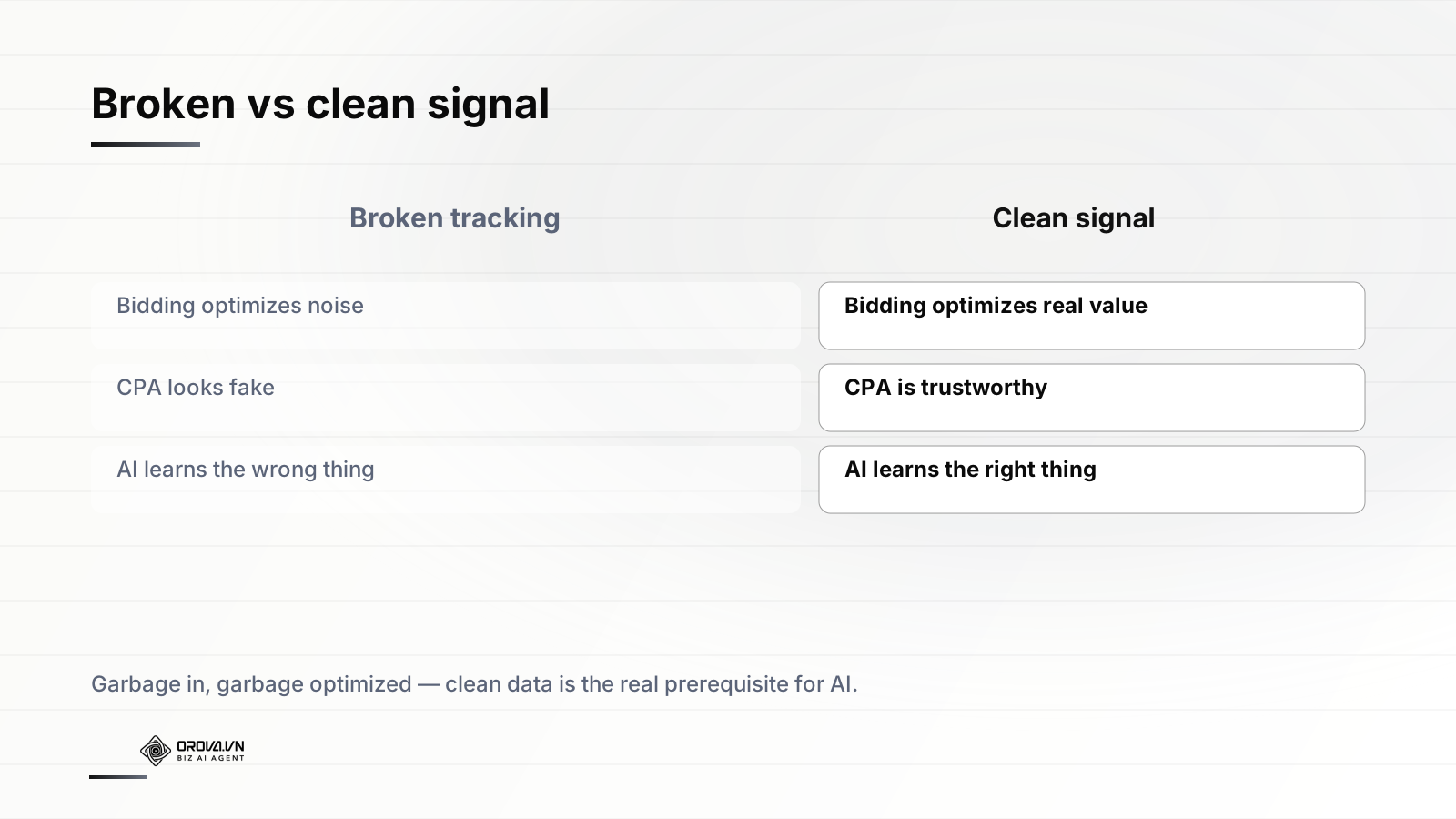
The old maxim "garbage in, garbage out" undersells the danger. In a static report, garbage in produces a garbage number you can at least notice and discount. In an optimization loop, garbage in produces garbage action — the system spends real money chasing the artifact. By the time you notice CPA "improving" suspiciously fast, the budget has already migrated toward whatever generates the broken signal most cheaply. You are not just measuring wrong; you are actively training the algorithm to prefer the customers who least resemble your real buyers.
Consider the asymmetry. A measurement error in a dashboard wastes your attention for a few minutes. A measurement error in a reward signal compounds daily, redirecting spend, reshaping audiences, and entrenching the wrong creative — and it does so while the surface-level metrics look healthier than ever. That asymmetry is the entire reason clean data has to come first, before any conversation about AI, automation, or scaling.
What a trustworthy conversion actually looks like
It helps to define the target before chasing it. A conversion you can safely optimize toward has four properties, and each one is a place where real campaigns commonly break.
First, the event has to fire only when the real thing happens — not on page load, not on a thank-you page someone can revisit, not on a soft step like "added to cart" labeled as "purchase." Second, it should be delivered reliably, which increasingly means a server-side path rather than relying solely on a browser pixel that ad blockers, cookie restrictions, and flaky connections routinely drop. Third, it must be deduplicated, so a single purchase counts once even when both the browser and the server report it. Fourth, it must be attributed within a window that matches your real buying cycle, so credit lands on the click that deserves it rather than getting lost or double-assigned.
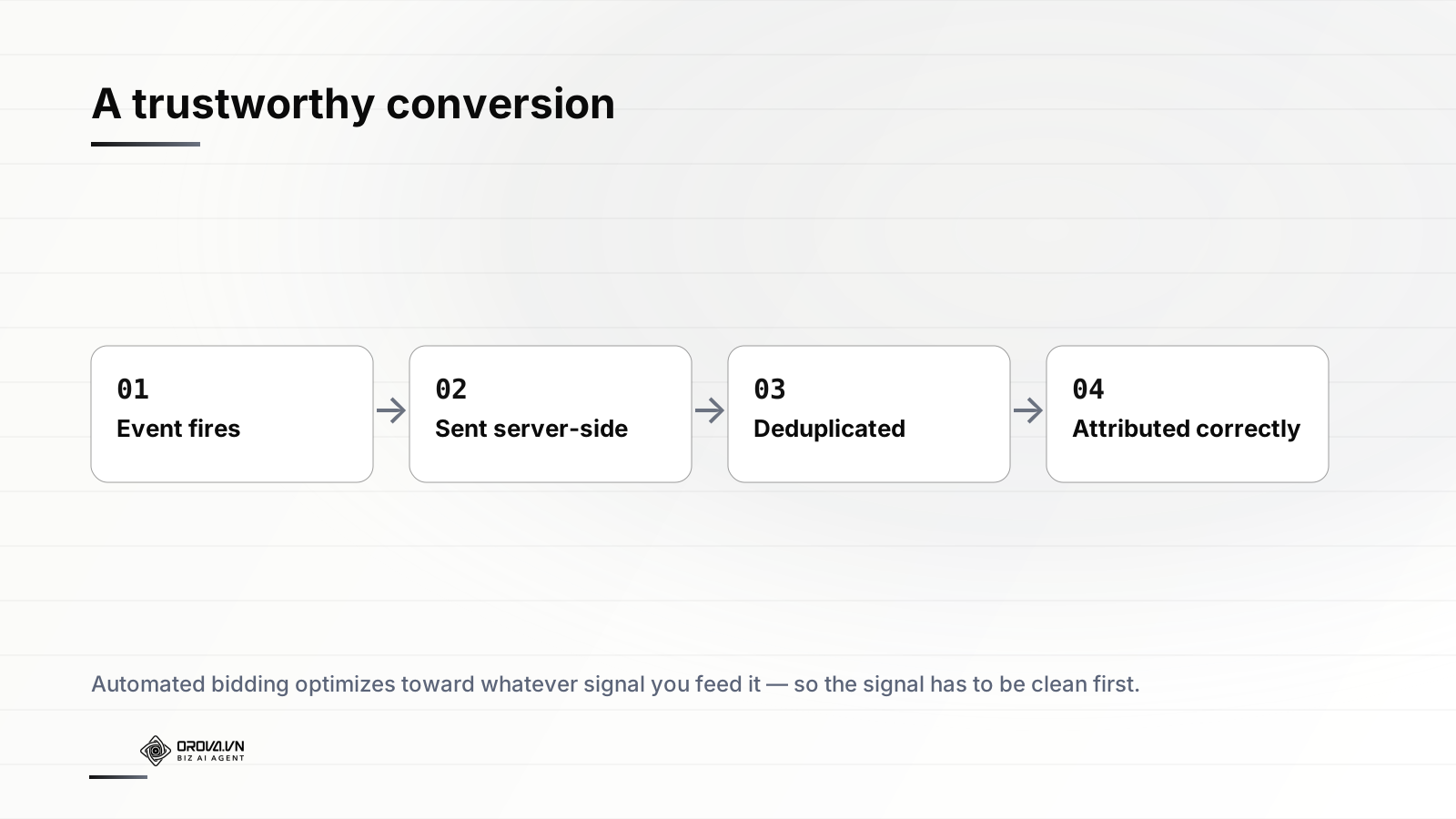
Miss any one of those four and the conversion becomes unsafe to bid on. The frustrating part is that broken tracking rarely announces itself. A pixel that fires twice still produces a chart. A server event that silently fails 30% of the time still shows conversions — just fewer than reality, with no error message. The dashboard looks plausible right up until you reconcile it against the source of truth in your order database or CRM and find the numbers do not agree.
The pixel is necessary but no longer sufficient
For years, dropping a JavaScript pixel on a thank-you page was the whole job. That era is over, and pretending otherwise is the single most common cause of degraded signal today. Browser-based tracking now loses a meaningful share of conversions for reasons entirely outside your control: Safari's Intelligent Tracking Prevention truncates cookie lifetimes, Firefox blocks many third-party cookies by default, ad and content blockers strip tracking scripts before they run, and privacy-focused browsers refuse the request outright. Industry estimates for browser-side conversion loss vary widely by audience and vertical, but figures in the range of 10% to 30% are common, and for privacy-conscious or technical audiences it can run higher.
The losses are not random, either, which is what makes them so corrosive to an optimizer. The people most likely to block tracking skew toward certain devices, browsers, and demographics. So your pixel does not just under-count — it under-counts a specific slice of your customers. The bidder, seeing fewer conversions from that slice, learns to avoid it. You end up systematically under-investing in a segment that may convert perfectly well, simply because your measurement could not see them. Clean signal is not only about totals; it is about not introducing bias into who the algorithm thinks your customers are.
Server-side tracking: moving the signal off the browser
The structural fix for browser fragility is to send conversions from your own server rather than relying on the visitor's browser to do it. The platforms have built this in deliberately. Meta calls it the Conversions API (CAPI). Google has Enhanced Conversions and the broader server-side tagging model. TikTok offers its Events API. The names differ; the principle is identical. Instead of trusting a script in a hostile browser environment to phone home, your backend — which already knows for certain that a payment succeeded — reports the conversion directly to the platform.
The advantages are concrete. A server call is not blocked by an ad blocker. It is not truncated by cookie policy. It does not fail because someone closed the tab a half-second early. And because it originates from your system of record, it can carry the data you actually trust: the real order value, the real product, the real customer identifier (hashed for privacy), rather than whatever the browser happened to have in scope. For lead-generation businesses, server-side tracking unlocks something even more valuable — the ability to send back offline conversions, like a lead that became a closed deal three weeks later, so the bidder optimizes for revenue instead of raw form fills.
Don't replace one truth with two
Here is the trap that catches teams the moment they adopt server-side tracking: they leave the old browser pixel running and add the server event, and now every conversion gets reported twice. The bidder, dutifully optimizing toward its reward, now believes each purchase is worth double. CPA targets get hit "easily," budgets scale, and the whole system drifts because the unit of measurement silently doubled. This is the moment deduplication stops being a nice-to-have and becomes non-negotiable.
The most dangerous tracking bug is not the one that loses data. It is the one that quietly doubles it, because the metrics improve and nobody goes looking for a problem.
Deduplication: counting each conversion exactly once
When the same purchase is reported by both the browser and the server — which is the recommended redundant setup, precisely because either path can fail — the platform needs a way to recognize them as one event. That mechanism is deduplication, and it works by attaching a shared, unique identifier to both reports. Meta uses an event_id sent on both the pixel and the CAPI call. Google's stack relies on consistent transaction identifiers and ordering data. The platform matches on that key and collapses the duplicates into a single counted conversion.
Get this right and you have the best of both worlds: redundancy without inflation. If the browser pixel is blocked, the server event still arrives and counts. If the server event fails, the pixel covers it. When both succeed, they are recognized as the same event and counted once. Get it wrong — mismatched IDs, an ID generated fresh on each report instead of tied to the order, a server event sent with no identifier at all — and you are back to double-counting, with a bidder learning the wrong lesson at full speed.
A practical rule that prevents most deduplication failures: the conversion identifier should be derived from something that is genuinely unique to the transaction and stable across both reports — the order number is ideal. Never generate it from a timestamp or a random value created independently in two places, because the browser and the server will produce different keys and the platform will see two events where there is one.
Attribution windows: giving credit to the right click
Even a perfectly fired, reliably delivered, properly deduplicated conversion can mislead if it is attributed to the wrong interaction or counted in the wrong timeframe. Attribution is the set of rules that decides which ad click gets credit for a conversion and how long after a click a conversion is still allowed to count. These settings quietly shape what your reward signal even contains.
The defaults are not always right for your business. A seven-day click attribution window suits an impulse purchase or a low-consideration product. But if your typical buyer researches for three weeks before converting — common in B2B, high-ticket retail, and considered services — a seven-day window throws away the majority of your real conversions, or credits them to a later, cheaper click that happened to land just before purchase. The bidder then optimizes toward bottom-funnel clicks and starves the upper-funnel campaigns that actually started the journey. Conversely, an excessively long window in a fast-cycle business invites over-crediting and noise.
The principle is to match the attribution window to your real, observed sales cycle — not to a platform default and not to whatever makes the dashboard look best. If you genuinely do not know your sales cycle length, that is itself a measurement gap worth closing before you scale spend, because the bidder is making that assumption for you whether or not you have made it consciously.
Value, not just count
One more dimension separates serviceable tracking from genuinely clean signal: the value attached to each conversion. A bidder told only "a conversion happened" treats a $20 order and a $2,000 order identically and will happily buy a hundred small orders over five large ones. Passing accurate, dynamic conversion value — the real order total, ideally net of returns and margin where you can manage it — lets value-based bidding optimize for the revenue you care about rather than a flat conversion count. This is one of the highest-leverage upgrades available, and it depends entirely on the value being correct. A static placeholder value, or a value that includes tax and shipping inconsistently, teaches the system a distorted picture of which customers are worth pursuing.
How to audit your conversion signal before trusting any AI
You do not need a data science team to verify your tracking. You need discipline and a willingness to reconcile against the only source of truth that matters — the money that actually landed in your business. Here is a practical sequence that catches the overwhelming majority of problems.
- Reconcile platform conversions against your source of truth. Pull purchases from your order database or CRM for a fixed period and compare to what each ad platform reports. They will never match perfectly — attribution differs — but they should be in the same neighborhood. If the platform reports 1,000 purchases and your database shows 400, you are double- or triple-counting. If it reports 200 against your 400, you are losing signal. Either way, stop and fix it before optimizing.
- Verify each event fires exactly once for the real action. Walk through a real purchase with the platform's testing tools open. Refresh the confirmation page. Hit the back button and return. Confirm the conversion does not re-fire on any of these. This single test catches the most common and most expensive bug there is.
- Confirm deduplication is actually working. If you run both pixel and server events, check that they share a consistent event identifier tied to the order and that the platform's diagnostics report them as deduplicated rather than as separate conversions.
- Check the server-side path independently. Confirm server events are arriving with a match rate the platform considers healthy, that they carry order value, and that they are not silently failing for a subset of traffic.
- Sanity-check the attribution window against your real sales cycle. If your buyers take three weeks and your window is seven days, your conversions are being systematically misattributed.
- Look for impossibly good numbers. A CPA that suddenly halves, a conversion rate that doubles overnight with no other change, a campaign that converts far above everything else — treat these as suspected tracking artifacts until proven otherwise. Real improvements are usually gradual; measurement breaks are usually sudden.
Run this audit before you turn on aggressive automated bidding, and re-run a lighter version whenever you ship a site change, swap a checkout provider, migrate a tag, or rebuild a landing page — all of which routinely break tracking without warning. The cost of the audit is an afternoon. The cost of skipping it is weeks of an algorithm optimizing toward a lie.
Where an AI agent fits — and where it cannot save you
It would be convenient if an AI layer could simply look past bad data and infer the truth. It cannot, and any tool that claims to is selling you a comforting fiction. No amount of cleverness downstream recovers a conversion that never reached the platform or un-counts one that fired twice. The signal is the substrate. Garbage in is still garbage optimized, regardless of how sophisticated the optimizer is.
What a well-designed agent can do is treat your conversion signal as something to be verified rather than blindly trusted. A good agent reads your data daily and notices when the picture stops making sense: conversions that suddenly spike or vanish, a CPA that improves implausibly fast, a value distribution that shifts overnight, a platform's reported numbers diverging sharply from prior baselines. Instead of cheerfully scaling spend toward a corrupted signal, it can flag the anomaly, pause aggressive moves, and surface the discrepancy to a human before any budget chases a ghost. That posture — skeptical of the signal, conservative when the data looks wrong — is the difference between automation that compounds your wins and automation that compounds your tracking bug.
This is also why human-in-the-loop approval matters specifically here. The moments when tracking breaks are exactly the moments you want a person confirming "yes, that 40% CPA improvement is real" before the system reallocates the budget. An audit trail of every change lets you trace, after the fact, whether a shift in performance was a genuine market move or the downstream echo of a measurement error. Clean data and accountable automation are not separate concerns; they are two halves of the same discipline.
The discipline that makes AI worth it
Strip away the tooling and the principle is almost old-fashioned: measure the right thing, measure it once, measure it where you can trust it, and credit it to the right cause. Fire events on the real action and only the real action. Send them server-side so privacy controls and blockers cannot quietly erase your best customers. Deduplicate so redundancy never becomes inflation. Set attribution windows to your actual sales cycle, and pass real value so the system optimizes for revenue rather than raw counts. Reconcile relentlessly against the money that truly arrived.
Do this, and automated bidding has a fighting chance to be genuinely brilliant, because it is finally learning from reality. Skip it, and you have built a fast, expensive machine for pursuing artifacts. The platforms will keep getting smarter; the models will keep improving. None of that changes the prerequisite. The intelligence of the optimizer is bounded above by the honesty of the signal. Get the signal clean first, and everything downstream — every bid, every audience expansion, every dollar of scale — gets to stand on solid ground.
For the platform-by-platform detail behind this, see Meta CAPI vs Google vs TikTok Events API — it covers match rates, dedup keys, and the failure modes worth knowing about.
If you want optimization that respects this discipline rather than ignoring it, Orova Ads is an AI agent that manages your paid campaigns across Google, Meta, and TikTok with the signal front of mind. It reads your data every day, watches for the kind of conversion anomalies that quietly poison automated bidding, and recommends optimizations across budget, bids, on/off decisions, and audiences — executing them only with your approval and a full audit log of every change. Start with clean data, and let the agent do the rest. See how it works at orova.vn.
Run your business with AI Agents
Orova is the always-on Biz AI Agent — it plans, runs, and optimizes the work for you. Save time, unlock productivity.
Try it free