
Ad Retargeting vs Prospecting: How to Split the Budget
Ad retargeting is advertising aimed only at people who have already interacted with you — visited the site, viewed a product, added to cart, watched most of a video, opened the app. A tracking pixel or an uploaded customer list builds that audience, and the campaign shows ads back to it. Prospecting is the opposite: reaching people who have never encountered you at all.
Almost every account gets the balance between those two wrong in the same direction, and the reason is that the reporting rewards it. A SaaS company I worked with had a 9.2x blended ROAS and a flat new-customer count for five straight months. Their dashboard looked like a triumph. Their bank account told a different story: revenue had plateaued, and the cost to acquire each genuinely new customer was quietly climbing. Roughly 65% of their ad spend was pouring into ad retargeting that re-engaged people who had already visited the site, while only 35% went toward reaching anyone new. They were harvesting demand faster than they were creating it, and the harvest was running dry.
This is the single most common structural mistake in paid media, and it is seductive precisely because the numbers reward it in the short term. Retargeting almost always shows a higher return than prospecting, so when budgets tighten or a quarter looks shaky, the instinct is to shift more money to the campaign with the best ROAS. Followed to its logical end, that instinct slowly strangles growth.
This article covers how ad retargeting actually works, why its reported return overstates its real contribution, what happens to an account that over-corrects in either direction, and how to size the split — including the cap that protects growth and the way to measure incremental rather than reported results.
How ad retargeting actually works
Before the budget question, the mechanics, because most retargeting problems are configuration problems wearing a strategy costume.
The audience comes from a signal you collected. A pixel or SDK records site and app behaviour; the platform records engagement on its own surfaces — video views, profile visits, form opens; and you can upload lists of existing customers or leads. Each source produces a different kind of warmth. Someone who abandoned a cart yesterday and someone who read one blog post last month are both "retargetable" and should not be in the same campaign.
Segments are defined by action and recency. The two levers are what they did and how long ago. Cart abandoners inside seven days behave nothing like all-site-visitors inside ninety. Lumping them into one audience hands most of your budget to the largest and coldest group, which is usually the one that would have converted least — or, on the other side, most of it to the group that would have converted anyway.
Windows decide who is still in the pool. A short window keeps the audience hot and small; a long one keeps it large and dilutes it with people who have moved on. The right length follows your actual consideration cycle, not a default.
Exclusions matter as much as inclusions. Anyone who has already converted should be excluded unless you are deliberately selling them something else. Without that rule you pay to advertise a product to people who already bought it, and the platform happily reports those repeat purchases as retargeting revenue.
Frequency is the throttle. The audience is finite by definition. Spend more on a fixed pool and you do not reach more people — you reach the same people more often. That is the mechanism behind everything else in this article, and the reason retargeting cannot absorb budget the way prospecting can.
Signal loss shrinks the pool quietly. Cookie restrictions, tracking prevention and consent choices mean a share of your real visitors never enter the audience at all. The pool you can target is smaller than the traffic you actually get, which makes over-funding it worse than it looks on paper.
Two jobs that look like one
Prospecting and retargeting are often lumped together as "the ad budget," but they do fundamentally different jobs. Treating them as interchangeable line items is the root of the imbalance. They sit at different points in the customer journey, they answer to different metrics, and they fail in different ways.
Prospecting creates demand
Prospecting is the work of reaching people who do not yet know you exist, or who know you but have never engaged. It is your top of funnel. When you target a lookalike audience, an interest segment, a broad keyword, or simply let an algorithm explore a wide pool of cold users, you are prospecting. The goal is to introduce your product to someone for the first time and earn enough attention to pull them into your orbit.
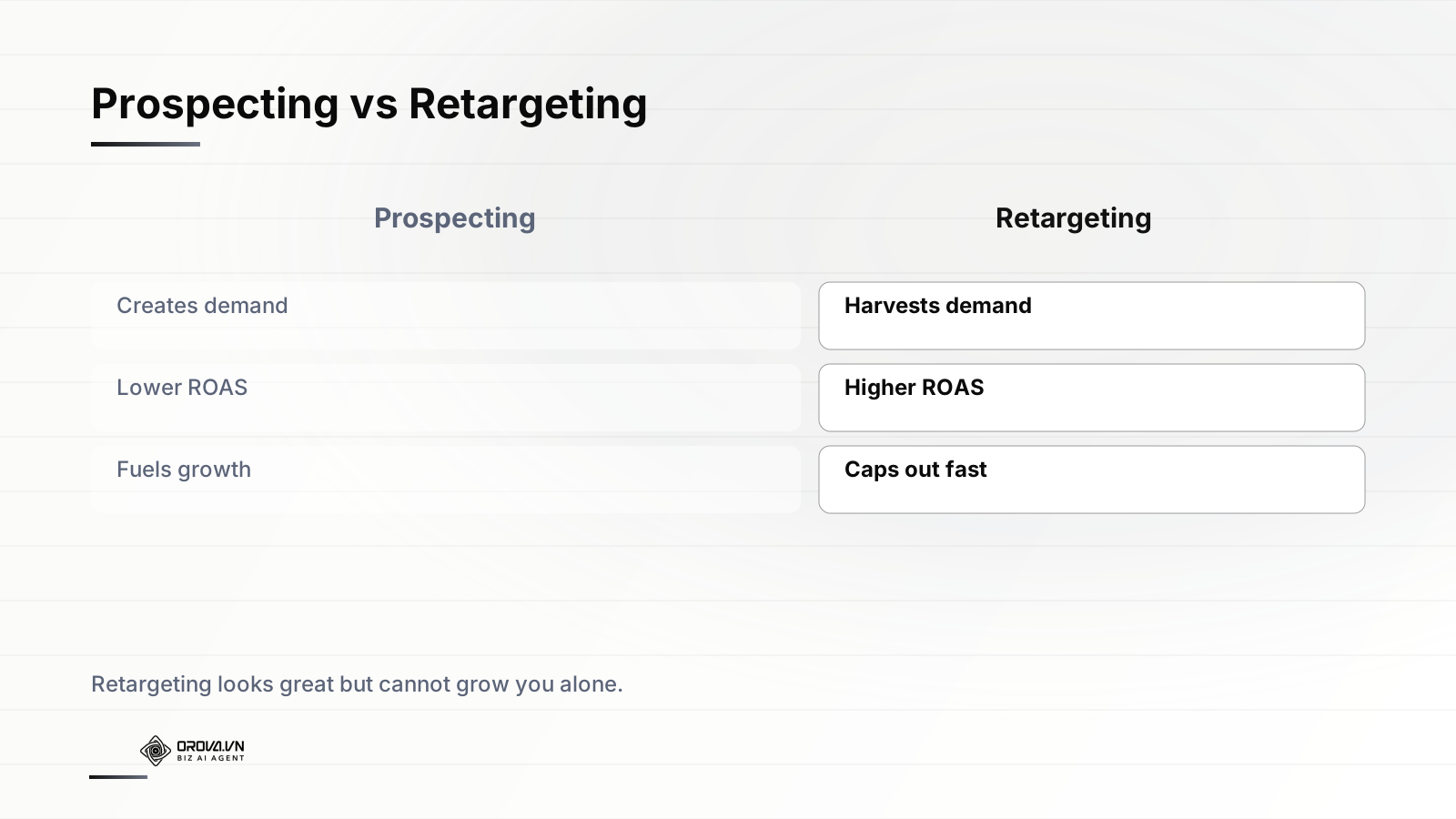
Prospecting is hard, and its metrics reflect that. Cold audiences convert at lower rates because most people seeing your ad were not actively shopping. The click-through rates are lower, the cost per acquisition is higher, and the reported ROAS is the weakest in your account. A prospecting campaign returning 1.8x while your retargeting returns 8x will, on a naive read of the dashboard, look like a failure. It is not. It is doing the one job retargeting can never do: filling the top of the funnel so there is anyone left to retarget tomorrow.
Retargeting harvests existing demand
Retargeting reaches people who have already shown intent — visited a product page, added an item to cart, watched 75% of a video, started a signup. These people are warm. They were already considering you. A retargeting ad nudges them across the line they were already standing on.
Because the audience is pre-qualified by their own behavior, retargeting posts spectacular efficiency metrics. The ROAS is high, the CPA is low, the conversion rate is enviable. And this is exactly where the trap is set, because much of that performance is not actually caused by the ad.
Why retargeting overstates its own ROAS
Here is the uncomfortable truth at the center of this whole topic: a large share of the conversions your retargeting campaigns claim credit for would have happened without the ads at all. The discipline that exposes this is called incrementality, and it separates the conversions an ad caused from the conversions that merely happened to follow an ad impression.
Think about who is in a retargeting pool. They are people who, by definition, already visited your site with intent. A meaningful fraction of them were going to come back and buy regardless. Maybe they were comparison shopping and chose you anyway. Maybe they got distracted and would have returned the next day. When your retargeting ad shows up in front of that person and they convert, last-click and even most multi-touch attribution models hand the credit to the ad. The platform reports a sale. Your ROAS climbs. But the ad did not change the outcome — it just got in the path of a decision already made.
Retargeting ROAS measures how good you are at appearing next to purchases. It does not measure how many purchases you created. Those are very different numbers, and the gap between them is where budgets go to die.
The cleanest way to see this is with a holdout test. Take your retargeting audience and randomly withhold ads from a slice of them — say 20%. Then compare the conversion rate of the group that saw ads against the group that did not. In well-run experiments across many advertisers, the incremental lift from retargeting is often dramatically smaller than the reported ROAS implies. It is not unusual to find that a campaign reporting 8x is delivering an incremental return closer to 2x or 3x once you subtract the conversions that would have happened anyway. Sometimes, for tightly defined audiences like recent purchasers or people one click from checkout, the incremental lift approaches zero.
None of this means retargeting is worthless. It means retargeting's headline ROAS is not comparable to prospecting's headline ROAS, even though they sit in the same column of the same spreadsheet. When you move budget from a 1.8x prospecting campaign to an 8x retargeting campaign, you are not moving from a weak channel to a strong one. You may be moving from a channel creating new, fully incremental customers to a channel that is largely taking credit for sales you already had. The dashboard improves. The business does not.
The death spiral of over-retargeting
The damage from an imbalanced split is not a one-time hit. It compounds, and it does so in a way that disguises itself as success until it is well advanced. Walking through the mechanism makes it obvious why this is so dangerous.
- You cut prospecting because its ROAS is lower. A bad quarter or a nervous finance team pushes you to defend efficiency. The lowest-ROAS line items are prospecting campaigns, so they get trimmed first.
- Blended ROAS goes up immediately. Because you removed your lowest-return spend, the average improves. Everyone feels smart. The decision looks validated within days.
- The retargeting pool keeps performing — for now. There are still plenty of warm visitors in the funnel from previous prospecting, so retargeting continues to convert them efficiently. The high ROAS persists, reinforcing the belief that retargeting is the strong channel.
- The pool starts to shrink. With less prospecting feeding the top of the funnel, fewer new people enter the warm audience each week. You are spending your retargeting budget against a slowly draining reservoir.
- Frequency climbs and fatigue sets in. To spend the same retargeting budget against a smaller audience, the platform shows your ads to the same people more often. Frequency rises, performance softens, and the people most likely to convert have already done so.
- New-customer growth stalls, then declines. Two to three months later — long after the original decision — net-new customer acquisition flattens. Revenue plateaus. The lagging nature of this damage is precisely what makes it so hard to diagnose.
By the time leadership notices that growth has stopped, the dashboards have looked healthy for an entire quarter. The cause and the symptom are separated by months, so the connection is rarely made. People blame the market, the season, the competition, the product — anything except the budget split that quietly cut off the supply of new demand.
The reverse failure: over-prospecting
It is worth being honest that the opposite mistake is real too, even if it is rarer. Pouring nearly all your budget into cold prospecting while neglecting retargeting means you are paying full price to attract interested visitors and then letting them walk away. You generate a wave of intent and fail to close it. Cart abandoners never get the reminder, page visitors never get the second touch, and your acquisition costs balloon because you are converting cold traffic in a single shot instead of warming and closing it efficiently.
Some efficiency-harvesting on warm audiences is not just acceptable, it is responsible. The mistake is never having retargeting; the mistake is letting it become the center of gravity. Retargeting should be the close, not the engine.
Sizing the split
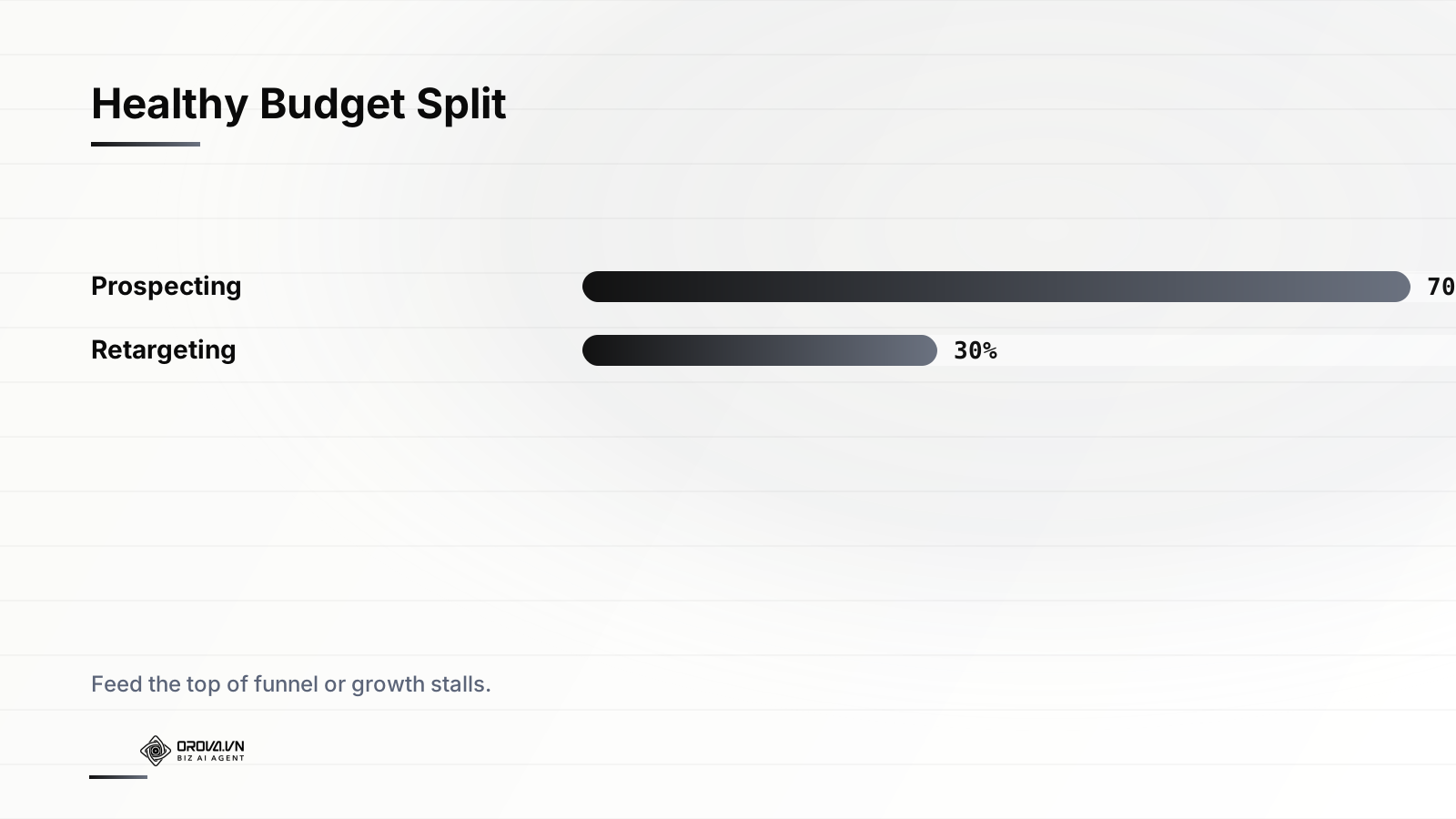
So what is the right balance? There is no universal constant, but there is a defensible starting point and a clear logic for adjusting it. For most growth-oriented accounts, a split in the neighborhood of 70% prospecting and 30% retargeting is a healthy default. The exact ratio depends on where you are in your lifecycle and what you are optimizing for.
Factors that should push you toward more prospecting
- You are trying to grow. Growth is, by definition, the rate at which you add new customers. New customers come from prospecting. If the mandate is to scale, the budget should lean hard toward the top of the funnel — sometimes 80% or more.
- Your retargeting pool is small or saturated. If you have a low-traffic site, there simply are not enough warm users to spend meaningful retargeting budget against without hammering them with frequency. Spend that money finding new people instead.
- Your sales cycle is short and impulsive. When people decide quickly, there is less of a consideration window for retargeting to influence, so its incremental value is lower.
Factors that justify more retargeting
- You have a long, high-consideration purchase. Expensive or complex products involve many touchpoints over weeks. Here, retargeting genuinely helps stay top of mind during a real deliberation period, and its incremental lift is higher.
- You have a large, fast-replenishing warm audience. A high-traffic site that constantly generates new visitors can support more retargeting spend because the pool refills as fast as you spend against it.
- You are in a harvest-and-defend mode, not a growth mode. A mature, cash-generating business prioritizing efficiency over expansion can reasonably tilt the split toward retargeting — as long as everyone understands that this is a choice to optimize the present at the expense of the future.
The cap that protects growth
The most important single tactic in this whole discussion is also the simplest: put a ceiling on retargeting spend and let prospecting absorb the rest of the budget. The reason is structural. Retargeting will always look more efficient than prospecting on the dashboard, so any optimization process — human or automated — that simply chases ROAS will keep shoveling money into retargeting until growth chokes. A cap removes that pressure.
A retargeting cap can be expressed a few ways:
- As a share of total spend. "Retargeting never exceeds 30% of the account budget." Simple, robust, and easy to enforce.
- As a frequency ceiling. "No warm user sees more than X retargeting impressions per week." This directly prevents the fatigue spiral when the pool shrinks.
- As an absolute budget floor for prospecting. "Prospecting never drops below $Y per day, regardless of its ROAS." This guarantees the top of the funnel keeps getting fed even during efficiency panics.
Whatever form it takes, the cap exists to override the dashboard's natural bias. It is a deliberate decision that some demand creation is non-negotiable, even when the spreadsheet would prefer you to harvest. The companies that scale consistently are the ones that protect their prospecting budget the way you would protect any other strategic investment that pays off on a delay.
Measure what matters: incremental, not reported
If you take one operational habit away from this article, make it this: judge the channels on incrementality, not on platform-reported ROAS. That means running holdout tests on your retargeting audiences periodically to see how much lift the ads actually generate, and watching net-new customer counts as a first-class metric alongside blended return. When you measure on incrementality, the case for prospecting stops looking like charity and starts looking like exactly what it is — the engine of every dollar of future revenue.
Two metrics belong on the same screen, side by side, at all times: new customers acquired this period, and the incremental return on your retargeting holdout. If new-customer growth is flat and your blended ROAS is rising, you are not winning. You are eating your funnel.
Putting it together with the rest of the account
The prospecting-retargeting balance does not live in isolation. It interacts directly with how you scale your winning campaigns and how you manage the learning phases of the platforms' algorithms. When you find a prospecting campaign that works, the temptation is to scale it fast — but doing so carelessly resets the learning and can tank performance right when you need it most. The discipline of scaling winners without breaking the learning phase is the natural companion to getting the funnel split right: first you make sure the top of the funnel is fed, then you scale the parts of it that are proving themselves, carefully.
It is also worth being explicit about how attribution windows distort this picture. Short click-based attribution windows tend to over-credit retargeting because warm users convert quickly after seeing an ad, while the long, multi-week influence of a prospecting impression often falls outside the window entirely. If your attribution setup systematically under-counts prospecting's contribution, your reports will push you toward over-retargeting by default. Knowing this lets you read the numbers with the right amount of skepticism rather than taking them at face value.
A practical operating rhythm
Here is a simple cadence that keeps the balance honest over time:
- Weekly: Check that retargeting has not crept above its cap. Platforms drift, automated rules misfire, and a campaign that was 28% of spend last week can be 41% this week without anyone touching it.
- Weekly: Track net-new customers as a headline number, not buried in a tab. If it is sliding while ROAS rises, investigate the split immediately.
- Monthly: Watch retargeting frequency. A rising frequency on flat budget is the early warning sign that the warm pool is shrinking — meaning prospecting needs more, not less.
- Quarterly: Run a retargeting holdout test to re-measure incremental lift. Audiences and market conditions change; last quarter's incrementality is not a permanent fact.
Do this consistently and you will avoid the two failure modes entirely. You will not over-retarget your way into a stalled quarter, and you will not over-prospect your way into wasted demand. You will keep a living, defensible split that creates demand at the top and harvests it efficiently at the bottom — which is, in the end, the entire job of a paid media program.
Common objections, answered
When you start moving budget back toward prospecting, you will hit a predictable set of pushbacks. Each one sounds reasonable, and each one has a clear answer once you separate reported performance from real performance.
"But the retargeting ROAS is so much higher — why would we spend less on it?"
Because reported ROAS and incremental ROAS are different numbers, and only the second one represents money the ad actually made. A retargeting campaign reporting 8x might be delivering 2.5x in true incremental terms, while a prospecting campaign reporting 1.8x is delivering nearly all of it incrementally because those customers are genuinely new. Once you adjust for incrementality, the gap narrows dramatically and sometimes reverses. The honest comparison is incremental-to-incremental, never reported-to-reported.
"Our blended ROAS will drop if we add prospecting."
It will, on paper, and that is fine. Blended ROAS is an average, and adding lower-reported but fully incremental spend pulls the average down even as it grows the business. The question to ask is not "did the average go down" but "did net-new customers and total profit go up." A lower blended ROAS with rising new-customer counts is a healthier account than a high blended ROAS with flat growth. Optimizing the average instead of the outcome is how accounts shrink themselves into a corner.
"Can't the algorithm just figure out the right split for us?"
Not reliably, and for a structural reason. Most platform bidding optimizes toward conversions or value as the platform attributes them — and the platform attributes generously to retargeting. Left fully automated against reported value, the system will tend to over-invest in the warm audiences that look most efficient. That is why an external cap matters: it sits above the bidding logic and enforces a strategic constraint the optimizer cannot see. Automation is excellent at execution within constraints; it is not a substitute for setting the constraint.
A worked example
Numbers make the abstract concrete. Imagine an account spending $100,000 per month, currently split 60% retargeting ($60,000) and 40% prospecting ($40,000). The dashboard shows a blended 6.5x return — revenue of $650,000 — and the team is pleased.
Now run a holdout test. The retargeting campaigns report 9x ($540,000 from $60,000) but the holdout reveals the true incremental lift is only 3x — meaning of that $540,000, roughly $360,000 would have happened anyway, and the ads genuinely caused about $180,000. Prospecting reports 2.75x ($110,000 from $40,000), and the holdout confirms nearly all of it is incremental at about 2.6x.
So the real picture is this: prospecting is generating roughly $104,000 of incremental revenue from $40,000, while retargeting is generating roughly $180,000 of incremental revenue from $60,000. On incremental terms, prospecting is the more efficient channel per dollar — 2.6x versus 3x looks close, but remember retargeting's pool only exists because prospecting filled it. Shift the split to 70/30 — $70,000 prospecting, $30,000 retargeting — and you would expect incremental prospecting revenue to climb toward $182,000 while incremental retargeting settles around $90,000, for materially more real revenue and far healthier new-customer growth, even though the reported blended ROAS falls.
The lesson is not that these exact numbers will hold in your account. They will not; you have to measure your own incrementality. The lesson is that the move which looks like it sacrifices performance — cutting your highest-ROAS channel — is frequently the move that grows the business, and you can only see that once you stop trusting the reported figures and start trusting holdout-measured lift.
The mindset shift
The hardest part of all this is not the math. It is resisting the pull of a dashboard that rewards the wrong behavior. Every efficiency-focused review meeting, every nervous quarter, every finance conversation will push you toward the channel with the highest reported return. That channel is almost always retargeting, and following that pull feels prudent in the moment and proves costly two months later.
The advertisers who scale year after year have internalized one idea: retargeting is the close, prospecting is the engine, and you do not turn off the engine to make the close look better. They protect their top of funnel with hard caps, they measure on incrementality rather than reported ROAS, and they keep net-new customer growth in front of them as the number that actually tells the truth. Get that mindset right, and the budget split takes care of itself.
Keeping prospecting and retargeting in balance — and resisting the daily temptation to over-harvest — is exactly the kind of disciplined, unglamorous work that machines do better than humans. Orova Ads is an AI agent that manages your paid campaigns across Google, Meta, and TikTok: it reads your account data every day, recommends optimizations, and executes them — budgets, bids, on/off switches, audiences — with retargeting caps that protect your growth, human-in-the-loop approval on every change, and a full audit log of what it did and why. Let it hold the line on your funnel split so your dashboard never quietly eats your future.
Orova Ads optimises campaigns for you
Connect Google, Meta and TikTok in one place. AI reads the numbers, proposes changes and executes under the rules you set.
Explore Orova Ads