
Rule-Based Automation vs AI Agents: When to Use Each
At 2:47 in the morning, a competitor pauses a campaign and frees up auction inventory. Your cost-per-click drops by eighteen percent for the next four hours. A rule sees none of this. It only knows what you told it to watch: "if CPA exceeds $40, lower the budget by 20%." It will never notice the opportunity, never lean in, never spend more while the buying is cheap. Meanwhile, across the same account, a different problem is unfolding: a single ad set has quietly blown through $300 with zero conversions because of a broken landing page. A rule would have caught that instantly — "if spend > $100 and conversions = 0, pause" — and saved you the money while a more sophisticated system was still "thinking about it."
This is the whole argument in one paragraph. Rules are reflexes. Agents are judgment. The teams that run paid media well in 2026 are not choosing between them — they are wiring them together so each does the part it is good at. The mistake almost everyone makes is treating this as an either/or religious debate when it is actually an engineering question about which decisions deserve a brain and which should be a tripwire.
Let's take it apart properly: what each one actually is, where each one quietly fails, how to decide which to reach for, and how the strongest setups use both at the same time.
What rule-based automation actually is
A rule is a condition-action statement. If some measurable thing crosses a threshold, then do a specific thing. It is the oldest, most reliable form of automation in marketing, and it predates anything that could reasonably be called artificial intelligence by decades. Every ad platform ships with a version of it: Google Ads has automated rules, Meta has rules in Ads Manager, and most third-party tools layer their own on top.
The defining property of a rule is that it is deterministic. Given the same inputs, it produces the same output every single time, with no variance, no interpretation, and no surprises. If you write "pause any keyword with more than 50 clicks and zero conversions in the last 14 days," that is exactly what happens — not approximately, not most of the time, but always. This predictability is not a limitation to apologize for. It is the entire value proposition.
The four things rules are genuinely great at
- Speed. A rule evaluates in milliseconds. There is no model to call, no context to assemble, no reasoning step. When the platform's automation engine ticks, the rule fires. For anything where the right response is obvious and waiting is expensive — runaway spend, a sudden conversion-tracking failure — this matters enormously.
- Cost. Rules are effectively free to run. There is no inference cost, no per-token charge, no compute bill that scales with how often they execute. You can have a thousand rules checking every hour and pay nothing extra for the volume.
- Predictability and auditability. When a rule does something, you know exactly why, because the "why" is written in the rule. There is no probabilistic explanation, no "the model weighted these factors." The logic is the documentation. When a client or your CFO asks why budget moved, you point at the rule.
- Trust through transparency. Because the behavior is fully specified, you can reason about every edge case in advance, test it, and sign off on it. Nothing the rule does should ever genuinely surprise you.
If you have ever set a rule that pauses campaigns when daily spend hits a hard ceiling, you have used automation at its most dependable. That rule has probably saved you from a five-figure mistake at least once, and it did so without any cleverness at all. It just did the one thing you asked, the instant the condition was true.
Where rules quietly fall apart
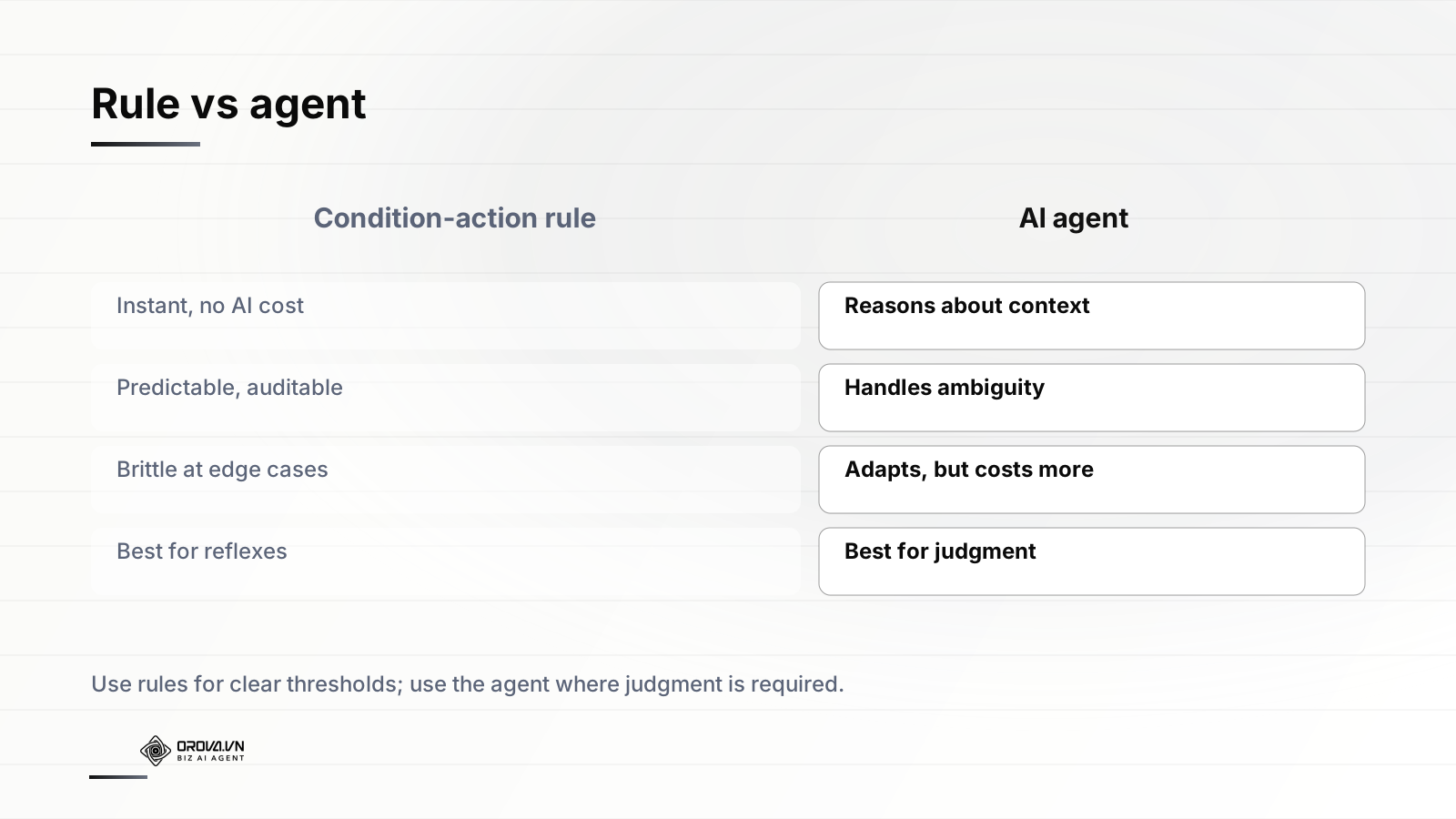
The same rigidity that makes rules trustworthy makes them brittle. A rule cannot tell the difference between a meaningful signal and a coincidence. Consider the classic: "if CPA over the last 3 days exceeds target by 30%, reduce budget by 25%."
That rule looks sensible. Now run it through reality. It is the Tuesday after a long holiday weekend, your conversion tracking had a 36-hour delay, and the three-day window happens to capture the lull before a product launch you scheduled for Thursday. The CPA looks terrible. The rule, dutifully, cuts your budget by a quarter — right before the launch when you most wanted reach. It was technically correct and strategically disastrous, because it had no idea what was actually going on. It saw a number cross a line and pulled a lever.
This is the core weakness: rules have no context. They cannot ask "is this CPA spike real or is it a tracking artifact?" They cannot know there's a launch on Thursday. They cannot recognize that the same 30% spike means "panic" on an evergreen campaign and "completely normal" on a campaign you launched yesterday that hasn't exited the learning phase. To a rule, a number is a number.
The other failure mode is combinatorial. Real accounts have hundreds of conditions that interact. To cover them with rules, you write more rules. Then those rules start contradicting each other — one rule lowers a budget because CPA is high, another raises it because volume is low, and now they're fighting at 3 a.m. and your budget oscillates. Anyone who has managed a large rule set knows the feeling of a system that has become too complicated to reason about, which is ironic, because reasoning is exactly what rules were supposed to spare you from.
What an AI agent actually is
An AI agent is a fundamentally different kind of automation. Instead of a fixed condition-action pair, it has a goal, access to data and tools, and the ability to reason about what to do next. Where a rule executes a predetermined response, an agent assembles context, weighs competing factors, and decides. If you want the longer definition, we wrote a whole piece on what an AI ads agent is and how it differs from a script, but the short version is: a rule answers "what should I do when X is true?" while an agent answers "given everything I can see, what's the best thing to do right now?"
That difference is enormous. The agent can look at the same CPA spike and consider: how long has this campaign been running? Is it still in the learning phase? Did conversion volume actually drop, or did tracking lag? How does this compare to the same day last week? Is there a budget-pacing reason the algorithm pulled back? Then it forms a recommendation that accounts for all of it, rather than reacting to a single threshold.
What agents are genuinely great at
- Context and ambiguity. The real world is full of situations where the right answer is "it depends," and the dependencies are many. Agents are built for exactly these. They can hold a dozen factors in view and produce a judgment that no single rule could encode.
- Pattern recognition across noise. An agent can notice that three seemingly unrelated metrics are moving together in a way that suggests an audience is fatiguing, or that a creative is wearing out, long before any single metric crosses a hard line.
- Explaining its reasoning in plain language. A good agent doesn't just act; it tells you why, in sentences a marketer can read. "I'm recommending we shift 15% of budget from the prospecting set to retargeting because retargeting ROAS has climbed for six straight days while prospecting frequency has hit 4.2 and CTR is declining." That's a sentence a rule can never produce.
- Adapting as conditions change. The world shifts — seasonality, competitor moves, platform algorithm changes. An agent re-reasons each time it runs. It is not locked to thresholds you set three months ago and forgot about.
Where agents fall short
Agents are not magic, and treating them as such is how people get burned. Three honest limitations:
They cost more. Reasoning is not free. Every time an agent assembles context and thinks, there is real compute behind it. For high-judgment decisions a few times a day, that cost is trivial relative to the spend it optimizes. For a decision that needs to happen ten thousand times an hour, it is absurd — you would never pay an agent to do what a rule does for free.
They are slower. Assembling context and reasoning takes time — seconds, not milliseconds. For a runaway-spend tripwire, that latency is the difference between losing $5 and losing $500. You do not want an agent "considering the situation" while a broken ad set hemorrhages budget.
They are probabilistic, not deterministic. An agent's output can vary. Given nearly identical situations, it might reason slightly differently, or surface a different recommendation. That variance is the price of judgment, but it means you cannot fully predict an agent's behavior in advance the way you can a rule's. This is precisely why serious systems keep a human in the loop and keep an audit trail — you accept the variance and then bound it.
The right mental model: a rule is a circuit breaker, an agent is an electrician. You want the breaker to trip instantly and identically every time there's a surge. You want the electrician to diagnose why the surges keep happening. You would never replace one with the other.
How to decide which one a task needs
Forget the hype. The decision is practical, and it comes down to a few questions you can ask about any individual task.
Question 1: Is the right response obvious and fixed?
If a task has one correct response that never changes based on context, it's a rule. "Pause anything that spends $100 with no conversions" has exactly one right answer regardless of season, campaign age, or anything else. There is no judgment to apply. Encoding it as a rule is not a compromise — it is the correct engineering choice. Throwing an agent at it would be slower, costlier, and less reliable, for zero benefit.
Question 2: How expensive is waiting?
If a wrong delay costs real money fast, lean toward a rule for the protective layer. Budget guardrails, spend ceilings, and broken-tracking detection all fall here. The thing you're protecting against happens in seconds, so your protection must too. Use the agent for the slower, strategic layer where a few seconds of thinking changes nothing.
Question 3: Does the right answer depend on context the rule can't see?
This is the tell for agent work. If you find yourself writing a rule and then immediately listing exceptions — "lower budget when CPA is high, unless it's a new campaign, unless there's a launch coming, unless tracking is delayed, unless..." — you have discovered a judgment task masquerading as a rule. Every "unless" is context. Stop adding clauses and give it to the agent.
Question 4: How often does it run, and how much does each run matter?
High-frequency, low-stakes decisions favor rules because of cost. Low-frequency, high-stakes decisions favor agents because the quality of the call dwarfs the cost of making it. A budget reallocation across an account that touches thousands of dollars happens a few times a week and is worth careful reasoning. A "is this keyword obviously dead" check might run across ten thousand keywords nightly and should be a rule.
A quick triage you can actually use
- Is the response fixed and obvious? → Rule.
- Is waiting expensive and the trigger clear? → Rule (as a guardrail).
- Does the answer change with context you can't fully enumerate? → Agent.
- Are you writing endless exceptions? → Agent.
- High volume, low individual stakes? → Rule.
- Low volume, high stakes, real judgment? → Agent.
The real answer: use both, deliberately layered
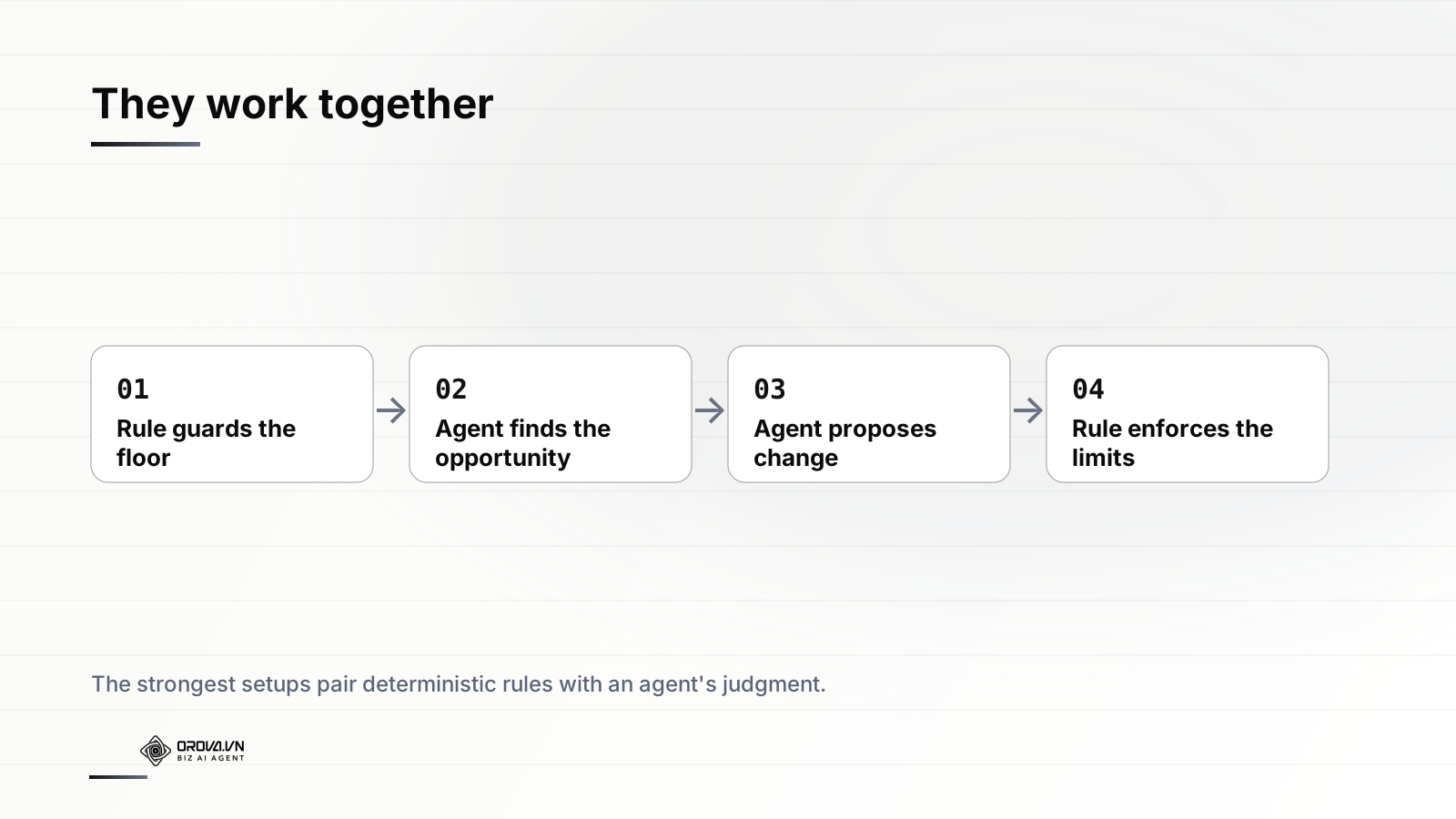
Here is what experienced operators figure out eventually. The question was never "rules or agents." It is "which jobs go to reflexes and which go to judgment, and how do they hand off to each other." The strongest paid-media setups in 2026 run a layered architecture where rules and an agent each own the part they're suited for, and they reinforce one another rather than compete.
Think of it as three layers.
Layer 1: Rules as the floor and the ceiling
At the bottom, deterministic rules define the boundaries of acceptable behavior. These are your non-negotiable guardrails: a hard daily spend cap per account, an instant pause on any campaign that spends meaningfully with zero conversions, a freeze on changes during a known tracking outage. These rules are fast, free, and absolute. They protect you from both human error and — importantly — from the agent itself. No matter how confident the agent is, it cannot spend past the ceiling the rule enforces. The floor is guarded.
Layer 2: The agent as the strategist
Inside those boundaries, the agent does the thinking. It reads the data daily, looks across campaigns, audiences, creatives, and time, and finds the opportunities a rule could never see: the retargeting segment that's quietly outperforming, the creative that's fatiguing, the budget that should shift from a saturated audience to an underfunded one with room to grow. The agent reasons about why, not just whether. It proposes the change and explains it.
Layer 3: Rules again, enforcing the agent's limits
When the agent proposes a change, the rules check it. If the agent wants to raise a budget, a rule confirms the new total stays under the ceiling. If the agent wants to shift spend, a rule confirms no single campaign drops below the minimum needed to stay out of the learning phase. The agent finds the opportunity; the rule enforces the limits. This is the part people miss: rules don't just sit beneath the agent, they wrap around it. They turn an agent's probabilistic judgment into something bounded and safe.
The pattern, in one line: a rule guards the floor, the agent finds the opportunity, the agent proposes the change, and a rule enforces the limits. That loop gives you the speed and safety of deterministic automation and the judgment and adaptability of an agent, without forcing you to give up either.
A worked example: the 3 a.m. CPA spike, revisited
Let's run the opening scenario through this layered system and watch it behave well.
At 2:47 a.m., CPA on a campaign spikes 35% over target. In a pure-rules world, the budget gets cut 25% and you wake up to a throttled launch. In a pure-agent world, you might be paying an agent to reason about every metric fluctuation across the account all night. In the layered world, here's what happens:
- The protective rule checks first: is this campaign hemorrhaging money with zero conversions? No — it's still converting, just at a higher cost. So no emergency pause. The floor holds; nothing drastic happens.
- The agent picks it up on its next scheduled pass, not in a panic but in context. It notices the campaign launched 30 hours ago and is still in learning. It notices conversion volume actually rose, and CPA rose because cheap impressions earlier had skewed the baseline. It notices Thursday's launch on the calendar.
- The agent's conclusion: do nothing to the budget; the spike is a learning-phase artifact and cutting now would reset the learning. It logs the reasoning so you can read it.
- If instead the agent had wanted to act — say, shift budget toward a stronger audience — the enforcement rules would have verified the move stays under the spend ceiling and doesn't starve any campaign below its minimum.
Same spike, completely different outcome, because the right kind of automation handled each part. The rule was the reflex that decided "this isn't an emergency." The agent was the judgment that decided "this is normal, leave it alone." Neither could have produced that result alone.
Common mistakes when combining them
Layering rules and agents well is not automatic. A few traps worth naming:
Letting the agent override the guardrails
The whole point of the rule layer is that it's absolute. If you build a system where a confident agent can talk its way past the spend ceiling, you've thrown away the safety. The hard limits must be hard. The agent operates inside them, never around them.
Using an agent where a rule would do
It is tempting, once you have an agent, to route everything through it because it feels more sophisticated. Resist. Obvious, fixed-response, high-frequency tasks should stay as rules. Paying for reasoning on a decision that has one right answer is waste, and it makes the system slower and harder to audit for no gain.
Drowning in rules instead of reaching for judgment
The opposite failure: refusing to use an agent and instead piling exception onto exception until the rule set is an unmaintainable thicket that contradicts itself nightly. If you're past five "unless" clauses on a single decision, that decision wanted judgment. Hand it over.
No human in the loop on the judgment calls
Because agents are probabilistic, the consequential moves they propose should be reviewable. Human-in-the-loop approval on budget shifts and on/off decisions — paired with a full audit log of what the agent did and why — is not a lack of trust in the agent. It is how you safely run something that exercises judgment. You get the agent's reach and the human's veto.
The bottom line
Rules are cheap, instant, predictable, and brittle. Agents are contextual, adaptive, costlier, and probabilistic. Neither is "better" — they're built for different jobs. Rules are reflexes: use them for clear thresholds, hard limits, and anything where waiting is expensive and the right move is obvious. Agents are judgment: use them where the right answer genuinely depends on context you can't fully enumerate in advance.
And the real win is refusing the false choice. Put rules at the floor to keep you safe, an agent in the middle to find what you'd miss, and rules again at the edges to keep the agent honest. That layered setup is what separates accounts that merely don't blow up from accounts that actually compound.
Orova Ads is built on exactly this principle: an AI agent that reads your Google, Meta, and TikTok data every day, reasons about the context, and proposes the budget, bid, on/off, and audience changes worth making — all of it bounded by your guardrails, gated behind human-in-the-loop approval, and recorded in a full audit log. The reflexes and the judgment, working together. See how Orova Ads pairs deterministic guardrails with an AI agent's judgment.
Run your business with AI Agents
Orova is the always-on Biz AI Agent — it plans, runs, and optimizes the work for you. Save time, unlock productivity.
Try it free