
Human in the Loop Automation for Ads: Where People Decide
The fastest way to lose trust in an automated ad system is to let it do something irreversible at 2 a.m. while everyone is asleep. Picture a campaign that quietly triples its daily budget because an algorithm spotted a temporary spike in conversions during a flash sale. By the time the team logs in, the sale is over, the spike is gone, and the account has burned through a week of budget chasing demand that no longer exists. Nothing about the automation was technically wrong. The rule fired exactly as designed. The problem was that no one decided whether that particular move deserved a human pause before it ran.
This is the real question behind ad automation, and it is rarely the one people ask. The popular framing is "manual versus automated," as if the goal were to remove humans entirely and declare victory. That framing is misleading. The better question is far more specific: for any given decision, where in the loop should a person stand, and how much should they be allowed to slow things down? Some actions are so cheap to reverse and so low in stakes that asking a human to approve them is pure friction. Others are expensive, slow to undo, and easy to get wrong, and skipping the human is reckless. Most automation programs fail not because the automation is bad but because they apply one policy to both categories.
Human-in-the-loop automation is the discipline of deciding, action by action, whether a machine may act alone or must wait for a person to say yes. Done well, it gives you most of the speed of full autonomy with almost none of the catastrophic downside. Done badly, it either drowns your team in approval requests they rubber-stamp without reading, or it removes oversight from exactly the decisions that needed it most. This article lays out a practical framework for getting it right: a simple test you can apply to any ad action, a map of the actions you face every week, and a model for how the loop should tighten or loosen as trust accumulates.
Why full autonomy is the wrong default
There is a seductive logic to full automation. Machines do not sleep, do not get distracted, and can evaluate thousands of signals faster than any analyst. If the system is good, the reasoning goes, why slow it down with human approvals? And for a large class of decisions, that reasoning holds. But it breaks down precisely where it matters most, for three reasons that are easy to overlook.
The first is that ad platforms reward and punish on different timescales than the data the machine sees. A conversion spike on Tuesday afternoon might be a genuine demand signal or it might be a tracking glitch, a one-off corporate bulk order, or a competitor's outage sending you overflow traffic. A model optimizing on a short window cannot always tell the difference. A human who knows there was a product recall in the news, or that a major customer placed an annual order, can. The machine sees the number; the person sees the context behind the number.
The second reason is asymmetry of consequences. Many ad actions are cheap to try and cheap to undo. Lowering a bid by 10% and watching what happens costs almost nothing, and you can reverse it in a click. But other actions are structurally different. Launching a brand-new creative puts your brand voice in front of customers in a way that cannot be unseen. Expanding into a new audience can teach the platform's delivery algorithm patterns that take days to unlearn. Raising a budget by a large multiple spends real money the moment it executes. When the downside of being wrong is large and slow to reverse, the value of a five-minute human check is enormous relative to its cost.
The third reason is organizational. Marketing teams are accountable to people who do not read audit logs. When a campaign goes sideways, "the algorithm did it" is not an answer a CMO can take to the board. Keeping a human on the high-stakes decisions is not just risk management; it is how the function stays legible to the rest of the business. The goal is not to distrust the machine. The goal is to keep the decisions that carry reputational and financial weight inside the chain of human accountability where they belong.
The mistake is treating autonomy as a setting you flip for the whole account. Autonomy is a property of individual decisions, and the right level differs wildly between them.
The cost of getting the loop wrong in either direction
It helps to name both failure modes, because teams tend to obsess over one and ignore the other. The first failure is too little human involvement: the system makes a consequential, hard-to-reverse decision with no review, and by the time anyone notices, the damage is done. This is the dramatic failure, the one that makes people swear off automation entirely.
The second failure is quieter and, over a year, often more expensive: too much human involvement. When every trivial change requires sign-off, two things happen. People stop reading the requests, because most of them are obviously fine, so they approve in bulk without thinking. And the team's attention, the scarcest resource you have, gets consumed by approving bid nudges instead of focused on the handful of decisions that actually need a brain. An approval queue stuffed with low-stakes items does not add oversight. It launders the absence of oversight behind a wall of clicks. A good human-in-the-loop design is as much about removing humans from trivial decisions as inserting them into critical ones.
The risk-and-reversibility test
Every ad action can be scored on two independent dimensions, and those two dimensions tell you almost everything about whether a human should be in the loop.
The first dimension is risk: how bad is the outcome if this action is wrong? Risk combines financial exposure (how much money is at stake), reach (how many people see the result), and reputational weight (does it touch brand voice, claims, or sensitive audiences). Pausing a single ad group that is overspending is low risk. Pushing a new top-of-funnel creative to a national audience is high risk.
The second dimension is reversibility: if the action turns out to be wrong, how quickly and cleanly can you undo it? Reversibility is not just "can I click undo." It includes how long the effect lingers after you reverse it. Lowering a bid is highly reversible: raise it back and you are roughly where you started. Expanding an audience is poorly reversible even if you can technically shrink it again, because the platform's delivery system has already learned from the new traffic and will take time to relearn. Spending money is the least reversible thing of all, because spent budget does not come back.
Plot any action on these two axes and a clear policy emerges. Low risk and high reversibility means automate freely; the worst case is small and you can fix it instantly. High risk and low reversibility means always keep a human; the worst case is large and you cannot take it back. The two mixed quadrants are where judgment lives, and they are where most of the interesting design decisions sit.
Working through the quadrants
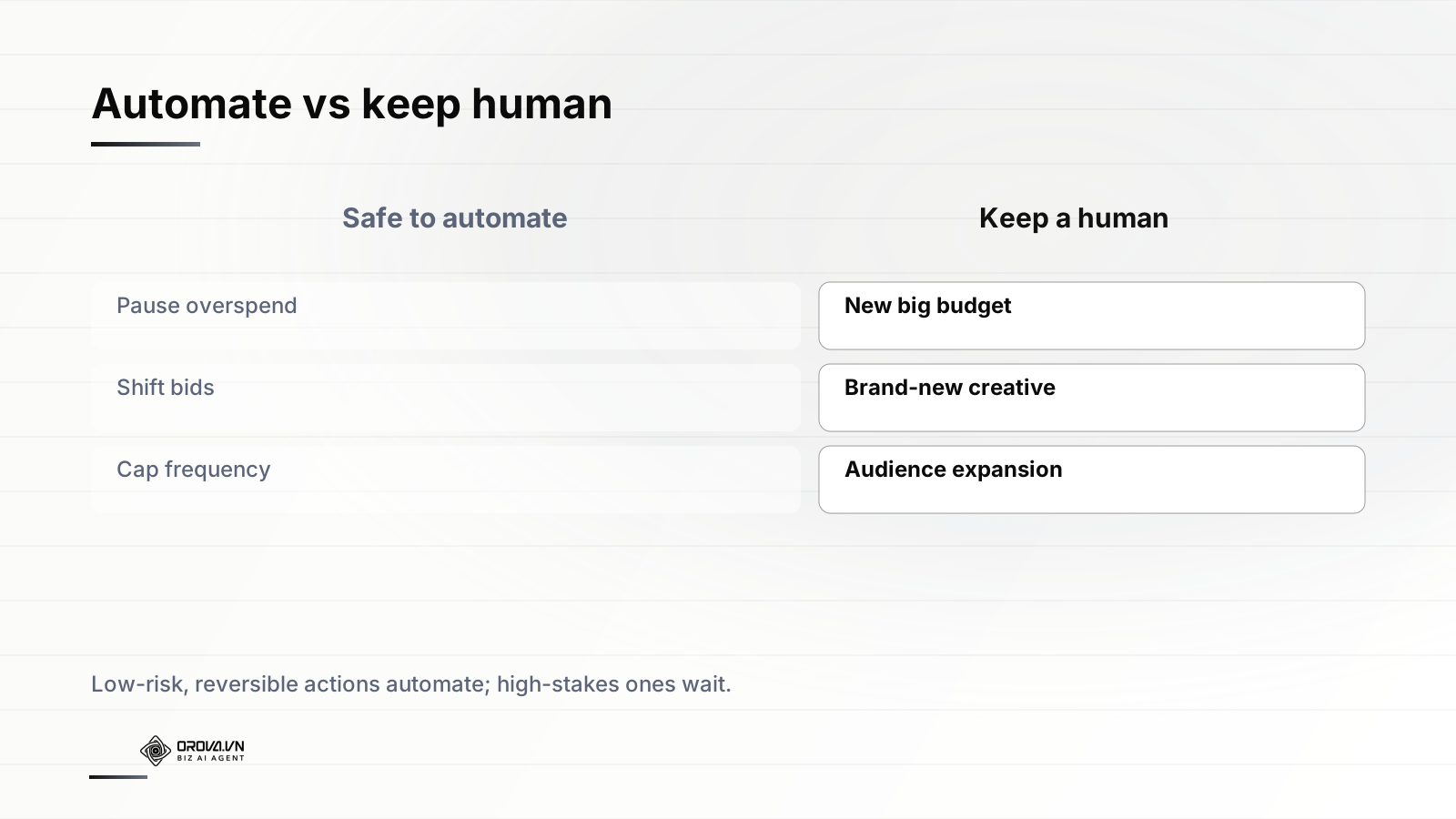
Start with the easy corner. Low risk, high reversibility is the home of routine optimization. Pausing an ad group that has blown past its cost-per-acquisition ceiling. Nudging a bid up or down within a tight band. Reallocating a modest amount of budget between two ad sets that are both already approved and running. Capping the frequency on an audience that is seeing your ad too often. These actions are the daily metabolism of a healthy account. Forcing a human to approve each one is a waste of everyone's time, and the worst outcome of a mistake is a small, instantly correctable wobble. Automate them and move on.
The opposite corner, high risk and low reversibility, is where a human belongs every single time, no exceptions. A large budget increase, say doubling a campaign's daily spend, commits real money the moment it runs and cannot be clawed back. Launching brand-new creative exposes your brand to the market in a way you cannot retract. Expanding into a new audience, especially a broad lookalike or a fresh geography, reshapes how the delivery algorithm spends for days afterward. These are not decisions to delegate to a rule, no matter how confident the system is. The pause is the point.
Then there are the mixed quadrants. High risk but reversible actions, like a moderate budget shift on a high-spend campaign, can often be automated within guardrails: allow the machine to act, but cap the magnitude and require approval above a threshold. Low risk but hard to reverse actions are rarer but exist, and they usually deserve at least a notification even if not a hard stop, so a human can catch a pattern the machine missed. The test does not give you a binary answer in these zones; it tells you where to set the dial.
Mapping the actions you actually take
Abstract frameworks are easy to nod along to and hard to apply. So here is a concrete map of the actions a typical paid-media operation performs in a given week, sorted by where the human should stand. Use it as a starting template and adjust the thresholds to your own risk tolerance and account size.
Actions safe to automate
- Pausing overspend. An ad set or keyword that has crossed a clear, pre-agreed cost-per-result ceiling can be paused automatically. The action saves money, it is trivially reversible (turn it back on), and waiting for a human only lets the waste continue. This is the single highest-value action to automate, because the cost of delay is direct and ongoing.
- Bid adjustments within a band. Moving bids up or down inside a defined range, say plus or minus 20% of the current value, in response to performance shifts. Reversible, low magnitude, and the kind of continuous tuning no human can do at scale.
- Frequency capping. Reducing how often a single user sees an ad once frequency climbs past a threshold. Protects against fatigue and wasted impressions, and is easy to relax later.
- Reallocating budget between approved, running ad sets. Shifting spend toward the better performer among options a human has already blessed. The set of choices is bounded, so the machine is optimizing within a sandbox you defined.
- Pausing clearly broken placements. Cutting a placement or network that is delivering impressions with zero engagement and obvious signs of low quality. Low risk, fully reversible.
Actions that should keep a human
- New, large budgets. Any budget increase beyond a meaningful threshold, or the launch of a new campaign with significant spend, commits money that cannot be recovered. A human confirms the demand signal is real and the spend is intended.
- Brand-new creative. Putting a new ad, message, image, or video in front of customers. This touches brand voice and cannot be unseen. A person should review what the audience will actually experience.
- Audience expansion. Broadening targeting, adding lookalikes, or entering new geographies. The delivery algorithm learns from the new traffic, so the effect persists well beyond the click that reverses it. A human weighs whether the expansion fits the strategy.
- Bidding strategy changes. Switching a campaign from one optimization goal to another, for example from clicks to conversions, resets the learning phase and can disrupt performance for days. This is a strategic choice, not a tuning knob.
- Anything touching claims, offers, or sensitive categories. Changes that alter what you are promising customers, or that involve regulated or sensitive audiences, always need human eyes for compliance and brand reasons that no model fully internalizes.
The boundary between these lists is not fixed forever. As your system proves itself on the safe list, you can carefully move items from the second list toward supervised automation. But you move them deliberately, one at a time, with evidence, not by flipping a master switch. The distinction between letting an agent advise you and letting it act on its own is worth thinking through carefully; the trade-offs in advisory versus auto-execute modes map directly onto this risk-and-reversibility logic.
The approval queue: making the loop work in practice
Knowing which decisions need a human is half the problem. The other half is the mechanism that connects the machine's proposals to the human's judgment without grinding the whole operation to a halt. That mechanism is the approval queue, and its design quality determines whether human-in-the-loop is a genuine safeguard or a bureaucratic theater.
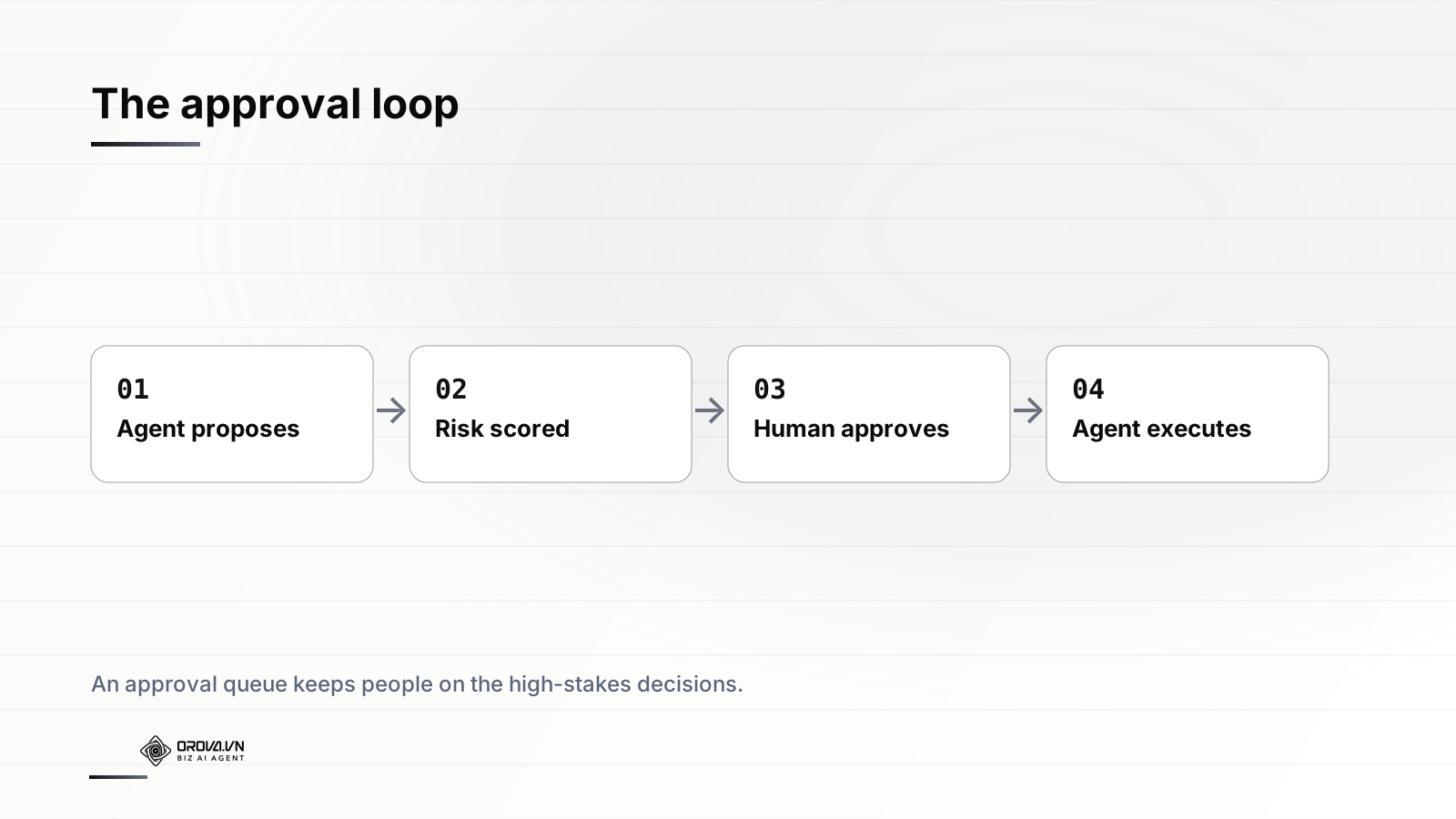
A good approval loop has four stages. First, the agent proposes: it identifies an action, gathers the supporting data, and frames a specific recommendation rather than a vague alert. Second, the proposal is risk scored automatically against the risk-and-reversibility test, so it is routed correctly: low-risk reversible items can execute immediately or with a light notification, while high-stakes items are flagged for review. Third, a human approves (or rejects, or modifies) the high-stakes proposals, with full context in front of them. Fourth, the agent executes the approved action and records what it did. The loop then closes: the outcome feeds back into the data the agent reads tomorrow.
What a good proposal looks like
The difference between an approval queue people use and one they ignore comes down to the quality of each proposal. A bad proposal says "Increase budget on Campaign A?" and forces the human to go investigate before they can decide. A good proposal carries its own justification. It states the recommended action, the specific trigger ("cost per acquisition has been 30% below target for six consecutive days at the current budget cap"), the expected effect, the magnitude and reversibility, and the risk score that routed it here. The human should be able to make a sound decision from the proposal alone, escalating to deeper investigation only when something feels off.
This matters because human attention is the binding constraint. If approving a request takes ten minutes of digging, people will either avoid the queue or approve blindly to clear it. If approving takes thirty seconds because the proposal already contains the reasoning, the human stays genuinely engaged on the decisions that warrant it. The goal is to make the human's judgment cheap to exercise, not to make them do the machine's homework.
Batching, thresholds, and notification tiers
Not every action that keeps a human needs the same intensity of involvement. A practical loop uses tiers. Hard approvals block execution until a person says yes; these are reserved for the high-risk, low-reversibility actions. Soft approvals execute after a delay unless a human intervenes, useful for medium-stakes actions where you want a chance to object but do not want to require active sign-off. Notifications execute immediately and simply tell the human what happened, appropriate for the low-risk reversible actions where you want awareness without friction.
Thresholds make the tiers practical. A 10% budget shift might be a notification; a 50% shift a soft approval; a doubling a hard approval. The same action sits in different tiers depending on its magnitude, which is exactly right, because magnitude is what moves an action along the risk axis. Batching helps too: rather than pinging a human for each of twenty small proposals, the system can group them into a single digest reviewed once a day. The principle throughout is to spend human attention in proportion to the stakes.
How the loop tightens as trust grows
The point of human-in-the-loop automation is not to keep a person stapled to every decision forever. It is to start cautious and earn your way to more autonomy as the system demonstrates it deserves it. The loop should tighten, meaning the human's involvement should concentrate on fewer and higher-stakes decisions, over time and on the basis of evidence.
Here is how that progression typically runs. In the early weeks, you keep the human on almost everything, even some actions that the risk test says could be automated, simply because you do not yet trust the system's judgment. The agent proposes, the human approves, and crucially, the human watches whether the agent's recommendations would have been good ones. This is the calibration phase. You are not just protecting the account; you are gathering evidence about where the agent is reliable and where it is not.
As that evidence accumulates, you graduate categories of action from "human approves" to "agent acts, human is notified." You do this category by category, not all at once. Maybe the agent earns the right to pause overspend autonomously after a month of always recommending the right pauses. Then bid adjustments. Then frequency caps. Each graduation is a deliberate decision backed by a track record, and each is reversible: if the agent starts making mistakes in a graduated category, you pull it back to requiring approval.
Over time, the steady state emerges. The agent handles the high-volume, low-stakes optimization on its own, freeing the human entirely from that work. The human's attention concentrates exactly where the risk-and-reversibility test said it should: on new budgets, new creative, audience expansion, and strategy changes. The loop has tightened not by removing oversight but by removing it from the decisions that never needed it, leaving a sharper, more focused form of oversight on the ones that do.
Audit logs: the foundation of earned trust
None of this graduation is possible without a complete, honest record of what the agent did and why. Audit logs are not a compliance afterthought; they are the substrate on which trust is built. Every proposal, every risk score, every human decision, every executed action, and every outcome should be recorded in a form a person can review later. When you are deciding whether to graduate a category to autonomy, the audit log is your evidence. When something goes wrong, the audit log is how you diagnose whether the failure was in the agent's reasoning, the risk scoring, the human's approval, or the execution.
Good logs also restore the legibility we discussed earlier. When the CMO asks why spend moved last week, the answer is not "the algorithm did it" but a specific, reviewable chain: the agent proposed a shift based on these signals, it was scored low risk, it executed automatically per the policy you approved, and here is the outcome. That chain is what makes automated ad management defensible inside an organization, and it is what lets you expand autonomy responsibly rather than as a leap of faith.
Common mistakes to avoid
A few failure patterns recur often enough to call out directly. The first is uniform policy: applying the same level of automation to every action because it is simpler to configure. This guarantees you are either over-controlling the trivial decisions or under-controlling the critical ones. Resist the urge to simplify away the distinction the risk test exists to capture.
The second is approval fatigue by design: routing too many low-stakes items to a human, who then approves them mechanically. Once people start rubber-stamping, your approval queue provides the appearance of oversight with none of the substance, which is worse than no queue at all because it creates false confidence. If you notice approvals happening in under a few seconds across the board, your thresholds are wrong and you are escalating things that should run on their own.
The third is graduating too fast or too slow. Too fast, and you grant autonomy before the evidence supports it, reintroducing the catastrophic-failure risk. Too slow, and you never capture the efficiency gains, leaving your team buried in approvals indefinitely. The remedy for both is the same: tie graduation to an explicit, observable track record rather than to a gut feeling or an arbitrary calendar.
The fourth is forgetting that reversibility decays. An action that is reversible in the abstract may not be reversible in practice once the platform's delivery system has learned from it. Always ask not just "can I undo this" but "how long does the effect linger after I undo it." Audience and bidding-strategy changes look more reversible than they are for exactly this reason.
Putting it together
Human-in-the-loop automation is not a compromise between manual and automated work. It is a more sophisticated answer than either extreme, one that matches the level of human oversight to the stakes of each individual decision. The two-dimensional test, risk and reversibility, gives you a principled way to sort your actions. The approval queue, with its tiers and well-formed proposals, gives you a mechanism to apply that sorting without crushing your team's attention. And the graduation model, anchored in audit logs, gives you a path from cautious oversight to earned autonomy that never sacrifices accountability.
The teams that get the most out of ad automation are not the ones that hand everything to the machine and hope. They are the ones who automate the routine relentlessly, keep a person firmly on the consequential, and steadily move the boundary as evidence allows. The machine does the work that benefits from speed and scale. The human does the work that benefits from context and accountability. The loop is the contract between them.
If you want an automation partner built around exactly this principle, Orova Ads is an AI agent that manages paid campaigns across Google, Meta, and TikTok. It reads your account data daily, recommends optimizations, and executes them, adjusting budgets and bids, turning campaigns on and off, and refining audiences, with human-in-the-loop approval on the decisions that matter and full audit logs on everything it does. Start with the agent advising, graduate it as it earns your trust, and keep your team focused on the calls only a person should make.
Related reading: What Is an AI Ads Agent? Autonomous Ad Management Explained
Read next: Automated Rules vs AI Agents: When to Use Each · What Is an AI Ads Agent? Autonomous Ad Management Explained · AI Ads Agent Setup: What to Do in Your First Week
Orova Ads optimises campaigns for you
Connect Google, Meta and TikTok in one place. AI reads the numbers, proposes changes and executes under the rules you set.
Explore Orova Ads