
AI Campaign Assistants: One Agent Per Ad Campaign
Imagine handing one analyst the full P&L of every business unit in a holding company and asking them to make pricing calls on all of it before lunch. That is roughly what most teams do when they point a single AI bot at an entire ad account. The agent gets a search campaign chasing $4 leads, a retargeting campaign defending a 6x ROAS, a top-of-funnel video campaign optimizing for cheap reach, and a branded-keyword campaign whose only job is to not get poached — and it tries to reason about all of them through one shared set of rules and one undifferentiated context window. The result is the kind of decision that looks defensible in aggregate and is wrong everywhere specifically.
The alternative is structurally simple and, in practice, far better: give each campaign its own dedicated AI assistant. One scoped agent per campaign, each with its own goal, its own budget cap, its own guardrails, and a context window that contains only the data that campaign actually generates. This article makes the case for that architecture — what changes when you scope an agent down to a single campaign, why it produces sharper decisions, and how it dramatically shrinks the blast radius when the agent inevitably gets something wrong.
The core problem with one agent for everything
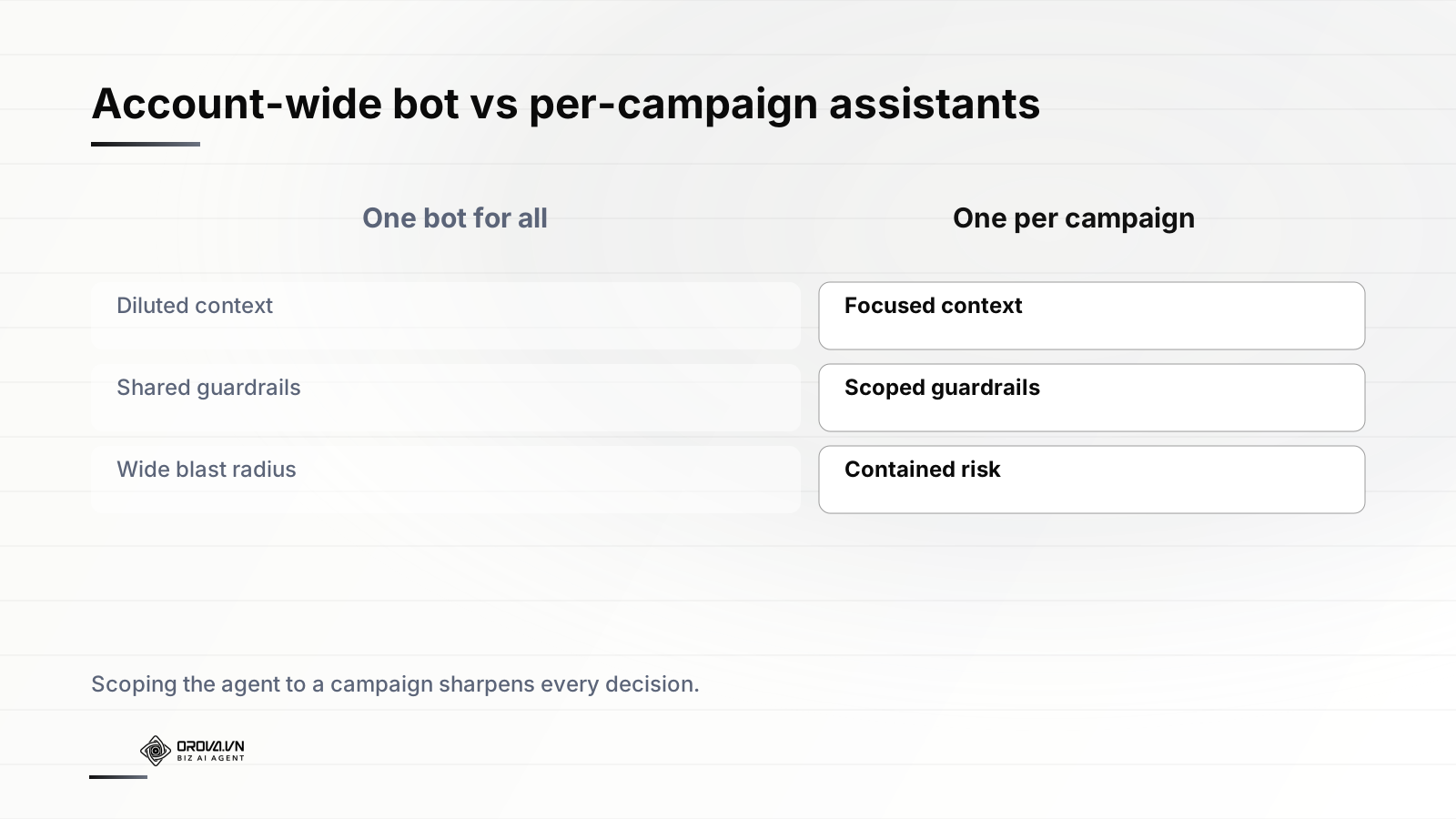
An account-wide bot is attractive on paper. One place to configure, one set of credentials, one dashboard. But the appeal hides three failure modes that compound as the account grows.
Context dilution
Large language models reason over whatever you put in their context window, and they reason best when that context is dense with relevant signal. When you feed a single agent the performance data for forty campaigns, three things happen. First, the truly relevant facts for any one decision get buried in noise — the model has to find the five rows that matter inside hundreds. Second, the model starts pattern-matching across campaigns that have nothing to do with each other, importing a heuristic that worked for a prospecting campaign into a remarketing decision where it is actively harmful. Third, you hit practical token limits and start summarizing, which means the agent is now reasoning over a lossy compression of the account rather than the real numbers.
Scoping the agent to one campaign collapses that problem. The context window holds the last 30 days of that campaign's spend, conversions, CPA trend, ad-group breakdown, audience performance, and creative fatigue signals — and nothing else. Every token in the window is on-topic. The agent is not deciding whether this campaign matters relative to the other thirty-nine; it is deciding only what this campaign should do next given its own objective.
Shared guardrails that fit nothing
Guardrails are the rules that keep an autonomous agent from doing something catastrophic: do not raise a daily budget by more than X%, do not pause an ad group with fewer than N conversions, do not bid above a CPC ceiling. With one account-wide bot, those guardrails have to be set at the lowest common denominator. A 20% daily budget-increase cap might be reckless for a fragile lead-gen campaign with a $50/day budget and far too timid for a proven ecommerce campaign with $5,000/day that could profitably absorb a 50% scale-up on a good day.
So you compromise. You set guardrails loose enough not to handcuff your best performers and you accept that they are dangerously permissive for your weakest ones — or you set them tight and leave money on the table everywhere. Either way the rules fit no individual campaign well, because campaigns differ in maturity, volatility, margin, and strategic role. Per-campaign assistants let each set of guardrails match the campaign it governs. The branded-search defender gets a near-frozen budget and a hard CPC cap. The scaling-phase ecommerce campaign gets room to push spend when efficiency holds. Each guardrail is calibrated to one reality instead of averaged across many.
A blast radius the size of the whole account
The most underrated reason to scope agents is what happens when one makes a bad call — and it will, because the data it reads is noisy, attribution lags, and the world outside the ad platform (a stockout, a competitor promo, a broken landing page) is invisible to it. With one bot governing everything, a single flawed inference can ripple across the account: it misreads a platform-wide tracking gap as universal underperformance and starts cutting budgets on healthy campaigns simultaneously. The damage is correlated and account-wide.
When each campaign has its own isolated assistant, a bad decision is contained to that one campaign by construction. The retargeting assistant cannot touch the prospecting budget. The TikTok video assistant cannot pause a Google Search ad group. Isolation is not a feature you bolt on; it is the default property of the architecture. You have turned one large, correlated risk into many small, independent ones — and many small independent risks are vastly easier to monitor, cap, and recover from than one big entangled one.
What a per-campaign assistant actually is
It helps to be concrete, because "one agent per campaign" can sound like forty copies of the same thing. It is not. A per-campaign assistant is a configuration of three elements that are unique to that campaign, sitting on top of shared underlying machinery.
A single, explicit objective
Every campaign exists to do one thing well. A lead-gen campaign wants conversions at or below a target cost-per-lead. A remarketing campaign wants to recover abandoned carts above a ROAS floor. An awareness campaign wants the cheapest qualified reach. The assistant is configured with that one objective as its north star, expressed as a measurable target — not a vague instruction to "improve performance." This matters because autonomous agents drift toward whatever metric is easiest to move. If you do not pin the objective, an agent will happily optimize a vanity metric. Pin it to "CPA at or under $32 with at least 40 conversions per week before scaling" and every recommendation it makes can be evaluated against that one sentence.
Its own budget envelope
The assistant operates inside a budget it is allowed to move and a hard ceiling it cannot cross. A campaign with a $200/day budget might let its assistant flex between $150 and $300 based on efficiency, with an absolute cap of $300 the agent physically cannot exceed regardless of how confident it is. This is the financial expression of the blast-radius principle: the worst case for any single campaign's assistant is bounded by a number you chose in advance. No combination of bad inferences can spend more than the cap, because the cap is enforced outside the agent's reasoning, at the execution layer.
Scoped permissions and a scoped action set
Finally, the assistant can only take actions on its own campaign, and only the actions you have enabled for that campaign. You might let the remarketing assistant adjust bids and budgets but not touch audiences, while the prospecting assistant is allowed to add and remove audience segments but cannot pause ad groups without approval. The action set is scoped to the campaign's risk profile. A campaign carrying a brand's most valuable keyword gets a conservative action set; an experimental campaign you are deliberately stress-testing gets a wide one.
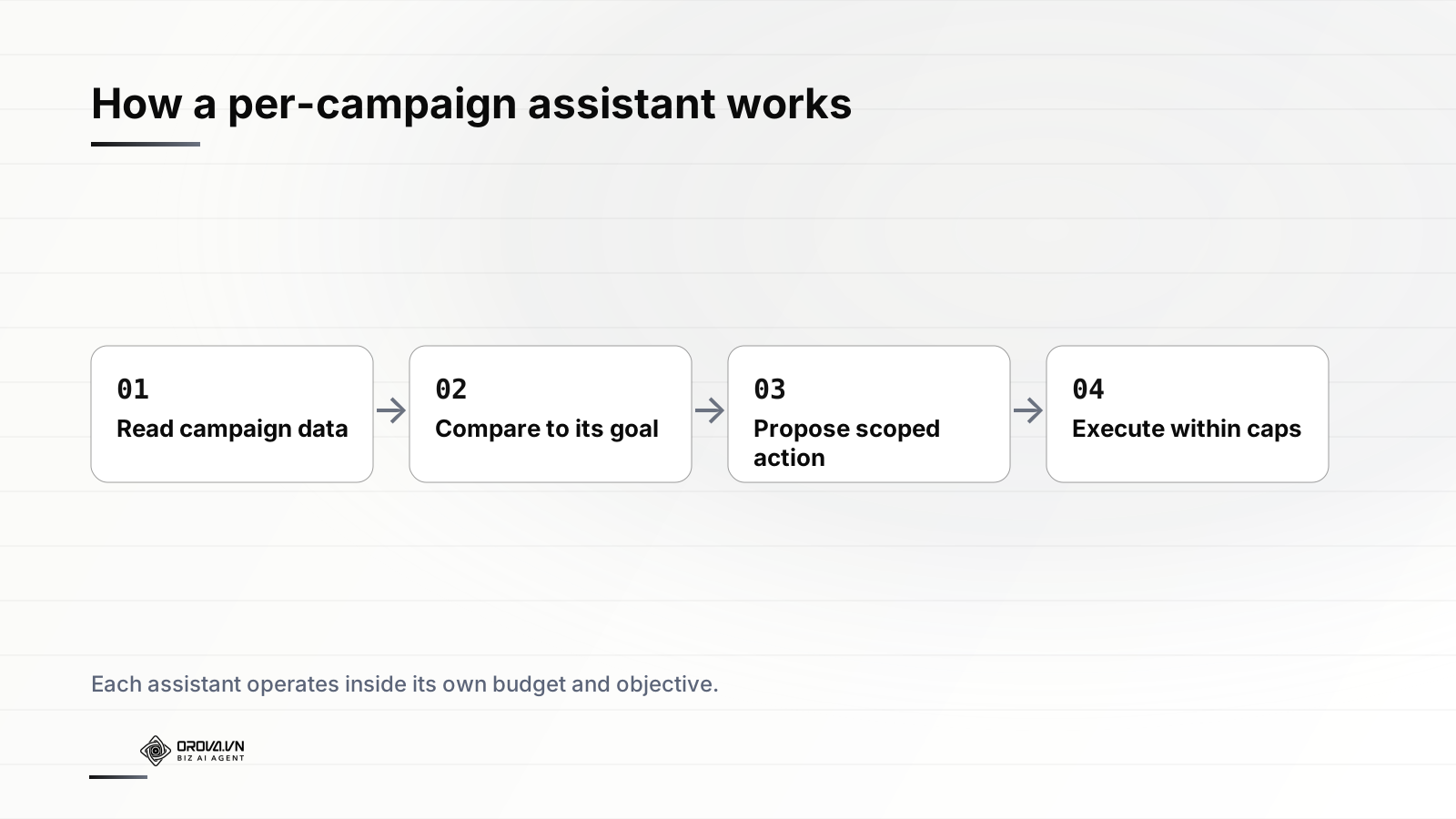
The day-to-day loop is the same for every assistant even though their configurations differ. It reads its campaign's fresh data, compares the current state to its objective, identifies the gap, proposes the smallest scoped action likely to close that gap, and either executes within its caps or surfaces the action for a human to approve. This is the same disciplined logic behind well-built condition-action rules for automating ad ops — except the agent reasons about whether the condition is meaningful rather than firing the moment a threshold is crossed. The structure is rules-like; the judgment is model-like.
Why focused context produces better decisions
The strongest argument for per-campaign scoping is not safety — it is decision quality. Three mechanisms drive it.
Local baselines instead of account averages
A campaign's "normal" is specific to that campaign. A $45 CPA is alarming for a campaign that historically runs at $28 and unremarkable for one that has always lived around $50. An account-wide agent reasoning over a pooled view tends to anchor on account averages, so it over-reacts to campaigns that are simply more expensive by nature and under-reacts to genuine degradation in a normally-cheap campaign. A scoped assistant learns the local baseline — this campaign's own trailing distribution of CPA, CTR, conversion rate by day of week, and seasonal rhythm — and judges every new data point against that. It catches a real 30% efficiency slide on a stable campaign that the pooled view would have shrugged off.
Coherent multi-signal reasoning
Good optimization is rarely about one metric. A rising CPA might be caused by creative fatigue, an auction-pressure spike, a worsening audience mix, or a landing-page conversion-rate drop — and the right action differs completely depending on which. A scoped assistant has all of that campaign's signals in front of it at once and can reason about them as a coherent picture: CPA up, CTR down, impressions flat, frequency climbing — that pattern points to creative fatigue, so the right move is to refresh creative, not to slash the budget. An account-wide bot working from summarized data often only has the headline metric and reaches for the bluntest lever.
No cross-campaign contamination
When campaigns share an agent, the agent's recent reasoning about one campaign subtly colors its reasoning about the next. If it just talked itself into aggressively cutting a failing prospecting campaign, that "cut spend" frame can leak into its evaluation of an adjacent campaign that actually deserves more budget. Scoped assistants start each decision from a clean, single-campaign context. There is no prior reasoning about unrelated campaigns to contaminate the call.
Accountability you can actually audit
Beyond decisions and safety, per-campaign scoping fixes a quieter problem: attribution of the agent's own behavior. When one bot manages everything and performance moves, you are left guessing which of its hundreds of recent actions mattered. The audit trail is a single interleaved stream of changes across the whole account, and untangling cause from effect is genuinely hard.
With one assistant per campaign, every action has an obvious owner and a clean local timeline. You can look at one campaign's log — "raised budget 15% on the 3rd because seven-day CPA held under target; refreshed creative on the 9th because frequency crossed 4.0 and CTR fell 22%" — and read the agent's reasoning as a coherent story about that one campaign. When something goes wrong, you know exactly which assistant, which decision, and which trigger to interrogate. When something goes right, you can codify what worked into that campaign's guardrails and, where appropriate, port the pattern to similar campaigns deliberately rather than hoping a monolithic bot generalizes correctly.
The unit of trust in autonomous ad operations is the campaign, not the account. Trust the agent with what it can fully see and what it can safely break — and that is exactly one campaign at a time.
The human-in-the-loop layer gets cleaner too
Approval workflows are far more usable when the request is scoped. An approval prompt that says "the prospecting campaign assistant wants to raise daily budget from $200 to $250 because seven-day CPA is $26 against a $32 target and conversion volume is climbing" is a decision a marketer can make in five seconds. A monolithic bot's approval queue tends to bundle changes across many campaigns into batches that are tedious to review and easy to rubber-stamp — which quietly defeats the purpose of having a human in the loop at all. Scoped requests keep approvals meaningful.
Addressing the obvious objections
"Won't I lose cross-campaign coordination?"
This is the legitimate concern. Some decisions genuinely are account-level: reallocating budget from a saturated campaign to one with headroom, or noticing that two campaigns are bidding against each other on overlapping audiences. Per-campaign scoping does not mean abandoning that layer — it means putting it where it belongs. The right architecture is scoped assistants for in-campaign optimization plus a thin coordination layer above them that handles genuinely cross-campaign moves, with its own conservative guardrails. The assistants own the depth; the coordinator owns the breadth. Crucially, the coordinator only needs to reason over campaign-level summaries — total spend, blended efficiency, headroom — not the granular data each assistant chews through. That keeps even the coordinator's context clean.
"Isn't running forty agents more overhead?"
Operationally it is less, not more, once the orchestration is built — and in a managed platform you do not build it. From the practitioner's seat, you configure each campaign's objective, budget envelope, and action set once, and the assistants run inside that. Because each one is scoped and capped, you can grant more autonomy with less anxiety, which means fewer items in your approval queue, not more. The overhead of a monolithic bot is hidden in the constant second-guessing of decisions you cannot cleanly attribute. Scoped assistants move that cost off your plate.
"Don't the agents need to learn from the whole account?"
Pattern-sharing is valuable, but it should be deliberate and reviewed, not an emergent side effect of dumping all campaigns into one context. The better path is to let each assistant master its own campaign, surface what worked as explicit, inspectable patterns, and promote proven tactics to other campaigns through configuration. That gives you the upside of shared learning without the contamination and context dilution of one undifferentiated brain.
What this looks like across Google, Meta and TikTok
The per-campaign model is not platform-specific, but the three major channels reward it for slightly different reasons, and seeing the differences makes the architecture more concrete.
Google Search and Performance Max
Search campaigns live and die by query-level relevance and bid efficiency, and the signals that matter — search-term reports, impression share lost to budget versus rank, conversion lag by keyword — are dense and campaign-specific. A scoped assistant on a Search campaign can read the actual search-term report, notice that 18% of spend last week went to a query theme that converts at half the campaign rate, and propose adding negatives or splitting that theme into its own ad group. An account-wide bot summarizing across forty campaigns will almost never get down to that grain. Performance Max raises the stakes further: because so much of its mechanics are opaque, the few levers you do control — asset groups, audience signals, budget, and target CPA or ROAS — need careful, campaign-local judgment. Pooled reasoning over many PMax campaigns at once tends to produce timid, averaged moves precisely where decisive, local ones are needed.
Meta
On Meta the dominant failure mode is creative fatigue and audience saturation, and both are inherently campaign-specific phenomena measured by frequency, first-time-impression ratio, and CTR decay over the campaign's own learning history. A scoped Meta assistant watches that one campaign's fatigue curve and knows the difference between the temporary instability of a fresh learning phase and genuine saturation — a distinction an account-wide bot routinely botches, because it sees a learning-phase wobble on a new campaign and a saturation slide on an old one as the same "CTR is falling" event. Meta also punishes thrash: too many edits reset learning. A per-campaign assistant with a scoped action set and a minimum-dwell guardrail makes fewer, better-timed changes to its one campaign rather than spraying edits across the account.
TikTok
TikTok's velocity is the differentiator. Creative lifecycles are short, trends move in days, and a campaign can go from efficient to exhausted inside a week. That tempo makes daily, campaign-local reading essential — the assistant has to catch a fatiguing hook before it burns the budget, which means it needs that campaign's hour-by-hour and day-by-day signal in clean focus. A monolithic bot working from weekly summaries is structurally too slow for the channel. Scoping the agent to the TikTok campaign gives it the cadence the platform demands.
Across all three, the pattern is identical: the decisions that move the needle depend on dense, campaign-specific signal read at the campaign's natural tempo. That is the strongest practical reason scoping wins — it is the only architecture that keeps the right data in front of the agent at the right frequency.
A practical way to adopt this
You do not have to flip the whole account at once. The migration is naturally incremental.
- Start with your two extremes. Pick your most valuable campaign and your most volatile one. Give each a scoped assistant with tight, campaign-specific guardrails and full audit logging, and run them in approve-only mode for two weeks. You will immediately feel the difference in how reviewable the decisions are.
- Define each campaign's one objective in writing. If you cannot state a campaign's objective as a single measurable target, the campaign — not the agent — is the problem. This step alone improves your account before any automation runs.
- Set guardrails per campaign, not globally. Budget caps, percentage-change limits, and bid ceilings should reflect each campaign's maturity and margin. Write down the worst case each cap permits, and make sure you can live with it.
- Graduate autonomy by track record. Once an assistant has shown a month of sound, well-reasoned recommendations on a campaign, let it execute the low-risk action types on its own and keep humans in the loop only on budget moves above a threshold. Autonomy is earned per campaign, on evidence.
- Add the coordination layer last. Once several scoped assistants are running well, introduce a conservative account-level coordinator for cross-campaign reallocation. Build depth first, breadth second.
The throughline is the same idea applied at every step: keep the agent's responsibility no larger than what it can fully understand and safely contain. A campaign is that natural unit. Scope to it, and the agent's context gets dense, its guardrails fit, its mistakes stay small, and its work becomes auditable. Scale past it into one bot for everything, and you trade all of that away for the false economy of a single login.
The takeaway
One agent for everything optimizes for the convenience of whoever sets it up. One agent per campaign optimizes for the quality and safety of the decisions themselves. Focused context means the agent reasons against local baselines and coherent multi-signal pictures instead of pooled averages and summaries. Scoped guardrails fit each campaign's maturity and margin instead of an unworkable lowest common denominator. And isolation turns one account-sized risk into many small, independent, recoverable ones. The architecture is not more complex to live with — it is simpler, because every decision has an owner, a reason, a cap, and a clean place in a log you can actually read.
Orova Ads is built on exactly this principle: an AI agent that manages your paid campaigns across Google, Meta and TikTok by reading each campaign's data daily, comparing it to that campaign's own goal, and proposing scoped optimizations — budget, bids, on/off, audiences — that you approve before they execute, with every action captured in a full audit log. See how scoped, accountable automation works at Orova Ads.
Related reading: What Is an AI Ads Agent? Autonomous Ad Management Explained
Orova Ads optimises campaigns for you
Connect Google, Meta and TikTok in one place. AI reads the numbers, proposes changes and executes under the rules you set.
Explore Orova Ads