
Automated Rules for Ad Ops: Automate Without AI Cost
Automated rules are the if-then instructions you set inside Google Ads, Meta Ads Manager or TikTok Ads: check a metric on a schedule, and when it crosses a threshold you chose, take an action — pause, raise the budget, adjust a bid, send an alert. Every major platform ships them under that name. Underneath, each one is a plain condition-action pair, which is why they never guess and never cost you a cent per check.
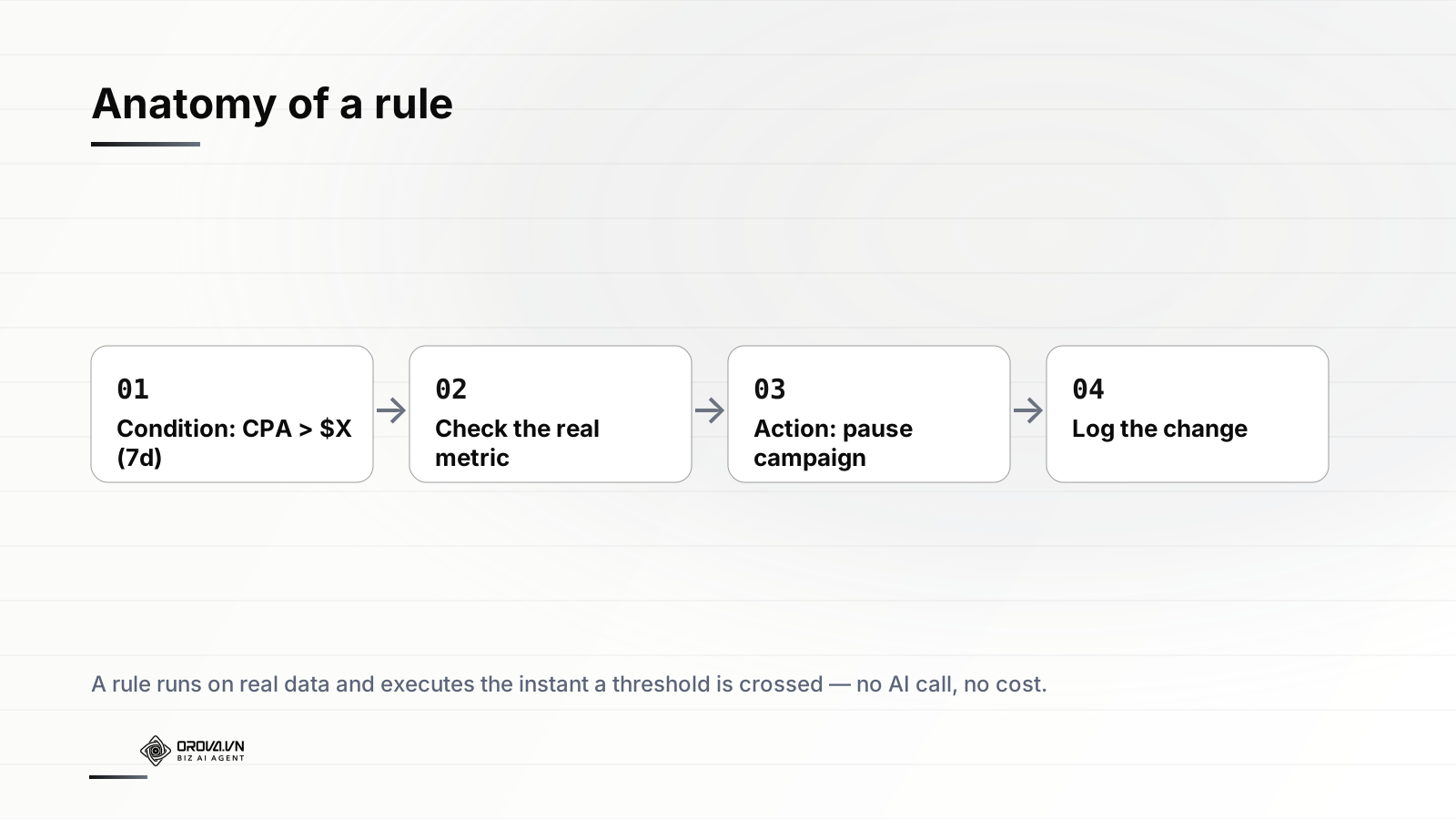
At 2:14 a.m. on a Tuesday, a promo code leaks to a deals forum. By 6 a.m., one of your shopping campaigns is spending $40 an hour on a coupon-hunting crowd that will never pay full price. Your cost per acquisition has quietly tripled. Nobody on the team will see this until they open the dashboard with their coffee at 9 a.m. — by which point you have burned roughly $280 on traffic that converts at a loss. An automated rule would have caught it at 6:05 a.m.: if seven-day CPA exceeds $45, pause the campaign and log the change. No human awake, no AI model consulted, no quota spent. Just a reflex.
That gap — between when a number goes wrong and when a person notices — is where most wasted ad spend lives. Teams obsess over targeting, creative and bidding strategy, but a large share of avoidable loss comes from latency: the hours or days between a metric crossing a dangerous threshold and somebody doing something about it. Automated rules close that gap. They are the oldest, simplest form of ad automation, and in the rush toward AI agents they get dismissed as primitive. They are not primitive. They are reliable, and for a specific and important class of decisions, reliable beats clever — at zero marginal cost, which matters when the alternative bills you per model call.
This is a practical guide to running day-to-day ad operations on automated rules: how they work, the rules every account should have switched on, where they break down, and how to pair them with an AI agent so each does the job it is actually good at.
What an automated rule actually is
Strip away the platform labels and an automated rule is three things bolted together: a condition (a check against a real metric over a real time window), an action (a concrete change to your account), and a schedule (how often the condition is evaluated). When the condition is true, the action fires. When it is false, nothing happens. That is the entire model.
The classic shape is "if X then Y." If seven-day return on ad spend is above 4.0, raise the daily budget by 20%. If frequency over the last week is above 3.5, send an alert. If cost per acquisition over fourteen days is above $60, pause the ad set. The condition is evaluated on a cadence — every hour, every morning, every thirty minutes — and the action only executes on the evaluations where the threshold is crossed.
Three properties make this design valuable, and they are worth naming precisely because they are exactly the properties an AI agent does not have for free.
It runs on real numbers, not predictions
A rule does not estimate, forecast or infer. It reads the actual metric for the actual window and compares it to a fixed number you chose. There is no probability attached to its decision. If the rule says "CPA over seven days is greater than $45," then either that is literally true in your account right now or it is not. This makes rules trustworthy in a way that probabilistic systems can struggle to be: the decision is fully determined by data you can pull up and verify yourself.
It fires the instant the threshold is crossed
Latency is the enemy. A rule evaluated every hour will act within sixty minutes of a metric going bad, around the clock, on weekends, during holidays, while your team sleeps. No human workflow matches that. The cost of a runaway campaign is roughly linear in time — every hour it runs unchecked is another hour of loss — so collapsing reaction time from twelve hours to one hour is not a 10% improvement. On a bad day it is the difference between a $25 mistake and a $300 mistake.
It costs nothing per evaluation
This is the part teams overlook when they move to AI-driven tooling. Every time you ask a language model to look at your account and decide something, that call consumes compute — and in any platform with usage-based pricing, it consumes quota or budget. A rule does not. Checking whether a number is above another number is effectively free and can run thousands of times a day across hundreds of campaigns without adding a cent to your tooling bill. For high-frequency, mechanical checks, that economics matters enormously. You do not want to spend AI budget asking a model the same trivial yes-or-no question every fifteen minutes.
The right mental model: a condition-action rule is a smoke detector, not a fire marshal. It does not assess the situation, weigh options or write a report. It detects one specific condition and pulls one specific lever, immediately, every time, for free.
The rules every ad account should be running
You do not need dozens of rules. You need a small set of well-chosen ones that cover the failure modes that actually hurt: spend running away, budget sitting idle on winners, and audience fatigue going unnoticed. Below are the core rules, written the way you would actually configure them, with the reasoning behind each threshold so you can adapt the numbers to your own economics.
The circuit breaker: pause on runaway cost
This is the single most important rule and the first one to set up. The logic:
- Condition: cost per acquisition over the last seven days is greater than your maximum allowable CPA.
- Action: pause the campaign (or ad set) and send an alert.
- Schedule: evaluate every one to three hours.
Set the threshold above your target CPA but below the point where the spend genuinely loses money. If your target CPA is $30 and you start losing money above $50, set the rule at something like $48. You are not trying to micro-optimize with this rule — you are trying to stop catastrophes. Use a seven-day window, not a one-day window, so a single unlucky day does not trip the breaker. A common mistake is making this rule too twitchy: if it pauses campaigns over a few hours of noise, the team learns to ignore it, which is worse than not having it.
A refinement worth adding is a minimum-conversions guard. Pausing a campaign because its CPA is $90 after a single conversion is statistically meaningless — one conversion tells you almost nothing. Add a condition that the campaign has at least, say, ten conversions in the window before the CPA check is allowed to fire. Many platforms let you combine conditions with AND; use it here.
The accelerator: scale your winners
The mirror image of the circuit breaker. Most accounts under-fund their best performers because nobody is watching closely enough to push budget toward them in real time.
- Condition: ROAS over the last seven days is greater than your target ROAS by a comfortable margin, AND the campaign is spending its full budget (a sign it is budget-constrained, not demand-constrained).
- Action: raise the daily budget by 15–20%.
- Schedule: evaluate once daily.
Two cautions here. First, scale in small steps. A 15–20% daily increase lets the platform's delivery system re-stabilize; jumping a budget by 100% overnight often resets the learning phase and tanks performance for days. Second, cap the total increase. A budget-raise rule with no ceiling can run away in the other direction — happily scaling a campaign to ten times its original budget over a couple of weeks based on a ROAS figure that was true at small scale but collapses at large scale. Add an absolute maximum budget the rule will never exceed.
The fatigue alarm: catch creative burnout
This one usually fires an alert rather than taking an action, because the right response (refresh the creative) requires a human.
- Condition: frequency over the last seven days is greater than 3.5 (the exact number depends on your audience size and offer).
- Action: send an alert to the team; optionally, pair it with a CPA or CTR check before acting.
- Schedule: evaluate daily.
High frequency on its own is not always bad — a retargeting pool will naturally see high frequency. What you actually care about is frequency rising while performance falls, which is the signature of creative fatigue: the same people seeing the same ad too many times and tuning it out. A more precise version of this rule combines a frequency threshold with a declining click-through rate, but even the simple frequency alert catches the most common version of the problem before it eats a week of budget.
The day-parting and pacing helpers
Beyond the big three, a handful of smaller rules earn their keep:
- Spend pacing: if daily spend by noon is already above 60% of the daily budget, alert — you may exhaust budget before your best converting hours.
- Zero-conversion guard: if a campaign has spent more than 2× your target CPA with zero conversions in the last three days, pause it. This catches broken landing pages, tracking failures and mis-targeted launches.
- Schedule enforcement: turn campaigns off outside business hours if your offer only converts when your sales team is available to answer the phone.
- Bid ceiling: if a manual or target-CPA bid drifts above a level you have decided is uneconomic, cap it and alert.
Notice a pattern across all of these: each rule encodes a decision you have already made. You decided in advance what your maximum CPA is, what frequency is too high, what spend-by-noon is concerning. The rule is just executing a policy you set when you were calm and thinking clearly, rather than when you are reacting to a fire at 11 p.m. That is the deeper value of rules — they let you make good decisions once and have them enforced consistently forever.
There is also a quiet organizational benefit here that rarely gets mentioned. A team that runs on rules has, almost by accident, written down its operating policy. The thresholds in your rule set are your account management philosophy, made explicit and inspectable. A new hire can read the rules and understand in ten minutes how the account is supposed to behave, what counts as a winner, and what counts as a problem. Compare that to the usual situation, where the real rules of an account live only in the head of whoever has managed it longest, and walk out the door when they leave. Rules turn tribal knowledge into shared infrastructure, and that alone is worth the setup time for any team larger than one person.
Where rules break down
If rules were the whole answer, nobody would be building AI agents. They are not the whole answer, and understanding exactly where they fail is what tells you when to reach for something smarter.
They are rigid — they only know the thresholds you gave them
A rule has no concept of anything outside its single condition. The CPA-circuit-breaker does not know that today is the day before your biggest sale of the year, when a temporarily high CPA is perfectly acceptable because conversions are about to spike. It does not know that the campaign it is about to pause is the one your CEO personally cares about. It does not know that the reason CPA jumped is a one-time tracking glitch that will resolve itself in two hours. It sees a number above a threshold and it pulls the lever. Context is invisible to it.
They cannot weigh trade-offs
Real ad decisions are rarely about one metric. Should you pause a campaign with a slightly high CPA but a strong assisted-conversion role in your funnel? Should you scale a campaign with great ROAS but worrying audience saturation? These are judgment calls that require holding several factors in tension at once. A rule can only ever check the conditions you explicitly wrote, combined with AND or OR. As soon as the decision involves "it depends," rules become brittle. You can try to encode the nuance with ever-more-complex nested conditions, but past a point you are essentially trying to write a program to capture judgment — and you will always miss a case.
They do not explain themselves or adapt
A rule tells you what it did, not why the situation arose or what you should do next. It paused a campaign; it cannot tell you that the root cause was a competitor launching an aggressive sale, or recommend that you respond by shifting budget to a different channel. And a rule never improves. The threshold you set six months ago is the threshold it still uses, even though your margins, your competition and your seasonality have all changed. Someone has to remember to revisit it.
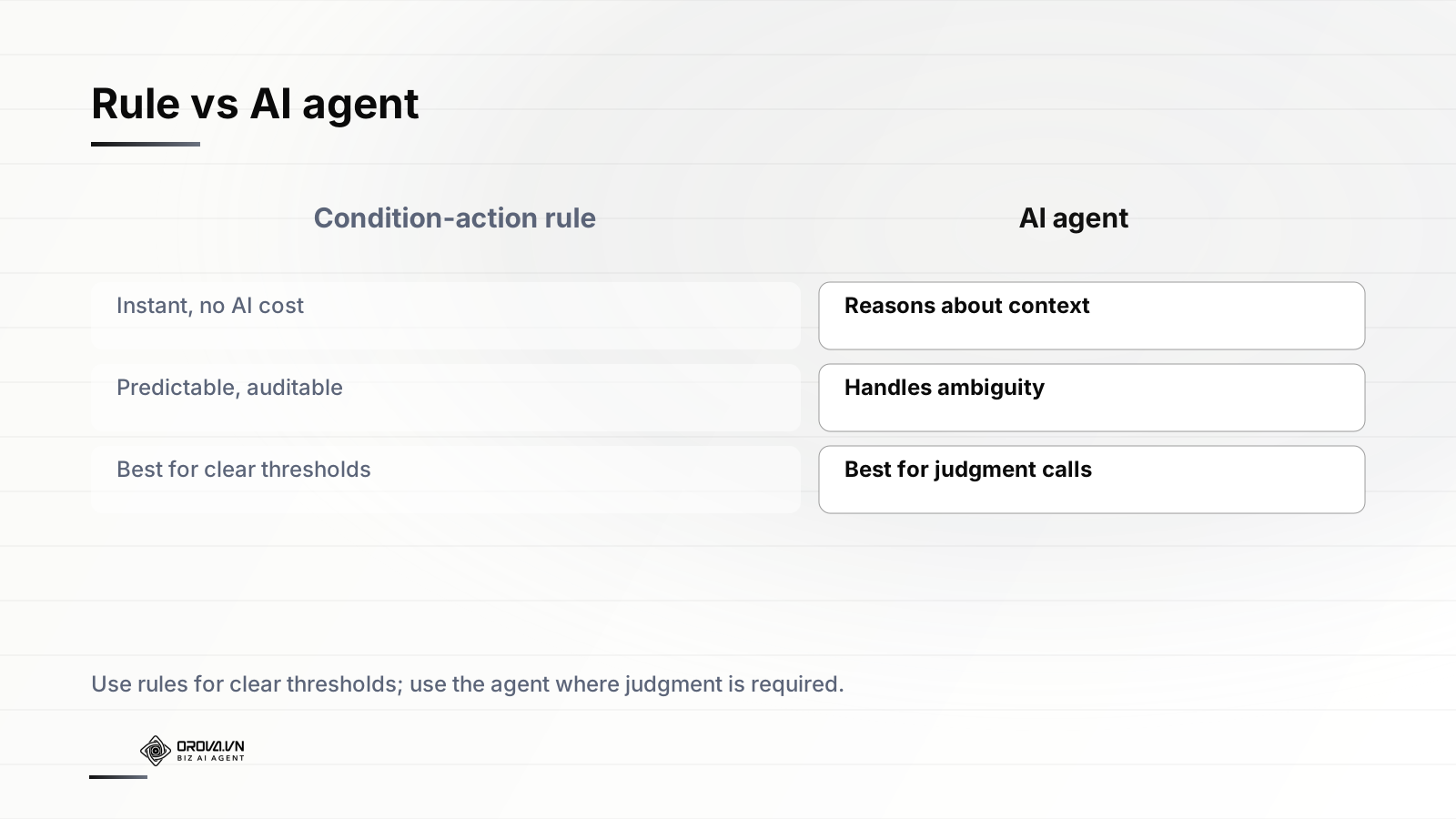
The honest summary is that rules and AI agents are good at opposite things, and the comparison above is not a competition — it is a division of labor. Rules are instant, free, predictable and auditable, which makes them ideal for clear, mechanical thresholds. An AI agent reasons about context, handles ambiguity and weighs trade-offs, which makes it ideal for the judgment calls rules cannot touch. We have written more on this distinction in our deeper piece on rule-based automation versus AI agents, but the practical conclusion is simple: stop choosing between them and start layering them.
Pairing rules with an AI agent
The strongest ad operations setup uses rules and an AI agent as two layers with different jobs. Think of it as a fast reflex layer beneath a slow reasoning layer.
Rules as the safety net
The bottom layer is your rules. They run constantly, cheaply and instantly, and they handle the binary, time-critical decisions: stop catastrophic spend, scale obvious winners in small steps, flag fatigue. Their job is to make sure that no matter what else happens, certain bad outcomes are physically prevented and certain good ones are not missed for lack of attention. This is the layer that protects you while everyone sleeps. Because it is deterministic, you can fully audit it — every fire of every rule leaves a record of exactly what condition was true and exactly what action was taken.
The agent as the strategist
On top sits the AI agent, which runs less often — typically once a day — and does the thing rules cannot: it looks at the whole account in context. It notices that three campaigns are all underperforming for the same upstream reason. It weighs the assisted-conversion value of a campaign before recommending you cut it. It reads the seasonal pattern and suggests you raise your CPA tolerance for the next ten days. It produces a recommendation with a reason attached, so you understand not just what to change but why.
Crucially, the two layers communicate. When a rule pauses a campaign, that is not the end of the story — it is a signal for the agent to investigate. The next morning the agent can look at why the circuit breaker tripped, diagnose the cause, and propose a real fix rather than just leaving the campaign paused. The rule bought you time by stopping the bleeding; the agent uses that time to solve the actual problem.
A concrete handoff
Here is how the layers work together on the leaked-promo-code scenario from the opening:
- 6:05 a.m. — the rule acts. Seven-day CPA crosses the $45 threshold. The circuit breaker pauses the shopping campaign and logs the change. Loss is capped at a few dollars instead of a few hundred.
- 9:00 a.m. — the agent investigates. Reviewing the overnight activity, the agent sees the paused campaign, traces the CPA spike to a surge of coupon-driven, low-value traffic from a single referral source, and recognizes the pattern as a leaked code rather than a genuine demand shift.
- 9:01 a.m. — the agent recommends. Instead of simply unpausing, it proposes adding the offending source to an exclusion list, expiring the leaked code, and re-enabling the campaign — with the reasoning written out so a human can approve it in one click.
Neither layer could have handled this alone. A rule could stop the spend but never diagnose the leak. An agent could diagnose the leak but, running only once a day, would not have caught the spend in time. Together they turn a $300 overnight loss into a $5 footnote and a fixed root cause by mid-morning.
Getting started without overcomplicating it
The failure mode for teams adopting rule-based automation is not too few rules — it is too many, badly tuned, that nobody trusts. Resist the urge to automate everything on day one. A disciplined rollout looks like this:
- Start with alerts, not actions. For the first week or two, set your rules to notify rather than act. Watch when they would have fired and check whether you agree with the action. This calibrates your thresholds against reality before you give a rule the power to pause spend.
- Add the circuit breaker first. The pause-on-runaway-CPA rule has the highest payoff and the lowest risk of bad surprises. Get it right, then move on.
- Use generous time windows. Seven-day windows for cost rules, not one-day. You want rules to react to genuine shifts, not daily noise.
- Guard against thin data. Always pair a cost rule with a minimum-conversions condition so it never acts on a sample too small to mean anything.
- Review the audit log monthly. Look at what your rules actually did. If a rule never fires, your threshold may be too loose. If it fires constantly and gets ignored, it is too tight. Either way, tune it.
Done this way, rules become invisible infrastructure — the kind of automation you forget is running until the month it quietly saves you from a costly mistake. They will never be the whole story, because a meaningful share of ad decisions genuinely require judgment. But for the mechanical, high-frequency, threshold-based decisions that make up the bulk of day-to-day ad ops, a good rule is not a poor substitute for intelligence. It is exactly the right tool: instant, free, predictable, and awake at 2 a.m. when you are not.
If you want both layers working together without building the plumbing yourself, Orova Ads is an AI agent that manages paid campaigns across Google, Meta and TikTok — reading your data daily, recommending optimizations and executing them (budget shifts, bid changes, on/off toggles, audience adjustments) with human approval and a full audit log for every action. Pair its judgment with your own automated rules and you get the reflexes and the reasoning in one place.
Related reading: What Is an AI Ads Agent? Autonomous Ad Management Explained
Orova Ads optimises campaigns for you
Connect Google, Meta and TikTok in one place. AI reads the numbers, proposes changes and executes under the rules you set.
Explore Orova Ads