
Google Ads Agent Oversight: Logs, Approval and Undo
A media buyer I worked with once inherited an account where daily spend had quietly drifted upward over three weeks. A google ads agent had been "optimizing" the whole time, but when she asked what changed and why, all she got was a shrug and a dashboard showing the current state — never the path that led there. There was no record of which campaigns got scaled, on what date, against which signal, or who approved it. The tool had been busy. It had just never been accountable.
This is the trap with most automation tools: they show you results, not decisions. You can see that spend moved, but not the reasoning behind each change, so when something goes wrong you're stuck reconstructing a trail that was never written down in the first place. Checking in manually every day doesn't fix this either — it just means you're the one doing the guessing instead of the tool. The stakes are real: roughly a quarter of programmatic ad spend is wasted on inefficient buying and invalid impressions, according to the ANA Programmatic Transparency Study, and an unsupervised agent making silent, unlogged decisions is exactly how that waste compounds unnoticed.
This article lays out exactly what a trustworthy automation setup should show you: a full change log, a clear approval step before money moves, a reason behind every action, and a real way to undo it if something goes sideways. By the end, you'll know how to read an agent's activity the way you'd read a financial statement, and how to spot the warning signs that mean you should pull back control before a small mistake becomes an expensive one.
Why auditability is the real prerequisite for autonomy
People tend to debate AI in advertising as a question of capability: can it find the right audience, can it set bids better than I can, can it catch a fading creative before I do? Those are fair questions. But they're the second question. The first one is governance: when this system makes a decision I disagree with — and it will, eventually — can I see it, understand it, and reverse it before it costs me?
Paid media is unusual among marketing channels because the feedback loop involves real money moving every hour, automatically. A bad SEO decision degrades slowly and is cheap to fix. A bad bidding decision can burn through a week's budget by lunchtime. The blast radius of an unaccountable system is proportional to how fast it can spend, and a capable agent can spend fast. That's precisely why the bar for transparency has to rise as the autonomy rises. The more you let a system do on its own, the more complete its record-keeping needs to be.
There's also a human reason. Marketing teams don't operate in a vacuum — they answer to finance, to leadership, and sometimes to clients. "The AI did it" is not an acceptable answer in a budget review. You need to be able to point to a specific change, on a specific date, justified by a specific signal, and ideally approved by a specific person. Auditability isn't bureaucratic overhead. It's what lets you defend your spend, learn from your wins and losses, and keep using automation without quietly losing control of your own account.
If you can't reconstruct why your spend looks the way it does today, you don't have an optimization system. You have a liability that happens to be productive most of the time.
This is the same reasoning that should govern the broader decision of whether to delegate budget at all. I've argued elsewhere that the question whether you should let AI spend your budget comes down less to trusting the model and more to trusting the controls around it. Auditability is the most important of those controls, because it's the one that makes every other control verifiable after the fact.
What a good change log actually records
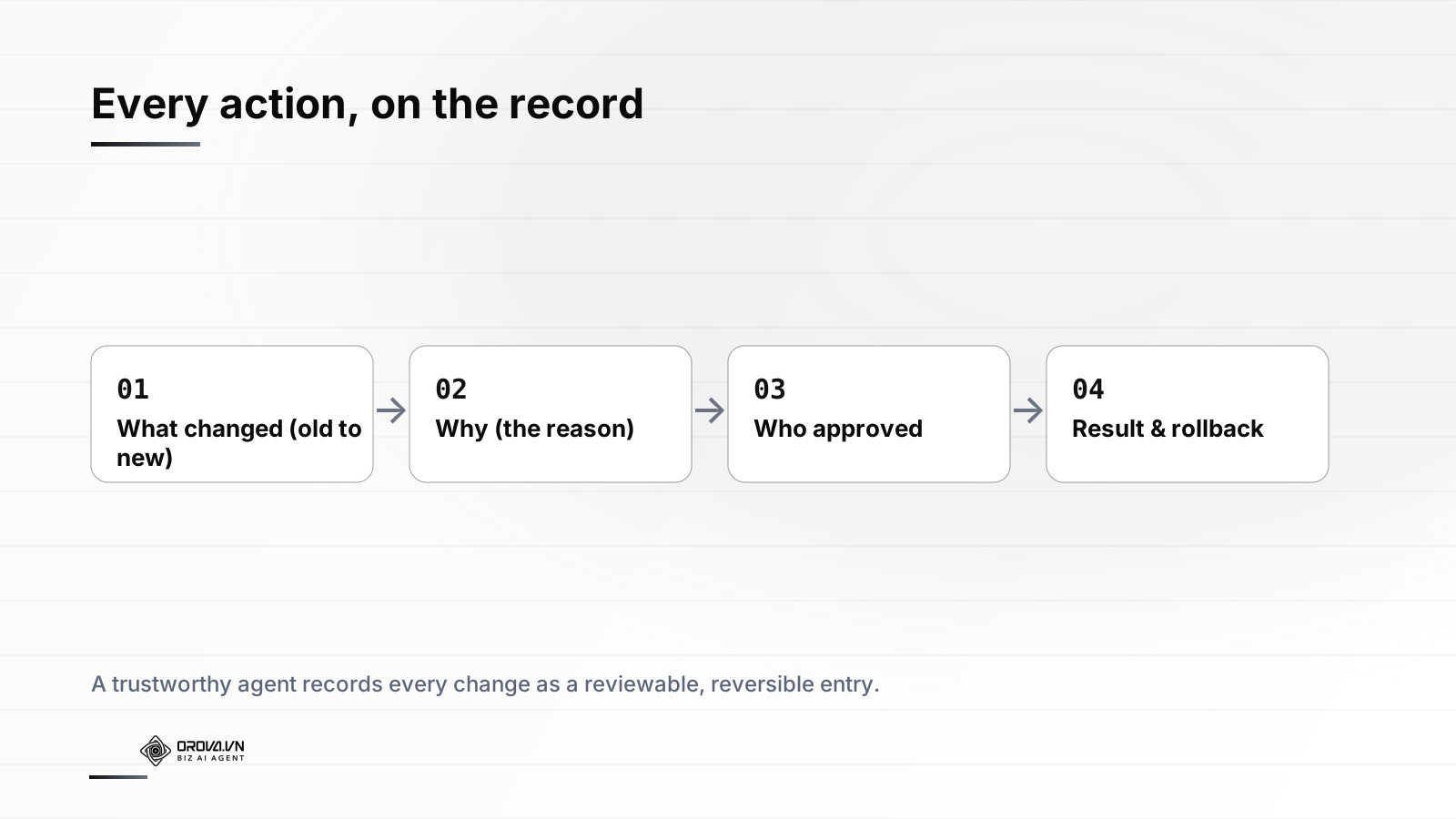
The heart of an auditable agent is its change log. Not a feed of vague "optimizations applied" notifications — an actual ledger where each entry is a complete, self-contained record of a single decision. When you read one row, you should never have to go hunting in another system to understand what happened. A well-built entry answers five questions on its own.
What changed — the before and after
Every entry needs to show the old value and the new value, explicitly. "Increased budget on Campaign A" is not auditable. "Daily budget on Campaign A: $200 → $260" is. The same applies to every kind of action: a bid adjustment should read "Target CPA: $35 → $30," an audience change should name the segment added or removed, a status change should read "Ad set #4471: ENABLED → PAUSED." The delta is the whole point. Without the prior value, you can't tell whether a change was a tweak or a swing, and you can't reason about cumulative drift across dozens of small adjustments.
This is also where you catch the slow-creep problem from my opening story. Ten individual "+15% budget" changes each look harmless. The log makes the compounding visible: if you can sort by entity and see the trajectory of a single campaign's budget over time, a runaway pattern jumps out immediately.
Why — the reason attached to the action
A change without a reason is an instruction you can't evaluate. The strongest auditable systems attach a plain-language rationale to every single action, tied to the data that triggered it. Not a generic label like "performance optimization," but something you can verify: "ROAS on this campaign held above 4.0 for 7 consecutive days while hitting its budget cap on 6 of them; raising the cap to capture demand." Now you can check the claim. You can pull the same metric and see if the agent read it correctly. You can disagree with the threshold. The reason turns an opaque action into a reviewable argument.
This is what separates a tool that reports from a tool you can actually supervise. When the reasoning is on the record, you stop being a passenger and start being an editor. You can spot when the agent is reacting to noise, when it's misreading a seasonal spike as a trend, or when its logic is sound and you should just get out of the way.
When — precise timestamps
Timing matters more than people expect. A budget change made at 9 a.m. before a known traffic surge has a different meaning than the same change made at 11 p.m. Precise timestamps let you correlate actions with outcomes, reconstruct sequences ("what did the agent do in the hour before performance dropped?"), and detect whether a system is acting on stale data. They're also what makes a rollback meaningful — you need to know the exact state of the account at a given moment to restore it.
Who — the approval and the actor
Every entry should name who was responsible. In a human-in-the-loop setup, that means recording which person approved the change and when. In a fully autonomous mode, it means clearly marking the action as agent-initiated and logging which policy or permission allowed it. Either way, "who" closes the accountability loop. When something goes wrong, the first question is always "who decided this," and the log should answer without an investigation.
Result — what happened next
The best logs don't stop at the moment of action. They circle back and record the outcome: did the budget increase actually capture more conversions, or just more spend at a worse cost? Attaching results to changes turns your audit trail into a learning system. Over weeks, you can see which categories of decision tend to pay off and which don't, and you can tune the agent's permissions accordingly. A change log that records intentions but never outcomes tells you what the agent tried; one that records results tells you whether to trust it.
The approval trail: human-in-the-loop done right
Autonomy and oversight are not opposites — the design challenge is to get the benefits of speed without surrendering control. The mechanism that makes this work is the approval trail, and it's worth understanding what a good one looks like in practice.
In a human-in-the-loop model, the agent doesn't silently execute. It proposes. It surfaces a recommendation — "Pause these 3 underperforming ad sets, projected savings $1,400/week" — along with the reasoning and the data behind it, and a person approves, modifies, or rejects it. Crucially, that entire exchange becomes part of the record. The proposal, the decision, the timestamp, and the person are all logged together. Six weeks later you can answer not just "what changed" but "was this reviewed, by whom, and did they have the full picture when they signed off."
A mature approval system also lets you tune the threshold of what requires sign-off, because not every decision deserves the same friction. Reasonable teams configure it roughly like this:
- Auto-approve, log only: low-risk, easily reversible actions within tight bounds — small bid nudges, pausing an ad with zero conversions and meaningful spend. These happen autonomously but are fully recorded.
- Require approval: anything that moves real money or changes structure — budget increases above a set percentage, launching new audiences, reallocating spend between campaigns.
- Hard stop, never automatic: actions you've decided no system should take alone — exceeding a total spend ceiling, touching a protected brand campaign, changing conversion tracking.
The point isn't to approve everything; that defeats the purpose of automation. The point is to draw the line deliberately and have the system honor it, with every crossing of the line written down. A graduated approval model lets you start cautious — approving nearly everything while you build trust — and progressively widen the agent's latitude as its track record earns it, exactly the way you'd extend authority to a new hire who keeps making good calls.
Rollback: the difference between a mistake and a disaster
No system, human or AI, makes only good decisions. The thing that determines whether a bad decision is a footnote or a catastrophe is how quickly and cleanly you can undo it. Reliable rollback is the safety net that makes everything else safe to attempt.
Good rollback is more than an "undo" button. Because the log records the exact prior state of every changed entity, the system can restore that state precisely: the budget that was $200 before the agent raised it to $260 goes back to $200, not to some default, not to a guess. One-click rollback on a single action is the baseline. Better systems let you roll back a batch — "undo everything the agent did between 2 and 4 p.m. yesterday" — which matters when a cascade of small changes added up to a problem.
There's a subtle but important consequence of having dependable rollback: it changes your psychology about delegation. When undoing is cheap and certain, you're far more willing to let the agent try things, because the downside is bounded. When there's no real undo — when reversing a change means manually reconstructing what the account looked like before — every grant of autonomy feels like a gamble, and you end up either micromanaging the tool into uselessness or ignoring it out of anxiety. Rollback is what lets you actually use the automation you're paying for.
Ask any automation vendor a single question: "If your system makes a change I disagree with at 3 a.m., how do I get the account back exactly as it was, and how long does it take?" The quality of that answer tells you most of what you need to know.
One caveat worth naming: rollback restores configuration, not money already spent. If an over-aggressive budget burned $2,000 overnight, reverting the budget setting stops the bleeding but doesn't recover the cash. That's exactly why the approval trail and spend ceilings matter alongside rollback — the trail prevents many bad changes from ever executing, and the ceiling caps the damage of the ones that slip through. Rollback is the last line of defense, not the only one.
Reviewing the agent like a team member
The most useful mental model I've found is to stop thinking of an AI agent as software and start thinking of it as a new member of the media team — a fast, tireless, occasionally overconfident junior buyer who needs supervision and grows into trust. Everything about auditability falls into place when you adopt that frame.
You'd never give a new hire your full budget and root access on day one. You'd start them on a small account, review their work closely, ask them to explain their reasoning, and widen their authority as they demonstrated good judgment. An auditable agent lets you do exactly this. The change log is their work product. The reasons attached to each action are them showing their thinking. The approval trail is your code review. Rollback is the ability to fix their mistakes without drama.
This frame also tells you how to review. A few practices that work well:
- Run a weekly log review. Block 20 minutes to scan the week's changes. You're not re-approving everything — you're looking for patterns: is the agent's reasoning sound? Are its predicted results materializing? Is it drifting toward more aggressive moves over time?
- Spot-check the reasoning against the data. Pick two or three actions and verify the claim. If the agent said it paused an ad set for "rising cost per acquisition," confirm the CPA actually rose. This is how you build — or lose — trust, calibrated to evidence rather than vibes.
- Watch the outcome column. Decisions that consistently produce the predicted result are candidates for wider autonomy. Decisions that consistently miss are candidates for tighter approval rules or removal from the agent's permission set.
- Treat repeated overrides as feedback. If you keep rejecting the same type of recommendation, that's signal. Either the agent's policy needs adjusting or there's context it doesn't have. Good systems let you encode that feedback so the pattern stops recurring.
Done consistently, this turns supervision into a flywheel. The agent earns latitude where it's reliable, stays on a short leash where it isn't, and you spend your attention on judgment calls instead of grunt work — which is the entire promise of automation in the first place.
Red flags: how to spot automation you can't trust
Once you know what accountability looks like, the warning signs become easy to recognize. Here are the ones that should make you slow down or walk away, whether you're evaluating a vendor or auditing a system you already use.
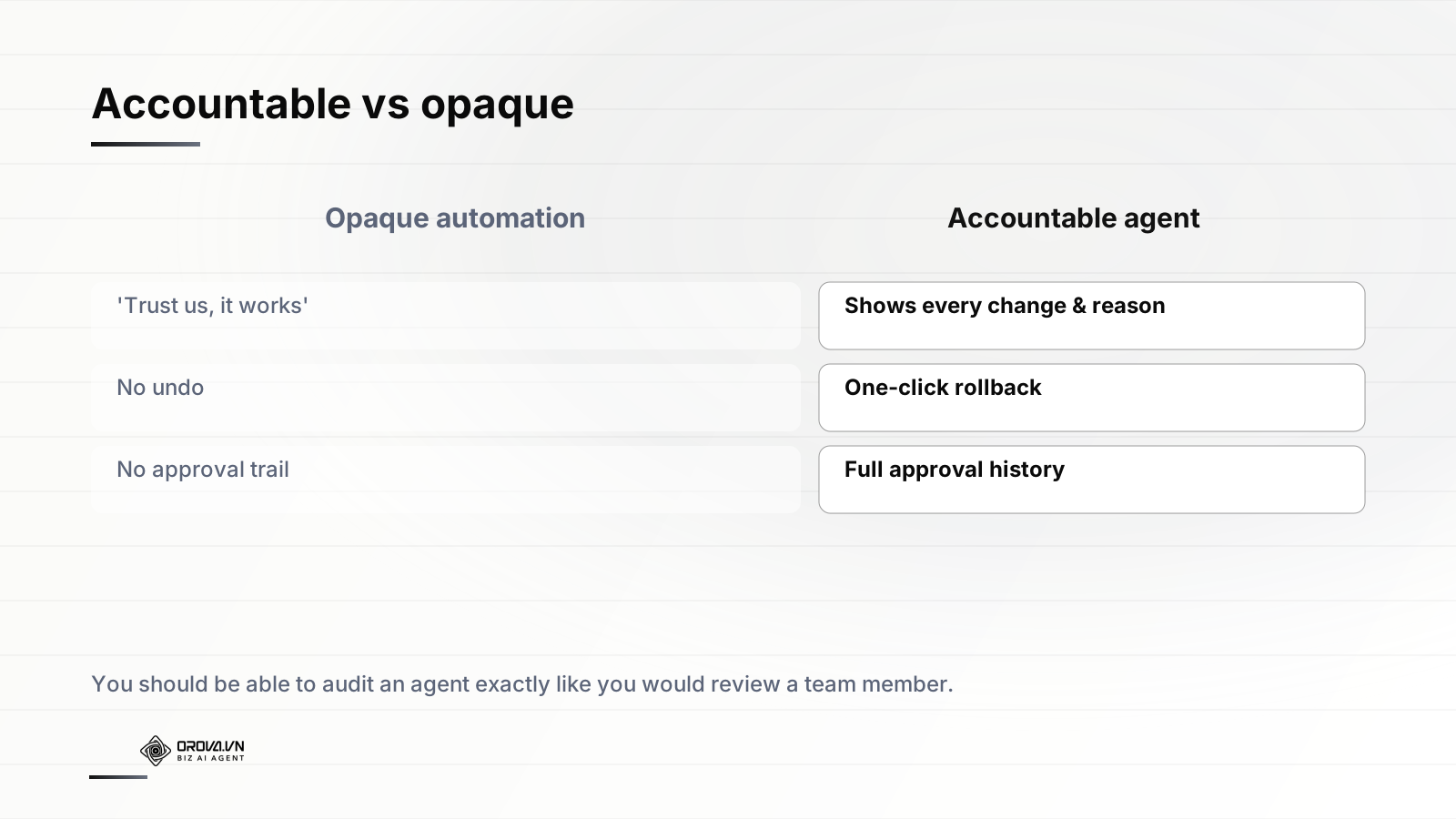
"Trust us, it works"
The biggest red flag is a system that asks for faith instead of showing its work. If the answer to "what did you change and why" is a marketing claim about results rather than a per-action record, the accountability isn't there. Opaque automation hides behind aggregate outcomes — "we improved your ROAS by 23%" — precisely because it can't or won't show the individual decisions. A real ROAS improvement is fine; the inability to break it down into auditable changes is not.
No reasons, just actions
A feed that says "budget optimized," "bids adjusted," "audience refined" with no underlying rationale is a notification system, not an audit trail. You can't supervise actions you can't evaluate, and you can't evaluate actions whose justification is hidden. If the reason field is empty, generic, or always the same, treat the autonomy as untrustworthy regardless of how good the results look this week.
No undo
If reversing a change means manually reconstructing the prior state, the system isn't built for the reality that some decisions will be wrong. The absence of reliable rollback tells you the builders optimized for the happy path and never seriously planned for their own mistakes — which is exactly when you need the safety net most.
No approval trail
If you can't tell which changes were reviewed by a person and which the system made on its own, you've lost the accountability loop. The most dangerous version of this is a system where the autonomy level is invisible — you think a human is in the loop, but the tool has quietly been acting alone, or vice versa. The autonomy setting and its history should be as auditable as the changes themselves.
Logs that disappear or can't be exported
An audit trail that only exists inside a dashboard, that gets pruned after 30 days, or that you can't export is half a trail. You may need records months later for a budget review or a client report. If the history is short-lived or locked in, plan around it — or pick something else.
Permissions that can't be scoped
If a system is all-or-nothing — either it can do everything or you turn it off — it can't grow with your trust. The lack of granular permissions usually correlates with the lack of a granular log, because both come from the same design instinct: do a lot, explain a little. Look for the ability to define what the agent may touch, up to what magnitude, and what always requires a human.
Putting it together: a practical audit checklist
If you're evaluating or already running an AI ad agent, here's the concrete checklist I'd run through. None of these are aspirational — they're the table stakes for letting software move real money on your behalf.
- Completeness: Does every action appear in the log, or only some? A partial log is a misleading one.
- Before/after values: Can you see the prior and new value for every change, not just a description?
- Reasons: Is there a specific, data-tied rationale on each action you can independently verify?
- Approval history: Can you see what was approved, by whom, and when — and what ran autonomously?
- Outcomes: Does the system record what each change actually produced, not just what it intended?
- Rollback: Can you undo one action, or a batch, and restore the exact prior state? How fast?
- Scoped permissions: Can you set what the agent may do, within what bounds, and what always needs a human?
- Spend ceilings: Is there a hard cap the system cannot cross no matter what its logic says?
- Export: Can you get the full history out, for as long as you might need it?
Run that list against any system that wants access to your accounts. The ones built for accountability will pass it comfortably and probably volunteer features you didn't ask about. The ones built to impress will get vague somewhere around "reasons" or "rollback" — and that vagueness is your answer.
The deeper point is that auditability and autonomy aren't in tension. They enable each other. The more completely a system records and explains itself, the more comfortable you can be widening its authority — because you can always see what it's doing and undo what you don't like. A black box forces you to choose between control and convenience. A transparent agent lets you have both, growing the autonomy in step with the evidence that it's earned. That's not a compromise. It's the whole design goal.
If you want to see what accountable automation looks like in practice, that's exactly how Orova Ads is built. It's an AI agent that manages paid campaigns across Google, Meta, and TikTok — reading your data daily, recommending optimizations, and executing them on budgets, bids, on/off switches, and audiences — with human-in-the-loop approval and a complete audit log on every change. You see what changed, why, who approved it, and you can roll it back with one click. Try delegating the busywork without ever losing the trail.
Let the log do the watching for you
Doing this by hand means someone on your team has to check campaign changes every day, dig through dashboards trying to piece together what moved and why, and hope they catch a problem before it turns into thousands of dollars in wasted spend. That kind of manual watching is slow, easy to skip, and almost impossible to keep up once you're running more than one account.
Orova Ads is built to handle that oversight automatically — keeping a clear record of every change, requiring approval where it matters, and making it simple to roll back when something isn't working. If you'd rather spend your time on strategy instead of digging through logs, it's worth taking a look.
Related reading: What Is an AI Ads Agent? Autonomous Ad Management Explained
Orova Ads optimises campaigns for you
Connect Google, Meta and TikTok in one place. AI reads the numbers, proposes changes and executes under the rules you set.
Explore Orova Ads