
Don't Panic: A Decision Tree for Sudden Ranking Loss
Somewhere on the cover of a famous book, in large friendly letters, are the two most important words anyone ever wrote about losing search rankings: Don't Panic. The book was not about SEO. It was about the end of the world. But the advice transfers perfectly, because a sudden ranking loss feels, to the person experiencing it, like a small personal apocalypse — and the response it triggers is exactly as useful as flailing your arms while the planet is demolished.
So this is a decision tree for the moment your rankings fall off a shelf. It is written with jokes, because panic hates jokes, and a calm mind is genuinely your best diagnostic tool. But underneath the jokes is a real, ordered procedure. Follow it and you will diagnose the problem like a professional. Ignore it and you will diagnose it like a person setting fire to their own house to deal with a wasp.
First, accept that you will want to do something stupid
The most honest thing I can tell you about ranking loss is that your brain, the very instant it sees the drop, will produce an urgent and confident suggestion. It will say: do something. Now. Anything.
This suggestion is not your friend. This is the same part of your brain that, in our ancestral past, kept us alive by reacting to rustling bushes before thinking — and it is spectacularly miscalibrated for spreadsheets. There is no tiger in your Search Console. There is a number that got smaller. The correct response to a smaller number is to look at it carefully, not to sprint at it screaming.
So step zero of the decision tree is simply this: notice the urge to act, name it as panic, and then deliberately do nothing for one hour except gather information. One hour. Your rankings, having already fallen, are not going to fall extra because you spent sixty minutes being a calm and competent adult. They will, however, fall considerably further if you spend those sixty minutes "fixing" things at random.
Branch one: "Did the traffic actually drop, or did you just look at a Monday?"
Welcome to the first fork in the tree, and the one that quietly resolves an enormous number of "emergencies" before they get going.
A surprising amount of search traffic is, for entirely innocent reasons, lumpy. Many websites are simply busier on weekdays than weekends, because their audience has a job and on Saturday that audience is doing literally anything other than reading about your subject. So if you are looking at a dashboard on Monday morning and recoiling in horror at the weekend's "collapse," congratulations: you have discovered that Saturday exists. This is not an algorithm update. This is the calendar.
The fix here is to compare like with like. Look at this Tuesday against last Tuesday, not this Sunday against last Wednesday. And while you are at it, make sure you are not staring at today — a half-finished day always looks like a catastrophe, because it is, definitionally, missing most of its hours. If your "drop" vanishes the moment you compare proper, complete, equivalent days, then the tree ends here, you may close the laptop, and we shall never speak of this again.
Branch two: "Does anything else in the universe agree with you?"
Suppose the drop survives the calendar check. It is on real, completed, fairly-compared days. The line is genuinely lower. Before you escalate to full crisis mode, the tree asks you a deceptively simple question: does any second instrument agree?
You have, at minimum, three witnesses available. Your analytics tool. Google Search Console. And your raw server logs. If your analytics is wailing about a one-third drop, but Search Console reports clicks and impressions calmly holding steady, then you do not have a ranking problem — you have a measurement problem, and a measurement problem is, frankly, the good outcome. It means your business is completely fine and your thermometer is merely broken.
This branch matters because a single dashboard is a witness, not a verdict. Acting on one unconfirmed source is how teams spend a week heroically diagnosing a drop that, it later transpires, never happened — because a developer touched a tracking tag and nobody thought to ask. Get a second witness. If the witnesses disagree, you are investigating a tracking bug, not the algorithm, and you should go and feel relieved.
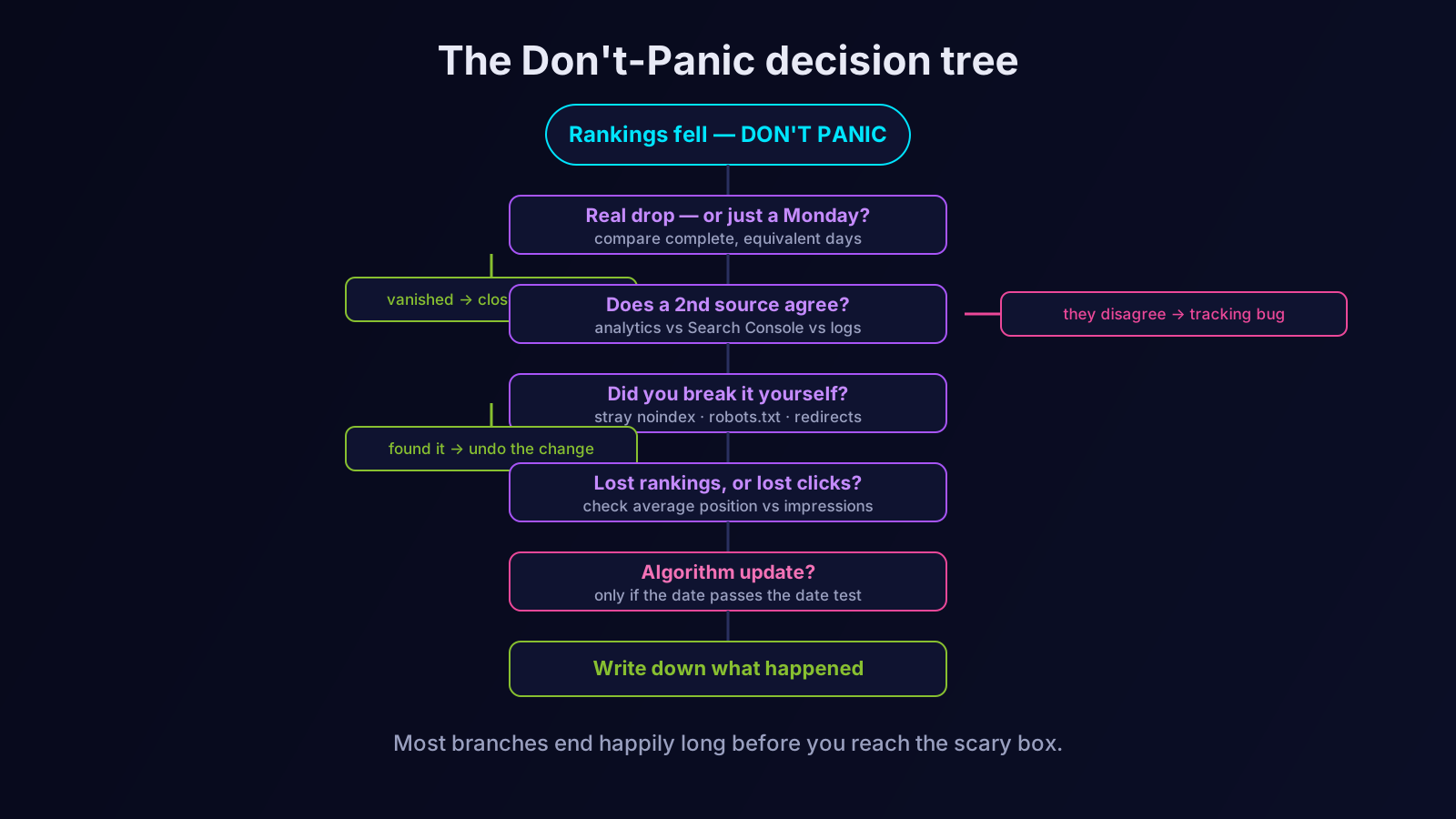
Branch three: "Did you, perhaps, break your own website?"
Two witnesses now agree that traffic really did fall. Excellent. The tree's next question is delivered gently, the way a friend asks whether you have checked that the appliance is plugged in: did you, by any chance, break it yourself?
This is not an insult. It is statistics. A genuinely large share of sudden traffic losses are self-inflicted, and the most common culprit is a thing called noindex — a small tag that politely instructs Google not to show a page. It belongs on staging sites. It absolutely does not belong on your live site. And yet, with the grim regularity of a sitcom plot, it gets pushed to production anyway, where it works exactly as designed and quietly evicts your pages from the search results.
So this branch is a checklist of self-sabotage. Did a deployment ship recently? Did your robots.txt change and start blocking a directory? Did the redirects from a recent migration get set up incompletely? Did a canonical tag start pointing every page at the homepage? Did a firewall or bot-protection rule begin, with tremendous diligence, blocking Googlebot itself? The good news about self-inflicted wounds is that they are the cheapest to fix — you simply undo the thing. The bad news is the brief, character-building moment of realising the thing was you. This is also, decisively, why your team needs a shared change log: so this branch takes two minutes instead of a tearful afternoon of interviewing colleagues.
Branch four: "Did you lose rankings, or did you lose clicks?"
The technical layer is clean. Nothing was unplugged. The tree now asks a question that sounds like wordplay but is actually the difference between two completely different problems: did you lose rankings, or did you lose clicks?
These are not the same, and confusing them will send you off treating the wrong illness entirely. Losing rankings means your pages genuinely slid down the results — position three became position nine — and the clicks loyally followed them into the gloom. Losing clicks means your pages held their positions perfectly, but fewer people clicked anyway, because the search results page rearranged the furniture around you: an AI-generated answer moved in upstairs, a new pack of features elbowed the classic results downward, the whole neighbourhood changed while your house stayed exactly where it was.
Search Console settles the argument. If average position got worse, you have a true ranking problem and the question becomes why you fell. If average position is unchanged but clicks dropped while impressions held flat, you have a click-through problem, and the question becomes what changed on the results page. Same falling line, two unrelated diagnoses, two unrelated treatments. Reading the wrong one is like taking cough medicine for a broken ankle.
Branch five: the box marked "algorithm update"
And now, at last, we reach the box everyone wanted to open first. It is at the bottom of the tree on purpose. It is the search industry's comfort blanket — vague, external, nobody's fault — and precisely because it is so comfortable, it gets grabbed far too early and far too often.
The tree only lets you into this box if you pass one test. Find the exact date your traffic fell. Now check whether a confirmed search algorithm update was rolling out on or around that date. If your drop lands neatly inside a known update window: fine, the box is yours, this is a legitimate algorithmic event. If your drop happened on an ordinary date with no update within shouting distance, then "it was probably an update" is not a diagnosis. It is a shrug wearing a lab coat.
And even if you do legitimately enter this box, brace yourself, because there is no big red UNDO button inside it. An algorithm update is not a thing you reverse; it is feedback. It re-weighted what search rewards, and recovery means understanding the new standard — usually more genuine helpfulness and demonstrated expertise — and then actually clearing it, over months. It is the slowest, least satisfying box in the whole tree, which is one more reason it should never, ever be the first one you open.
A short word on the towel, and why preparation beats heroics
The same famous book that gave us "Don't Panic" also insists, at length, that the most useful thing any interstellar traveller can carry is a towel — not because the towel has magical properties, but because anyone who can lay hands on a towel at the critical moment is obviously someone who has their affairs in order. The towel is a stand-in for preparedness. And preparedness, it turns out, is the entire difference between a ranking loss that is a bad afternoon and a ranking loss that is a bad fortnight.
Here is the unglamorous truth the decision tree quietly depends on. Every branch is faster, calmer, and more reliable if you did some boring work before the drop ever happened. The "did you break it yourself" branch takes two minutes instead of a tearful afternoon — but only if you already keep a shared, dated change log of deployments, content edits, and configuration changes. The "does a second source agree" branch is instant — but only if Search Console and your server logs are already set up, already trusted, already something you know how to read. The "was it an algorithm update" branch is decisive — but only if you have access to a reliable record of confirmed update dates to test against.
None of that preparation can be done in the middle of a panic. You cannot retroactively write a change log for the deployment you cannot remember. You cannot calmly learn to read a tool for the first time while your stomach is somewhere near your shoes. The work that makes the decision tree fast is work done on an ordinary, boring Tuesday when nothing is wrong — which is, of course, exactly when nobody feels like doing it.
So treat this as the towel clause. Before the next drop — and there will be a next drop — make sure your instruments are connected and trusted, your change log exists and is actually filled in, and at least one teammate other than you knows how to walk the tree. The heroic all-nighter during a crisis gets the stories told about it. The quiet hour of preparation beforehand is what actually saves you. One of those is fun to talk about. The other one works.
The end of the tree: write down what happened
Whichever branch you ended on — calendar quirk, tracking bug, self-inflicted noindex, click-through shift, or a genuine update — there is one final, deeply unglamorous step, and skipping it is why some teams re-live this exact panic every single quarter like a haunted house with a subscription model.
Write it down. The date, what you checked, what you ruled out, what it turned out to be, what you did, what happened next. This little document is what converts a terrifying experience into a calm one next time. Because there will be a next time — traffic is a wiggly line, not a straight one — and future-you will be enormously grateful to past-you for leaving a note that says, in effect, "relax, last time the sky also appeared to be falling, and it was a Tuesday and a broken tag."
Where an AI agent helps (and why panic is so hard to beat alone)
Here is the genuinely unfunny truth underneath all the jokes. The decision tree is not hard to understand. It is hard to follow, because it asks you to be slow, methodical, and calm at the exact moment your brain is sprinting around the room with its hair on fire. The tree is reasonable. Panic is not. That is an unfair fight.
Which is the entire case for letting an SEO AI agent walk the tree with you. Orova monitors your rankings and traffic continuously, so it spots a real drop early and — crucially — never panics, because it does not have a nervous system to hijack. It runs the branches automatically: comparing equivalent days, cross-checking analytics against Search Console, scanning for self-inflicted technical faults, separating ranking loss from click loss, and lining the drop date up against the known update calendar. By the time a human looks, the comforting boxes have already been ticked or ruled out, and you are looking at evidence instead of a void. To go further, see our guides on internal linking strategy and what an SEO AI agent changes.
Your rankings will, someday, fall off a shelf. It is not a question of if. When it happens, the planet will not actually be demolished, the tiger is not actually real, and the smaller number is not actually trying to hurt you. Take a breath. Open the tree. And whatever else you do — in large, friendly, slightly smug letters — Don't Panic.
Let an AI Agent handle your SEO
Orova plans, writes, optimizes, and tracks rankings on its own — you just read the results.
Try it free