
Should You Let AI Spend Your Ad Budget? A Framework for Trust and Guardrails
A marketing director I worked with once described the moment she turned on automated bidding for the first time as "watching a stranger drive my car while I sat in the back seat with the seatbelt off." The campaign was spending roughly $4,000 a day. The platform's algorithm could, in theory, double that overnight if it decided the conversion signal looked promising. She had no kill switch she trusted, no clear record of what the system had changed, and no way to undo a bad call before the credit card was hit. So she did what most cautious people do: she turned it back off and went back to managing bids by hand, losing sleep and time but keeping control.
That instinct is not irrational. It is the correct starting posture. Handing real money to software that acts on its own is a serious decision, and anyone who tells you to "just trust the AI" is either selling something or has never been the person whose name is on the budget. But the opposite reaction — refusing all automation and grinding through spreadsheets at midnight — is its own kind of failure. It is slower, more error-prone, and it does not scale. The useful question is not "should I trust AI with my ad budget, yes or no." It is "how do I build trust in stages, with hard limits, so that the autonomy I grant is always smaller than the autonomy I can safely lose?"
This article lays out a framework for exactly that. It is built around two ideas: a trust ladder you climb deliberately, and a set of guardrails that make every rung safe to stand on. By the end you should have a concrete way to decide what to delegate, what to keep, and how to tell whether an AI ads agent has actually earned more rope.
The legitimate fear, named precisely
Vague anxiety is hard to manage. To build a real framework, you have to name what you are actually afraid of. When practitioners say they do not trust AI with budget, they usually mean one or more of five distinct things, and each has a different remedy.
1. The runaway spend
The classic nightmare: the system misreads a signal, decides a campaign is a winner, and quietly scales spend far beyond what you intended. By the time you notice, you have burned a week's budget in a day on traffic that never converts. This is a fear about magnitude — not that the agent acts, but that it acts too big, too fast.
2. The silent change
Almost worse than a big mistake is a mistake you cannot see. You log in Monday and performance has cratered, but you have no idea what changed, when, or why. Was it a budget shift? A new audience? A pausing of your best ad set? Without a clear record, you are debugging blind. This is a fear about visibility.
3. The irreversible move
Some actions are easy to undo — a budget you can lower again in a click. Others are not. If an agent merges audiences, resets a learning phase, or deletes a campaign structure you spent months building, "undo" may not exist. This is a fear about reversibility.
4. The judgment gap
AI optimizes for what it can measure. It does not know your product launch is next Tuesday, that the cheap leads from one region never close, or that the boss has decreed the brand campaign stays on regardless of ROAS. This is a fear about context the model does not have.
5. The accountability vacuum
If the agent makes a bad call, who answers for it? "The AI did it" is not a sentence you can say to a CFO. This is a fear about ownership — and it is the one most often ignored by automation vendors, because it is uncomfortable.
Notice that none of these fears is solved by "better AI." A more accurate model still spends, still changes things, still lacks your context, still needs an owner. They are solved by structure — by the way you wire the relationship between human and agent. That is what the rest of this piece is about.
Graduated trust: the ladder
The single biggest mistake people make is treating the decision as binary: full manual or full autopilot. In reality, trust in any system — a new hire, a contractor, a piece of software — is earned in stages. You give a little, watch the results, and widen the mandate as evidence accumulates. An AI ads agent should be no different. There are four rungs on the ladder, and you should be able to point to exactly which one you are on for each account, each campaign, and even each type of action.
Rung 1: Advisory only
The agent reads your data every day, analyzes performance, and tells you what it would do — but does nothing on its own. It might say: "Campaign A's cost per acquisition has risen 40% over seven days while Campaign B is hitting target with budget to spare; I recommend shifting $300/day from A to B." You read it, you decide, you execute by hand.
This rung costs you nothing in risk and buys you two valuable things. First, you get a tireless analyst surfacing patterns you might miss. Second — and this is the part people skip — you get a trial period. Every recommendation the agent makes is a prediction you can score. After a few weeks of advisory output you will have a concrete record: when I followed its advice, did things improve? When I overrode it, was I right to? That track record is the evidence you need to climb higher. If you want a deeper treatment of how advisory and execution modes differ in practice, this companion piece on advisory versus auto-execute modes walks through the trade-offs side by side.
Rung 2: Approve every change
Now the agent prepares the actual change — not just a suggestion in prose, but a ready-to-execute action with the exact parameters filled in — and waits for your one-click approval. "Shift $300/day from Campaign A to Campaign B. Approve / Reject / Modify." You are still the decision-maker, but the friction is gone. You no longer have to translate advice into clicks; you just sign off.
This is the rung most teams underrate. It captures the overwhelming majority of the speed benefit while keeping a human in the loop on every single action. Approving twelve well-reasoned changes in two minutes is a fundamentally different experience from manually reconfiguring twelve campaigns over an hour — and your hand is still on every decision. For many accounts, this is a perfectly good permanent home. Climbing higher is optional, not mandatory.
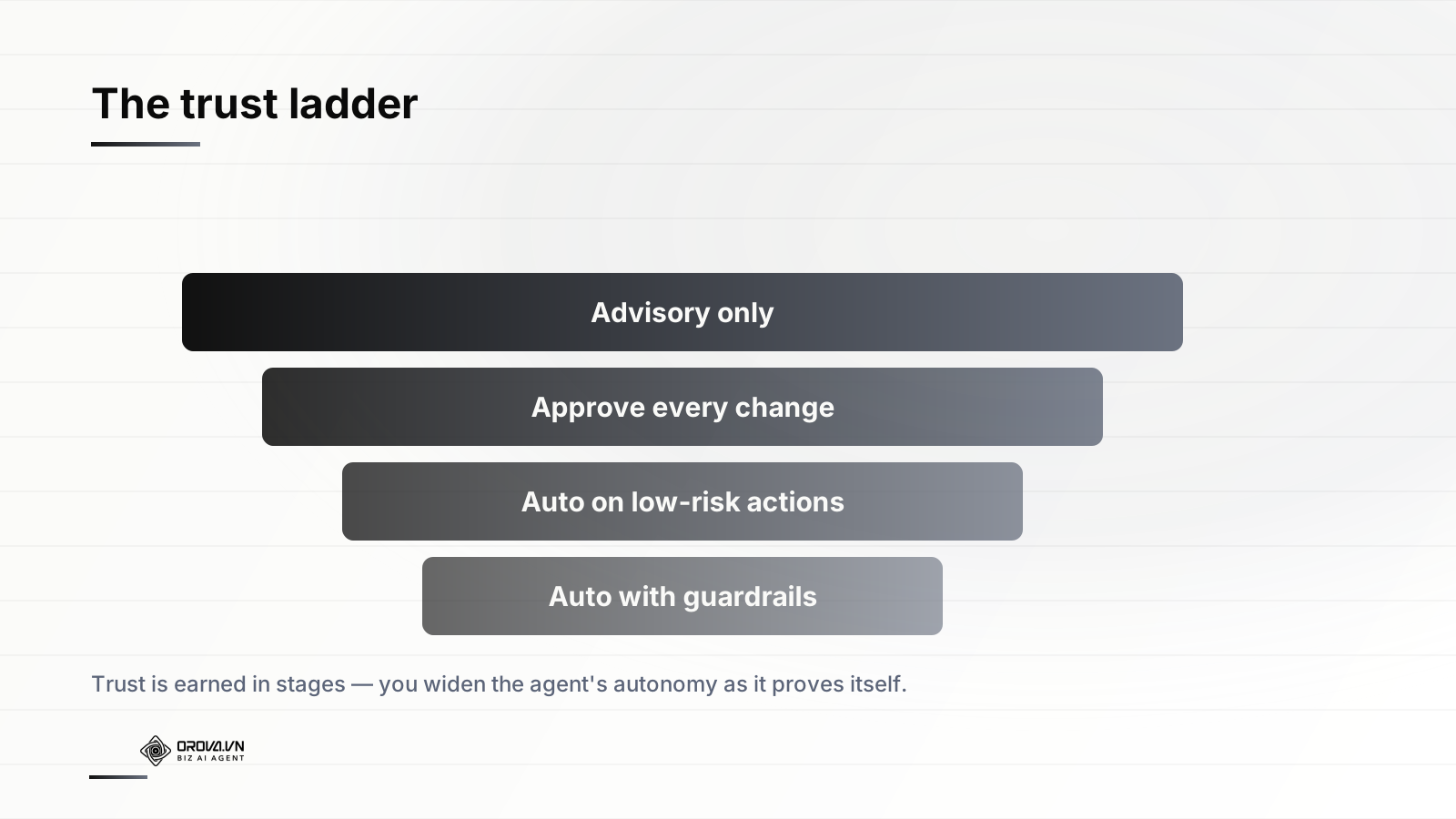
Rung 3: Auto on low-risk actions
Here you let the agent act without asking — but only on a carefully drawn list of actions where the downside is small and the reversibility is high. The key word is low-risk, and you define it explicitly. A reasonable starter list:
- Pausing a clearly failing ad — an ad with hundreds of clicks and zero conversions over a meaningful window. Pausing is instantly reversible, and the cost of a false positive is tiny.
- Small budget reallocations within a fixed total — moving spend between two campaigns you already approved, with no change to the overall daily cap.
- Bid adjustments inside a tight band — say, plus or minus 10% on a target CPA, never a wholesale strategy change.
- Pausing duplicate or overlapping ad sets that are cannibalizing each other.
Everything not on the list still routes back to you for approval. This is the crucial design move: autonomy is not a global switch, it is granted per action type. The agent earns the right to act alone on the boring, reversible, low-stakes stuff, which frees your attention for the decisions that actually require judgment.
Rung 4: Auto with guardrails
The top rung is broad autonomy — the agent manages day-to-day optimization across budgets, bids, on/off toggles, and audiences without per-action approval. But "broad" is not "unlimited." This rung only exists inside the guardrails described in the next section. The agent operates freely within a fenced yard whose walls it cannot move, and everything it does is logged and reversible. You are no longer approving each change; you are reviewing a daily digest and spot-checking the audit trail. You have moved from operator to supervisor.
Most mature accounts end up living at a blend of rungs 3 and 4 for routine work, with rung 2 reserved for sensitive moves. The point of the ladder is not to reach the top as fast as possible. It is to make every step a deliberate, evidence-backed decision rather than a leap of faith.
The guardrails that make autonomy safe
Climbing the ladder is only responsible if there is a net under it. The guardrails below are what turn "the AI can act on its own" from a terrifying sentence into a manageable one. Critically, these limits should be your limits, enforced by the system — not promises the agent makes, but hard constraints it physically cannot exceed.
Spend caps: the wall against runaway cost
This is the single most important guardrail and the direct answer to fear number one. You set hard ceilings the agent cannot cross under any circumstances:
- Daily spend cap per account — the absolute most that can be spent in 24 hours, regardless of how promising the signal looks.
- Per-campaign budget ceilings — so no single campaign can swallow the whole budget.
- Maximum total increase rate — a rule like "budget may not rise more than 20% in a single day" that prevents fast escalation even within the cap.
With these in place, the runaway-spend nightmare becomes mathematically impossible. The worst case is bounded and known in advance. You can sleep because the downside is a number you chose, not a number the machine might choose.
Per-change limits: small steps, not lurches
Even within the caps, you want to constrain the size of any individual move. A bid change limited to 15%, a budget shift limited to $200, an audience expansion limited to adjacent segments. This does two things. It keeps each action small enough that a mistake is cheap, and it forces the agent to make progress through many small, observable steps rather than a few dramatic ones. Small steps are easier to evaluate and easier to reverse — which feeds directly into the next two guardrails.
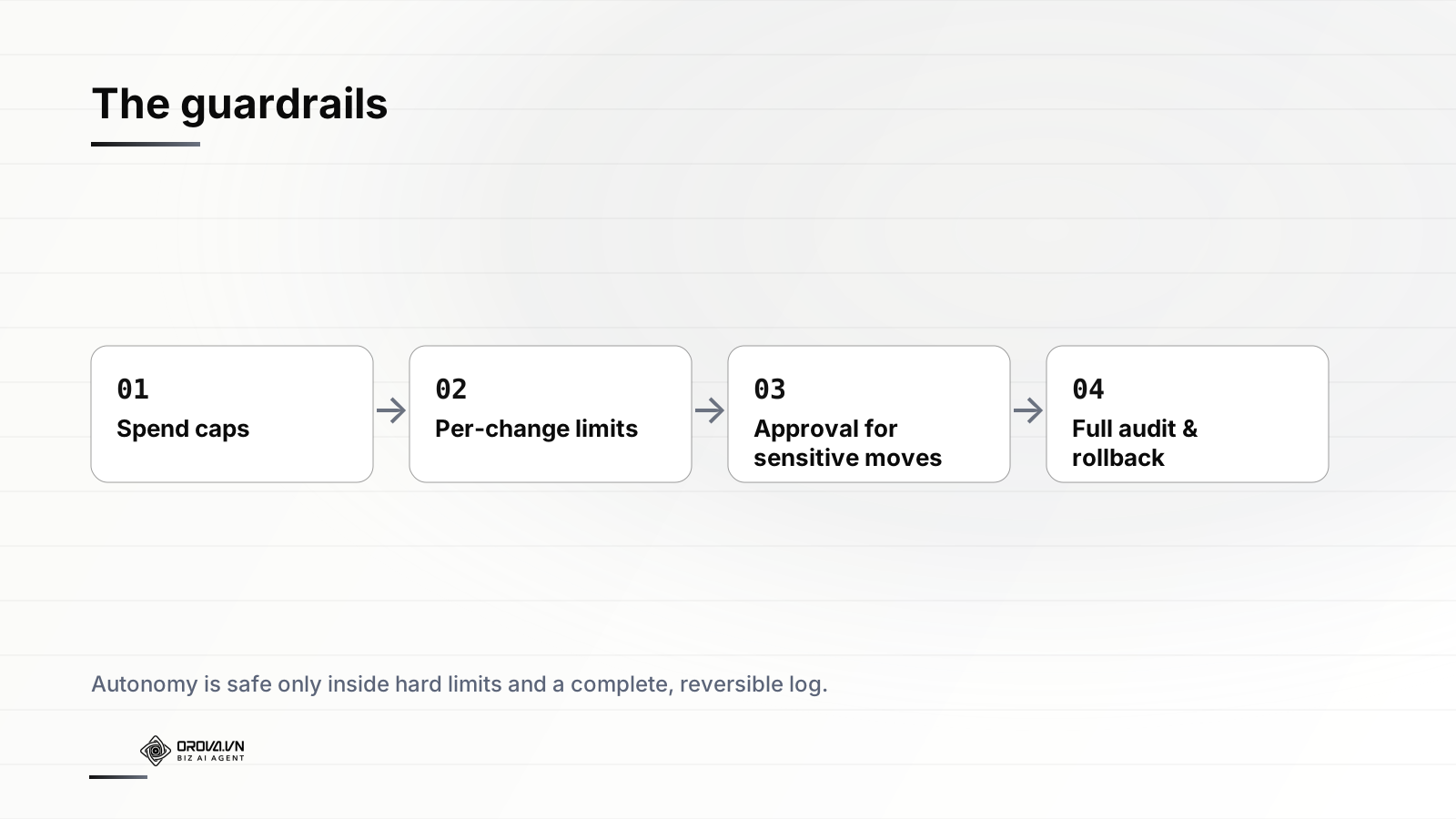
Allowlists and approval gates for sensitive moves
Some actions should never be automatic, no matter how high you climb. These get pulled out of the agent's autonomous scope and routed back to a human every time. A sensible "always ask" list:
- Pausing or deleting an entire campaign (as opposed to a single ad).
- Any action that resets a learning phase or rebuilds an audience from scratch.
- Spending changes above a defined threshold — anything large, regardless of direction.
- Structural edits: merging campaigns, changing conversion goals, altering attribution settings.
- Anything touching a campaign you have flagged as off-limits (the brand campaign the boss wants left alone, the seasonal launch you are hand-managing).
This is also where the judgment gap (fear number four) gets handled. The agent does not know your launch is Tuesday — but the approval gate gives you a moment to apply that context before a sensitive change goes through. The fix for missing context is not a smarter model; it is a well-placed human checkpoint.
Full audit trail and rollback: visibility and undo
This guardrail answers fears two and three at once. Every action the agent takes — automatic or approved — should be recorded in a complete, human-readable log: what changed, when, the before and after values, and the reason the agent gave. No silent changes, ever. When performance shifts, you do not debug blind; you open the log and read the story.
The audit trail also enables rollback. Because each change is recorded with its prior state, you can reverse a bad call cleanly — restore the previous budget, re-enable the paused ad, revert the bid. The combination of "I can see everything that happened" and "I can undo it" is what makes autonomy psychologically tolerable. The blast radius of any mistake is small, visible, and reversible.
The right mental model is not "trust the AI." It is "trust the system" — the agent plus the caps plus the logs plus the undo button. You are not betting on the software being perfect. You are designing an arrangement where its imperfections cannot hurt you much.
A maturity ladder for your own team
The trust ladder describes how much autonomy you grant. A separate, parallel progression describes how ready your operation is to grant it. Plenty of teams fail not because the agent is untrustworthy but because their own house is not in order. Here is a rough maturity path.
Level 0: Reactive and manual
You change things when something looks wrong, by hand, with no consistent rules. There is no documented definition of "good" performance, so there is nothing for an agent to optimize toward. Before automating anything, write down your targets: target CPA or ROAS by campaign, acceptable spend ranges, which campaigns are protected. An agent can only be as disciplined as the goals you give it.
Level 1: Rule-based and advisory
You have clear targets and you have an agent running in advisory mode (rung 1). You are reading its recommendations daily and scoring them. This is where you build the evidence base. Spend at least a few weeks here. The output of this stage is a simple, honest answer to: "How often was the agent right, and how big were the misses?"
Level 2: Supervised autonomy
The agent acts on low-risk actions automatically (rung 3) and routes everything else for approval (rung 2). Your guardrails are configured and tested. You review a daily digest rather than every change. Most of your time goes to the genuinely strategic decisions the agent escalates to you. This is a healthy, sustainable steady state for the majority of accounts.
Level 3: Governed autonomy at scale
You run many accounts or large budgets. The agent operates broadly within tight guardrails (rung 4), and your role is governance: setting policy, auditing the logs, adjusting caps as conditions change, and handling exceptions. You manage the system, not the individual clicks. Reaching this level is less about the AI getting smarter and more about your guardrails and review processes being mature enough to trust at volume.
The honest truth is that most teams should aim for Level 2 and stay there happily. Level 3 is for operations whose scale genuinely demands it. There is no prize for maximum autonomy; the prize is the right amount of autonomy for your risk tolerance and your scale.
How to actually run the experiment
Frameworks are easy to nod along to and hard to apply. Here is a concrete, low-risk way to test whether you can trust an AI ads agent with your specific budget — a four-week protocol any cautious operator can run.
- Week 1 — Advisory, no action. Connect the agent in read-only advisory mode on one account. Each day, log its recommendations and your reaction. Do not act on them through the agent; if you want to make a change, make it yourself. The goal is purely to observe its reasoning quality.
- Week 2 — Approve-each on a single campaign. Pick one non-critical campaign. Let the agent prepare changes for it and approve them one by one. Keep the rest of the account manual. Watch whether its prepared changes match what you would have done.
- Week 3 — Auto on one or two low-risk action types. Enable automatic pausing of clearly-failing ads and small intra-budget reallocations, with strict caps. Everything else still routes to you. Check the audit log daily; confirm every automatic action was sensible and that you could have reversed it.
- Week 4 — Review and decide. Pull four weeks of data. Compare performance, count the agent's hits and misses, and read back through the audit trail. Now you are making a trust decision based on evidence from your account, not a vendor's promise.
By the end of this you will know, concretely, whether to climb higher, stay put, or pull back. And because every step was bounded by caps and reversible by design, the cost of running the experiment is small even if the agent turns out to be mediocre. That asymmetry — large potential upside, tightly bounded downside — is exactly what a good trust framework manufactures.
Common objections, answered
"What if the agent and I disagree?"
Good — disagreement is information. In advisory and approve-each modes, your override is the mechanism. Over time, a well-built agent should learn from your overrides and your protected-campaign flags. The relationship is not master-and-servant; it is closer to a sharp analyst whose recommendations you weigh against context they cannot see. Keep the context-dependent calls; delegate the data-dependent ones.
"Doesn't keeping a human in the loop defeat the point?"
No — it defeats only the fantasy that you can disappear entirely. The point of automation here is not to remove humans; it is to remove drudgery and reaction time. Approving a batch of well-prepared changes in minutes, or reviewing a digest instead of fifty dashboards, is an enormous gain even with a human firmly in the loop. Full unattended autonomy is a destination some accounts reach and many never need.
"What about accountability?"
This is why the audit trail matters beyond debugging. When every action is logged with its reason, before/after values, and who or what initiated it, accountability is preserved. The human who set the policy and approved the autonomy is the owner; the log is the record of how that policy played out. "The AI did it" becomes "we authorized the agent to do X within these limits, here is the complete record" — a sentence you can actually defend.
The bottom line
Should you let AI spend your ad budget? The answer is neither blind faith nor blanket refusal. It is graduated trust inside hard limits. Start advisory and score the recommendations. Move to approving each change and capture most of the speed with all of the control. Graduate to automatic action on low-risk, reversible moves once the evidence supports it. And do all of it inside spend caps, per-change limits, approval gates for sensitive moves, and a complete audit trail with rollback. Build it that way and the question stops being scary, because the autonomy you grant is always smaller than the autonomy you can afford to lose.
The marketing director from the opening eventually went back to automation — but on her terms this time, with caps she set and a log she could read. The stranger was still driving, but now she could see the speedometer, the route, and the brake pedal was hers. That is the whole game.
If you want an agent built around exactly this philosophy — one that reads your Google, Meta, and TikTok data every day, recommends and executes optimizations across budgets, bids, on/off toggles, and audiences, but always inside human-in-the-loop approval, hard guardrails, and a full audit trail you can roll back — take a look at Orova Ads. It is designed to climb the trust ladder with you, one verified rung at a time.
Run your business with AI Agents
Orova is the always-on Biz AI Agent — it plans, runs, and optimizes the work for you. Save time, unlock productivity.
Try it free