
Trust & Control of Autonomous Spend
The first time a marketing manager watches software move real money without asking, the feeling is rarely relief. It is a low, specific dread. You set up an automated rule, you go to lunch, and you come back to find that a campaign you barely remember has burned through 40% of the monthly budget on a placement nobody vetted. That single experience teaches a lesson that no vendor demo can undo: autonomy without control is not efficiency, it is exposure. And it is exactly why most teams who could benefit enormously from automating their paid media instead leave the machine on a tight leash, second-guessing every move, until the automation delivers neither speed nor peace of mind.
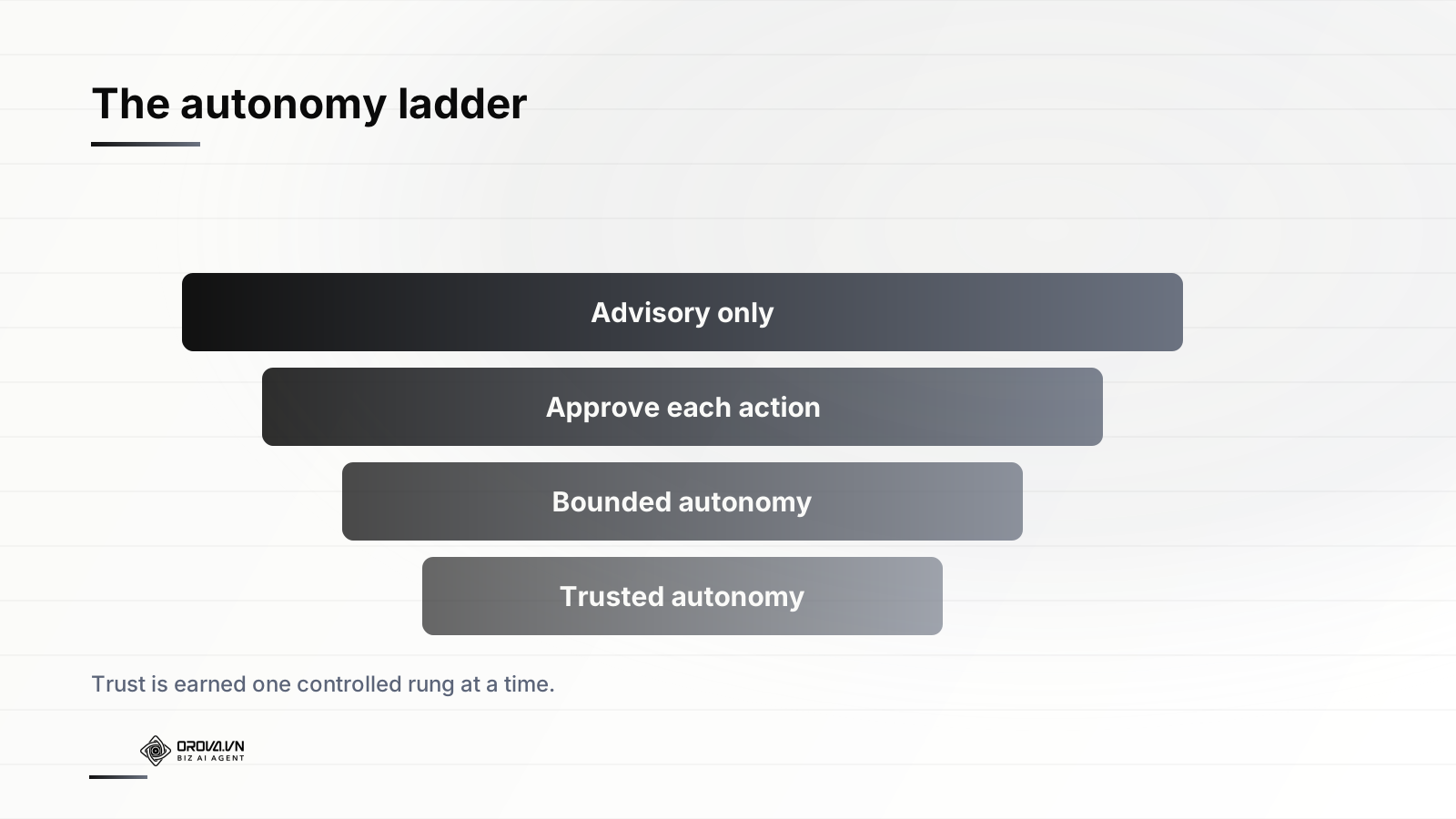
Autonomous ad spend control is the discipline of letting software make and execute budget, bid, and targeting decisions while keeping the outcomes inside boundaries you defined and can prove. The word that matters is earned. You do not hand a new media buyer the company credit card and a blank approval threshold on day one. You give them a small budget, watch the decisions, expand the mandate as the track record accumulates, and keep the receipts. The same logic applies to an AI agent that manages campaigns. This article lays out a practical framework for doing exactly that: a trust ladder with four rungs, the guardrails that make each rung safe, the audit trail that makes trust verifiable, and the escalation paths that keep a human in the loop where it counts.
Why "trust the AI" is the wrong frame
The instinct to frame this as a question of trusting the AI is the first mistake. Trust, in everyday speech, means relying on something whose behavior you cannot fully verify. That is a reasonable definition for people, where you genuinely cannot audit every thought. It is the wrong definition for software that operates on accounts where every action is logged, reversible, and bounded by limits you control. You do not need to trust the agent in the leap-of-faith sense. You need to trust the control system around it.
This reframing changes everything about how you adopt automation. If the question is "do I trust the AI to be smart enough," the answer is always anxious and binary, and you will oscillate between over-delegating and yanking it back. If the question is "are my guardrails, logs, and rollback good enough that a bad decision cannot hurt me much and cannot hide," then trust becomes incremental and testable. You expand autonomy not because you feel braver but because the control mechanisms have proven they catch problems.
Consider the parallel with self-driving features in cars. Nobody sensible says "I trust the car." They say "I trust adaptive cruise control on the highway in clear weather, with my hands near the wheel, because I have seen it behave for 3,000 miles and I can override it in half a second." The trust is conditional, domain-specific, and backed by an override. Autonomous ad spend deserves the same posture. The goal of the framework below is to make that posture concrete.
The cost of getting the frame wrong
Teams that skip this thinking tend to fail in one of two directions. The first group never grants meaningful autonomy at all. They run the automation in advisory mode forever, approving every suggestion by hand, and conclude after three months that "the AI doesn't really save time." Of course it doesn't, they never let it act. The second group flips the switch to full autonomy on a large account because a dashboard looked impressive in a sales call, then discovers a week later that an aggressive bid strategy chased expensive conversions that never closed into revenue. Both outcomes are avoidable. Both come from treating autonomy as a single on/off decision instead of a ladder you climb deliberately.
The autonomy ladder: four rungs
The core of the framework is a ladder. Each rung grants the agent more independence, and each rung is tied to specific guardrails, logging requirements, and escalation rules. You start at the bottom for any new account, campaign type, or capability, and you climb only when the rung below has earned it. Importantly, different parts of your account can sit on different rungs at the same time. A mature, stable search campaign might run at bounded autonomy while a freshly launched product line sits in approval-required mode.
Rung 1 — Advisory only
At the bottom rung the agent observes, analyzes, and recommends, but executes nothing. It reads the account every day, identifies the campaigns wasting budget, flags the bid adjustments it would make, and presents them with reasoning. You read the recommendations and act, or ignore them, by hand.
This rung looks like it wastes the automation's potential, and over the long run it does. But it has a real job: it is your calibration period. Advisory mode lets you compare what the agent would have done against what you actually did, with no money at risk. After two or three weeks you will know whether its recommendations are sharp or noisy, whether it understands your business context, and where its blind spots are. If you would have followed 80% of its advice anyway, you have evidence to climb the ladder. If you would have followed 30%, you have learned something important before any harm was possible.
- Guardrail: none needed, nothing executes.
- Logging: record every recommendation and your decision to accept or reject it. This log is the evidence for promotion.
- Escalation: not applicable. Everything is already in your hands.
Rung 2 — Approve each action
On the second rung the agent proposes specific, ready-to-execute actions, and you click approve before any of them happen. The difference from advisory mode is subtle but meaningful: the action is fully prepared. The agent has already worked out that it wants to pause ad group 7, shift 15% of budget from campaign A to campaign C, and raise the target ROAS on the branded set. You are not designing the change, you are ratifying it. This is far faster than advisory mode because the cognitive work is done, and you can approve a batch of ten changes in the time it would take you to design one.
This rung is where most teams discover how much of their manual work was reactive judgment they were happy to delegate. Approving a sensible pause on a campaign that has spent $200 with zero conversions feels effortless. After a few weeks of clicking approve on substantially every proposal, the question naturally arises: why am I clicking approve on the obvious ones? That question is the signal you are ready for bounded autonomy.
- Guardrail: the proposal preview must show the exact before/after state and the projected spend impact so approval is informed, not blind.
- Logging: who approved what, when, and the agent's stated reason. This builds the accountability record.
- Escalation: any proposal above a spend threshold you set gets a more prominent flag, or a second approver, before it can be ratified.
Rung 3 — Bounded autonomy
This is the rung where the framework earns its keep. Under bounded autonomy the agent executes routine, low-risk actions on its own, within hard limits, and only escalates the decisions that fall outside those limits. The boundaries are the whole point. The agent can shift up to 20% of a campaign's daily budget without asking. It can pause an ad set that has spent more than your defined waste threshold with no conversions. It can raise or lower a bid within a defined band. Cross any boundary and it stops and asks.
The art here is drawing the boundaries to match your actual risk tolerance. A boundary that is too tight collapses the rung back into approval mode, because everything interesting requires a human. A boundary that is too loose recreates the dread we started with. The right boundaries are specific and quantitative: a maximum daily budget change as a percentage, a hard ceiling on total daily spend per account, a list of action types the agent may take unsupervised, and a list it may only propose. The decision of whether to grant this kind of autonomy at all deserves its own careful thought, and we have written separately about whether you should let AI spend your budget and what to weigh before you do.
Bounded autonomy is also where time savings become real. The agent handles the dozens of small, defensible optimizations that used to eat your mornings, pausing dead ad sets, nudging budgets toward what is converting, trimming bids on placements that overpay, while reserving your attention for the strategic calls. A practitioner who reaches this rung typically reports spending less time in the campaign manager and more time on offer, creative, and landing-page decisions that software cannot make.
- Guardrail: hard, numeric limits on spend change magnitude, total daily spend, and the allowed action set. These are enforced by the system, not by the agent's discretion.
- Logging: every autonomous action logged in real time with its trigger, its magnitude, and its reasoning, reviewable after the fact.
- Escalation: anything outside the bounds is automatically demoted to a proposal that waits for human approval. Unusual patterns, a spend spike, a sudden CPA jump, trigger an alert.
Rung 4 — Trusted autonomy
The top rung widens the boundaries substantially for accounts and capabilities that have earned a long, clean track record. The agent operates with broad latitude, the human reviews on a weekly cadence rather than per-action, and the relationship resembles managing a senior media buyer you have worked with for years: you set objectives and constraints, you check the results, and you intervene by exception.
Trusted autonomy is not "no oversight." It is oversight that has shifted from per-decision to periodic, justified by months of evidence that the agent's decisions inside the bounds were consistently good. The guardrails do not disappear, they loosen. The audit log does not disappear, it becomes your weekly review document. And critically, the override never disappears. Even at the top rung, a human can pause everything in one click, and any single action can be rolled back. The day you find yourself unable to undo what the automation did is the day you have left the framework entirely.
- Guardrail: wider limits, but still finite and still enforced. A ceiling on catastrophic single actions remains absolute.
- Logging: the same complete log, now consumed as a weekly performance and decision review.
- Escalation: reserved for genuinely anomalous situations, defined narrowly so the channel stays meaningful.
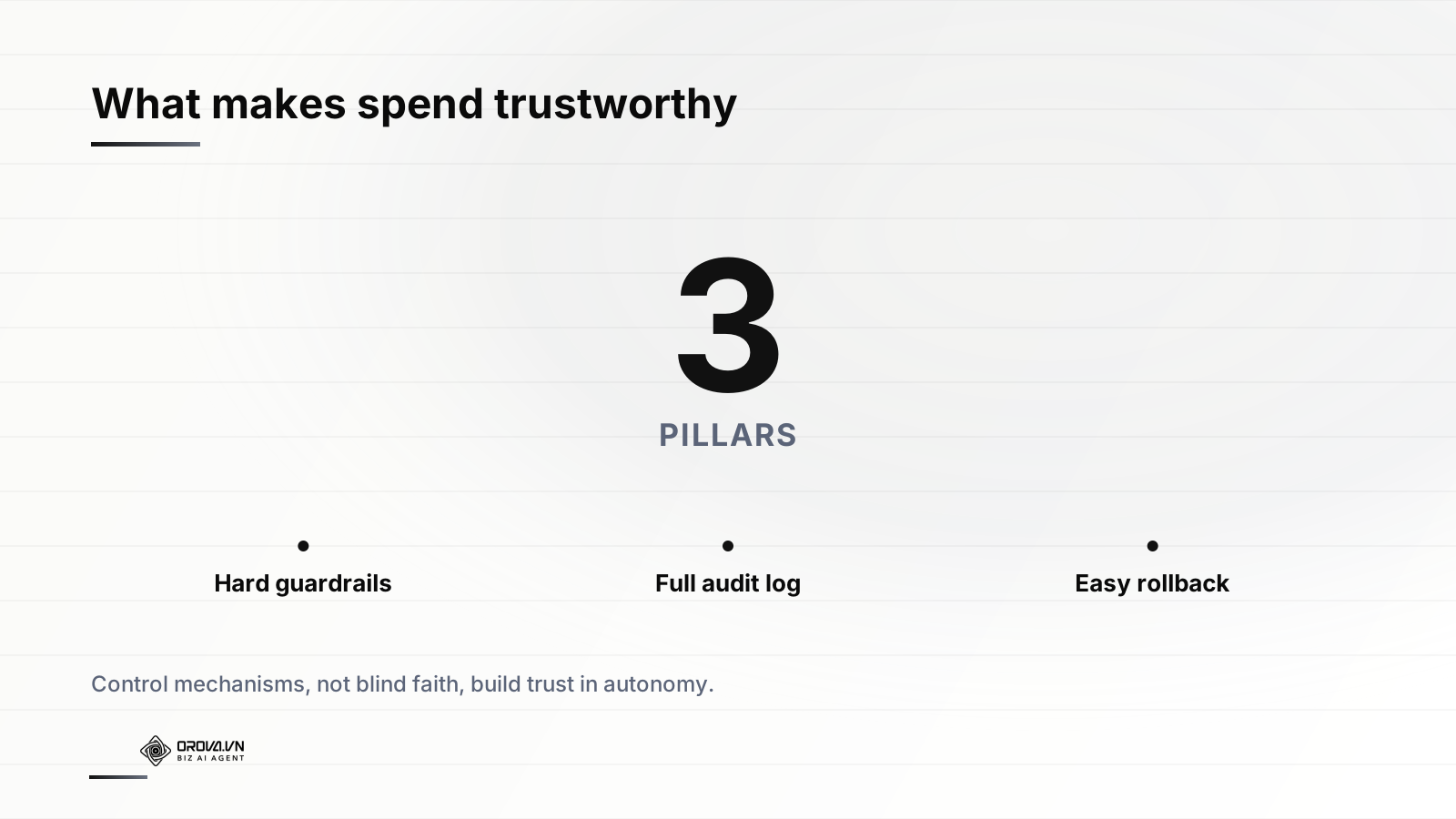
The three pillars that make spend trustworthy
Climbing the ladder is only safe if three control mechanisms sit underneath every rung. These are not features to admire in a feature list, they are the load-bearing structure. Take any one away and the whole framework becomes blind faith dressed up as process. The three pillars are hard guardrails, a full audit log, and easy rollback.
Pillar one — Hard guardrails
Guardrails are the limits the agent physically cannot exceed, enforced by the system rather than by the agent's judgment. The distinction matters enormously. A guideline the agent is asked to follow can be misread, reasoned around, or simply ignored when the model produces an odd output. A hard guardrail is a wall: the agent can request a budget increase, but if the increase would breach the configured ceiling, the request is rejected before it ever reaches the ad platform's API.
Good guardrails are quantitative and unambiguous. Vague instructions like "don't spend too aggressively" are not guardrails, they are wishes. Real guardrails read like this:
- No single budget change may exceed a set percentage of the current daily budget.
- Total daily spend across the account may not exceed a fixed ceiling, regardless of what individual campaigns request.
- Certain action types, deleting campaigns, changing conversion goals, launching new campaigns, are never autonomous and always require approval.
- Bid adjustments are confined to a defined band around the current bid.
- If the conversion-tracking signal degrades or goes missing, autonomous spend changes pause automatically rather than flying blind.
The most important property of a guardrail is that it fails safe. When the agent encounters a situation outside its limits, the default is to stop and ask, never to guess and proceed. A guardrail that lets ambiguous cases through is not a guardrail.
Pillar two — A full audit log
If guardrails prevent disaster, the audit log makes trust verifiable rather than emotional. Every action the agent takes or proposes should be recorded with enough context that anyone can reconstruct exactly what happened and why, weeks later, without asking the person who set it up. A usable log entry answers five questions: what changed, when, what the state was before and after, what triggered the change, and what reasoning the agent gave.
The audit log does three distinct jobs. First, it is the evidence base for climbing the ladder, you promote an account to the next rung because the log shows a clean record, not because you have a good feeling. Second, it is your debugging tool when results dip, you read the log to find which decisions preceded the dip rather than guessing. Third, it is accountability: when a client, a finance team, or your own manager asks why the budget moved, you have an answer with a timestamp instead of a shrug. Automation without a log forces you to trust blindly; automation with a thorough log lets you trust because you can check.
The difference between automation you fear and automation you rely on is almost never the intelligence of the system. It is whether you can answer, at any moment, the question "what did it just do, and can I undo it?"
Pillar three — Easy rollback
The third pillar is the one that converts anxiety into confidence faster than any other: the ability to undo. Knowing that any action can be reversed, and that everything can be paused at once, changes your entire relationship with the automation. A mistake stops being a catastrophe and becomes a momentary inconvenience you correct in seconds. This is why a reliable override is the precondition for granting autonomy, not a nice-to-have you add later.
Rollback operates at two levels. At the granular level, any single change should be reversible to its prior state, the budget that was raised can be lowered back, the ad set that was paused can be resumed. At the global level, there must be a single, unmistakable control that halts all autonomous activity immediately, the equivalent of a kill switch. The global pause is the control you hope never to need and want available the instant you do, when a tracking glitch, a platform outage, or a business event makes you want everything to stop while you assess.
Crucially, rollback must remain available at every rung, including the highest. The moment automation reaches a state it cannot exit, it has stopped being a tool you control and become a risk you host. The framework holds together only as long as the human at the top of it can always, at any rung, take the wheel back.
Matching the rungs to the pillars
The ladder and the pillars are not two separate ideas, they interlock. Each rung you climb depends on the pillars being correspondingly stronger. Thinking through that mapping explicitly is what keeps a rollout disciplined.
- Advisory only needs almost no guardrails because nothing executes, but it needs disciplined logging of recommendations and your responses, that log is what justifies the first promotion.
- Approve each action needs informative proposal previews and an approval record. The guardrail here is the human click itself, the log captures who approved what.
- Bounded autonomy is where hard guardrails become non-negotiable, because the agent now acts alone inside them. Real-time logging and automatic escalation of out-of-bounds cases are what make the rung safe.
- Trusted autonomy relies on the maturity of all three pillars, wider but still enforced guardrails, a log mature enough to support weekly review instead of per-action checking, and an override you have tested and trust absolutely.
Read top to bottom, this is also a diagnostic. If you are tempted to grant bounded autonomy but you cannot point to your hard numeric guardrails, you are not ready, build the guardrails first. If you want trusted autonomy but your log is thin, tighten the logging before you widen the latitude. The pillars set the ceiling on how far up the ladder you can responsibly climb.
How to actually run the climb
Frameworks are easy to nod along to and hard to execute. Here is a concrete sequence that has worked for teams moving from manual management to autonomous spend without a scary week in the middle.
Start narrow, not broad
Do not put your entire account on the ladder at once. Pick one campaign or one campaign type, ideally a stable, well-understood one with predictable behavior, and run the whole climb there first. A search campaign on established branded terms is a good candidate: the patterns are clear, the downside of a mistake is small, and you will quickly see whether the agent's judgment matches yours. Save the volatile, high-spend prospecting campaigns for after you have a clean track record on the easy ones.
Set guardrails before you grant autonomy, not after
The order is not negotiable. Define your numeric limits, daily spend ceiling, maximum change percentage, allowed action set, before you move a campaign to bounded autonomy. Setting guardrails after the agent is already acting is like installing a fence after the dog is already in the road. Spend an hour deciding what the agent absolutely may not do, and that hour will buy you months of calm.
Promote on evidence, demote without ego
Climb a rung only when the log shows the rung below earned it. And when something goes wrong, drop a rung without treating it as a failure of the whole project. Demotion is the framework working, not the framework breaking. If bounded autonomy on a campaign produces a result you did not like, move that campaign back to approval mode, study the log to understand what happened, tighten the relevant guardrail, and try again later. The ability to move freely up and down the ladder per campaign is what makes the whole approach safe to adopt in the first place.
Review on a cadence that matches the rung
At the lower rungs you are reviewing constantly because you are approving constantly. As you climb, shift to scheduled reviews, a weekly read of the audit log for bounded and trusted campaigns is usually right. The review is not a formality. It is where you spot drift early, the slow creep of a metric in the wrong direction that no single action would trigger an alert for but that a human reading the week's decisions in context will notice.
Common objections, answered honestly
It would be dishonest to present this framework as friction-free. A few objections come up every time, and they deserve straight answers.
"This sounds like a lot of process for something meant to save time." The setup is front-loaded, an afternoon defining guardrails and a few weeks of calibration. After that, the process recedes and the time savings compound. The alternative, perpetual manual management or reckless full automation, costs far more over any horizon longer than a month.
"What if the AI makes a decision that is technically inside the guardrails but still wrong for my business?" This is the real risk, and the honest answer is that guardrails limit damage, they do not guarantee perfect judgment. That is precisely why you climb the ladder slowly and why the audit log exists, so that a merely-suboptimal decision is caught at weekly review and the guardrail or the agent's instructions are refined. Bounded autonomy assumes the agent will occasionally be wrong; the framework's job is to ensure wrong is recoverable and visible, not catastrophic and hidden.
"My account is too complex for fixed limits." Complexity is an argument for more granular guardrails, not for none. Different campaigns can have different limits and sit on different rungs. The complexity that feels like a reason to avoid the framework is usually a reason you need it, complex accounts are exactly where small, defensible, automated optimizations add up to the largest gains.
The endpoint: control that scales
The promise at the top of the ladder is not that you stop paying attention. It is that your attention scales. Manual management ties the quality of your account to the number of hours you can personally spend in the campaign manager, an unforgiving ceiling. A well-governed autonomous system breaks that link. The agent handles the volume of small, routine decisions that no human could keep up with across many campaigns, while your judgment is concentrated where it is irreplaceable: strategy, offers, creative, and the periodic check that the whole system is still pointed at the right goal.
That is what autonomous ad spend control delivers when it is done as a discipline rather than a leap. Not blind delegation, not anxious micromanagement, but a relationship where autonomy is earned rung by rung, bounded by limits you set, recorded in a log you can read, and reversible the instant you decide otherwise. Trust, in this framing, is not a feeling you talk yourself into. It is a property of a system you can verify, and that is the only kind of trust worth giving your budget to.
If you want to put this framework into practice, Orova Ads is built around exactly this model. It is an AI agent that manages paid campaigns across Google, Meta, and TikTok, reading your account data daily, recommending optimizations, and executing them, budgets, bids, on/off decisions, audiences, with human-in-the-loop approval, hard guardrails, and a full audit log behind every action. You climb the autonomy ladder on your terms, and you can always take the wheel back.
Related reading: What Is an AI Ads Agent? Autonomous Ad Management Explained
Orova Ads optimises campaigns for you
Connect Google, Meta and TikTok in one place. AI reads the numbers, proposes changes and executes under the rules you set.
Explore Orova Ads