
Beating Alert Fatigue in Ad Ops
A mid-sized retail team I worked with once counted their Slack notifications for a single week. The "ad alerts" channel had logged 1,840 messages. That is more than 260 a day, roughly one every two minutes during working hours. When I asked the two people responsible for that account how many of those alerts had led to an action, they thought about it and said: "Maybe four. Maybe five." Everything else was scrolled past, muted, or marked as read without being read.
That ratio — roughly 1,840 pings to produce five decisions — is the clearest definition of alert fatigue I can give you. It is not a problem of caring too little. The people on that team cared a great deal. It is a problem of a system that cried wolf so often that the humans attached to it learned, sensibly, to stop listening. And the cruel irony of alert fatigue is that the day a campaign actually breaks — a tracking pixel fails, a budget triples overnight, a top product goes out of stock while ads keep spending — the alert that would have caught it is sitting in the same drowned channel as the 259 pings that meant nothing.
This article is about fixing that. Not by adding more alerts, and not by turning them all off, but by building an alerting system that earns trust because it only speaks when it has something worth saying. We will cover severity tiers, deduplication, adaptive thresholds versus fixed ones, digesting the low-priority noise, and routing the genuinely critical events to a human within minutes. The goal is a short, real list every morning instead of an endless feed nobody reads.
Why ad ops is uniquely prone to alert fatigue
Every operations discipline fights notification overload, but paid advertising has a few traits that make it worse than most. Understanding them is the first step to designing around them.
Metrics are inherently noisy
Ad performance fluctuates for reasons that have nothing to do with anything being wrong. Cost per click drifts with auction competition. Conversion rate dips on Mondays and spikes on paydays. A campaign with a 200,000 VND daily budget might see its cost per acquisition swing 40% from one day to the next purely because of small-sample randomness — twelve conversions instead of eight is a "33% drop in CPA" that means absolutely nothing. If you set an alert to fire whenever CPA moves more than 20%, you have just signed up for a daily false alarm on every low-volume campaign you run.
The surface area is enormous
A modest account can contain hundreds of campaigns, thousands of ad sets or ad groups, and tens of thousands of individual ads and keywords. Multiply that by the dozen or more metrics worth watching — spend, impressions, clicks, CTR, CPC, conversions, CPA, ROAS, frequency, quality score, delivery status — and you have hundreds of thousands of metric-entity combinations that could, in theory, generate an alert. Even a conservative trigger rate produces a flood.
Multiple platforms, multiple alerting systems
Most teams run Google, Meta, and TikTok at once. Each platform has its own native notifications, its own definition of "learning phase" or "limited delivery," its own email digests. Stack a third-party tool or two on top, and a single underlying problem — say, a payment method declining — can generate the same warning four times in four different inboxes. The human on the receiving end cannot tell that they are looking at one event reported four ways.
Alerts decay in value the moment they are ignored once
This is the psychological core of the problem. The first time someone dismisses an alert without consequence, the alert's credibility drops. After the tenth false alarm, the channel itself is mentally filed under "ignore." Restoring trust in an alerting system that has been crying wolf is far harder than building a trustworthy one from the start, because you are fighting a learned habit, not just a configuration.
An alert nobody acts on is not a safety net. It is a cost — it consumes attention, trains people to ignore the channel, and provides a false sense of coverage. Fewer, better alerts beat comprehensive, ignored ones every time.
Severity tiers: not every problem deserves the same volume
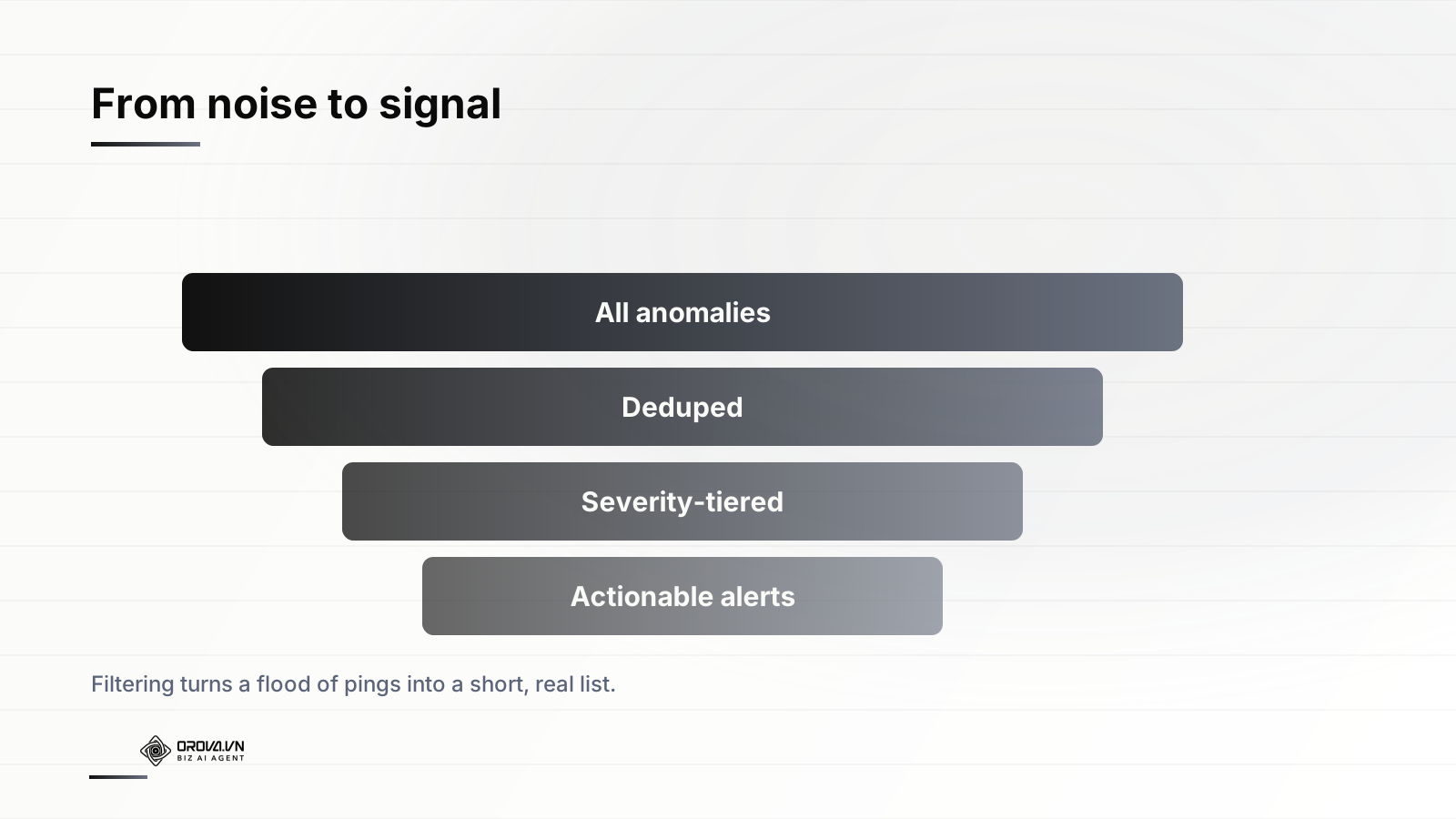
The single most powerful change you can make is to stop treating all alerts as equal. A campaign whose budget has somehow been set to ten times its intended value is not the same kind of event as an ad whose CTR slipped two-tenths of a percent. Yet most default alerting setups deliver both with the same urgency, in the same place, at the same time. Severity tiers fix this by deciding, before anything fires, how loudly each class of problem is allowed to speak.
A practical three-tier model works for almost every team:
Tier 1 — Critical: interrupt a human now
These are events where money is actively being wasted or lost, and every hour of delay has a real cost. They justify a phone notification, a page, or a direct message even outside working hours. Reserve this tier ruthlessly — if everything is critical, nothing is. Good candidates:
- Spend on a campaign exceeds its expected daily pace by a large, sustained margin (for example, 3x in the first few hours of the day).
- Conversion tracking has stopped reporting entirely while spend continues — the classic "spending blind" failure.
- A payment method has been declined or an account has been suspended, stopping all delivery.
- A flagship product or landing page is returning errors while its ads keep running.
Tier 2 — Warning: surface today, act within the day
Genuine issues that warrant a human decision but not an interruption. These belong in a single, reviewed-once-or-twice-daily place — a dashboard, a morning channel post, a worklist. Examples: a campaign's CPA has risen meaningfully and consistently over several days, frequency on an audience has climbed past the point of diminishing returns, or a previously strong ad set has slipped into limited delivery.
Tier 3 — Informational: digest, never interrupt
Things worth knowing but not worth a single individual ping: a small budget was auto-adjusted by a rule, an A/B test reached significance, a campaign exited its learning phase. These should be batched into a periodic digest — daily or weekly — that a person can skim in two minutes and skip entirely on a busy day without missing anything that matters.
The discipline here is in the placement and the routing, not just the labelling. A severity tier only helps if Tier 1 reaches someone immediately and Tier 3 never does. The moment an informational alert sneaks into the critical channel, you are back to teaching people to ignore it.
Deduplication: stop reporting one problem five times
Once severity is in place, the next biggest source of noise is duplication. A single root cause routinely fans out into many alerts, and a human reading them cannot tell that they all trace back to one thing. Effective deduplication collapses related signals into a single, contextual notification.
Collapse by root cause, not by symptom
Suppose a tracking tag breaks on your site. Within minutes, every campaign driving traffic to that site shows zero conversions. A naive alerting system fires "conversions dropped to zero" for each of the forty campaigns affected — forty pings. A deduplicating system recognizes that forty simultaneous identical drops across one destination almost certainly share one cause, and sends one alert: "Conversion tracking appears to have failed across 40 campaigns; likely a site-side issue." That is the difference between panic and diagnosis.
Suppress repeats of an open issue
If an alert has already fired and the underlying condition is still true, do not fire it again every time the data refreshes. A campaign overspending at 9am is still overspending at 10am, 11am, and noon — but the human already knows. Send the alert once, then suppress repeats until either the condition clears or it crosses into a worse severity tier. A single follow-up when something resolves ("the overspend you were warned about at 9am has stopped") is genuinely useful; nine identical reminders are not.
Group by entity and time window
When several distinct but related issues appear together — three ad sets in the same campaign all hitting frequency caps — group them into one notification about the campaign rather than three about the ad sets. The reader gets the full picture in one glance and one decision, instead of reconstructing it from scattered fragments.
Deduplication is where a thoughtful rules layer earns its keep. If you are formalizing the logic that decides when something is worth a human's attention, it pays to think of it the same way you think about automated optimization — as explicit condition-action rules that drive your ad operations, where the "action" for an alert is simply "notify, at this severity, deduped against open issues."
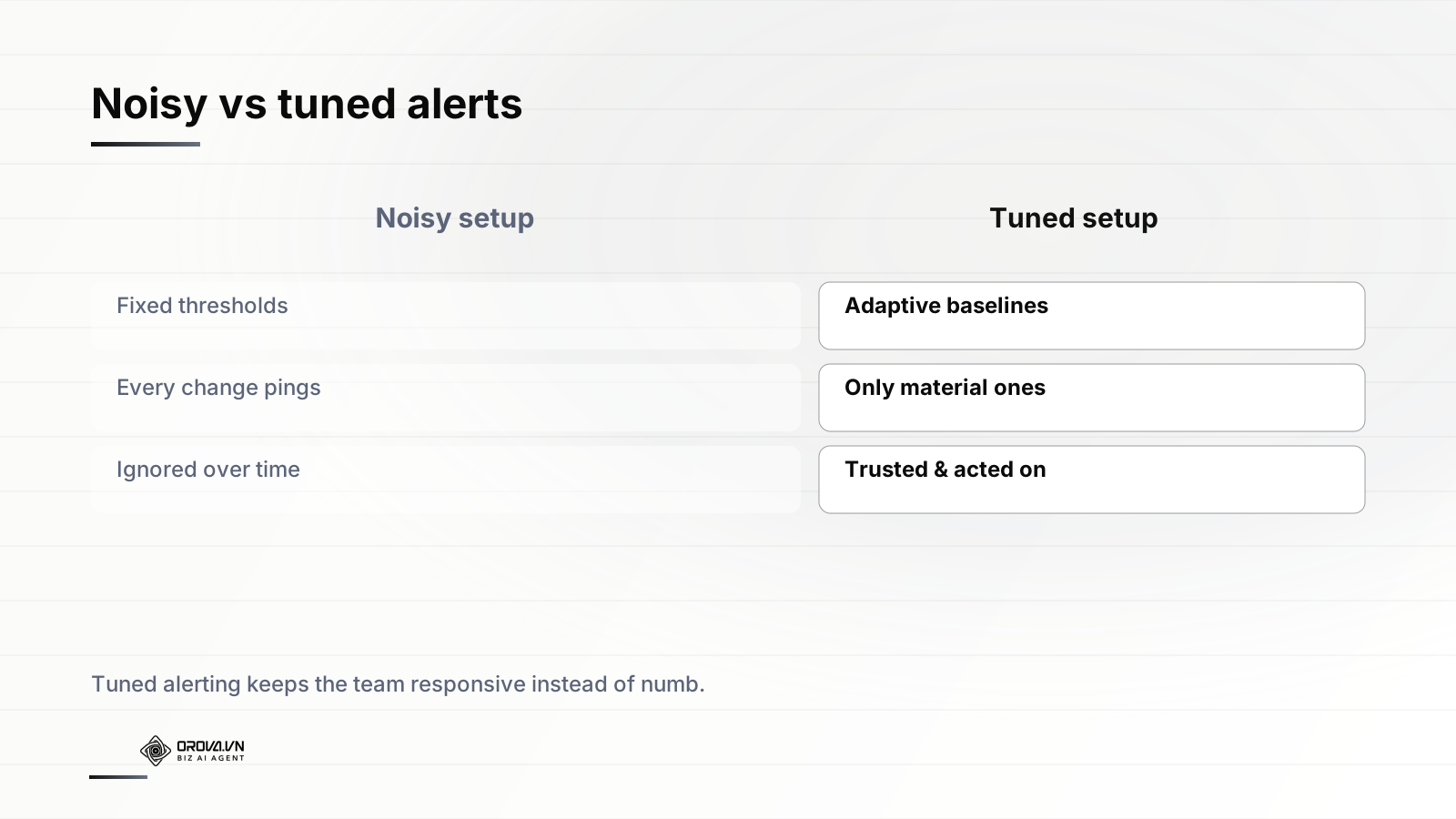
Smart thresholds beat fixed ones
Fixed thresholds are the original sin of noisy alerting. "Alert me if CPA exceeds 150,000 VND" feels precise, but it ignores everything that makes a number meaningful: how much data is behind it, what is normal for this campaign, and what time of week it is. The result is an alert that screams on a campaign that has always run at 160,000 VND and stays silent on a campaign that just doubled from 40,000 to 80,000.
Why fixed thresholds fail
- They ignore baselines. A 5% CTR is excellent for one campaign and alarming for another. A single global threshold cannot be right for both.
- They ignore sample size. A metric built on eight conversions is statistical noise; the same threshold applied to it produces constant false alarms on low-volume entities.
- They ignore seasonality. Spend that looks alarming on a Tuesday is routine during a weekend sale. Fixed thresholds have no concept of "expected for this day."
- They go stale. The threshold you set in March no longer fits the account in September, and nobody remembers to revisit it.
What adaptive baselines do instead
An adaptive approach compares each metric to its own recent history and asks whether the current value is a meaningful departure, not just whether it crossed an arbitrary line. The practical building blocks:
- Rolling baselines. Compute a moving average and a measure of normal variation (standard deviation, or percentile bands) over a trailing window — say, 14 to 28 days. Alert when a value falls outside the expected band, not when it crosses a fixed number.
- Day-of-week awareness. Compare Mondays to Mondays. A baseline that knows your weekends run hot will not panic every Saturday.
- Minimum-volume gates. Refuse to fire a performance alert until the entity has enough conversions or clicks for the movement to be real. This single rule eliminates the majority of low-volume false alarms.
- Sustained-change requirements. Require a deviation to persist for a defined period — two consecutive days, or several hours — before alerting on anything that is not an immediate emergency. A one-hour blip self-corrects; a three-day trend is a signal.
Adaptive thresholds take more effort to build than a hardcoded number, and they are not infallible — a baseline learned during an unusual period can be skewed. But for the vast majority of metrics, they cut false positives dramatically while catching the real departures that a fixed line would miss because it was set in the wrong place.
Digest the low-priority, route the critical
Severity tiers tell you how loud an alert is allowed to be. Delivery design decides where and when it actually arrives. Get this wrong and even a well-tiered system fails, because the right information shows up in the wrong place at the wrong time.
Digesting: batching the routine
Everything in your informational tier, and much of your warning tier, should be batched rather than delivered one notification at a time. A digest is a single message — an email, a channel post, a dashboard panel — that collects everything from a period into one scannable summary. The advantages compound:
- One interruption instead of fifty. The reader chooses when to engage, rather than being pulled away fifty times.
- Context and grouping become possible. A digest can sort by severity, group by campaign, and show trends a stream of isolated pings never could.
- Skipping is safe. If today is chaotic, a person can ignore the digest entirely and catch tomorrow's, confident that anything truly urgent would have come through a different, louder channel.
A good ad-ops morning digest might lead with "3 items need a decision today," followed by a short list of warnings with enough context to act, then a collapsed section of informational items for anyone curious. Two minutes to read, and the day's real work is visible at the top.
Routing: getting the rare critical event to a human fast
The flip side of digesting the routine is that the genuinely critical must bypass the digest entirely and reach a specific person immediately. Routing is about making sure the right human gets the right emergency without delay or ambiguity:
- Send to a person or a clear on-call role, not just a channel. A critical alert in a shared channel at 8pm is everyone's responsibility, which means it is no one's. Direct it to whoever owns the account or holds the on-call rotation.
- Use a louder medium for higher severity. Tier 3 lives in a digest, Tier 2 in a once-a-day channel, Tier 1 as a direct message or push that breaks through.
- Include enough to act, not just to worry. "Campaign X is spending 3x pace" is an anxiety generator. "Campaign X has spent 600,000 of its 200,000 VND daily budget by 10am; pacing 3x; suggested action: cap or pause" is something a person can act on in seconds.
- Make resolution legible. Once a critical issue is handled, the alert should be closeable so the next person to look does not re-investigate something already solved.
Putting it together: a worked example
Let me return to that retail team with 1,840 weekly pings and walk through what changing the system looked like, because the principles only become real when you see them applied.
We started by auditing what was actually firing. The overwhelming majority — well over 80% — were performance alerts on low-volume campaigns and individual ads, triggered by fixed percentage thresholds on metrics with single-digit conversion counts. The first move was a minimum-volume gate: no performance alert fires unless the entity has accumulated at least a meaningful number of conversions in the window. That one rule eliminated the bulk of the noise overnight.
Next, we replaced the fixed CPA and ROAS thresholds with rolling 21-day baselines that compared each campaign to its own history and required a deviation to persist for two days before warning. The remaining performance alerts dropped by more than half again, and crucially, the ones that survived were real — campaigns genuinely drifting, not statistical wobble.
Then we built deduplication around root cause: simultaneous conversion drops across multiple campaigns collapsed into one "likely tracking issue" alert, and any open condition suppressed its own repeats until it cleared. The four-platform duplication problem was solved by funneling all sources into one alerting layer that recognized the same event reported multiple ways.
Finally, we split delivery. A morning digest carried everything routine. A single dashboard held warnings for the day. And a short, fiercely guarded list of critical conditions — overspend, tracking failure, account suspension, landing-page errors — went straight to the account owner as a direct push, with suggested actions attached.
The result, measured over the following month: roughly 30 to 40 notifications a week instead of 1,840, and — this is the part that matters — the number of real problems caught and acted on went up, not down. The team trusted the channel again. When a critical alert came in, they responded within minutes, because they knew it was real.
The measure of a good alerting system is not how much it catches. It is the ratio of alerts to actions. Aim for a system where most alerts lead to a decision, and the rare false alarm is the exception, not the rule.
A practical checklist for tuning your own alerts
If you are starting from a noisy setup today, work through these in order. Each step compounds with the last.
- Audit before you change anything. Count what fires over a week and tag each alert as "led to action" or "ignored." The ignored pile tells you exactly what to fix first.
- Add minimum-volume gates. Stop alerting on metrics with too little data behind them. This is usually the single biggest noise reduction available.
- Replace fixed thresholds with rolling baselines wherever you have enough history, and add day-of-week awareness for spend and conversion metrics.
- Require persistence for everything that is not an immediate emergency. Two consecutive days, or several sustained hours, filters out self-correcting blips.
- Define three severity tiers and assign every alert type to exactly one. Be ruthless about what earns "critical."
- Deduplicate by root cause and suppress open-issue repeats. Collapse related signals; never report the same ongoing problem twice.
- Digest the routine, route the critical. Batch tiers 2 and 3; send tier 1 directly to a named owner with suggested actions.
- Review monthly. Baselines drift, accounts change, and a tier that made sense in spring may not in autumn. Treat the alerting system as something you maintain, not set and forget.
None of this requires exotic technology. It requires the discipline to decide, in advance, what is actually worth a human's attention — and the restraint to stay silent about everything else. That restraint is the whole game. A team that hears from its alerting system only when it should learns to trust it, and a trusted alert is the only kind that gets acted on.
Let the routine watching happen on its own
Tuning thresholds, deduping signals, and routing the right problems to the right person is exactly the kind of patient, never-tired work that an AI agent does well. Orova Ads reads your Google, Meta, and TikTok data every day, learns each campaign's normal baseline instead of relying on brittle fixed thresholds, surfaces only the changes that genuinely matter, and can execute the fixes — budgets, bids, on/off, audiences — with your approval and a full audit log. Less noise, fewer missed problems, and a clear record of every decision. See how it cuts through the alert flood at orova.vn.
Related reading: What Is an AI Ads Agent? Autonomous Ad Management Explained
Orova Ads optimises campaigns for you
Connect Google, Meta and TikTok in one place. AI reads the numbers, proposes changes and executes under the rules you set.
Explore Orova Ads