
Brand Safety in Automated Ads
In March 2023, a major consumer electronics brand discovered that its automated bidding had quietly placed display ads next to a viral conspiracy-theory video, paying for 40,000 impressions before anyone noticed. The campaign was performing beautifully by every metric the platform reported: low cost per click, healthy view-through rate, an algorithm humming along exactly as designed. The problem was that the algorithm had no idea what the brand stood for, and nobody had told it. That gap between machine efficiency and human judgment is the entire subject of brand safety in automated advertising, and it gets wider every time you hand more decisions to an AI.
Automation is not the enemy here. An AI agent that reviews placement reports every day, prunes low-quality inventory, and reallocates budget in minutes is doing work that a human team could never keep up with manually across thousands of placements. The danger is not speed itself; it is speed without guardrails. A human buyer who sees a questionable site makes a snap reputational judgment based on years of context. An automated system makes a math judgment based on the objective you gave it. If your objective is "maximize conversions at the lowest cost," and a forum full of extremist content happens to convert cheaply, the system will buy there enthusiastically until you stop it. Brand safety is the discipline of encoding that human judgment into rules the machine can follow, and deciding which calls the machine is never allowed to make alone.
What brand safety actually means when a machine is buying
Most marketers use "brand safety" loosely, but it splits into three distinct concerns once you start automating, and conflating them leads to weak controls. The first is placement adjacency: where your ad physically appears. The second is content category: the subject matter of the surrounding context, regardless of whether the specific page is "bad." The third is tone and message integrity: whether the creative the agent serves still says what your brand intends to say, in the way it intends to say it.
Placement adjacency is the classic case. Your video pre-roll runs before a clip glorifying violence; your banner sits beside a comment thread of slurs. This is what most platform tools were built to address, and it is the easiest to automate because it is concrete and binary: the placement is on your blocklist or it is not.
Content category is subtler. A news article about a plane crash is not "unsafe" content in any moral sense, but an airline does not want its cheerful summer-fare creative running next to it. A baby-formula brand does not want to appear inside a serious investigative piece about infant illness, even though that piece is responsible journalism. These are contextual mismatches, and they require category-level exclusions rather than individual blocklists.
Tone and message integrity is the dimension most teams forget, and it is the one automation makes riskiest. When an AI agent rotates creatives, tests headlines, or assembles responsive ads from a pool of assets, it can produce combinations no human ever reviewed. A pharmaceutical brand once had a dynamic system pair the headline "Feel nothing again" with a depression-medication landing page in a way that, recombined, read as deeply tone-deaf. The individual pieces were approved; the combination was not. Automation that recombines approved fragments still needs a safety layer, because the unit of risk is the final impression, not the source asset.
Why automated buying raises the stakes
Three properties of automated advertising amplify every brand-safety failure. Scale means a single bad rule touches millions of impressions before a quarterly review catches it. Speed means money flows to a problematic placement within hours, not over a planning cycle where a human might intervene. And opacity means the agent's reasoning is often invisible unless you deliberately build logging and review into the workflow. A spreadsheet-driven media plan from 2010 was slow and dumb, but it was legible: you could read it and know exactly where money would go. A modern optimization agent is fast and smart, but if you cannot see its decisions, you cannot govern them. The fix is not to slow the agent down to human pace; it is to make its decisions auditable and to fence off the categories where a mistake is unrecoverable.
Building the exclusion foundation
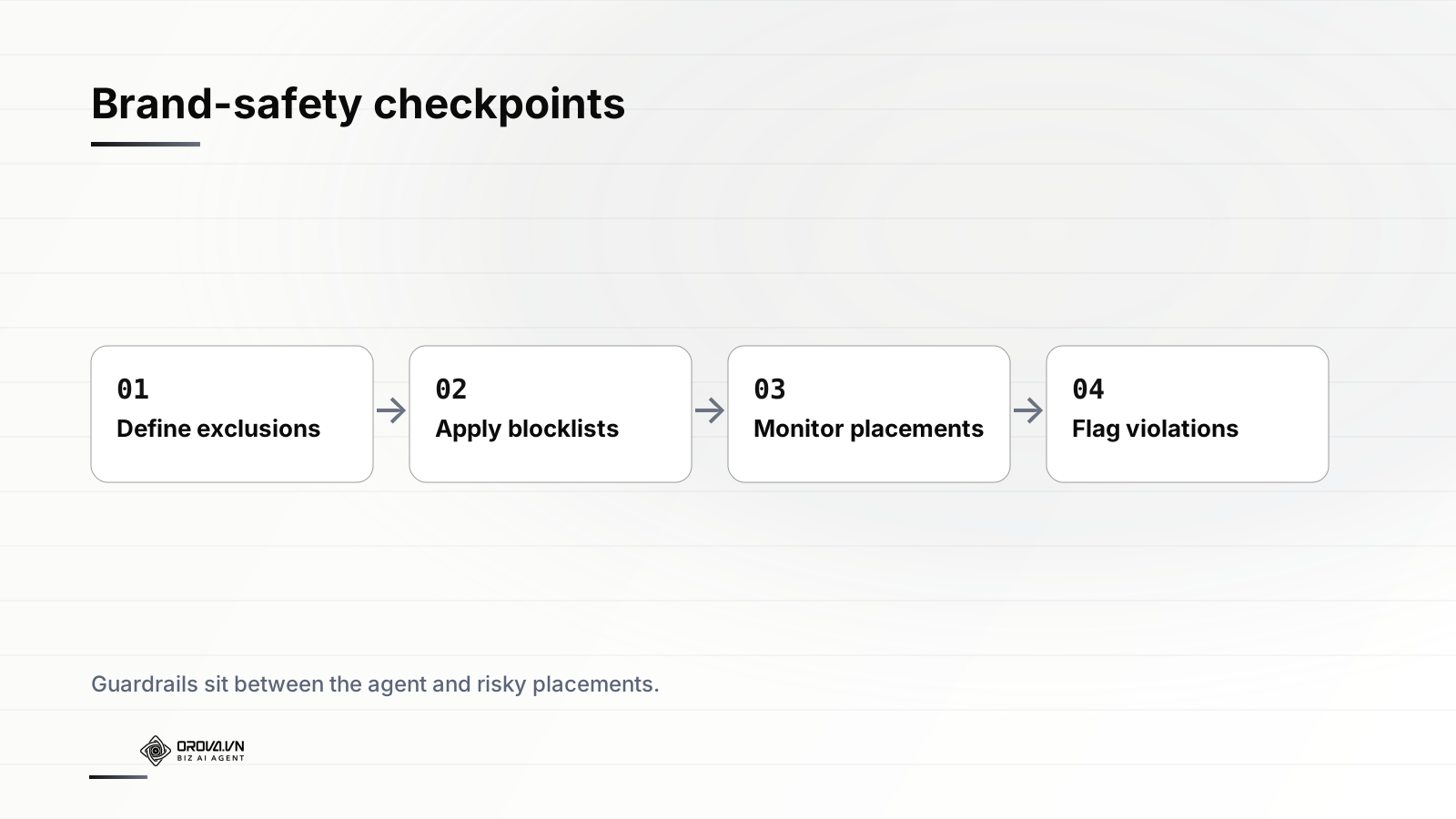
Every brand-safety program starts with exclusions, and the discipline here is to be specific rather than exhaustive. A blocklist of 50,000 random sites scraped from a vendor is worse than a tight list of 200 that actually map to your risk profile, because the giant list creates false confidence while missing the placements that genuinely threaten you. Start by defining the categories your brand must never appear in, then build the technical exclusions that enforce them.
The standard sensitive-content categories most brands exclude include adult content, violence and weapons, hate speech and discrimination, illegal drugs, gambling (unless you are in that vertical), and tragedy or conflict news. Beyond these universal exclusions, every brand has category-specific landmines. A family entertainment company excludes far more aggressively than a B2B software firm. A financial institution worries about appearing next to "get rich quick" content that could imply endorsement. Map your exclusions to your actual reputational exposure, not to a generic template.
Once categories are defined, they translate into concrete mechanisms across platforms. On Google's Display Network you have content-category exclusions, placement exclusions, and digital-content-label filters that screen by audience-appropriateness rating. On Meta you have inventory filters (limited, standard, or expanded), publisher block lists, and topic exclusions for in-stream and Audience Network placements. On TikTok you have inventory filters and the option to run inside the brand-safety-vetted inventory tier. The mistake is treating these as one-time setup. Inventory changes constantly; new sites and apps appear daily, and an exclusion list that was comprehensive in January is leaky by June. An AI agent is genuinely useful here precisely because it can re-scan placement reports continuously and surface emerging risks a quarterly human review would miss.
Blocklists versus allowlists
There is a strategic choice underneath the tooling: do you block the bad or admit only the good? A blocklist approach excludes known-bad placements and runs everywhere else. It maximizes reach and is cheap to maintain, but it is permanently reactive, you are always one step behind new bad inventory. An allowlist approach (sometimes called an inclusion list) runs only on a vetted set of publishers you trust. It is far safer and is the right default for high-reputation brands, but it sacrifices reach and can drive up costs by removing the long tail of cheap inventory.
The practical answer for most automated programs is a tiered hybrid. Run your prospecting and high-volume awareness campaigns on a blocklist with aggressive category exclusions, accepting some residual risk in exchange for scale. Run your most reputation-sensitive campaigns, executive-visibility brand work, regulated-product messaging, anything a journalist might screenshot, on a tight allowlist. Let the AI agent operate freely within the blocklist tier where mistakes are cheap and reversible, and require human approval before anything changes in the allowlist tier. This is the core principle that runs through everything: match the level of automation to the cost of being wrong.
What the AI agent should be allowed to do alone
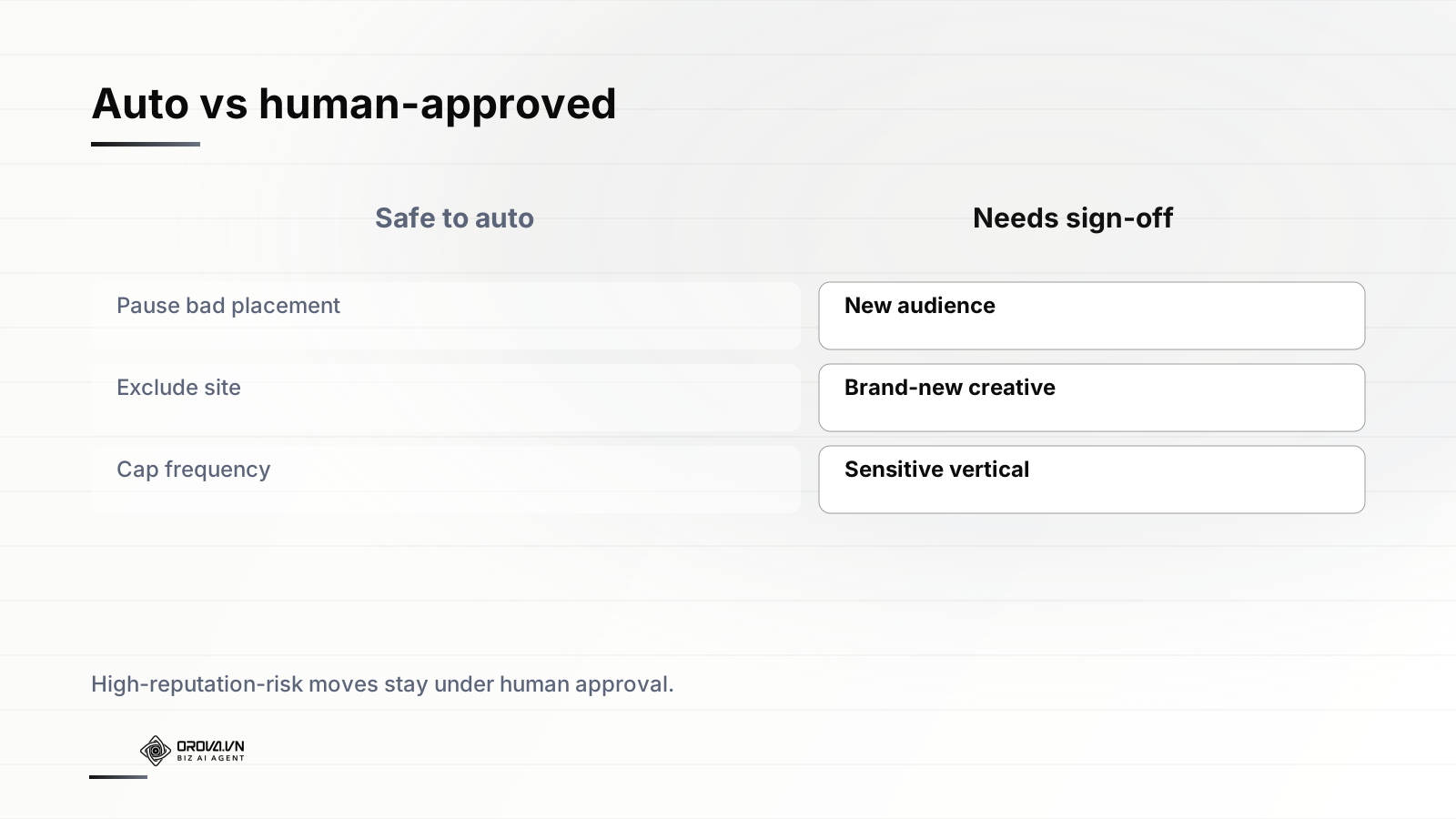
The central governance question in automated advertising is not "should we use automation" but "which specific actions can the agent execute without a human in the loop." The answer comes from a simple test: if the agent makes this move and it turns out to be wrong, how bad is the damage and how quickly can we undo it? Reversible, low-blast-radius actions are excellent candidates for full automation. Irreversible or high-reputation-risk actions should stay advisory, where the agent recommends and a human approves.
Consider the actions that are clearly safe to automate. Pausing a placement that is showing on a low-quality site is purely protective, the worst case is you lose a little volume, and you can always re-enable it. Excluding a specific domain that turned up in a placement report is the same: it only removes risk. Capping frequency to stop hammering the same user is defensive and trivially reversible. Pulling budget away from a campaign whose placements have degraded is a sensible, recoverable response. All of these are subtractive, protective moves, and an agent that performs them continuously is doing exactly the watchdog work humans are too slow to do.
Now consider the actions that should never run unsupervised. Launching a brand-new audience the agent assembled itself is a reputation decision, you might suddenly be targeting a segment that creates legal or perception problems, and you cannot un-show those ads. Pushing a brand-new creative live is the textbook case for human review: the agent has no way to know that a phrase is legally risky, culturally insensitive, or off-brand in a way that only a person steeped in the brand would catch. Entering a sensitive vertical, anything touching health, finance, children, politics, or crisis events, demands a human who understands the regulatory and reputational context. Expanding into entirely new inventory pools that have not been vetted is similarly a decision to accept unknown risk, which is a human's call to make.
The advisory-only category in detail
Some brand-safety decisions are valuable precisely because the agent surfaces them but a human decides. This is the advisory-only mode, and it deserves more respect than it usually gets, because it captures most of the value of automation (continuous monitoring, pattern detection across huge datasets) while removing the catastrophic-mistake risk. We have written separately about the broader trade-off between advisory recommendations and auto-execution, and brand safety is the clearest case where that distinction earns its keep.
Here is what advisory-only looks like in practice. The agent notices that a cluster of placements share a content category trending toward controversy, an emerging news event is making previously-safe sites risky, and it flags them with evidence: "These 14 placements now carry adjacency risk because of breaking coverage of [event]. Recommend pause. Estimated volume impact: 8%." A human reviews the evidence, understands the context the machine cannot, and approves or rejects in seconds. The agent did the tireless watching; the human made the judgment call. Crucially, the human is making one fast decision on pre-digested evidence, not manually combing through placement reports, so you keep almost all the speed advantage.
Categories that belong in advisory-only mode include: entering any new content vertical, responding to a live news event or crisis, any change touching regulated products, audience expansions into protected or sensitive demographics, and creative changes of any kind. The rule of thumb is that if a mistake would generate a screenshot, a complaint, or a legal letter, a human signs off first.
Monitoring: catching what the rules missed
Exclusions and approvals are preventive. Monitoring is detective, it catches the failures that slip past your rules, and in automated advertising something always slips past, because inventory is dynamic and bad actors actively work to evade brand-safety filters. A robust monitoring layer turns brand safety from a static configuration into a living system.
Effective monitoring rests on a few pillars. Placement reporting reviewed at high frequency is the baseline, you want to see exactly where impressions landed, ideally daily for active campaigns, not monthly. An AI agent excels here because it can scan thousands of placement rows every morning, compare against your exclusion logic, and surface anything anomalous: a new domain absorbing unusual spend, a sudden spike in a category that should be rare, a placement whose engagement pattern suggests fraud rather than genuine interest.
Anomaly detection on spend and performance is the second pillar. A placement that suddenly attracts disproportionate budget deserves scrutiny even if it is not on any blocklist, because abnormal patterns often indicate either fraud or a targeting drift that is taking you somewhere you did not intend. Third-party verification from vendors like IAS, DoubleVerify, or Moat adds an independent layer that does not depend on the ad platform grading its own homework, and integrating their signals into the agent's monitoring loop strengthens the whole system.
The feedback loop that makes safety improve over time
The most underrated property of a well-built brand-safety system is that every violation should make the system smarter. When a human pauses a flagged placement, that action should feed back into the exclusion logic so the same category of placement is caught earlier next time. When an approver rejects a recommended audience as too risky, that rejection should inform how the agent scores similar audiences in future. This is the difference between a brand-safety program that decays and one that compounds. A static blocklist gets leakier every month as the world changes around it. A learning loop gets tighter, because each incident becomes a rule, and each rule narrows the gap the next bad placement could slip through.
Concretely, this means logging is not optional plumbing, it is the foundation of improvement. Every decision the agent makes, and every human approval or rejection, should be recorded with its rationale and its outcome. Over a quarter, that audit trail becomes a map of your real brand-safety posture: which categories generate the most flags, which approvers reject what, where the agent's recommendations are consistently accepted (and could perhaps be promoted to auto-execute) versus consistently overridden (and should stay advisory or be retuned).
Tone and message integrity in automated creative
Placement safety gets all the attention, but message safety is where automation creates genuinely novel risk, and it is worth a dedicated section because most brand-safety checklists ignore it entirely. When an agent assembles responsive ads, tests headline variations, or personalizes copy at scale, it is generating combinations no human signed off on as a whole. The components were approved; the emergent message may not be.
Three controls keep automated creative on-message. First, maintain an approved-asset pool with explicit pairing rules, not just a bag of headlines and images the system can combine freely. Some headlines must only run with certain images; some claims must only appear on certain landing pages for legal reasons. Encode those constraints so the agent cannot produce a non-compliant combination. Second, hold any genuinely new creative, anything the agent generated rather than recombined from approved parts, in an approval queue. This is the single most important creative safeguard, because generated copy is where regulatory and reputational accidents happen. Third, run a tone and compliance check on combinations before they go live, flagging language that is legally sensitive, culturally loaded, or off-brand against your style guide.
A useful discipline is to write down your brand's tone boundaries as explicit rules the system can check against: words you never use, claims you cannot make without substantiation, comparisons you avoid, sensitivities specific to your market. The clearer these rules, the more creative work you can safely automate, because the agent has a concrete fence to stay inside. Vague brand guidelines that live in a designer's head cannot govern a machine; written rules can.
A practical implementation checklist
Pulling this together, here is the sequence a team should follow to put brand-safety governance around an automated advertising program. Treat it as a build order, not a menu, the early items are prerequisites for the later ones.
- Define your exclusion categories in writing. List the content categories your brand must never appear in, then add the category-specific risks unique to your industry and market. This document is the source of truth everything else implements.
- Translate categories into platform controls. Configure content exclusions, inventory filters, and digital-content-label settings on each platform. Document what each setting maps to so the configuration is auditable.
- Build tiered blocklists and allowlists. Aggressive blocklists with category exclusions for high-volume tiers; tight allowlists for reputation-sensitive campaigns.
- Classify every agent action by reversibility and risk. Sort actions into auto-execute (protective, reversible) and advisory-only (irreversible, high-reputation-risk). Write the classification down so it is a policy, not an accident.
- Set up daily placement monitoring. Whether human-run or agent-run, review where impressions actually landed at a frequency matched to how fast money moves.
- Add third-party verification. Independent measurement that does not depend on the platform grading itself.
- Build the audit log and feedback loop. Record every decision and outcome; route violations back into the exclusion logic so the system tightens over time.
- Govern creative combinations. Approved-asset pools with pairing rules, an approval queue for generated creative, and written tone boundaries the system can check.
The governance mindset, not just the tooling
The teams that succeed at automated brand safety do not think of it as a configuration screen they fill in once. They think of it as a standing relationship between human judgment and machine execution, where the human defines the boundaries and reviews the edge cases, and the machine does the tireless, continuous enforcement within those boundaries. The machine never decides what the brand stands for; it only enforces decisions the brand already made. That division of labor is what lets you run automation at full speed without lying awake wondering where your ads went last night.
Brand safety done well is almost invisible, no incidents, no screenshots, no awkward calls from legal, which is exactly why it is chronically underinvested. But the cost of getting it wrong is asymmetric: years of brand equity damaged by a single bad adjacency that went viral. In automated advertising, where one misconfigured rule can touch millions of impressions before lunch, that asymmetry is sharper than ever. The good news is that the same automation that creates the risk is also your best tool for managing it, provided you keep humans firmly in charge of the decisions that cannot be undone.
If you want an AI agent that manages paid campaigns across Google, Meta, and TikTok while respecting exactly these boundaries, reading placement and performance data daily, recommending and executing optimizations like budget shifts, bid changes, on/off toggles, and audience adjustments, but always with human-in-the-loop approval and a full audit log of every action, take a look at Orova Ads. It is built so the protective, reversible moves happen automatically while the reputation-sensitive calls stay under your sign-off, which is precisely the balance brand safety in automated advertising requires.
Orova Ads optimises campaigns for you
Connect Google, Meta and TikTok in one place. AI reads the numbers, proposes changes and executes under the rules you set.
Explore Orova Ads