
Spend Guardrails & Caps for AI Ads
The fastest way to lose trust in an automated ads system is not a bad recommendation. It is a good recommendation applied four times in a row. A model decides a campaign is underfunded, raises the daily budget by 30%, sees more conversions the next morning, raises it again, and again, and by Friday a campaign that was spending $200 a day is burning $900 with a cost per acquisition that quietly crept past your break-even point three days ago. Nothing in that sequence was obviously wrong in the moment. Each step looked like the system doing its job. The problem was that nobody put a ceiling on how far the job could go before a human looked at it.
That is what spend guardrails are for. They are not a feature you bolt on after you trust the automation. They are the precondition for trusting it at all. A guardrail is a hard limit, defined in advance, that the system physically cannot cross no matter how confident its reasoning is. Daily caps, per-action deltas, per-run change limits, and total account ceilings are the difference between "autonomous" and "safe autonomous" — and the gap between those two phrases is where most failed automation projects live.
This article lays out the four kinds of caps that matter, how they stack, how to size them for your own account, and why the most aggressive optimization actually depends on having the tightest limits. If you are still deciding whether to hand budget decisions to software at all, it is worth reading whether you should let AI spend your budget first, because guardrails are the answer to most of the objections raised there.
Why "autonomous" is a liability without limits
Autonomy means a system takes actions without asking first. That is the whole value: it works while you sleep, reacts to data faster than a human checking dashboards twice a day, and does not get bored adjusting bids on 400 ad groups. But autonomy without limits is just an unsupervised process with access to your bank account through the proxy of an ad platform's billing.
The danger is not that automation is stupid. Modern systems reason reasonably well about individual decisions. The danger is compounding and feedback. Three things make automated spend uniquely risky compared to a human making the same calls:
- Speed. A human raises budgets a few times a week. An automated system can do it every hour. A 10% increase applied hourly is not a 10% increase; it is a curve that doubles spend in roughly seven hours if nothing stops it.
- Correlation across entities. The same logic that raises one campaign's budget will raise every campaign that matches the pattern. A reasonable rule applied to one line item is a reasonable change. The identical rule applied simultaneously to thirty line items is a budget event.
- Delayed signal. Conversions, especially considered purchases or B2B leads, arrive days after the click. The system optimizes on data that looks good now but reflects spend that has not yet shown its true cost. By the time the real cost-per-acquisition lands, you have already spent against the optimistic version three more times.
None of these are arguments against automation. They are arguments for bounding it. A guardrail does not make the system smarter. It makes the system's mistakes small, slow, and reversible — which, in practice, is most of what "safe" means.
The goal is not an automation that never errs. It is an automation whose worst possible day costs you a known, survivable amount.
The mental model: blast radius, not correctness
Engineers who run critical systems do not ask "will this code be correct?" They ask "when this fails, how much breaks?" That framing — blast radius — is exactly the right one for ad spend. You will never prove the optimization logic is perfect, because the future is not in the training data. What you can do is guarantee that any single failure, or any single bad day, is contained.
Caps are blast-radius controls. They do not try to prevent errors. They cap the cost of errors. Once you internalize that, the whole design becomes clearer: you are not building a system that is always right, you are building one whose wrongness is bounded at every level.
The four kinds of caps
There is no single "spend limit" that does the job. Real protection comes from layering several different kinds of limits, each catching a failure the others miss. Think of them as nested containers: a bad decision has to escape all four to actually hurt you, and they are sized so that it can't.
1. Per-action delta cap
This is the tightest, innermost limit. It governs how much any single change can move a value. The classic form is "no budget increase greater than 20% in one action" and its mirror, "no bid increase greater than 15% at once." It applies to the individual edit, not the campaign and not the account.
Per-action caps exist to kill the catastrophic single move. Without one, a unit error — a model misreading a 10x improvement, a stale data feed, a currency conversion bug — can translate directly into a 10x budget change. With a delta cap, the worst a single action can do is move the value by the capped percentage. Everything downstream is built on the assumption that no individual change is wild, and the per-action cap is what makes that assumption true.
A good per-action cap is asymmetric. Increases should be capped harder than decreases. Turning a budget down too far wastes opportunity but costs nothing; turning it up too far costs money immediately. Many well-designed systems will let an automation cut a budget by 50% in one move (because conserving spend is safe) but never raise it by more than 20% (because escalating spend is the dangerous direction).
2. Per-run change limit
A single run of the optimizer might touch dozens of entities. The per-run limit caps the aggregate. Even if every individual change is within its per-action delta, the sum of all changes in one pass should not exceed a defined ceiling — for example, "total budget across the account may not increase by more than 15% in any single run."
This is the limit that catches correlated decisions. Twenty campaigns each getting a perfectly legal 20% bump is a 20% increase across the account in one breath, and that is exactly the scenario per-action caps cannot see, because each action is individually fine. The per-run limit forces the system to prioritize: if the proposed changes would breach the run ceiling, it must pick the highest-confidence subset and defer or scale back the rest. That prioritization pressure is healthy — it pushes the system toward its best ideas instead of spraying medium-confidence changes everywhere.
3. Daily cap
The daily cap is the limit most people already understand, because ad platforms expose a version of it natively. But the platform's daily budget is per-campaign and easily overridden by the automation itself — that's the point of automation. The daily cap that matters here is one the automation cannot raise: an account-level or workspace-level ceiling that says "regardless of what any campaign budget is set to, total spend today stops at X."
This is your circadian safety net. It does not care why spend is high — runaway loop, traffic spike, a competitor dropping out and your auctions suddenly clearing cheaper at higher volume. Whatever the cause, the day ends at a number you chose. The daily cap is what lets you actually sleep, because the worst single night is mathematically bounded before you go to bed.
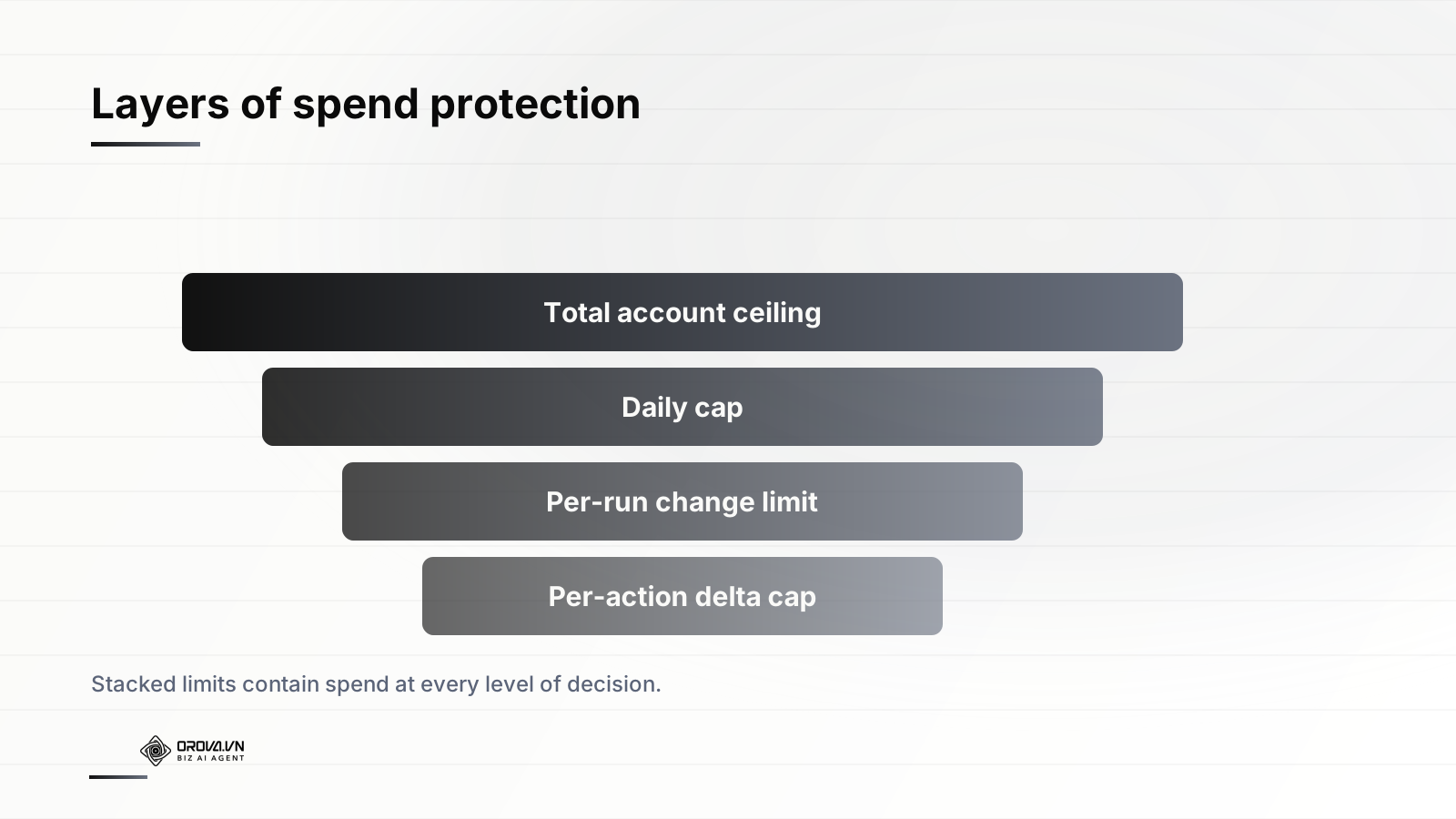
4. Total account ceiling
The outermost container is the absolute ceiling — a hard cap on cumulative spend over a longer window, usually the billing month or the campaign flight. This is the limit tied to the actual money you have committed. Where the daily cap protects against a bad night, the total ceiling protects against a bad week that no single night tripped.
It is the simplest cap conceptually and the most important psychologically. It is the number you can give to a finance team and say, with full confidence, "this is the most that can leave the account this month, full stop." Everything else is optimization inside that envelope. The total ceiling is what turns the conversation with your CFO from "trust me, the AI is careful" into "here is the contractual maximum."
How the four stack
The layers are not redundant — each one catches a class of failure the others structurally cannot:
- Per-action delta catches the single insane edit.
- Per-run limit catches the swarm of individually-sane edits.
- Daily cap catches the slow build across many runs in a day, plus external spikes the optimizer didn't cause.
- Total ceiling catches the steady drift across days that never tripped a daily alarm.
A failure has to slip past all four to reach your wallet, and because they operate at different time scales and different scopes, no single bug can blind all of them at once. That redundancy across dimensions — not across copies of the same check — is what makes the system trustworthy.
The one number that does the most work: max change per run
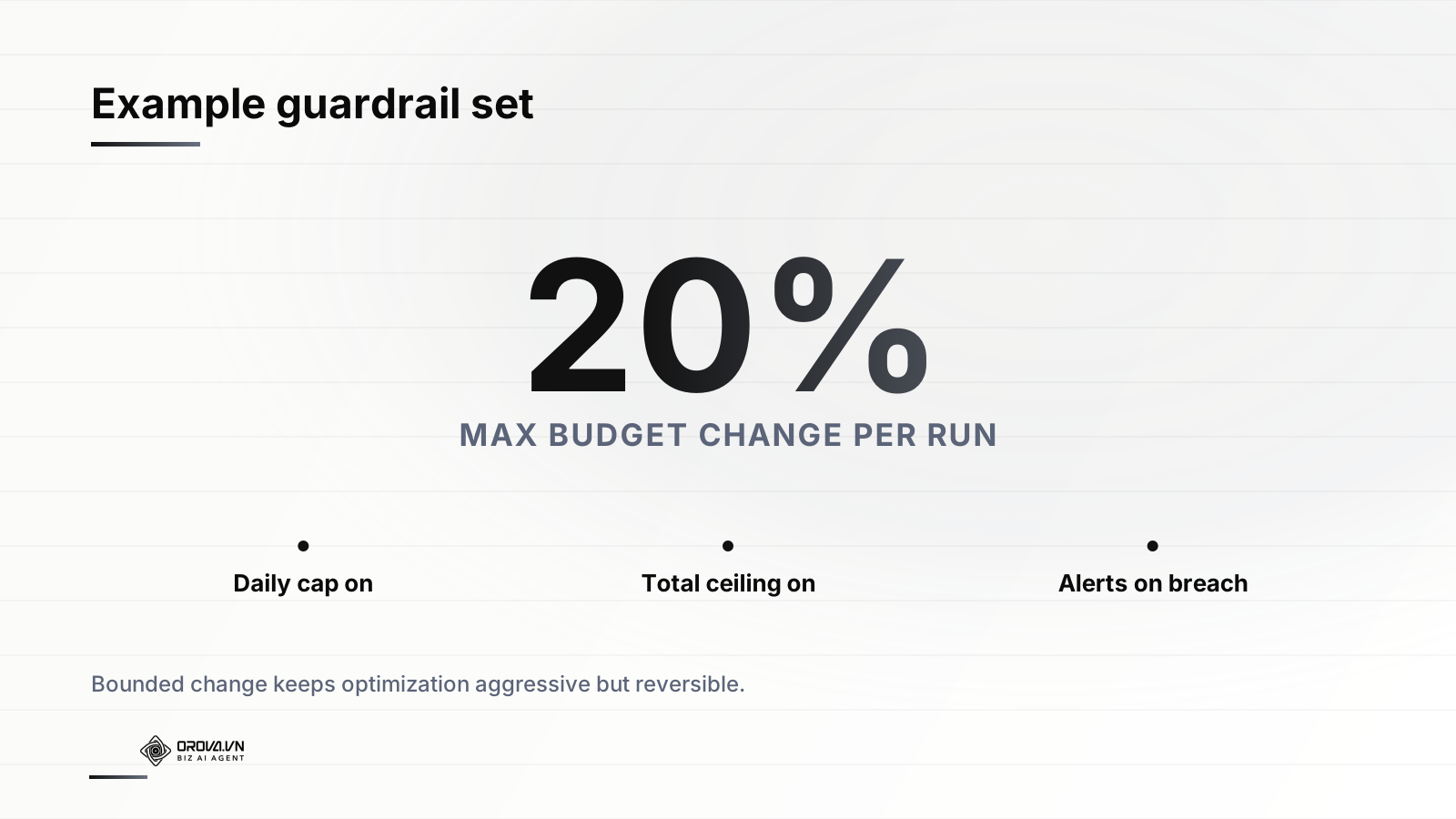
If you can only set one guardrail well, make it the maximum budget change per run. A commonly used and sensible default is 20%. It is worth understanding why this single parameter carries so much weight.
A bounded per-run change is what makes optimization reversible. If the most the system can move a budget in one pass is 20%, then a mistake takes several passes to become large — and several passes means several opportunities for the daily data to show the move was wrong and for the system (or a human) to reverse course. The 20% you went up yesterday, you can take back today. Contrast that with an unbounded system that can 3x a budget in one move: by the time you notice, the spend has already happened and there is nothing to reverse.
Bounded change also keeps optimization aggressive, which is the part people miss. A common fear is that tight caps make the system timid. The opposite is true. Because each move is small and reversible, the system can afford to be bold — it can act on a medium-confidence signal because the downside of being wrong is one capped step that it can walk back tomorrow. Remove the cap and every decision becomes high-stakes, which forces the system (or its operators) to demand more certainty before acting, which means it moves slower and misses opportunities. Guardrails are not a brake on aggression. They are what licenses it.
Why percentages beat absolute amounts
Set the per-run cap as a percentage, not a dollar figure, wherever possible. A $50 cap is meaningless on a $5,000/day campaign and catastrophic on a $40/day one. A 20% cap scales correctly with the size of what it governs: it is proportionally protective on every campaign automatically, and it keeps working when you scale spend up or down without you having to remember to re-tune every absolute limit.
The exception is the outer ceilings — daily cap and total account ceiling — which should be absolute, because they exist to protect a fixed pool of money, and money is denominated in dollars, not percentages.
Designing a guardrail set for your account
There is no universal correct configuration. The right caps depend on your spend volume, conversion lag, margin, and how much human attention the account gets. Here is a practical way to derive them.
Start from what you can afford to lose
- Set the total ceiling first. Ask: if this month went completely wrong, what is the spend number that would hurt but not break us? That is your ceiling. Not your target spend — your maximum tolerable spend. For most accounts this is somewhere between 110% and 130% of planned monthly budget.
- Derive the daily cap from the ceiling. A reasonable starting point is roughly 1.5x your average planned daily spend. That gives the system room to lean into a good day while still capping a bad one. If your plan is $200/day, a $300 daily cap lets the system capitalize on genuine opportunity without ever doubling.
- Set per-run change at 20% and adjust by conversion lag. If your conversions arrive same-day (most e-commerce), you can run more often with the standard cap because feedback is fast. If your conversions take a week (B2B, high-consideration purchases), lower the per-run cap to 10–15% and run less frequently, because the system is optimizing on incomplete data and you want each step smaller.
- Set per-action delta tightest of all. 15–20% for increases, looser (up to 50%) for decreases. This is the floor of the whole structure; keep it conservative.
Tune by margin, not by comfort
The single biggest factor people underweight is gross margin. A business with 70% margins can tolerate looser caps because there is more cushion between revenue and break-even. A business with 15% margins — a lot of retail — should run tight caps everywhere, because the distance between "profitable" and "losing money on every sale" is razor-thin and a 30% budget overshoot at thin margins can flip the entire campaign negative. Set your caps against the math of your margin, not against how brave you feel.
Asymmetry, again
Throughout the configuration, bias every cap toward caution on the spend-up side and generosity on the spend-down side. The system should be able to pull back fast and push forward slow. This asymmetry encodes a simple truth: the cost of under-spending is opportunity, which is recoverable, and the cost of over-spending is cash, which is not.
Guardrails are only half the system: visibility and reversibility
A cap that fires silently is a missed warning. Every breach — every time the system wanted to do more than a guardrail allowed — should generate an alert. Not because every breach is an emergency, but because a pattern of breaches is information. If the per-run cap keeps getting hit, either there is a genuine, sustained opportunity the system is straining against (raise the cap deliberately) or something is pushing it to over-spend repeatedly (investigate before raising anything). Breach alerts turn your guardrails into a sensor, not just a fence.
The audit trail
Caps protect the future; the audit log explains the past. Every automated change should be recorded: what changed, from what value to what value, why (which signal triggered it), and which guardrails it was checked against. When something looks off three days later, you do not want to reconstruct what happened from platform change history and guesswork. You want a clean, queryable record. The audit trail is also what makes human-in-the-loop approval meaningful — you cannot meaningfully approve a change you cannot see the reasoning for.
Reversibility as a first-class property
Bounded change makes individual moves reversible; a good system makes that reversal easy. The ability to roll back the last run, or to restore an entity to its state from a known-good checkpoint, converts "we made a mistake" from a crisis into a button. Combined with caps that keep every mistake small, reversibility means the realistic worst case is "we lost a fraction of one day's budget and undid it in a click."
Caps bound the size of a mistake. Alerts make you aware of it. Audit logs let you understand it. Reversibility lets you undo it. You want all four.
Common failure modes and how caps address them
It helps to walk through the specific ways automated spend goes wrong and see which guardrail catches each one.
- The runaway loop. System raises budget, sees more conversions, raises again, repeat. Caught by the per-run limit (each pass is small) and the daily cap (the day's total is fixed regardless of how many passes happen).
- The correlated swarm. One rule triggers across many entities at once. Caught by the per-run aggregate limit, which sees the total even though each individual change is fine.
- The stale-data spike. A delayed or duplicated data feed makes performance look 10x better than reality. Caught by the per-action delta, which caps the move regardless of how good the (wrong) data looks.
- The slow drift. Spend creeps up a few percent a day, never tripping a daily alarm, until the month is blown. Caught by the total account ceiling, the only cap watching the long window.
- The external spike. A competitor pauses, auctions clear cheaper, volume surges through no decision of the automation's. Caught by the daily cap, which does not care about cause, only total.
Notice that no single cap catches everything, and that is the point. The layered design exists precisely because each failure mode lives at a different scope and time scale.
The cultural shift: from monitoring to constraints
Teams new to automation often try to stay safe by watching dashboards more closely. This does not work and does not scale. Watching is reactive — by the time you see the problem on the dashboard, the spend has already happened. Watching also requires a human to be present, which defeats the purpose of automation that runs overnight and on weekends.
Guardrails invert the model. Instead of a human watching for problems, you encode the boundaries once and let the system operate freely inside them. The human's job shifts from monitoring every action to setting good constraints and reviewing exceptions. That is a far better use of human attention: a marketer is better at deciding "we can tolerate up to $300/day" than at catching a budget anomaly at 2 a.m. Set the boundary once; let the machine respect it forever.
This is also what makes automation politically viable inside an organization. The objection from finance, from leadership, from anyone whose neck is on the line for the ad budget, is always some version of "what if it spends everything?" Guardrails answer that question with a number, in advance, in writing. "It cannot spend more than X per day or Y per month, here are the logs, here is the rollback." That is a conversation that ends in approval. "Trust the algorithm" is a conversation that ends in a pilot that never graduates.
Putting it together
Safe autonomous spending is not a paradox and it is not a matter of how clever the optimizer is. It is an architecture. Four layers of caps — per-action delta, per-run change limit, daily cap, and total ceiling — contain spend at every scope and time scale. A standard 20% per-run change limit keeps optimization aggressive and reversible at once. Breach alerts turn the caps into sensors, audit logs make every move accountable, and easy rollback makes every mistake small and temporary.
The phrase to keep in mind is the one this whole structure is built to earn: not "autonomous," but "safe autonomous." The first is a capability. The second is a capability you can actually deploy against a real budget, defend to a finance team, and leave running overnight without lying awake. The caps are not what hold the automation back. They are what let you turn it loose.
Orova Ads is built around exactly this model: an AI agent that reads your Google, Meta and TikTok data daily, recommends and executes optimizations on budgets, bids, targeting and on/off decisions — all inside spend guardrails you set, with human-in-the-loop approval and a full audit log of every change. Aggressive optimization, hard limits, nothing you can't see or undo. See how it works at orova.vn.
Related reading: What Is an AI Ads Agent? Autonomous Ad Management Explained
Orova Ads optimises campaigns for you
Connect Google, Meta and TikTok in one place. AI reads the numbers, proposes changes and executes under the rules you set.
Explore Orova Ads