
Kill Switches for AI Ad Spend
At 2:14 a.m. on a Tuesday, a retailer's Meta account started spending money faster than anyone was awake to notice. A catalog feed had broken overnight, a top-performing campaign lost its product images, and the delivery system — doing exactly what it was told — kept pushing budget toward a dynamic ad set that was now serving blank creative. By the time the marketing manager opened her laptop at 8 a.m., the account had burned through eleven days of planned budget in under six hours, at a cost-per-acquisition roughly nine times the target. Nothing in that story required a bug in the bidding algorithm. It required only that the system had no way to stop itself, and no human standing watch in the middle of the night.
This is the uncomfortable truth about automated and AI-driven advertising: the same machinery that compounds your wins also compounds your mistakes, and it does both at machine speed. A human media buyer who makes a bad call wastes a few hundred dollars before lunch and catches it. An automated system making the same bad call — or, worse, faithfully executing a broken instruction — can move five figures before anyone refreshes a dashboard. The answer is not to distrust automation or rip it out. The answer is to build the thing every serious automated system has and most ad accounts lack: emergency stops. Specifically, two of them — a kill switch you pull by hand, and a circuit breaker that trips on its own.
Why ad spend needs the same safety thinking as electrical systems
The vocabulary here is borrowed deliberately. In an electrical panel, a circuit breaker monitors current and snaps open the instant the load exceeds a safe threshold — no operator, no permission, no delay. A master switch, by contrast, is something you throw on purpose when you decide the whole system should go dark. Both exist because the cost of an uncontrolled fault is catastrophic relative to the cost of a momentary, recoverable interruption. You would never wire a building and rely on someone noticing the smell of burning insulation in time.
Ad accounts have quietly become high-current systems. A modern campaign can scale spend automatically based on performance signals, shift budget across ad sets, raise bids to win more auctions, and expand audiences — often with an AI layer making or recommending those moves continuously. When the inputs are good, this is wonderful. When an input goes bad — a tracking pixel stops firing, a landing page 500s, a feed corrupts, a fraudulent traffic spike inflates clicks — the system has no innate sense that something is wrong. It sees signals and acts on them. A pixel that stops reporting conversions doesn't look like "the website is broken" to a bidding engine; it can look like "conversions just got expensive, so bid harder to find more," which is precisely the wrong response.
That gap between "the data is wrong" and "the system trusts the data" is where money disappears. The faster and more autonomous your stack, the wider the gap can open before anyone notices. Kill switches and circuit breakers are how you cap the damage. They don't make the system smarter; they make its failures survivable. That distinction matters, because most teams over-invest in making the engine clever and under-invest in making its mistakes cheap.
Speed is the whole problem
Consider the arithmetic. Suppose your account spends $5,000 a day under normal conditions, roughly $208 an hour. A genuine malfunction — a runaway campaign, a duplicated ad set, a bid cap that got removed — might push effective spend to 3x or 5x normal. At 5x, you are losing roughly $1,040 an hour above plan. Overnight, across an eight-hour window when no one is watching, that is more than $8,000 of avoidable waste from a single fault. Scale the daily budget up by 10x for a larger advertiser and you are looking at five-figure overnight losses from one broken feed. The breaker that trips in the first fifteen minutes saves almost all of it. The human who catches it at 8 a.m. saves almost none of it.
Kill switch versus circuit breaker: two different jobs
People use these terms loosely and interchangeably, but they solve different problems and you want both. The cleanest way to keep them straight is to ask two questions about any stop mechanism: who pulls it, and how much does it stop.
The kill switch: human-initiated, full stop
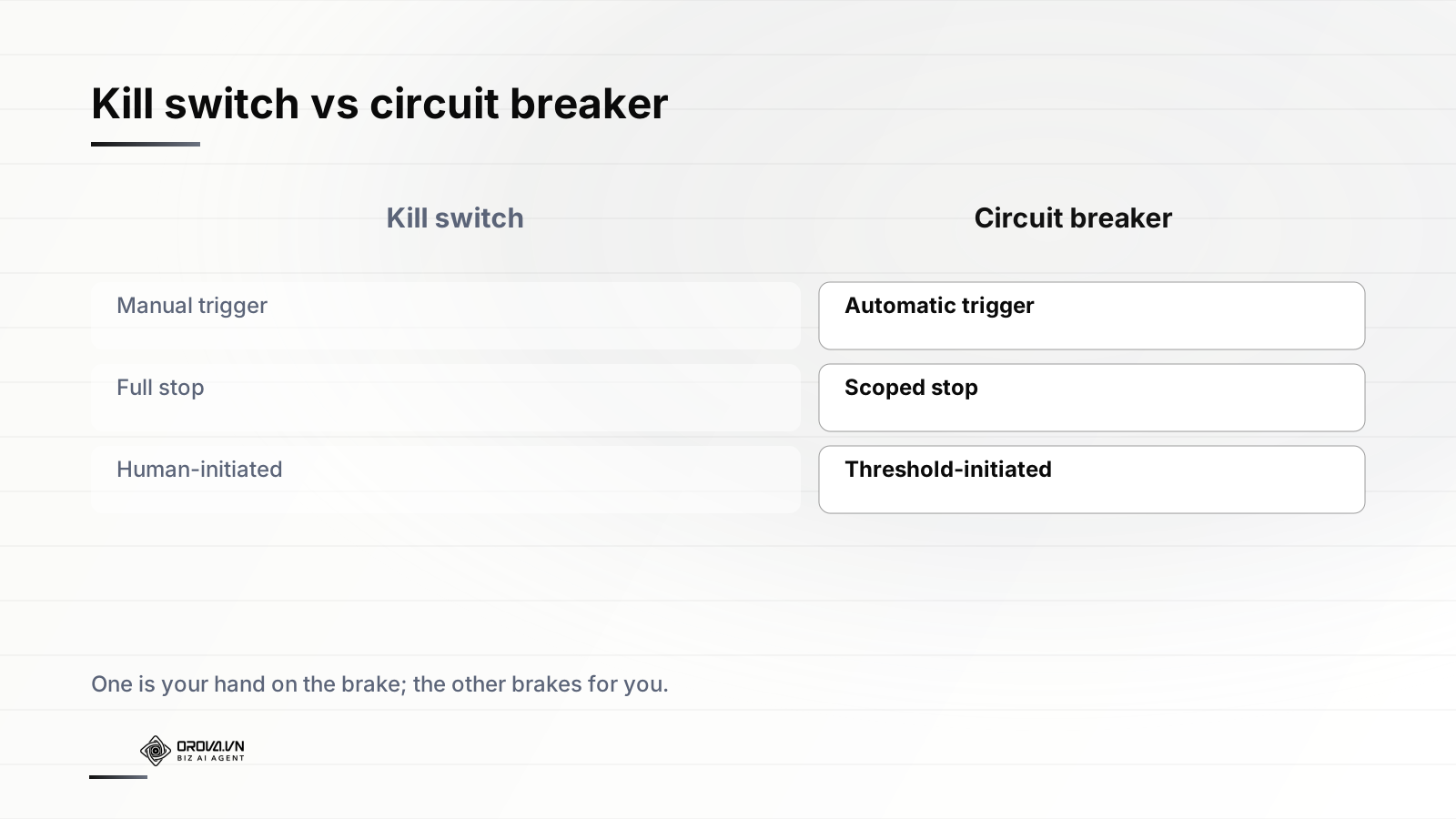
A kill switch is the big red button. A human decides, for any reason, that everything should stop now, and one action halts all spend across the account — or across a defined blast radius like a single brand, market, or platform. The defining traits of a good kill switch are that it is manual, fast, and total within its scope. You don't pull a kill switch because a metric crossed a line; you pull it because your judgment says stop, and you may not even know the full reason yet.
Real situations that call for a kill switch are rarely about a single misbehaving campaign. They are about events the automation can't see: a PR crisis where you do not want your brand appearing next to the wrong news cycle, a pricing error on the site, a product recall, a payment or billing dispute, a data breach, or simply the gut feeling of an experienced operator that something is off and they want everything frozen while they investigate. The value of a kill switch is that it requires no diagnosis. You hit it first and figure out the details after the bleeding has stopped. A kill switch that takes ten minutes and twelve clicks to deploy is not a kill switch; it's a procedure, and procedures fail under stress.
The circuit breaker: threshold-initiated, scoped stop
A circuit breaker is automatic. No human is in the loop at the moment it trips. It continuously watches a small number of well-chosen signals and, when one crosses a predefined threshold, it pauses the offending unit — a campaign, an ad set, a budget — without waiting for approval. Its defining traits are the mirror image of the kill switch: it is automatic, threshold-driven, and typically scoped rather than total. A breaker doesn't shut down your whole account because one ad set's CPA doubled; it pauses that ad set and leaves the rest running.
The reason you need a breaker even if you have a kill switch is simple: humans sleep, take weekends, sit in meetings, and miss notifications. The most expensive failures happen precisely when no one is watching, which is exactly when a manual switch is useless. The breaker is the part of your system that protects you at 2:14 a.m. It is not as smart as a person, and it doesn't need to be. It needs to do one thing reliably: stop the spend the moment a clear danger signal appears, and trust that a human will sort out the nuance later.
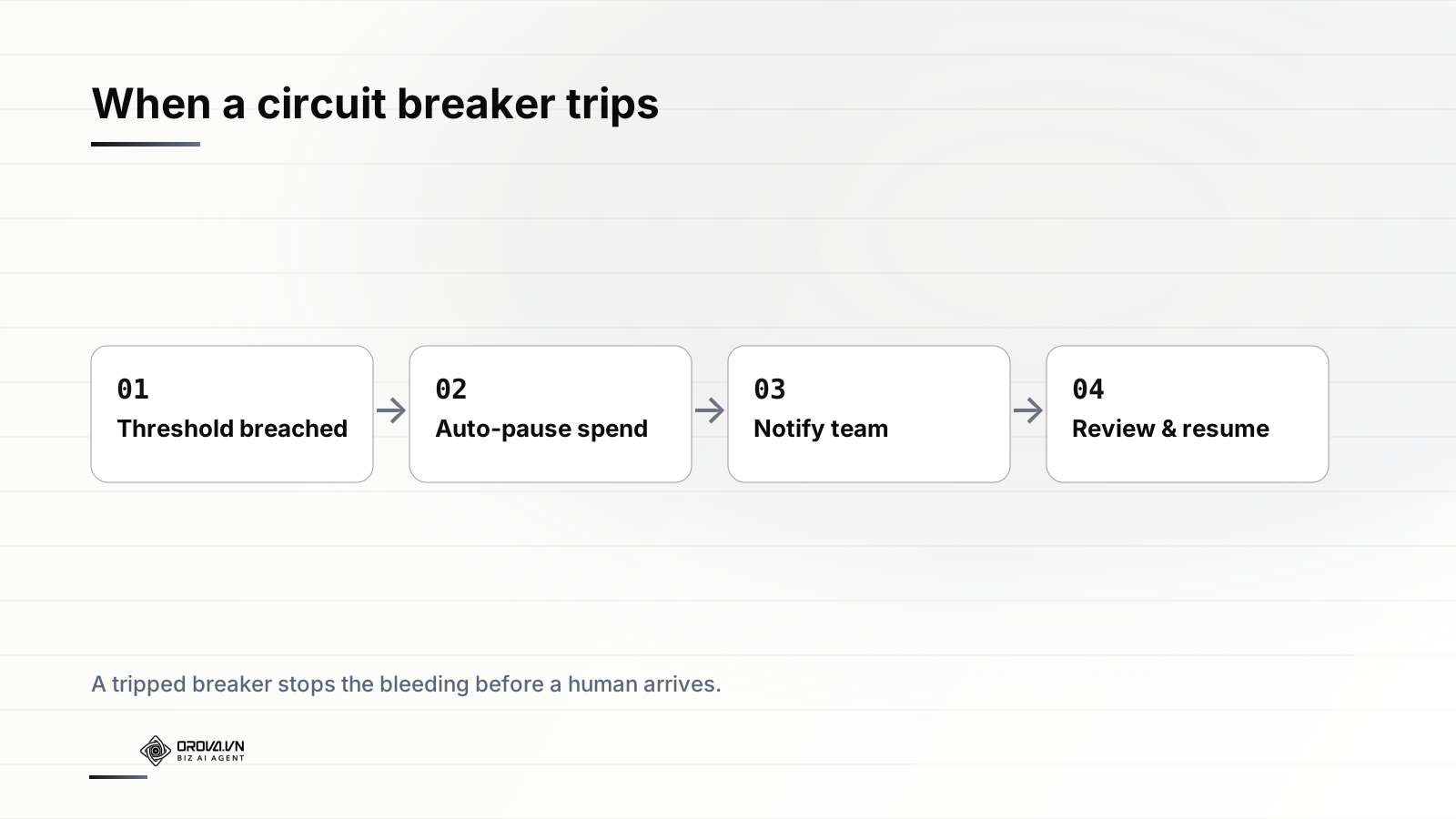
The two mechanisms are complementary, not redundant. The breaker handles the common, fast, measurable failures automatically and at small scope. The kill switch handles the rare, ambiguous, judgment-call failures manually and at large scope. A mature account has both wired up before it ever needs them — because the day you need an emergency stop is precisely the day you have no time to build one. If you are still deciding how much autonomy to hand your automation in the first place, it's worth reading our take on whether you should let AI spend your budget alongside this, since safety rails are what make a "yes" answer responsible rather than reckless.
What should trip a breaker: choosing your trigger conditions
A circuit breaker is only as good as the signals it watches. Pick the wrong triggers and you get one of two failure modes: a breaker that never trips when it should (useless), or one that trips constantly on normal volatility (annoying enough that people disable it, which is worse than useless). The goal is a small set of triggers that fire on genuine danger and stay quiet during ordinary noise. Here are the conditions that earn their place.
Spend rate spike
The most direct trigger is spend velocity. If a campaign or account is spending dramatically faster than its recent baseline, something is usually wrong even if you don't yet know what. A practical rule is to define an hourly or rolling spend rate and trip the breaker when actual spend exceeds, say, 2x to 3x the expected rate for that time of day. The "time of day" qualifier matters: many accounts spend more in business hours and less overnight, so a flat threshold either misses daytime runaways or false-trips during normal evening pacing. Compare spend to the expected curve, not to a single number.
Spend spikes catch the most dangerous class of failure — duplicated campaigns, removed budget caps, bid limits accidentally deleted, or an automation rule that scaled too aggressively — because all of them manifest first as money going out the door faster than planned. Even when the root cause is exotic, the symptom is the same and the breaker can act on the symptom.
CPA or ROAS blowout
Spend going up isn't always bad — sometimes you're spending more because you're winning more. The crucial pairing is to also watch efficiency. A breaker on cost-per-acquisition trips when CPA over a recent window exceeds a multiple of your target — for example, sustained CPA above 2.5x target across enough conversions to be statistically meaningful. The equivalent for revenue-tracked accounts is a return-on-ad-spend (ROAS) floor: if ROAS drops below a critical threshold over a meaningful window, pause.
The discipline here is the "meaningful window" part. A single expensive conversion, or a ten-minute stretch with one sale, tells you nothing — CPA on tiny samples swings wildly. Trip on a sustained breach over enough volume that the number is real. Otherwise you will pause healthy campaigns during normal early-morning thinness and train your team to ignore the alerts.
Conversion tracking failure
This is the silent killer and the one most accounts miss. If conversions suddenly drop to zero or near-zero while clicks and spend continue normally, the most likely explanation is not that your product stopped selling — it's that tracking broke. A pixel got removed in a site deploy, a tag manager change misfired, a consent banner update started blocking the tag, or the conversion API connection dropped. To the bidding engine, zero reported conversions looks like collapsing performance, and depending on the strategy it may either keep spending blindly or thrash trying to "recover." Either way you're now flying blind and paying for it.
The most expensive ad failures are rarely loud. They look like business as usual on the surface — clicks flowing, budget pacing — while the number that actually matters has quietly gone dark.
A breaker that watches the conversion-to-click relationship, and pauses or alerts when conversions flatline against continuing traffic, protects you from the exact scenario in the opening story. It is arguably the single highest-value trigger to implement, precisely because it catches failures the rest of your dashboard makes look fine.
Anomalous click or traffic patterns
Sudden, implausible surges in clicks or impressions — especially from a narrow geography, a single placement, or with a wildly different click-through rate than normal — can indicate click fraud, a bot wave, or a placement gone rogue. A breaker on traffic anomalies won't catch everything fraud-related, but it provides a backstop against the obvious cases where your spend graph spikes vertically for reasons that have nothing to do with real demand.
External and account-health signals
The most sophisticated breakers reach beyond the ad platform. If your website's uptime monitor reports the landing page is down, there is no point spending a cent driving traffic to it — a breaker tied to site health can pause spend automatically until the page returns. Similarly, breakers can watch for platform-side account warnings, policy flags, or billing failures and respond before those problems compound. The principle is that the best signal of whether you should be spending often lives outside the ad account entirely.
Scope: how much should a trip actually stop?
Once a breaker trips, the next design question is blast radius. Stop too little and the fault continues elsewhere; stop too much and one twitchy ad set takes your whole account offline at the worst possible moment. Scope is where good emergency-stop design earns its keep, and it should be deliberately layered.
- Ad set / ad group level. The narrowest scope. A single misbehaving ad set blows its CPA, so the breaker pauses just that ad set and leaves everything else running. This is the right default for efficiency-based triggers, where the problem is usually localized.
- Campaign level. When a trigger suggests the problem spans a whole campaign — a budget that's misconfigured, a creative set that all broke together — pausing the campaign is the proportionate response.
- Account or platform level. Reserved for triggers that indicate something systemic: a tracking failure affecting all conversions, a billing problem, an account-wide spend spike that can't be traced to one campaign. This is where the breaker starts to overlap with the kill switch.
- Cross-platform. The widest scope, usually reserved for the manual kill switch, where a brand-level event means you want everything dark across Google, Meta, TikTok and anywhere else simultaneously.
The art is matching scope to cause. A conversion-tracking failure is account-wide by nature — pausing one ad set is pointless when the tracking is broken everywhere — so it warrants a broad trip. A single ad set's CPA blowout is local, so it warrants a narrow one. Hard-wiring "trip the smallest unit that fully contains the problem" into your design prevents both under- and over-reaction.
Avoiding the false-positive trap
The fastest way to kill a circuit breaker is to make it trip too often. The first time it pauses a perfectly healthy campaign during a normal Sunday-night lull, people grumble. The third time, someone quietly raises the thresholds to the point of uselessness or turns the breaker off entirely. A breaker nobody trusts is worse than no breaker, because it creates a false sense of safety. Designing against false positives is therefore not a nicety; it's what keeps the system alive.
Several techniques help here. Use rolling windows, not instantaneous readings — judge spend and CPA over a meaningful recent period so a single odd minute can't trip anything. Require minimum volume before an efficiency breaker can fire, so thin-traffic noise is excluded. Compare against expected curves rather than flat thresholds, so normal time-of-day and day-of-week patterns don't look like anomalies. And tier your responses: a soft breach can fire an alert that asks a human to look, while only a hard, sustained breach triggers an automatic pause. That last point is important — not every trigger needs to slam everything off. The mildest setting of a breaker is simply to notify; the strongest is to pause; many situations are best served somewhere in between.
Test the breaker before you need it
An emergency stop you have never tested is a hypothesis, not a safeguard. The teams that get burned are almost always the ones who configured a breaker, never fired it, and discovered on the worst day that the integration token had expired, the pause action lacked permissions, or the alert went to a Slack channel nobody monitors anymore. Periodically and deliberately trip your breakers in a controlled way — pause a low-stakes campaign on purpose, confirm the right people get notified, confirm the resume path works. A fire drill is cheap. A breaker that silently failed is exactly as expensive as having no breaker at all, plus the false confidence.
Resuming safely after a trip
Stopping is only half the system. A breaker that trips and then nobody knows how to safely turn things back on creates a different problem: campaigns left paused for days because everyone is afraid to un-pause them, quietly bleeding opportunity instead of money. Safe resumption deserves as much design attention as the trip itself.
- Diagnose before you resume. The breaker bought you time by stopping the spend; use that time. Confirm what actually tripped it and whether the root cause is fixed. Resuming because the metric "looks better now" without understanding why is how you trip the same breaker an hour later.
- Verify the underlying systems. If a tracking failure tripped the breaker, confirm the pixel or conversion API is genuinely reporting again — fire a test conversion and watch it land — before turning spend back on. Resuming into a still-broken tracking setup just restarts the original problem.
- Resume gradually where it matters. For a campaign that was scaling aggressively when it tripped, consider bringing it back at a reduced budget and letting it re-stabilize, rather than restoring it to full throttle the instant the metric clears. The learning systems behind modern campaigns can behave erratically right after a hard stop, and easing back in reduces the chance of an immediate second trip.
- Log everything. Every trip, every resume, who approved it, what the values were, and what the root cause turned out to be. Over time this log becomes the single most useful artifact you have for tuning thresholds, because it shows you exactly which trips were real saves and which were false positives to engineer out.
The audit trail in particular is what turns a one-off scare into institutional learning. After a few months of logged trips, you can see patterns: that one campaign that trips every Monday because of a recurring data lag, the threshold that's slightly too tight, the alert that consistently reaches the wrong person. Each entry is a chance to make the system quieter and more trustworthy.
Where automation and human judgment meet
The deepest reason both mechanisms exist is that they encode two different kinds of trust. The circuit breaker says: for these specific, measurable dangers, I trust a predefined rule to act faster than a human can. The kill switch says: for everything else — the ambiguous, the novel, the gut-feel — I trust a human to override the machine entirely. A well-run automated ad operation doesn't choose between trusting the machine and trusting the person. It defines exactly where each one is in charge.
This is the practical heart of "human-in-the-loop" done properly. It's not about a person babysitting every bid change; that defeats the point of automation and doesn't scale. It's about the human setting the boundaries — the thresholds, the scopes, the kill-switch authority — and then letting the automation operate freely inside those boundaries, with the breakers as the guardrails that keep it from driving off a cliff while no one is looking. The person is in the loop at the level of policy and oversight, not at the level of every individual action. That is the only version of human oversight that survives contact with the speed and volume of modern advertising.
If you take one idea from all of this, let it be this: the question is never whether your automation will eventually do something wrong. It will, because the world feeds it bad data sometimes and broken instructions other times. The only question that matters is whether, when that happens, your system stops itself in fifteen minutes or keeps going until a human wakes up. Kill switches and circuit breakers are how you make sure the answer is fifteen minutes — and they are cheapest to build on a calm afternoon, long before you ever need them.
Orova Ads builds this safety thinking in from the start. It's an AI agent that manages your paid campaigns across Google, Meta and TikTok — reading performance data every day, recommending the optimizations that matter, and executing them on budgets, bids, on/off states and audiences with human-in-the-loop approval and a full audit log of every move. The autonomy is real, but so are the brakes. See how it keeps spend under control at orova.vn.
Related reading: What Is an AI Ads Agent? Autonomous Ad Management Explained
Orova Ads optimises campaigns for you
Connect Google, Meta and TikTok in one place. AI reads the numbers, proposes changes and executes under the rules you set.
Explore Orova Ads