
The Content Strategy Framework I Wish I Had 10 Years Ago
I have been doing content marketing for long enough to have made every mistake worth making at least twice. I have launched blogs that published faithfully for a year and produced nothing. I have written articles I was proud of that no one ever found. I have sat in the quarterly review where the only honest summary of the content program was "we were busy." And somewhere in the middle of all that, slowly and expensively, I assembled the framework I wish someone had handed me on day one.
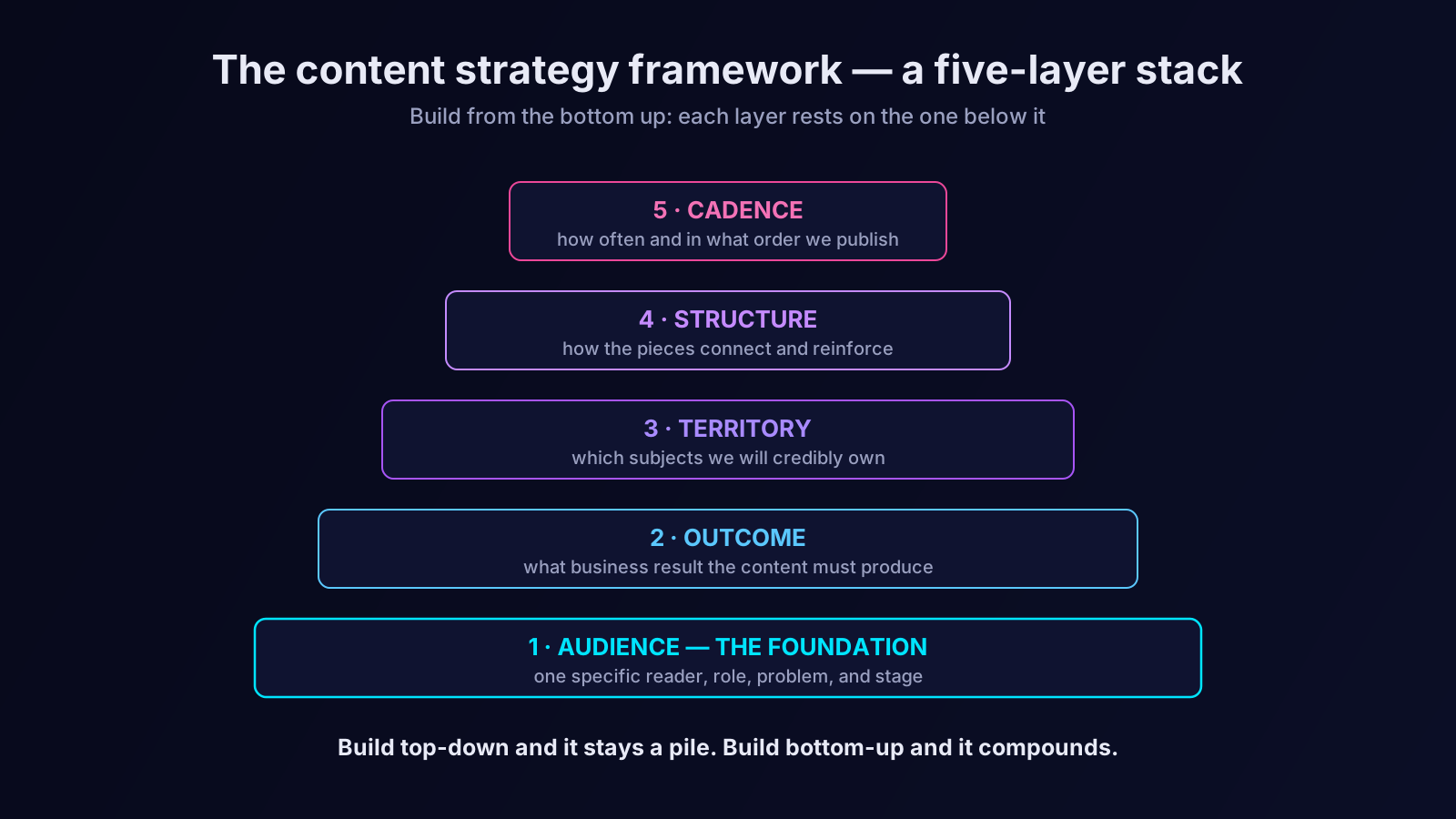
This is that framework. It is not clever and it is not new — most of it would be familiar to anyone who has thought hard about content. What it is, is ordered. The reason my early years were wasted was almost never that I did the wrong things. It was that I did the right things in the wrong sequence, or skipped the unglamorous steps and went straight to the satisfying ones. The framework is mostly a way of refusing to do that. Here are its five parts, in the order that matters.
The years before the framework
It is worth describing the failure first, because the framework only makes sense as a reaction to it.
For my first few years, "content strategy" meant, in practice, a list of article ideas and a publishing schedule. Someone had a topic, it sounded good, it went on the list, it got written, it got published. We hit our cadence. We were proud of our cadence. And the blog grew into a large archive of individually decent articles that, collectively, did almost nothing — no meaningful traffic growth, no measurable contribution to the business, no sense that the program was getting stronger as it got bigger.
The thing that finally made me stop was realising that if I deleted half the archive at random, nothing measurable would change. That is a brutal test, and the program failed it completely. The content was not an asset. It was just a pile. And a pile does not become an asset by getting taller. Something structural was missing, and the framework below is my attempt to name what.
Layer one: the audience decision
Everything starts with one decision, and it is the decision I used to skip fastest because it felt obvious: who, exactly, is this for?
Not "marketers" or "small businesses" — that is not an audience, it is a continent. The decision I learned to force is narrow and specific. One particular kind of person, in one particular role, with one particular problem, at one particular stage of trying to solve it. The narrower I made this, the better everything downstream worked, which surprised me for years because it feels backwards — surely a broader audience means more readers?
It does not, because content written for everyone is calibrated for no one. It pitches its assumed knowledge at an average that matches no real reader. The articles that actually performed for me were the ones written as if for a single, sharply imagined person. So layer one of the framework is a written, specific audience definition, and the rule is that nothing else gets decided until it exists.
Layer two: the outcome decision
The second decision is the one I most wanted to wave away with something vague. What is this content actually supposed to do for the business?
"Build awareness" was my favourite non-answer for years, because it cannot be checked, which meant it could never be wrong. The framework's second layer is the discipline of replacing that with an outcome you could actually recognise. Qualified signups. Support for an active sales conversation. Educating a market about a category it does not yet understand. Reducing churn by helping existing customers succeed. Each of those implies completely different content, and naming which one you are after is what makes the rest of the framework decidable.
For years I measured whether the content was good. The framework taught me to measure whether the content was for something. Those are not the same question, and only the second one matters.
The two together — a specific audience and a recognisable outcome — are layer one and layer two, and they are non-negotiably first. Every painful review meeting in my early career traces back to having skipped one or both.
Layer three: the territory decision
With an audience and an outcome fixed, the third layer asks: what subjects are we going to credibly own?
This is the layer where I learned the most, because it is where I had been weakest. My old approach treated every article as an independent idea. The framework treats articles as residents of a territory. You choose a defined set of subjects — connected, bounded, central to your audience and your outcome — and you commit to covering them with real depth, rather than scattering single articles across a dozen unrelated areas.
The shift in thinking is from "what should we write about?" to "what should we be known for?" The first question produces a calendar. The second produces a territory. And depth within a territory is what eventually earns the right to rank for the competitive terms — search engines reward demonstrated comprehensiveness, and comprehensiveness is impossible if your effort is spread thin across subjects you only touched once.
Layer four: the structure decision
The fourth layer is the one that converts a territory into something that compounds: how do the pieces fit together?
A territory covered as a flat list of articles is better than a random archive, but it still leaves most of the value on the table. The structure layer arranges that territory deliberately. Broad foundational pieces anchor each part of the subject; specific, focused pieces sit beneath them, answering particular questions; and the pieces link to one another so that a reader — and a search engine — can move through the territory and see how comprehensively it has been covered.
This is the layer my early work was missing entirely, and adding it is the single change that made the biggest difference. When the structure is right, every new article makes the existing ones more valuable, because it adds another supporting piece to a coherent whole. A deliberate internal linking structure is the connective tissue of this layer — it is what physically turns a set of separate pages into a navigable, mutually reinforcing system. Without structure, you publish a hundred articles and have a hundred articles. With it, you publish a hundred articles and have an asset.
Layer five: the cadence decision
Only at the fifth and final layer does the framework let you ask the question I used to start with: how often, and in what order, do we publish?
Cadence matters — consistency is real, and a program that publishes erratically struggles to build momentum. But cadence is the top of the stack, not the bottom. It is the operational rhythm that delivers a strategy already decided in the four layers below. My fundamental early mistake was starting here: I picked a publishing frequency and then scrambled to fill it. The framework inverts that. You decide audience, outcome, territory, and structure, and the cadence simply paces the delivery of work whose purpose is already settled.
Get the order right and cadence becomes easy, because you are never staring at an empty slot wondering what to write. The territory and structure already told you. You are just deciding what to deliver next from a plan that exists.
Why the order is the whole point
If there is one thing I would tattach to this framework with a permanent label, it is that the layers are a sequence, not a menu. You build from the bottom. Audience before outcome, outcome before territory, territory before structure, structure before cadence.
Every wasted year of my early career was a year spent building from the top — starting with cadence and titles, and never laying the foundation underneath. The work was not lazy. The cadence was hit. The articles were competent. But a competently built top floor with no foundation under it is still going to behave like a pile, and that is exactly what my archive was. The framework did not make me work harder. It made me work in the right order, and that turned out to be the entire difference between a blog that stayed a pile and one that finally started to compound.
There is a second, subtler benefit to respecting the order, and I only noticed it after a couple of years of working this way. When the layers are built in sequence, every decision higher up has a reason you can point to lower down. Why this territory? Because of that outcome. Why this structure? Because of that territory. Why this piece, this week? Because of that structure. The whole program becomes explicable — you can defend any single article all the way back to the audience definition. In my pile-building years I could not do that. If someone asked why a given article existed, the honest answer was "it seemed like a good idea at the time," and a program made entirely of good-ideas-at-the-time has no spine. The framework gave the program a spine, and a spine is what lets it survive a change of personnel, a change of management, a quarter of pressure — because the reasoning is written down, not carried in one person's head.
How I run the framework as a recurring review
One thing I got wrong even after I had the framework was treating it as a one-time exercise — something you do at the launch of a content program and then file away. That is not how it has served me best. The framework is most valuable as a recurring review, a lens I run the whole program through every quarter.
The review is simply the five layers, asked again as questions. Has the audience shifted — has the product moved upmarket, has the buyer's role changed, do we now need to speak to a different stage of awareness? Has the outcome changed — is the business now asking content to support sales conversations where last year it wanted top-of-funnel education? Has the territory drifted — have we started publishing into subjects that are not really ours, or left a part of our chosen territory thin? Is the structure still sound — have new pieces created overlaps, are there clusters with no anchor, are there stranded pages? And is the cadence honest — are we publishing at a rhythm the team can actually sustain, or quietly burning out to hit a number?
Running that review on a schedule is what keeps a content program from slowly decaying back into a pile. Programs do not fail all at once; they drift. A quarter of slightly-off-territory articles here, a few accidental overlaps there, and within a year a once-coherent program has lost its shape. The framework-as-review catches the drift while it is still small and cheap to correct. I wish I had understood, in my early years, that strategy is not a document you write once. It is a question you keep asking.
The mistake the framework does not prevent
I want to be honest about a limit of this framework, because frameworks are usually sold as if they solve everything and this one does not. The five layers make sure you build in the right order. They do not make sure you build well within each layer.
You can define an audience precisely and still define the wrong audience — a group that is easy to reach but will never buy. You can name a clear outcome and still name a vanity outcome that looks good in a report and means nothing to the business. You can map a territory crisply and still choose a territory with no commercial gravity. The framework guarantees sequence, not judgement. It ensures you do not skip the foundational decisions; it cannot ensure those decisions are good ones.
I mention this because in my early framework-using years I leaned on it too hard — I treated "I followed the framework" as if it were the same as "I got it right." It is not. The framework is scaffolding for thinking, not a substitute for it. The judgement still has to be good. What the framework reliably does is make sure the judgement gets applied — to audience, to outcome, to territory — instead of skipped in the rush to a calendar. That is a large and real benefit. It is just not the same as being correct, and I would tell my younger self not to confuse the two.
What I would tell myself on day one
If I could hand this to my younger self with one sentence of instruction, it would be: resist the urge to start producing. The instinct to skip the abstract layers and get to visible output is the most natural and most expensive instinct in this work. Producing feels like progress. Filling a calendar feels like a strategy. And neither is true until the foundation underneath them exists.
The honest difficulty is that the foundational layers — defining the audience, mapping the territory, structuring it so the pieces reinforce each other — are slow, abstract, and unrewarding in the moment, which is precisely why they get skipped. That is the part I would most want help with now, and it is the part an SEO AI agent is genuinely suited to. Orova can take a defined audience and outcome and do the heavy structural work of layers three and four: mapping the territory of subjects around that audience, organising those subjects into a coherent linked structure, and turning the result into a sequenced plan — so the foundation gets built instead of skipped. The strategic decisions at the base of the stack are still yours to make. But the framework only works if you actually do the unglamorous middle layers, and having an agent carry that load is the difference between a framework you admire and a framework you use. I wish I had had both — the framework and something to make its hardest layers achievable — ten years ago.
Let an AI Agent handle your SEO
Orova plans, writes, optimizes, and tracks rankings on its own — you just read the results.
Try it free