
How to Audit Your Existing Content Before Writing Anything New

Most content teams, when they want to grow, do the same thing: they plan new articles. It is the obvious move. Growth means more, more means new, new means a list of titles to commission. And it is very often the wrong move — or at least, the wrong first move.
Before you write a single new article, you should audit the ones you already have. Not as a tidy-up chore, but as a strategic step that routinely uncovers faster, cheaper wins than anything on a new-content plan, and that prevents you from building new work on top of problems you have not yet found. This is a practical, step-by-step guide to running that audit. It assumes you have an existing body of content — anything from a few dozen articles up — and it produces a clear set of decisions about every one of them before you commission anything new.
Why audit before writing — the case in one paragraph
Here is the logic. New content is the slowest and most expensive way to grow, because a new article starts from zero — zero rankings, zero authority, zero links — and takes months to mature. Your existing content has already done the hard early work. A page that ranks on the second page of results is far closer to traffic than a blank document is. Fixing it is faster and cheaper than writing a new piece, and the audit is how you find every such opportunity. Beyond that, the audit surfaces problems — pages competing with each other, thin pages dragging the whole site down, gaps in your coverage — that would silently undermine any new content you layered on top. Audit first, and you build on solid ground. Write first, and you build on whatever was already there, flaws included.
Step one: build the complete inventory
You cannot audit what you cannot see, so the audit begins with a complete list of every piece of content you have published. Every article, every guide, every landing page that holds editorial content. Not the ones you remember — all of them. Most teams underestimate their own archive substantially, and the forgotten pages are often exactly where the problems hide.
For each URL, gather a basic set of facts: the title, the target topic or query, the publish or last-updated date, its current organic traffic, its current ranking position for its main query, and how many internal links point to it. This factual layer is the raw material for every decision that follows. Do not skip the unglamorous data-gathering — an audit done from memory and impression simply reproduces your existing assumptions, and the whole value of an audit is that it overrides assumptions with evidence.
Step two: assign every page one of four verdicts
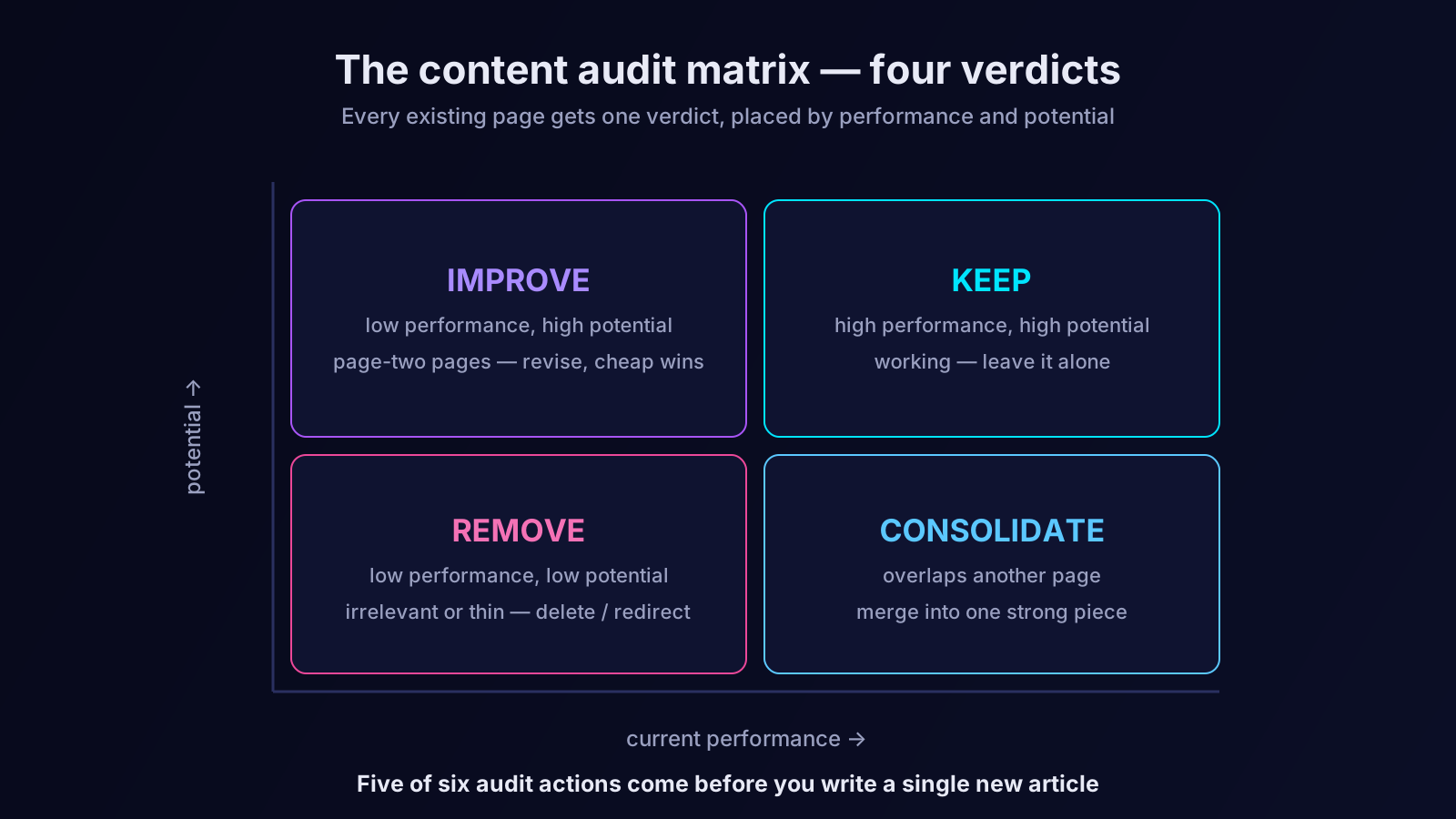
With the inventory built, you go through it page by page and give each URL exactly one verdict. Four verdicts cover every case.
Keep. The page is performing — ranking well, attracting relevant traffic, accurate, aligned with your strategy. It needs nothing. Resist the urge to fiddle with what works.
Improve. The page has clear potential it is not realising. It ranks on page two for a valuable query. It once had traffic and has slipped. It is fundamentally sound but out of date, or shallow where it should be deep. These pages are the gold the audit is mining for — they are close to a win and a revision is far cheaper than a new article.
Consolidate. The page overlaps substantially with one or more other pages. Two or three articles target nearly the same query and split the result between them. These need to be merged — combined into one strong, comprehensive page — which usually lifts the merged result above what any of the fragments achieved alone.
Remove. The page has no realistic future. It targets something irrelevant to your business, or a query with no demand, or it is so thin and so far from ranking that improving it would cost as much as starting over. These pages are not neutral — they are a drag — and removing or redirecting them is a genuine improvement.
Every page gets one verdict. The discipline is to actually decide — "not sure" is not a verdict, and pages left undecided are pages that will keep quietly causing problems.
Step three: hunt specifically for cannibalisation
Of all the problems an audit uncovers, the most damaging and the most invisible is keyword cannibalisation — two or more of your own pages competing for the same query. It is invisible because each page looks fine on its own; the problem only appears when you see them side by side, which is exactly what an audit does.
To find it, group your inventory by target query and look for clusters where multiple URLs aim at the same or near-identical search. When you find such a cluster, you have a decision: consolidate the competing pages into one definitive piece, or sharpen each one to target a genuinely distinct query so they stop competing. The principle behind the fix is one query, one page — covered in depth in our guide to turning keywords into a content plan. Doing this hunt before you commission new content is critical, because writing a new article without knowing your existing cannibalisation map is how you accidentally create a fourth competitor for a query three of your pages already fight over.
Step four: map the gaps against your strategy
The audit so far has been about what you have. This step is about what you are missing — and it is the bridge to the new content you will eventually write.
Lay your inventory against the territory your strategy says you should own. Where are the holes? Which sub-topics within your territory have no coverage at all? Which have only shallow coverage where depth is needed? Which parts of the buyer's journey — early-stage education, mid-stage comparison, late-stage decision support — are thinly served? This gap map is the only legitimate source of a new-content plan. New articles should exist to fill identified gaps in a strategic territory, not to satisfy a brainstorm. The audit, by showing you precisely what is missing, turns "what should we write?" from a guessing game into a reading of a map.
An audit does not just clean up the past. It is the only honest way to decide the future — because you cannot know what to write next until you know what you already have.
Step five: check the internal link structure
One more pass before you stop, and it is the one most audits skip. Look at how your pages connect to each other.
You are looking for two faults. The first is orphan pages — articles with few or no internal links pointing to them, effectively stranded, hard for both readers and search engines to discover. The second is imbalance — your most important pages receiving weak internal linking while minor pages are over-linked. Both are cheap to fix and disproportionately effective, because internal links route authority and attention through your site. Often the single highest-return action an audit produces is not rewriting anything at all — it is adding a handful of well-placed internal links to a page that was strong but stranded.
Step six: turn the audit into a sequenced action list
An audit that ends as a spreadsheet of verdicts has done half its job. The final step converts those verdicts into an ordered list of actions, and the order is chosen to bank the fastest wins first.
A sound sequence runs roughly like this. First, the quick structural fixes — adding internal links to stranded high-value pages — because they cost almost nothing and can move results within weeks. Second, the consolidations — merging competing pages — because resolving cannibalisation often lifts rankings quickly. Third, the improvements — revising the page-two pages with real potential — because they are close to the surface and cheaper than new work. Fourth, the removals, cleaned up so they stop dragging. And only then, fifth, the new content that fills the gaps the audit identified. Five of the six action types come before you write anything new. That ordering is the entire point of auditing first: it ensures the fast, cheap, high-certainty wins are captured before the slow, expensive, uncertain work of new content begins.
The mistakes that ruin an audit
An audit is only as good as the honesty and rigour you bring to it, and there are a few predictable ways teams undermine their own. Naming them is the cheapest way to avoid them.
The first is sentiment over evidence. Teams find it hard to mark "remove" against an article someone worked hard on, or "improve" against a piece a senior person wrote. The verdict drifts toward "keep" not because the data supports it but because the verdict is socially comfortable. An audit run on sentiment simply ratifies the archive you already have. The discipline is to let the data — traffic, ranking, overlap, links — drive the verdict, and to depersonalise the process: pages are pages, not the reputations of the people who wrote them.
The second is the incomplete inventory. An audit that quietly omits the pages nobody remembers is an audit that misses exactly where the problems concentrate, because forgotten pages are the ones most likely to be stale, orphaned, or cannibalising. If the inventory is partial, every conclusion drawn from it is partial too.
The third is auditing without a strategy to audit against. The gap-mapping step and even the verdicts themselves depend on knowing what you are trying to be — which territory you intend to own, which audience you serve. If that is undecided, "is this page relevant?" has no answer, and the audit collapses into vague tidying. An audit is a comparison of what you have against what you intend; without the second half, it is just a list.
The fourth is auditing and not acting. The most common fate of an audit is a thorough, intelligent spreadsheet that is admired, filed, and never executed. An audit that does not change the site changed nothing. The sequenced action list from step six exists precisely to convert analysis into scheduled, owned, dated work — and the audit is not finished until that work is on someone's calendar.
What a good audit feels like afterward
It is worth describing the payoff, because the audit is upfront effort and the reward is easy to underestimate before you have felt it.
After a real audit, the uncertainty that surrounds most content programs is largely gone. You know what you have. You know which pages are working and which are not, and why. You know where your own pages compete with each other. You know where the genuine gaps are, which means you know what new content should exist and — just as valuable — what new content should not, because it would duplicate something already published. The blank-page anxiety of "what do we write next" is replaced by a reading of a map.
You also tend to find that the first few months of post-audit work produce results faster than any new-content sprint would have, because the improve and consolidate actions operate on pages that already have some standing with search engines. Growth arrives sooner and cheaper than expected, and it arrives on a foundation you have actually inspected rather than assumed. That combination — faster results and verified ground — is the whole return on auditing first, and it is why the audit deserves to be a scheduled habit rather than a crisis response.
How often to run it
An audit is not a once-ever event. As a rule of thumb, a full audit once or twice a year keeps an active program healthy, with a lighter check on recent content quarterly. The larger and faster-moving your archive, the more often it pays off. The key mindset shift is to treat the audit as a recurring, scheduled part of the content cycle — not as an emergency response to a traffic crisis. Programs that audit on a schedule rarely have the crisis in the first place.
Why this is hard to do well by hand
Everything in this guide is doable manually, and for a small archive you should simply do it. But it is worth being honest about the difficulty as the archive grows. A thorough audit of a few hundred pages means gathering data on every URL, comparing every page against every other to find overlap, mapping coverage against a strategic territory, and tracing the internal link graph. That is a large, exacting, repetitive task — and because it is large and repetitive, it is the task most often shortened, skipped, or done from memory, which defeats its purpose.
This is precisely the kind of structured, large-scale analysis an SEO AI agent is built to carry. Orova can inventory an existing site, surface the pages competing for the same query, flag stranded and under-linked pages, compare your coverage against the territory you have chosen to own, and assemble the four-verdict map and the sequenced action list — turning an audit that might otherwise take a focused week into a draft you review and refine. The judgement stays yours: you decide your strategy and you make the final calls on each page. What the agent removes is the sheer mechanical weight that causes most teams to skip the audit and reach straight for the new-content plan. And skipping the audit, as this guide has argued from the first paragraph, is how growth gets slow and expensive. Audit first. Write second. In that order, growth is faster, cheaper, and built on ground you have actually checked.
Let an AI Agent handle your SEO
Orova plans, writes, optimizes, and tracks rankings on its own — you just read the results.
Try it free