
Why "Just Publish More" Is the Most Expensive SEO Advice
There is a piece of advice that has been given to more content teams than almost any other, usually with great confidence and the best of intentions. It is two words long. Publish more. Your traffic is flat? Publish more. Competitors pulling ahead? Publish more. Not sure what is wrong? Publish more — it can't hurt.
It can hurt. It can hurt a great deal, and it does so quietly, which is what makes it the most expensive advice in SEO. This article is built around a handful of aphorisms — short, memorable sentences — because the case against "just publish more" is really a case for thinking, and thinking is easier to carry around in the form of a phrase you can recall in the meeting where someone says "let's just publish more."
"Volume is not a strategy. It is the absence of one."
Start here, because this is the heart of it. When a team cannot explain why their content is not working, "publish more" is attractive precisely because it requires no explanation. It does not demand a diagnosis. It does not name a problem. It simply prescribes more of the same activity and calls it a plan.
But more of an activity that is not working is not a strategy — it is the decision to stop looking for one. If twenty articles produced no results, the useful question is why, and "publish more" is the instruction to not ask that question. It substitutes effort for thought. And effort substituted for thought is the most expensive thing a content team can buy, because it costs real money and real time and produces, reliably, more of the same nothing.
"You cannot out-publish a structural problem."
Here is why volume so often fails to fix things: most stalled content programs are not stalled because of a shortage of articles. They are stalled because of a structural fault — and you cannot out-publish a structural fault. You can only feed it.
Consider the common faults. The content targets the wrong audience — readers who will never buy. The articles compete with each other, two or three pages splitting one query between them so none of them wins. The pieces are disconnected, so the program never accumulates the depth that earns competitive rankings. None of these is a volume problem. Publishing more articles to the wrong audience just reaches more of the wrong audience. Publishing more articles that compete with each other just adds more competitors to the pile-up. The structure is the constraint, and pouring volume onto a structural constraint is like pouring water into a bucket with a hole — you can pour faster and faster and the bucket never fills, and your only conclusion is that you need to pour even faster.
Adding articles to a program with a structural fault does not fix the program. It just makes the fault bigger and more expensive to repair.
"Every article you publish is an article you have to maintain."
This is the aphorism teams forget most completely, because publication feels like a finish line. It is not. It is the start of a liability.
Every published article is now something that can go stale, that can develop broken links, that can drift out of date, that can quietly start competing with a newer piece, that occupies crawl attention, that a reader can land on and judge your brand by. A small, well-kept archive is an asset. A large, neglected archive is a maintenance burden that grows every time you obey the instruction to publish more. "Just publish more" never mentions this cost because the cost is deferred — it shows up months later as an archive nobody has the capacity to keep healthy. But deferred costs are still costs, and they compound.
"Thin content does not stay neutral. It drags."
There is a comforting belief underneath "publish more": the belief that a mediocre article is at worst harmless — it just sits there, neutral, maybe it catches something. This belief is wrong, and its wrongness is a large part of why the advice is so expensive.
Search engines form an impression of a site as a whole. A site that is mostly thin, mostly shallow, mostly written-to-hit-a-number is judged as a site of that character — and that judgement is applied to your good pages too. Thin content is not a neutral occupant of your domain. It is a drag on everything around it. So "publish more," when more means more thin content, is not adding harmless filler. It is actively lowering the ceiling for the genuinely good work you do. The mediocre article you published to hit cadence did not just fail to help. It made your best article a little harder to rank.
"More is not the opposite of stuck. Better-aimed is."
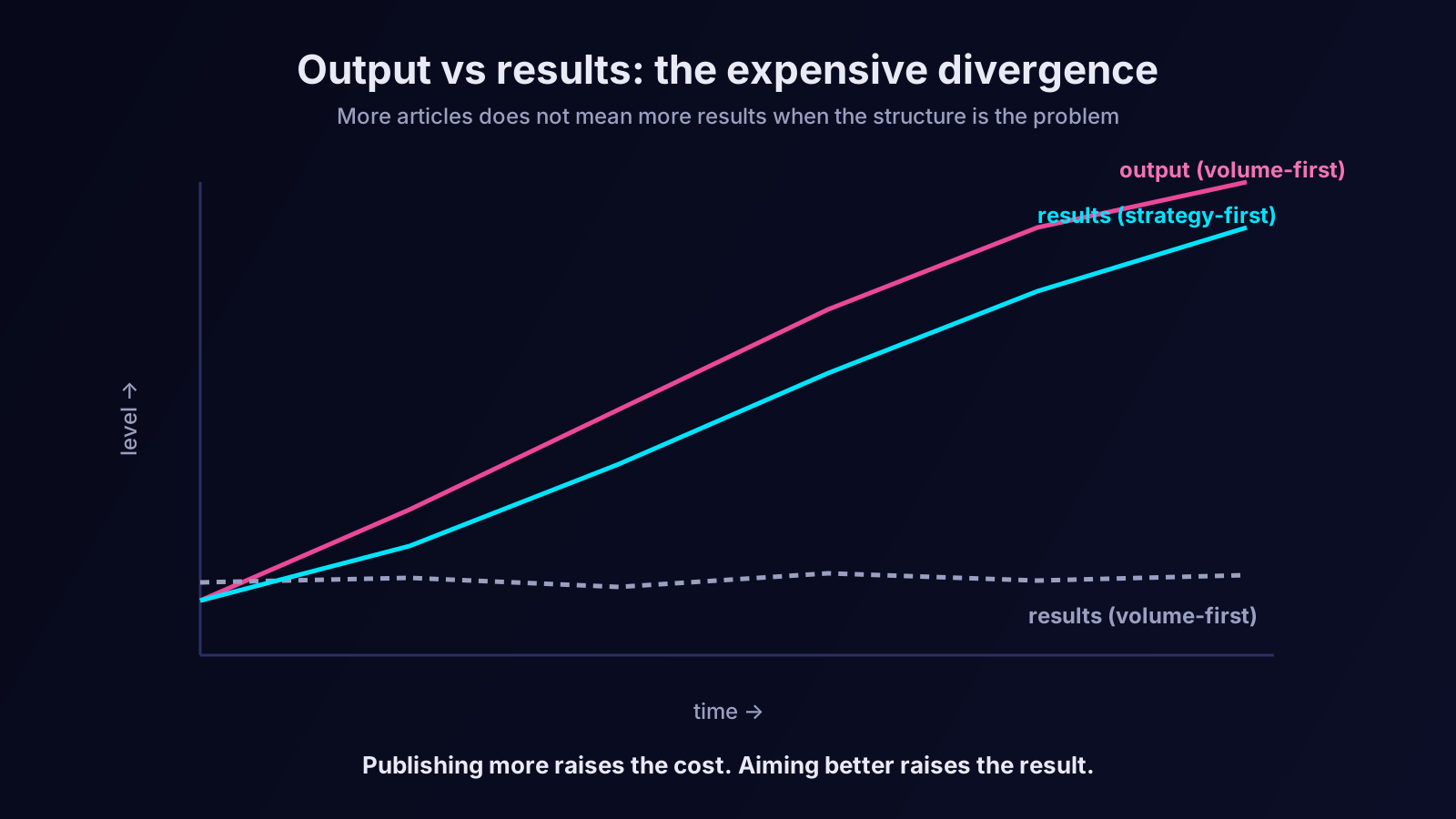
When a program is stuck, the instinct is to reach for more, because more feels like the opposite of stuck. It is not. The opposite of stuck is aimed.
A stuck program is almost always a program firing in no particular direction. The fix is not to fire more rounds in no particular direction — it is to aim. That means doing the diagnostic work "publish more" exists to avoid: identifying which audience you are actually serving, finding where your existing pieces compete and resolving it, deciding which territory you will own and structuring it so the pieces reinforce each other. A program that is properly aimed often publishes less than a panicking one, and outperforms it comfortably, because every piece it does publish is positioned to contribute. The volume was never the lever. The aim was.
"The cost of a bad article is not the article. It is the quarter."
To see the full price of "just publish more," widen the frame. The cost of one weak, strategy-free article is not just the few hundred dollars and few hours it took to make. It is the opportunity.
That same effort, spent on a piece that fit a real strategy, would have contributed to a compounding asset. Spent on filler, it contributed to a pile. Multiply that across a quarter of "publish more" — twenty, thirty, forty articles all commissioned to feed cadence rather than serve a plan — and the true cost is an entire quarter of a team's capacity converted into an archive that does not compound and now also needs maintaining. That is the expense the two-word advice hides. It is not priced as a quarter. It is priced, falsely, as "free — it can't hurt." It can. It costs you the quarter.
"Publish what the strategy needs. Then stop."
So what replaces "publish more"? Not "publish less" — that is just the same un-thinking instruction with the sign flipped. The replacement is "publish what the strategy needs."
That phrase contains a whole different way of working. It assumes a strategy exists — that you have decided your audience, your outcome, your territory, and the structure of that territory. Given that, the strategy itself tells you what to publish next: the piece the structure is missing, the query not yet answered, the cluster that needs one more supporting article. You publish that. And when the strategy's needs are met for now, you stop adding and start maintaining, refreshing, improving — strengthening the asset rather than enlarging the pile. Volume becomes an output of strategy, not a substitute for it. That is the entire reframe, and it is the difference between a program that compounds and one that just gets bigger.
"The advice is cheap to give and expensive to take."
It is worth pausing on why "publish more" spreads so easily, because understanding the mechanism helps you resist it. The advice is asymmetric: it is almost free to give and very expensive to follow, and that asymmetry is exactly what keeps it in circulation.
For the person giving it, "publish more" costs nothing. It requires no analysis of your specific situation, no diagnosis of your specific problem, no risk — if it does not work, the giver can always say you did not publish enough. It is the safest possible recommendation, which is why consultants, executives, and well-meaning colleagues reach for it so readily. It sounds proactive and it can never be proven wrong.
For the team taking it, the cost is enormous and deferred. They spend a quarter of budget and capacity acting on it, and the bill — an archive that does not compound and now needs maintaining — arrives months later, by which point the advice and the outcome are far enough apart that no one connects them. The giver bore no cost and faced no consequence. The team bore the whole cost and will likely be told, next quarter, to publish more. The advice survives not because it works but because its failures are never charged back to it.
Knowing this, you can treat "publish more" the way you would treat any recommendation that costs the recommender nothing: with suspicion proportional to how easy it was to say.
"A pause to diagnose is not lost time. It is the only time that pays."
The hardest moment to resist "publish more" is when results are flat and pressure is high. Everything in the situation pushes toward action, and "publish more" is the most available action. Stopping to diagnose feels, in that moment, like doing nothing — like losing time the program cannot afford.
But the arithmetic runs the other way. A program publishing into a structural fault is not gaining ground; it is spending money to stand still, or worse, to enlarge the fault. Every week of "publish more" in that state is a week of cost with no return. A pause — two or three weeks to inventory the content, find where pages compete, identify the real constraint — feels like lost time but is in fact the first time in months the program is doing something that can change the outcome. The pause is not the absence of progress. The frantic publishing was the absence of progress; the pause is where progress restarts.
This is genuinely hard to act on, because it requires a team under pressure to look slower in order to be faster, and most organisations punish looking slow. But the teams that recover from a stalled program almost all describe the same turning point: the moment they stopped publishing long enough to find out why publishing was not working.
"Frantic is not the same as productive."
One last aphorism, because "publish more" thrives on a particular feeling. It feels productive. A team publishing furiously feels like a team that is winning. The calendar is full, the output graph climbs, everyone is busy.
But frantic and productive are different things, and a program can be extremely frantic and entirely unproductive at the same time — that is, in fact, the default failure mode. The remedy is not to feel busier. It is to be aimed. A calm program shipping well-positioned pieces into a coherent structure will, over a year, comprehensively beat a frantic one shipping twice as much into a pile. The frantic team will be more tired. The aimed team will have more results. Effort was never the scarce resource. Direction was.
Where this leaves the advice — and where an agent fits
"Just publish more" is not malicious advice. It is given by people who genuinely want to help and who reach for the most actionable-sounding instruction available. But actionable-sounding is not the same as wise, and an instruction that lets a team skip diagnosis, skip strategy, and skip structure is an instruction to spend money fast in the wrong direction.
It is worth being clear about where AI fits in all this, because the lazy reading is "an AI agent lets you publish more, faster" — which would simply industrialise the mistake. The honest role is the opposite. The reason teams default to "publish more" is that the alternative — diagnosing the structural fault, mapping the territory, finding where pieces compete, planning what the strategy actually needs — is slow, demanding work, and "publish more" is the escape hatch from it. Orova is an SEO AI agent built to make that hard alternative achievable: it can audit an existing archive for the structural problems volume would only feed, surface where your own pages compete for the same query, map the territory you should own, and tell you what the strategy genuinely needs next — so "publish what the strategy needs" stops being a nice phrase and becomes something you can actually act on. Used that way, an agent does not help you publish more. It helps you stop needing to.
Keep the aphorisms. The next time someone says "let's just publish more," you do not have to argue from first principles. You can simply ask the question the advice is designed to avoid: more of what, aimed at what, and what structural problem are we hoping the volume will hide? If there is no good answer, you have just saved your team a quarter.
Let an AI Agent handle your SEO
Orova plans, writes, optimizes, and tracks rankings on its own — you just read the results.
Try it free