
The Day I Stopped Chasing High-Volume Keywords
There was a specific day I stopped chasing high-volume keywords. Not a gradual drift — a day. I can place it because it came with a particular, uncomfortable feeling: the realisation that I had spent the better part of a year being busy, diligent, and pointed in the wrong direction. This is the story of that day, what led to it, and what I do differently now. If you measure your keyword research by the size of the numbers in the volume column, I think you may recognise yourself somewhere in it.
How I got hooked on volume
It is worth being honest about why volume is so seductive, because it is not stupidity that pulls people in — it is something more reasonable, which makes it harder to escape.
When you start out, the volume number is the first thing every tool shows you, and it is the easiest thing to understand. A big number feels like a big opportunity. It is also the easiest thing to report upward: telling a manager "I'm targeting keywords worth fifty thousand searches a month" sounds like ambition, like scale, like a serious plan. Nobody in that meeting asks the awkward follow-up question. So you learn, early and without ever quite deciding to, that volume is the metric that earns approval. And what earns approval becomes what you optimise for.
For my first year of taking SEO seriously, I sorted every keyword list by volume, top to bottom, and worked my way down from the biggest numbers. It felt rigorous. It was, in fact, the opposite — it was outsourcing my judgement to whichever column the tool happened to print first.
The article I was proudest of
The piece that eventually taught me the lesson was, at the time, the one I was most proud of. I had picked a genuinely high-volume keyword — a broad, fat term right at the head of my industry's demand curve. The volume figure was glorious. I remember the small thrill of putting it at the top of the plan.
And I did the work properly. I researched it thoroughly, wrote it carefully, edited it hard, commissioned good illustrations, structured it cleanly. By any craft standard it was the best thing I had produced. I published it with the quiet confidence of someone who expected a reward.
The reward did not arrive. The article climbed, slowly, and then stopped — somewhere in the lower reaches of the second page, in that grey zone where a page is technically ranked and effectively invisible. I told myself it needed time. I waited. It did not move. The best article I had ever written was sitting in a place almost no human being would ever scroll to.
The number that should have warned me
Here is the detail that still slightly stings. The warning had been available the whole time, and I had not looked at it, because I had been staring at the wrong number.
I had chosen the keyword on volume. I had never seriously assessed whether my site — its age, its authority, its existing depth on the topic — could realistically compete for it. Had I opened the results page and read it like a competitor, I would have seen what I was up against: established brands, with years of accumulated authority and dense topical coverage, occupying every position. The volume number told me how big the crowd was. It said nothing — nothing at all — about whether I would ever be allowed near them. I had been reading a number that measured the prize and ignoring every signal that measured my odds.
The quiet keyword that outperformed it
The day itself arrived a few weeks later, while I was looking at performance data for an entirely different reason. I noticed a page I had barely thought about.
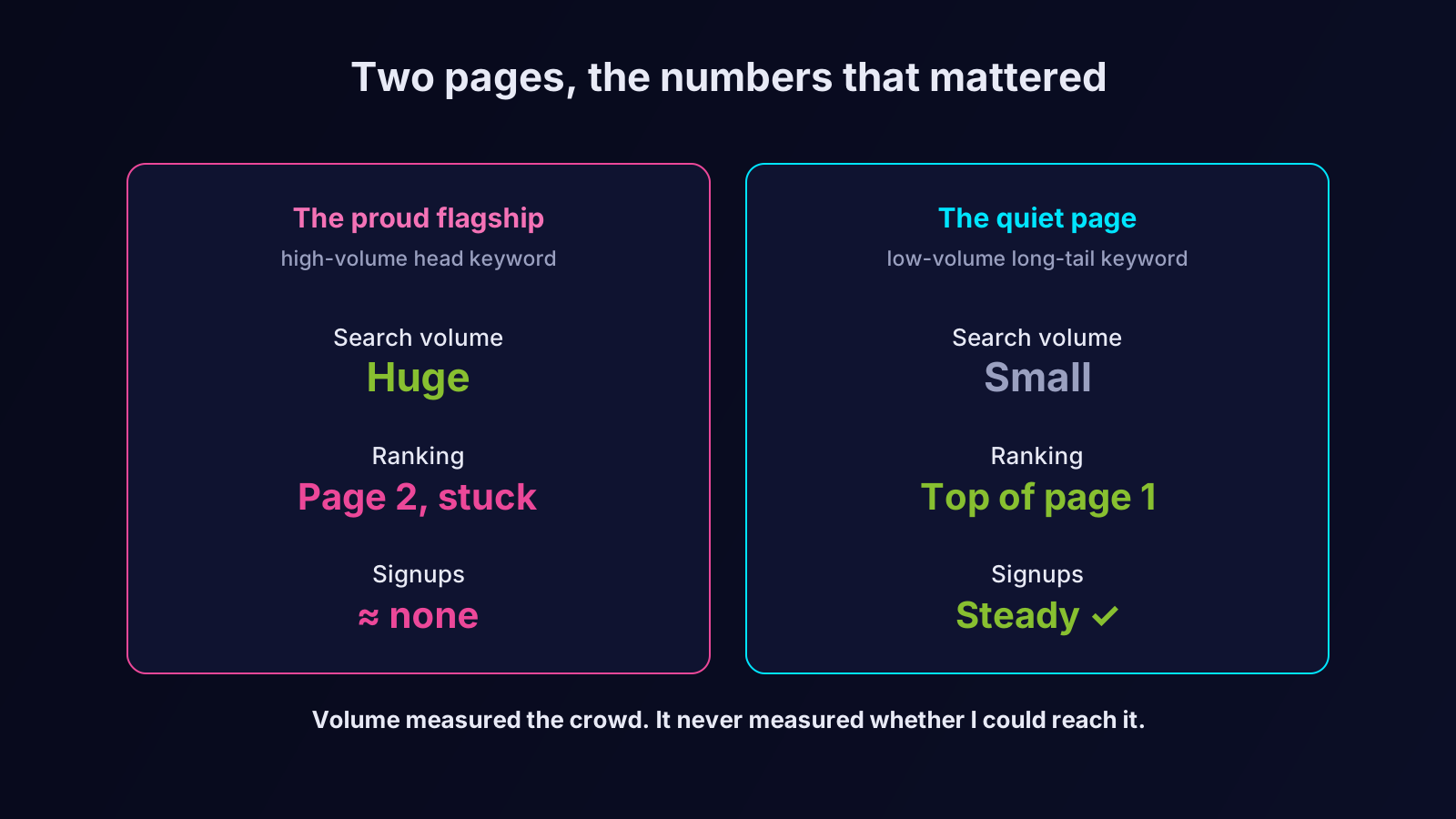
It targeted a long, specific, low-volume keyword — the sort of phrase I would once have skimmed straight past, because the volume figure was small enough to feel like a rounding error. I had written it almost as an afterthought, quickly, without ceremony. And it was quietly, consistently outperforming my proud flagship on every measure that actually mattered. It ranked near the top of its results. It brought a steady, modest stream of visitors. And those visitors converted — they signed up — at a rate the flagship had never come close to.
I sat with that for a while. The keyword with the small, unimpressive number was making the business money. The keyword with the large, impressive number was making me feel briefly important in a planning meeting. That was the day. That was the moment the spell broke.
What I had been measuring wrong
Once I could see it, the mistake was almost embarrassingly simple. I had been treating search volume as a measure of opportunity. It is not. It is a measure of crowd size — and crowd size is only one input, and not the most important one.
Opportunity is a combination of things volume cannot see. Can this specific site realistically rank for this term? Does the intent behind the keyword match a page I can genuinely build? Are the people searching it people who could become customers? Volume answers none of those questions. It just tells you how many people are in the room — not whether you can get into the room, not whether you can build what they came for, and not whether they have any money or any reason to spend it with you.
I had spent a year optimising the one variable that was easiest to see and least connected to results. Diligently. That was the part that stung — not that I had been lazy, but that I had worked hard in a straight line toward the wrong place.
The reframe: from audience size to audience fit
What replaced the volume obsession was a different question, and it reframed everything. I stopped asking "how many people search this?" and started asking "how well does this keyword fit — fit my site's ability to rank, fit a page I can actually build, fit the kind of person who becomes a customer?"
Audience fit beats audience size almost every time. A small, well-fitted keyword brings fewer people, but the right people, to a page that can actually rank — and a slice of them buy. A large, badly-fitted keyword brings, in practice, nobody at all, because you never rank for it. Fit is the variable that connects to revenue. Size is the variable that connects to slides.
How I changed my process
The change was concrete, not just philosophical. I no longer sort a keyword list by volume and work down. Volume is now one column among several, and not the one that decides anything.
Before any keyword survives, it gets assessed on the things that actually matter. I open the results page and read it honestly — are these competitors beatable, given what my site is today? I check the intent and the format the SERP is rewarding. I ask the blunt commercial question: if this page ranked first, would the visitors it brought have any path to becoming customers? Only the keywords that pass those checks make the plan. Some of them have healthy volume. Many of them have small, modest volume — the kind of number that, a year earlier, I would have dismissed on sight. Those modest-volume, high-fit keywords have been the most reliable performers I have ever published.
What happened after
The shift did not produce an overnight spike — real ones rarely do. What it produced was a slow change in the slope of things. The pages I published started, more often than not, to actually rank, because I was finally choosing keywords my site could win. Traffic grew, but more importantly the quality of the traffic grew, because I was choosing keywords with intent that fit. And conversions from content stopped being a rounding error and started being a number I could put in front of leadership without flinching.
The irony is that the volume eventually came too. Building a cluster of well-fitted, winnable pages slowly earned my site the authority it had been missing — and some of the bigger keywords, the ones I had failed to take by force, gradually became reachable. I got the head terms in the end. I just got them by climbing, not by jumping.
The mistake I still see everywhere
I tell this story partly because the mistake is not rare — it is close to universal. I still see it constantly: teams sorting by volume, picking the biggest numbers, pouring real craft into pages aimed at keywords they have no chance of ranking for, and then concluding that "SEO just takes time" when the pages stall. SEO does take time. But that is not why those pages failed. They failed on the day the keyword was chosen — chosen on volume, with no honest look at whether the site could compete.
If any of this is uncomfortably familiar, you do not need a dramatic day of your own. You can just decide, now, to stop letting the volume column run your strategy.
The hard part was not me — it was the meeting
I should be honest about the part of this that has nothing to do with keyword tools. Changing my own mind took an afternoon and a stinging chart. Changing how my team and the people above me thought about success took far longer, and it was the genuinely difficult work.
The problem is that volume is institutionally comfortable. When you walk into a review and say "we're targeting terms worth fifty thousand searches a month," everyone nods; it sounds like scale. When you walk in and say "we're targeting a set of specific, lower-volume terms we can actually rank for," it sounds, to an ear trained on big numbers, like you are lowering your ambition. You are not — you are raising your odds — but you have to make that case explicitly, because the default reading of a small number is "small thinking."
What finally moved the conversation was not an argument; it was the comparison itself. I stopped debating in the abstract and simply put the two pages side by side: the proud high-volume flagship, with its enormous addressable number and its near-zero conversions, next to the quiet low-volume page steadily producing signups. One slide. The flagship's volume number was still the bigger number — but next to a column showing actual customers, the bigger number suddenly looked like exactly what it was: a measure of a crowd we could not reach. After that, the team stopped asking "what's the volume?" first. They started asking "can we win it, and will it pay?" — and once the questions changed, the strategy changed on its own.
Where an AI agent helps
The honest reason teams keep defaulting to volume is that the better assessment is slower. Reading the SERP for every keyword, weighing the competition against your own site, checking intent, tracing whether traffic could ever convert — doing that properly for a whole list is real work, and "sort by volume, take the top rows" is instant. Under deadline, the instant option keeps winning, and another year gets spent the way I spent mine.
This is where an SEO AI agent changes the economics of the decision. Orova evaluates keywords the way I learned to, but at speed — weighing winnability against your specific site, reading the live results page for intent and competition, and flagging whether a keyword has any plausible path to business value, instead of just surfacing a volume figure. The thoughtful assessment stops being the slow option, which means there is no longer a reason to fall back on the lazy one.
I do not regret the year, exactly — it taught me the lesson properly, and lessons learned that way tend to stick. But you do not have to spend a year the way I did. The volume column is not your strategy. It never was. It is just the easiest number to see, sitting there looking important, waiting for someone to mistake it for the truth.
Let an AI Agent handle your SEO
Orova plans, writes, optimizes, and tracks rankings on its own — you just read the results.
Try it free