
Why Long-Tail Keywords Convert Better (And Cost Less)
Let me make you an offer most marketing channels cannot. A type of keyword that costs less to win, faces less competition, ranks faster, and brings you visitors who are measurably closer to buying. No catch, no trick — just a category of search term that most teams walk straight past because it does not look impressive on a dashboard.
Those are long-tail keywords, and if your blog gets traffic but not enough customers, they are very likely the gap in your strategy. This article is an unapologetically commercial case for them: why they convert better, why they cost less, and how to put them to work. If you sell anything online, read this as a pitch — because it is one, and the product being pitched is a smarter use of the budget you are already spending.
What long-tail keywords actually are
A long-tail keyword is a longer, more specific search phrase with comparatively low individual search volume. "CRM" is a head term. "CRM for a small real estate team" is long-tail. "How to import contacts into a CRM from a spreadsheet" is longer-tail still.
The name comes from the shape of search demand: a small number of broad keywords attract enormous volume — the fat head — followed by a vast, long tail of millions of specific phrases that each attract a trickle. Most teams chase the head because the volume number is large and exciting. This article is about why the quiet tail is where the revenue actually lives.
Reason one: specificity is pre-qualification
Here is the single most important idea in this whole piece. When someone types a specific, multi-word query, they are not just searching — they are telling you who they are.
Consider "project management software for remote design teams." In one search the person has handed you their job function, their team's working style, their company type, and the exact category of solution they want. They have effectively filled in the top of a lead form before they ever reached your site. A long-tail searcher self-qualifies through the very specificity of their phrasing. The head-term searcher typing "project management" has told you nothing — they could be a student, a journalist, a competitor, or a buyer, and you have no way to know. Specificity is free qualification, and long-tail keywords are made of specificity.
Reason two: they catch buyers later in the journey
People do not search the same way at the start of a decision as they do near the end. Early on, queries are broad and vague — they are still framing the problem. As they move toward a purchase, their searches grow longer, sharper, and more specific. They start naming features, use cases, comparisons, and constraints.
That means long-tail keywords naturally intercept people further down the funnel — closer to the moment money moves. A head term might catch someone idly curious about a category. A long-tail term like "best invoicing software for freelance designers under 20 dollars" catches someone who is, frankly, about to buy something. Ranking for that phrase puts you in the room at the decisive moment. Ranking for the head term puts you in the room while the visitor is still deciding whether they have a problem at all.
Reason three: less competition means you actually rank
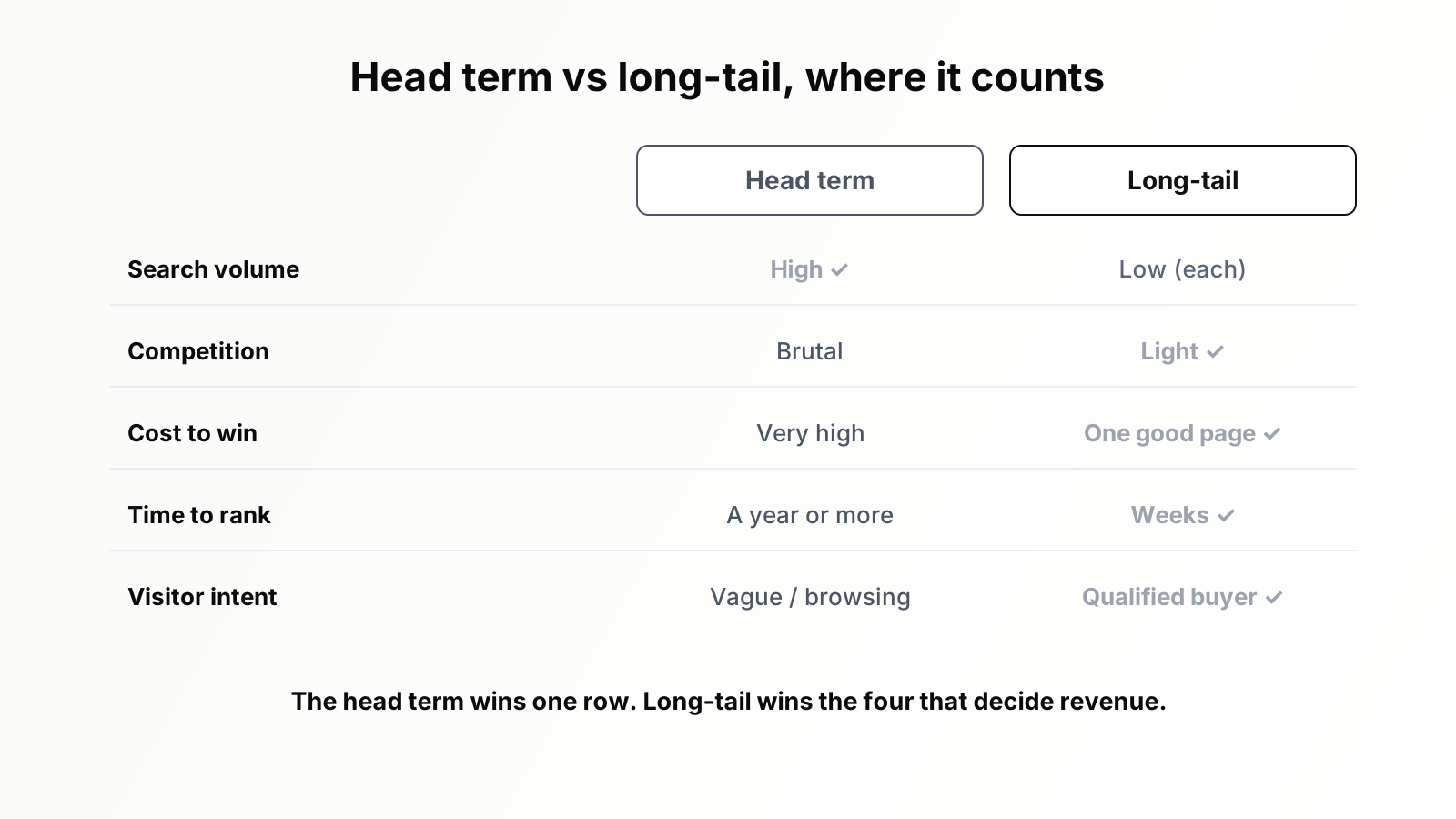
A keyword that brings zero traffic because you sit on page six converts at exactly zero percent, regardless of how wonderful the page is. Ranking is not a participation prize; either you are visible or you are not.
Head terms are fiercely contested by established competitors with years of authority. A newer or mid-sized site that targets them produces excellent pages that nobody sees. Long-tail keywords are far less contested — often genuinely winnable with one well-made, focused page. The conversion-rate comparison is almost unfair: a long-tail page that reaches the top of its results and a head-term page stranded on page six are not competing on conversion at all, because only one of them has any visitors to convert. The first rule of conversion is being seen, and long-tail is where being seen is realistic.
Reason four: they cost dramatically less to win
Now the part the finance team will like. Winning a head term is enormously expensive — it demands authority, which demands a long, costly campaign of content and links, often spanning a year or more, with no guarantee at the end.
Winning a long-tail keyword typically requires one thing: a single, genuinely useful, well-targeted page. No authority campaign, no link-building marathon. The cost is one good article. So compare the return per dollar honestly. A large budget poured into a head-term gamble may yield nothing for a year. The same budget spread across many focused long-tail pages yields a steadily growing set of pages that each rank, each convert, and each keep working. Long-tail is not the cheap option in a derogatory sense. It is the option with the better return on every dollar spent.
Reason five: long-tail pages compound
A head-term campaign is a single large bet with a binary outcome. A long-tail program is a portfolio that compounds — and compounding is the most underrated force in marketing.
Each focused long-tail page you publish is an asset that keeps earning. It ranks, it converts, and it does so next month and next year with no further spend. Publish steadily and the pages stack: ten become thirty, thirty become a hundred, and the combined traffic and revenue climbs even on the days you publish nothing. Better still, the pages reinforce one another — a cluster of related long-tail articles builds your site's authority on the whole subject, which makes the next page rank more easily, and eventually makes even the head term winnable. You do not have to choose between long-tail and the big keyword. The long-tail program is how you earn the big keyword.
The objection: "but the traffic per keyword is tiny"
Every time, someone runs the arithmetic: "a long-tail keyword gets, what, forty searches a month? Why write a whole article for forty visits?" It is the objection that keeps teams stuck on the head term, and it is wrong in three ways.
First, a focused long-tail page never ranks for only its one named phrase — it captures dozens of close variants, so real traffic is several times the headline number. Second, those visits are not equal to head-term visits; they are qualified, buyer-intent visits, worth far more per head. Third, the page does not retire — it earns for years on a one-time cost. And finally, the strategy is never one keyword. It is two hundred. Two hundred small, qualified, compounding streams add up to a river, and a river that you fully own. The "tiny traffic" objection looks at one keyword, in isolation, on day one, and misses everything that makes the strategy work.
How to find long-tail keywords that convert
You do not need exotic tools. The highest-converting long-tail keywords are hiding in plain, free sight. Google's autocomplete suggests real phrases as you type. "People Also Ask" and "related searches" hand you long-tail questions directly. Your own Search Console is the richest source of all — it shows the specific phrases you already get impressions for, long-tail terms you are accidentally near-ranking for and could win on purpose. And your sales and support inboxes are full of the exact questions buyers ask in their own words, which are long-tail keywords wearing plain clothes.
As you gather, prioritise for conversion, not volume. Favour phrases that name a use case, an audience, a comparison, a price point, or a specific problem — those are the phrases buyers, not browsers, type.
How to write them so they actually sell
Finding the keyword is half the job; the page has to convert. Three rules. Give each long-tail keyword its own dedicated page — one specific question, one focused answer — because the precision is the whole value and a fused mega-page throws it away. Answer the exact question directly and early; a long-tail searcher has a sharp question and a short fuse, so reward the specificity instead of opening with four hundred warm-up words. And include a clear, relevant next step — because a long-tail visitor is close to buying, a confident call to action is not pushy here, it is helpful. A page that ranks for a buyer-intent keyword and then forgets to offer the buyer anything has done four-fifths of the work and skipped the part that pays.
A tale of two quarters
Put the whole argument into one comparison. Two SaaS companies of similar size, similar budget, both decide to take content seriously this quarter. They make one different decision, and it decides everything.
Company A goes for the head. The team picks six broad, high-volume keywords — the category terms, the ones with the impressive numbers — and pours the quarter's effort into six ambitious flagship articles, each polished, long, and expensive. The pages ship. And then they sit. Against incumbents with a decade of authority, the six pages settle somewhere on pages four through seven of the results. They are genuinely good pages. Almost nobody reads them. At the quarterly review, traffic is flat, conversions from content are near zero, and the team's honest conclusion is that "SEO takes a long time" — which is true, but is not actually why this failed.
Company B goes for the tail. The same budget funds not six articles but around thirty focused long-tail pages, each targeting a specific, qualified, winnable query — use cases, comparisons, audience-specific problems. Some of those thirty rank within weeks, because the competition for each precise phrase is thin. By the review, a real fraction of them sit at or near the top of their results. Each one brings a modest stream of traffic — but qualified traffic, buyers, people who typed a phrase that all but announced a purchase. Thirty small streams combine into a visible, growing flow, and because these visitors arrived on buyer-intent queries, a meaningful number convert. Traffic is up. Signups from content exist. And the thirty pages are now an interlinked base that makes the next thirty rank faster.
Same industry, same money, same quarter. One company has six invisible trophies and a morale problem. The other has thirty working assets and momentum. The difference was not effort, talent, or budget. It was the decision about which kind of keyword to chase — and that decision is available to you, for free, on the first day of next quarter.
Where an AI agent makes this practical
Everything above works, and the catch is honest: long-tail at scale is a logistics problem. The strategy needs not five keywords but hundreds — hundreds of briefs, intent checks, focused pages, and internal links to keep coherent. That volume is precisely why most teams retreat to the comfortable head-term dream; the long-tail plan is sound but the workload looks daunting, so it never gets staffed.
That is the problem an SEO AI agent removes. Orova mines long-tail keywords from your Search Console and the live results pages, groups them into clusters, checks that each gets its own page rather than cannibalising a sibling, and keeps the internal links between them coherent as the library grows — turning "two hundred keywords" from a heroic slog into a system that simply runs. The strategy was never the hard part. The volume was. Hand the volume to the agent and the long-tail program becomes not just smart but achievable.
So here is the offer again, plainly. Lower cost, less competition, faster ranking, better-qualified visitors, and a compounding asset base. The price is giving up the vanity of a big volume number on a slide. For any business that would rather have customers than impressive-looking dashboards, that is the easiest trade in marketing. Stop chasing the head. Go and quietly take the tail. (For the strategic picture behind this, see why long-tail keywords are the unsexy secret behind every SaaS that ranks.)
Run your business with AI Agents
Orova is the always-on Biz AI Agent — it plans, runs, and optimizes the work for you. Save time, unlock productivity.
Try it free