
Long-Tail Keywords: The Unsexy Secret Behind Every SaaS That Ranks

Every SaaS founder, at least once, marches into a marketing meeting and points at a keyword the way a general points at a city on a map. "We should rank for that one." It is always a short, fat, glamorous keyword. "CRM software." "Project management." "Email marketing." Something with a search volume so large it has its own gravitational field.
It is a beautiful dream. It is also, for almost every company reading this, a way to spend a year producing content that performs roughly as well as a message in a bottle. The keywords that actually carry a SaaS company to the top of Google are the unglamorous ones — the long, specific, slightly awkward phrases that nobody puts on a slide because they do not fit on a slide. This article is a defence of those keywords, and an argument that the boring ones are the whole game.
First, what is a long-tail keyword?
A long-tail keyword is a longer, more specific search phrase with comparatively low search volume. The name comes from the shape of a graph: a few keywords get enormous traffic (the fat "head"), and then a very, very long "tail" of millions of specific phrases that each get a trickle.
"Project management" is a head term. "Project management software for remote design teams" is long-tail. "How to set up recurring tasks in project management software" is even longer-tail. As the phrase gets longer it gets less popular, less competitive, and — this is the twist the whole article rests on — dramatically more useful.
People hear "low search volume" and mentally file long-tail keywords under "not worth it," somewhere between business cards and the office plant nobody waters. That filing is the single most expensive instinct in content marketing.
Why the head term is a trap
Let us be honest about what happens when a young SaaS site decides to "rank for the big keyword."
The big keyword is already occupied. Not lightly occupied — occupied the way a medieval fortress is occupied, by incumbents with a decade of backlinks, hundreds of supporting pages, brand recognition, and a moat full of, presumably, more backlinks. You arrive with one article and a hopeful expression. Google, which has been doing this for a quarter of a century, gently files your page on the sixth page of results, a place so remote it has its own postal code and no visitors.
So you have now spent real money — a writer, an editor, a designer, a slot in the calendar — to produce a page that will be seen by approximately the writer, the editor, the designer, and your mother, if you send her the link. The head term did not reward effort. It rewarded a head start you did not have.
Ranking for a head term is not a content problem you can out-write. It is an authority problem, and authority is not something you can buy in a single afternoon, no matter how good the afternoon's article is.
Meanwhile the long-tail phrase — "project management software for remote design teams" — is sitting right there, barely contested, attached to a person who has all but told you their job title and their wallet's intentions.
The unsexy maths
Here is the part that wins arguments. Picture two strategies running for a year.
Strategy A: chase ten head terms. Each has gigantic volume. You rank, optimistically, somewhere on page five for most of them. Page five gets a click roughly never. Ten enormous keywords, almost no traffic, a year gone.
Strategy B: target two hundred long-tail keywords. Each one is small. But each one is winnable, and a focused page genuinely can reach the top of the results for a precise phrase. Two hundred small streams, all of them flowing, add up to a river — and crucially, a river that keeps flowing while you are asleep, on holiday, or in yet another meeting about the head term.
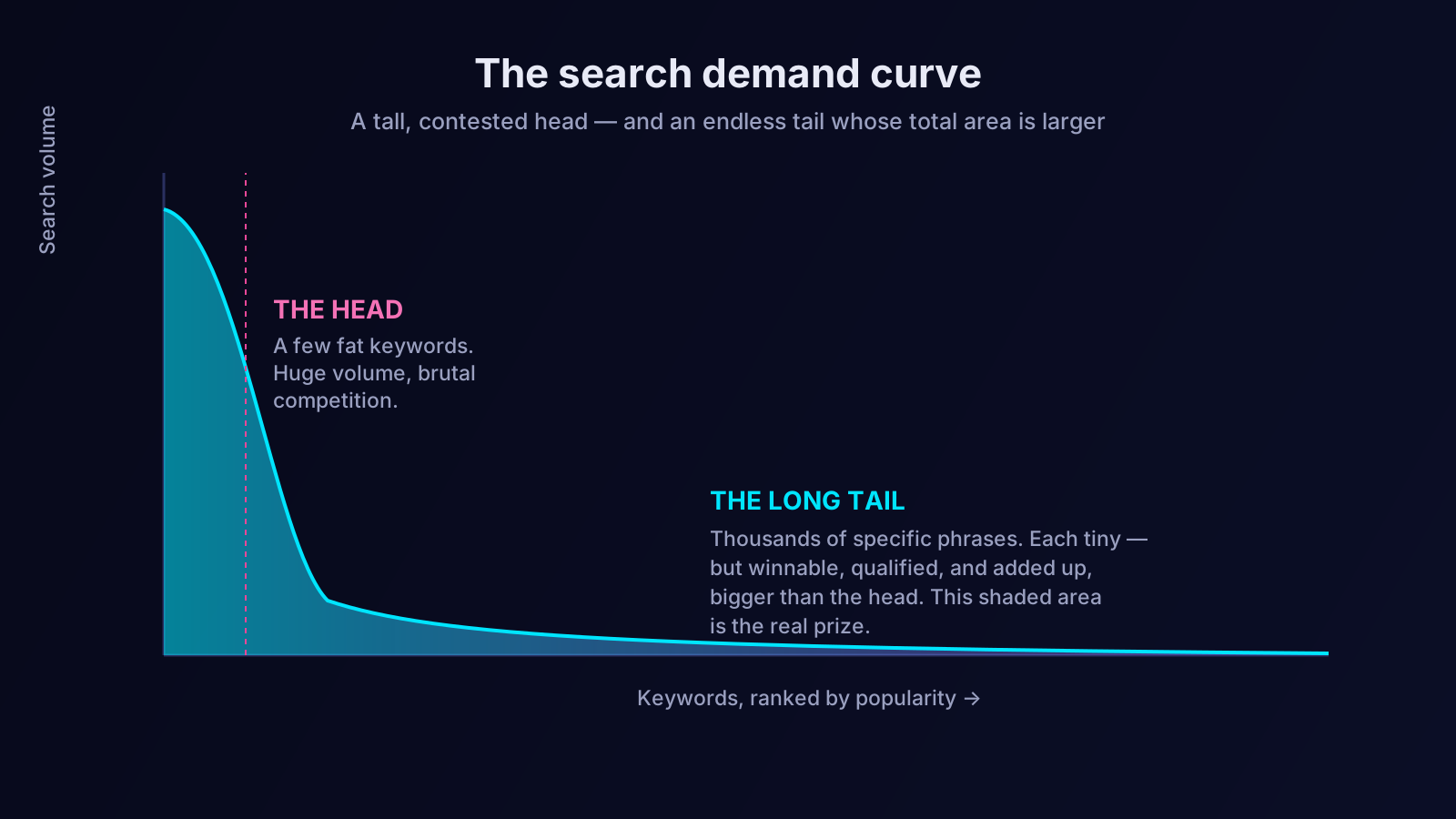
The counter-intuitive fact buried in that graph: the total search volume of the long tail, added up, is larger than the total volume of the head. The tail is not the consolation prize. It is the bigger prize, hidden inside a shape that does not photograph well for a pitch deck.
And then the part that is genuinely unfair
If long-tail keywords only matched head terms on traffic, they would already win on winnability alone. But they do not merely match — they out-perform, because of who is doing the searching.
Think about the person typing "email marketing." Who knows what they want. A definition? A job? A history of the discipline? A picture of an envelope? It is the conversational equivalent of someone walking into a shop and saying only the word "things."
Now picture the person typing "best email marketing software for a small e-commerce store." That person has handed you their context, their company size, their use case, and a flashing neon sign that reads I am close to buying something. They are not browsing. They are shortlisting. A visitor from a long-tail query is further down the funnel, more qualified, and far likelier to sign up — because the specificity of their search is their buying intent, written out in words.
This is the unsexy secret in one sentence: long-tail keywords bring fewer people, and the people they bring are the ones who came to spend money. Smaller crowd, much better crowd.
The objection, and why it folds instantly
At this point in the meeting, someone always raises a hand. They have done arithmetic, and they are pleased with it. "If a long-tail keyword only gets, say, thirty searches a month, and we win it, that's thirty visits. Thirty! We could get that many by accident. Why would we write a whole article for thirty visits?"
It is a reasonable-sounding objection. It is also wrong in three separate ways, which is impressive for one sentence.
It treats one keyword as one keyword. A well-written page for "how to migrate from spreadsheets to project management software" does not rank for only that exact phrase. It ranks for dozens of close variants — every slightly different way someone phrases that same question. The "thirty searches" you costed is one entry on a list the page quietly harvests in full. The real traffic to a focused long-tail page is routinely several times the volume of its named keyword. Your arithmetic used one number; the page collects many.
It treats all visits as equal. They are emphatically not. Thirty visits from a head term might be thirty curious browsers, students, and rubberneckers. Thirty visits from "best project management software for remote design teams" are thirty people who have all but filled in a lead form in their heads. Visit quality is not a rounding error; it is the entire point. A marketer who counts visits without weighting them by intent is counting footsteps and calling it revenue.
It forgets the page does not retire. A long-tail article written well is an asset that keeps working. Those thirty-plus monthly visits arrive next month, and the month after, and two years from now, with no further spending. Cost is paid once; the return compounds quietly for years. Judging that page by its first month is like judging a fruit tree by the afternoon you planted it.
So yes — one long-tail keyword, viewed in isolation, on its launch day, does look unimpressive. That is exactly the optical illusion that lets disciplined competitors walk past you and quietly take two hundred of them while you are still admiring the big keyword on the slide.
How to find the boring keywords
You do not need an exotic tool. The long tail is hiding in plain sight:
- Google's autocomplete. Start typing a topic and read the suggestions. Those are real searches, served fresh.
- "People Also Ask" and "Related searches." Google literally printing a menu of long-tail questions and declining to charge you for it.
- Your own Search Console. The single best source. It shows the exact phrases you already get impressions for — long-tail queries you are accidentally near-ranking for and could win on purpose with one focused page.
- Your sales and support inbox. The questions real prospects ask, in their own words, are long-tail keywords wearing a disguise.
How to actually write for them
One firm rule: one long-tail keyword, one dedicated page. The temptation is to write a single giant article and stuff fifteen long-tail phrases into it. Resist it. A giant page that gestures at fifteen queries serves none of them with the precision the tail rewards. Fifteen focused pages, each answering one specific question completely, is the move.
And specificity is the job. If the keyword is "how to migrate from spreadsheets to project management software," the page answers that — directly, completely, in the first screen — and does not warm up with four hundred words on the history of spreadsheets. The long-tail searcher has a precise question and a short fuse. Reward the precision; do not punish the patience they do not have.
The compounding bit (where it stops being boring)
One long-tail page is unremarkable. A trickle. But long-tail pages compound in a way head-term gambles never do.
Fifty focused pages on closely related long-tail queries do not just sit there as fifty trickles. Linked together, they tell Google your site covers the whole subject — and that accumulated authority is, eventually, what makes the head term winnable. The long tail is not an alternative to ranking for the big keyword. It is the staircase to it. You do not leap to the fat keyword; you earn it, one boring step at a time, and then one day it is simply yours and you are not entirely sure which Tuesday it happened.
So the founder pointing at the city on the map was not wrong to want it. They were wrong about the route. You take the city by quietly capturing every village around it until holding the city is the obvious next move.
And here is the part that makes the long-tail strategy genuinely hard to copy: it does not produce a single dramatic moment a competitor can see and react to. There is no day the graph leaps. There is just a slow, unglamorous accumulation — a village a week — that one quarter has produced an unassailable position nobody quite watched being built. Head-term gambles are loud and visible and easy to counter. A patient long-tail program is quiet, and quiet is much harder to defend against.
The catch, and the way around it
There is a reason teams default to the head term despite all of this: long-tail at scale is a logistics problem. Two hundred keywords means two hundred briefs, two hundred intent checks, two hundred focused pages, and two hundred sets of internal links to keep coherent. That is not glamorous and it is not quick, and somewhere around page thirty most teams quietly drift back to dreaming about the big keyword.
This is precisely the work an SEO AI agent is suited to carry. Orova can mine the long tail from your own Search Console and the live SERPs, group the phrases into clusters, check that each one gets its own page instead of cannibalising a sibling, and keep the internal links between them coherent as the set grows — turning "two hundred boring keywords" from a heroic slog into a system that simply runs. The strategy was never the hard part. The volume was. Hand the volume to the agent and the boring secret finally becomes practical.
Long-tail keywords will never look impressive on a slide. They will just quietly be the reason your SaaS is the result people find. Unsexy, specific, slightly awkward to say out loud — and, year after year, the thing that actually works.
Let an AI Agent handle your SEO
Orova plans, writes, optimizes, and tracks rankings on its own — you just read the results.
Try it free