
How I Build a Keyword Map for a New SaaS in One Afternoon
The first time I was handed a brand-new SaaS site and asked "so what should we write?", I did what most people do. I opened a keyword tool, exported a few thousand rows, and stared at them. Two hours later I had a spreadsheet, a headache, and no actual plan — just a very long list and the creeping sense that I had confused activity with progress.
I build keyword maps very differently now. For a new SaaS site I can produce a real, usable keyword map in a single focused afternoon — not a dump of keywords, but a structured picture of what to write, in what order, and why. This is the process, step by step, the way I actually run it. It is less about tools than about sequence and restraint.
What a keyword map is — and is not
A keyword map is not a keyword list. A list is raw material. A map is a structure: keywords grouped into topics, each group anchored by a main page, each individual keyword assigned to one specific page, with intent labelled and a rough priority attached.
The difference is the difference between a pile of bricks and a blueprint. The pile tells you what you have. The blueprint tells you what to build and in what order. The afternoon is spent turning the pile into the blueprint — and most of that time, as with all good keyword work, is spent leaving things out.
The first hour: understand the product, not the keywords
I do not open a keyword tool first. That mistake cost me my early afternoons. I start with the product.
For the first hour I write down, in plain language: what the product does, the precise problem it solves, who feels that problem most sharply, and what those people would have to believe to buy it. I read the homepage, the pricing page, any sales material. If I can, I talk to a founder or a salesperson for fifteen minutes and ask one question — "what do customers say right before they decide to buy?"
This hour feels like a detour. It is the opposite. Every later decision — which keyword matters, which intent to prioritise, which topics to anchor — depends on understanding the business. Skip it and you build a map optimised for traffic that has nothing to do with revenue. The keywords come later. The understanding comes first, or the map is built on sand.
The second hour: find the topic pillars
Now I find the pillars — the three to six broad subjects the entire content program will stand on. Not keywords yet. Subjects.
For a SaaS product, pillars usually fall out of the first hour naturally: the core problem the product solves, two or three adjacent problems the buyer also has, and the buyer's broader area of responsibility. A project-management tool for agencies might land on pillars like agency operations, project profitability, team capacity planning, and client communication. Each pillar is broad enough to hold dozens of articles and tight enough that ranking across it would genuinely matter to the business.
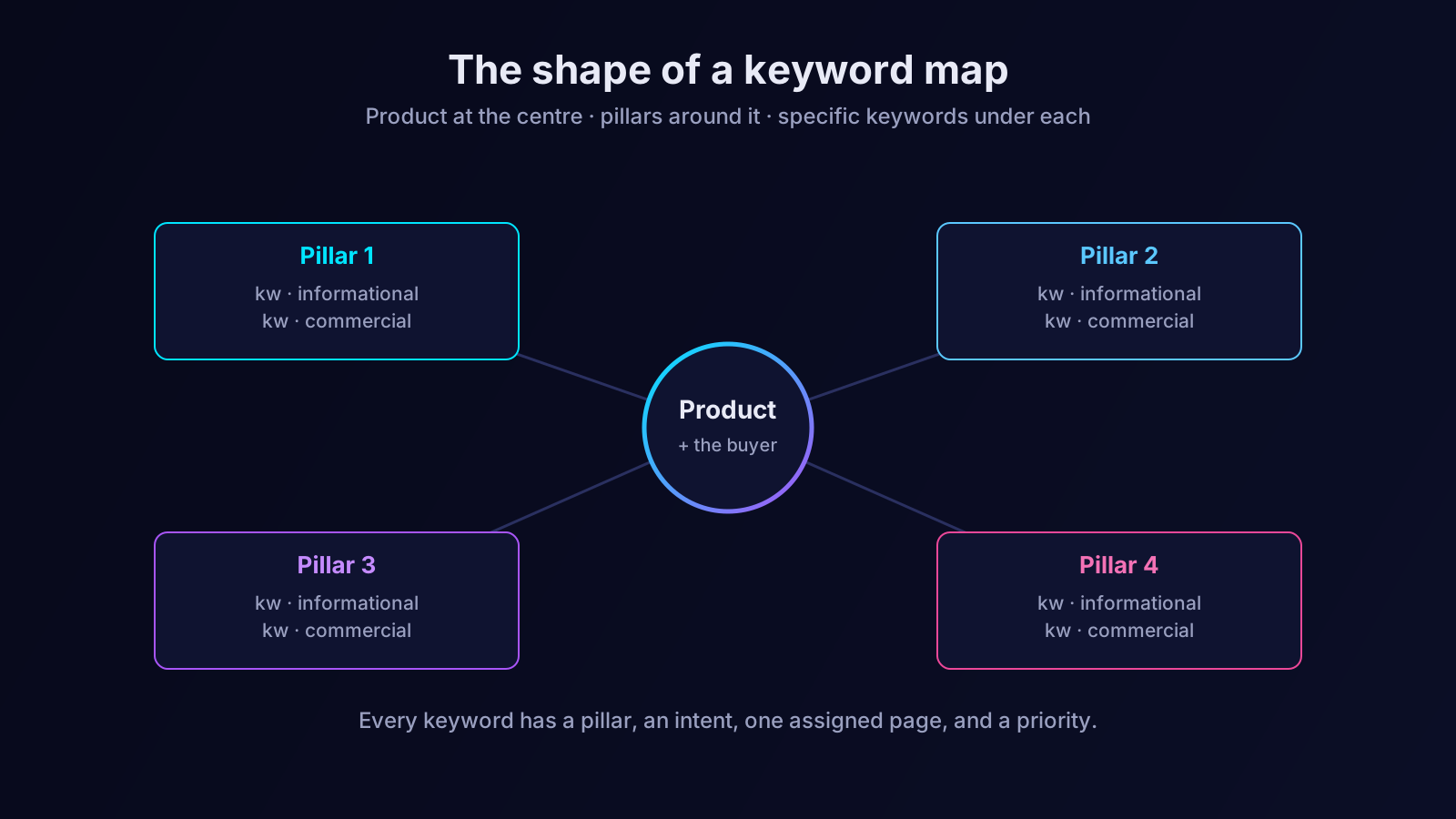
Picking pillars before keywords is the move that saves the afternoon. With pillars in place, the keyword research that follows has somewhere to go. Without them, every keyword floats free and you are back to staring at four thousand rows.
The third hour: populate the pillars
Only now do I open the keyword tools — and I open them with a job, not a hope. For each pillar in turn, I gather the keywords that belong under it. Autocomplete, "People Also Ask," the tool's exports, and — if the site is not brand new — Search Console for terms it already gets impressions for.
As keywords come in, they get sorted into their pillar immediately, and each one gets two quick tags: an intent label (informational or commercial — see our guide on the four intent types) and a keep/reject decision. I am ruthless here. A keyword that does not clearly fit a pillar, or whose intent I cannot serve, or that duplicates one already in the map, gets cut on sight. The map is supposed to be small. A pillar with fifteen sharp keywords beats a pillar with sixty vague ones.
By the end of this hour each pillar holds a tidy set of keywords, every one labelled by intent, every one assigned to its own future page. No keyword appears twice. That last rule matters — two keywords pointed at the same page, or one keyword smeared across two, is how a site ends up competing with itself.
The fourth hour: sequence and anchor
The final hour turns the populated pillars into something a team can act on Monday morning.
First, the anchor. Each pillar gets one main page — a broad, foundational article on the whole subject — and every other keyword in that pillar becomes a supporting page that will link to the anchor. This is the topic-cluster structure, and deciding it now, on the map, means the internal linking is designed rather than improvised later. (Our topic clusters guide covers why this shape works.)
Then, the sequence. A new site cannot publish everything at once, so the map needs an order. My rule of thumb: lead with the winnable, business-relevant keywords — usually specific, lower-competition, commercially meaningful terms that can rank reasonably soon and prove the program works. Save the broad, fiercely competitive anchor terms for later, once the cluster around them has built enough authority to make them realistic. You earn the hard keywords; you do not open with them.
What comes out of the fourth hour is the actual deliverable: a map where every row has a pillar, an intent, an assigned page, and a priority. That is a plan. A team can start writing from it immediately and never wonder what comes next.
A worked pillar, start to finish
To make the process concrete, follow one pillar through. Say the new SaaS is a tool that helps marketing agencies track project profitability, and the first hour surfaced a pillar: project profitability.
In the third hour I populate it. Autocomplete and "People Also Ask" offer up phrases: "how to calculate project profitability," "why are agency projects unprofitable," "project profitability formula," "best way to track project margins," "project profitability software for agencies," "agency profitability benchmarks." Six candidates arrive. I tag each one immediately.
"How to calculate project profitability" — informational, keep; a clear teaching query. "Why are agency projects unprofitable" — informational, keep; a strong problem-aware angle. "Project profitability formula" — informational, but it overlaps heavily with the "how to calculate" page; rather than two thin pages competing, I fold it in as a section of that one. "Best way to track project margins" — informational leaning practical, keep. "Project profitability software for agencies" — commercial, keep; this is close to the money. "Agency profitability benchmarks" — informational, keep; a natural linkable asset.
In the fourth hour I anchor and sequence. The anchor page is a broad guide — "Project profitability for agencies: the complete guide" — and every other page links up to it. For sequence, I lead with "project profitability software for agencies" (commercial, winnable, close to revenue) and the sharp problem-aware guide, then fill in the supporting informational pages, and save the broad anchor guide for later, once the cluster gives it authority to stand on. One pillar, six candidate keywords, one folded in, five pages planned, an anchor chosen, an order set. Repeat four times and the map is done.
What goes wrong when you skip the first hour
Of the four hours, the first — understanding the business before touching a keyword tool — is the one people are most tempted to skip. It feels like preamble. It is the load-bearing wall.
Skip it and the failure is subtle, because the map you produce still looks right. It has pillars, keywords, intents, priorities — all the parts. What it lacks is a connection to revenue, and that absence does not show up until months later, when the pages are written and ranking and somehow not moving the business.
Here is the mechanism. Without the first hour, you build pillars from what the keyword tool finds interesting rather than from what the buyer actually struggles with. You end up with topics that have healthy search volume and no relationship to a purchase decision. The content ranks. Traffic arrives. And it converts at close to nothing, because you attracted people who were curious about a subject adjacent to your product rather than people wrestling with the problem your product solves. The map optimised for traffic, and traffic is what it delivered — just not the kind that matters.
The first hour is also what lets you reject well. When you genuinely understand what a customer believes right before they buy, a huge share of the keyword export becomes obviously irrelevant — you can cut it on sight, because you know it does not touch the buying decision. Without that understanding every keyword looks vaguely plausible, nothing gets rejected confidently, and the map bloats. The hour spent on the business is not separate from the keyword work. It is the lens that makes the keyword work fast and correct.
So when the pressure is on and an afternoon feels tight, the instinct will be to "save time" by jumping straight to the tool. Resist it. The first hour is the cheapest hour in the whole process and the one that decides whether the other three produce a plan or a decorated guess.
The mistakes that turn an afternoon into a week
When this takes a week instead of an afternoon, it is almost always one of four mistakes.
Opening the keyword tool first. Start with the export and you have no pillars to sort into, so every keyword floats free and you drown. The tool comes third for a reason.
Refusing to reject. Treating every keyword the tool returns as something that must be placed somewhere turns a tight map into a bloated one and the afternoon into a marathon. Cut on sight.
Chasing perfect data. Agonising over whether a keyword's volume is 90 or 140 is time spent on precision that does not change a single decision. The map needs the right structure, not perfect numbers.
Skipping the sequencing. A map with no priority order is not finished — it just hands the team a new daily argument about what to write next. The order is part of the deliverable, not an optional extra.
Why an afternoon is enough — and why it often is not
An afternoon is enough because the work is mostly decisions, and decisions are fast when you make them in the right order: business first, pillars second, keywords third, sequence last. The reason it so often sprawls into a week is that people invert the order — they start with the keyword export, drown, and try to reverse-engineer a strategy from a spreadsheet. You cannot. Strategy comes from the product and the pillars, not from the rows.
Honesty compels a caveat, though. An afternoon gets you a strong initial map. Keeping it accurate is the harder, ongoing job. Search Console fills with new terms. Some pages rank and some do not. Competitors publish. The map that was perfect in month one needs maintenance by month three, and that maintenance is exactly the work busy teams let slide.
That ongoing upkeep is where an SEO AI agent earns its place. Orova can do the afternoon's gathering and grouping in minutes, but more usefully it keeps the map alive afterwards — pulling new query data from Search Console, slotting fresh keywords into the right pillar, flagging when a planned keyword duplicates a page you have already published, and re-sequencing priorities as pages rank or stall. The afternoon gets you the blueprint. The agent keeps the blueprint from going stale the moment real life touches it.
If you take one habit from this, take the order. Close the keyword tool. Spend the first hour on the business and the second on the pillars. Open the tool third. Sequence last. Do it in that order and a blank new SaaS site becomes a real content plan before the afternoon is out — not a longer spreadsheet, an actual map.
Let an AI Agent handle your SEO
Orova plans, writes, optimizes, and tracks rankings on its own — you just read the results.
Try it free