
The Keyword Difficulty Score Is Lying to You
Every keyword research tool gives you a number. It sits in its own column, coloured green or amber or red, labelled something like "Keyword Difficulty" or "KD." It runs from 0 to 100. It looks authoritative, it looks objective, and it shapes thousands of content decisions every day. A keyword scores 28 and the team writes the article. It scores 71 and the team walks away.
I want to make an uncomfortable case: that number, used the way most teams use it, is lying to you. Not maliciously — the tools are doing their best with what they can see. But the difficulty score answers a question subtly different from the one you are actually asking, and the gap between those two questions is where content programs quietly waste a year. Here are four ways the score misleads, and what to look at instead.
What the score actually measures
First, fairness: the difficulty score is not random. It is usually built mostly from the backlink profiles of the pages currently ranking on page one. Many strong, link-heavy pages ranking for a term produces a high score; weaker, less-linked pages produce a low one. As a rough proxy for "how link-rich is this SERP," it is fine.
The trouble starts the moment you read it as "how hard will this keyword be for me to rank for." That is the question you actually care about — and it is not the question the score answers. The score describes the SERP. It does not describe you. Everything below follows from that one gap.
Lie one: it pretends difficulty is an absolute property
A single number printed next to a keyword strongly implies the difficulty is a fixed property of the keyword — like its length or its language. It is not. Difficulty is a relationship between a keyword and a specific website.
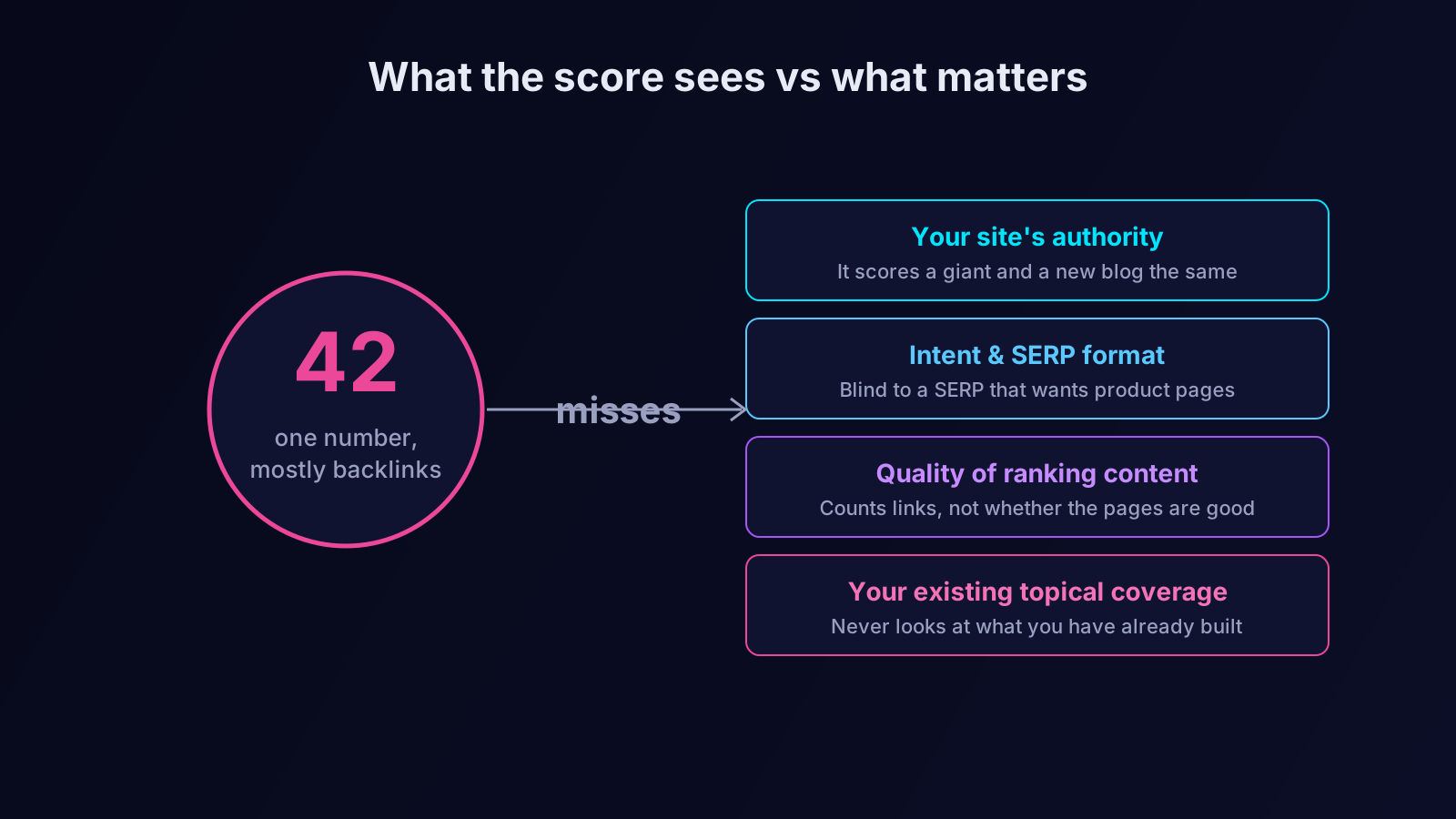
The same keyword, scored "42 — medium," can be a comfortable win for an established site with deep authority on the surrounding topic, and completely unreachable for a six-month-old site with three published posts. Same keyword, same score, opposite reality. The score cannot tell the difference because it never looked at your site. It hands the identical number to a domain authority titan and a brand-new blog, as if the contest were the same for both.
"Keyword difficulty 35" is not a fact about the keyword. It is a fact about the search results — addressed to nobody in particular, and read by you as if it were addressed to you.
Lie two: it mostly counts links, and ranking is not mostly links
Because difficulty scores lean heavily on backlink data, they implicitly model search as a link-counting contest. Out-link the competition and you win. That model is decades out of date.
Modern ranking weighs relevance, content quality, how completely a page satisfies intent, user-experience signals, freshness, and topical authority — alongside links. A SERP can be full of pages with thin backlink profiles that rank because they answer the query better than anything else. The difficulty score, staring only at links, would mark that keyword "easy" — and it might be genuinely hard, because the bar is content quality, not link count. The reverse happens too: a keyword scored "hard" on links can be winnable if every ranking page has stale, mediocre content and you can clearly out-serve the intent.
Lie three: it is blind to intent and SERP shape
The difficulty score does not read the results page the way a human must. It does not notice that the SERP is entirely product pages while you are planning a blog post — a format mismatch that makes the keyword effectively impossible for you no matter how "easy" the score claims.
It does not notice that the top of the page is consumed by an AI overview, a pack of ads, and a featured snippet, leaving the traditional blue links pushed so far down that ranking "first" earns a fraction of the clicks the volume implied. Two keywords can carry the same difficulty score and the same volume, and one delivers real traffic while the other delivers almost none — because of SERP features the score simply does not account for. The number looks at links and stops. The real difficulty is sitting in plain view on the results page it never opened.
Lie four: it ignores what you have already built
This is the most expensive blind spot. The difficulty score looks outward — at competitors, at the SERP. It never looks at your site. So it has no idea that you have already published fifteen strong, interlinked articles around this exact topic.
That existing cluster changes everything. A keyword inside a topic you have already covered deeply is far easier for you to rank for than its score suggests — your accumulated topical authority is doing work the tool cannot see. A keyword in a topic where you have nothing published is harder than the score suggests, because you are starting cold. The same "medium" score means two completely different things depending on what is already on your site. The tool, by design, cannot factor that in. You can.
Lie five: it freezes a moving target
A difficulty score is a snapshot. It describes the SERP roughly as it was when the tool last crawled it. But a results page is not a fixed object — it is a live competition that changes constantly.
A keyword scored "hard" today can soften within months: an incumbent lets a page go stale, a competitor pivots away from the topic, a thin page slips. A keyword scored "easy" can harden just as fast when a well-resourced player decides the topic matters. The number gives you a still photograph and lets you believe it is a forecast. By the time you publish — weeks or months after the brief — the SERP you were scored against may not be the SERP you actually compete in.
This matters most for sequencing. A keyword that is hard for you now may be perfectly winnable in two quarters, once your cluster around it has matured and the competitive picture has drifted. The score, frozen, cannot express "not yet." It just says "hard" and lets you cross off an opportunity that was only ever a timing problem.
Two keywords, same score, opposite reality
Make the problem concrete. Two keywords land on your list, both stamped "difficulty 38." The score says they are the same bet. Open the SERPs and the illusion collapses.
Keyword A: the first page is a row of articles three or four years old, written by sites with strong backlink profiles but visibly stale, thin content — surface-level pieces that never properly answer the question. The links are real, which is why the score is what it is. But the content is beatable. For a site with a genuine point of view and the willingness to go deep, keyword A is a real opportunity. The "38" understated how winnable it is, because it counted the links and never read the pages.
Keyword B: same score, but the SERP is a wall. Every ranking page is recent, comprehensive, genuinely excellent, and the layout is crowded — an AI overview up top, a featured snippet, a block of ads — so even position one would catch a thin slice of the clicks. The links happen to total the same as keyword A's, hence the matching score. But the real difficulty is far higher: you would have to out-write excellent content for a SERP that barely pays out. The "38" badly overstated how winnable it is.
Same number, opposite decisions. Keyword A: write it, and write it well. Keyword B: leave it, or at least postpone it. The difficulty score could not separate them because it never looked at the only things that mattered — the quality of the competing content and the shape of the page. You separated them in four minutes of reading. That four minutes is the actual job; the score is just what tempts people to skip it.
The one thing the score is genuinely good for
None of this means you should delete the column. The difficulty score has one honest use, and it is worth keeping for that: rough triage at the top of the funnel.
When you are staring at a freshly exported list of two thousand keywords, you need a fast way to split it into "probably worth a closer look" and "probably not, for a site like ours, right now." The score does that adequately. A brand-new site can reasonably use it to set aside the deep-red, link-saturated head terms for later and focus attention on the lower-scored majority. As a first, crude sieve over a huge pile, it saves time.
The error is never using the score. The error is letting the triage tool become the decision-maker — carrying a keyword straight from "score looks fine" to "commission the article" with no human reading of the SERP in between. The score earns a place at the start of the process and nowhere near the end. It opens the conversation; it must not be allowed to close it.
Use the difficulty score the way you use a weather icon: fine for deciding whether to look out the window, useless as the only thing you do before leaving the house.
How to assess difficulty for real
Keep the score — as one weak signal, not a verdict. Then do the assessment the tool cannot:
Open the SERP and read it like a competitor. Are these pages actually good, or just old and well-linked? Mediocre incumbent content is an opening; genuinely excellent content is a wall. Links do not tell you which; reading does.
Check the format and the features. Does the ranking format match what you can produce? Is the page so cluttered with ads, snippets, and AI answers that a top spot is barely worth winning? The SERP layout is half the difficulty.
Weigh it against your own site honestly. Have you built authority around this topic, or is this cold ground? Your existing coverage can turn a "hard" keyword into a realistic one — or its absence can turn an "easy" one into a slog.
Reframe the question. Stop asking "what is this keyword's difficulty?" Start asking "can this site, with what it has today, realistically reach the top for this specific SERP?" That question has no single number. It has an answer — and the answer is the one that matters.
Where an AI agent closes the gap
The honest assessment above is correct and also slow. Reading every SERP, judging competitor content quality, checking layout, and cross-referencing your own published library — doing that for a few keywords is fine; doing it for a few hundred is exhausting, so teams fall back on the score and let a backlink proxy make their content decisions for them.
This is exactly the gap an SEO AI agent can close. Orova assesses difficulty the way the score cannot: it reads the live results page for intent and format, weighs the contest against your domain's actual standing, and — the part no external tool can do — checks the keyword against the content you have already published, so a term inside an established cluster is correctly recognised as winnable for you. The single number becomes a real, site-specific judgement instead of a coloured cell.
The difficulty score is not useless. It is just badly overtrusted — a rough sketch of one SERP, mistaken for a personalised forecast. Treat it as a hint and verify everything that matters by looking. The keywords you win will be the ones where you ignored a scary red number and noticed the incumbents were beatable — and the year you waste will be the one you spent letting a colour-coded column decide what your team was allowed to write. (Once difficulty is judged honestly, the survivors still need sequencing — see our keywords-to-content-plan workflow.)
Let an AI Agent handle your SEO
Orova plans, writes, optimizes, and tracks rankings on its own — you just read the results.
Try it free