
"Just Pick the Keyword With Most Volume" and Other Expensive Advice
There is a piece of keyword advice so widespread it has the texture of common sense. It gets repeated in onboarding docs, in agency pitches, in the first reply on every forum thread about keyword research:
"Just pick the keyword with the most search volume."
It sounds prudent. More volume means more potential traffic; more traffic means more results; therefore chase volume. The logic is clean, the advice is simple, and it is one of the most expensive sentences in marketing. This article is a tour of that sentence and a few of its equally costly cousins — the keyword "wisdom" that sounds right and quietly drains budgets.
"Just pick the keyword with the most volume"
The flaw is that volume measures the size of a crowd, not your odds of reaching it or the value of the people in it. The highest-volume keywords in any industry are the broad head terms — and those are precisely the terms locked down by established competitors with years of authority. For a young site, "pick the highest volume" translates directly to "pick the keyword you have the least chance of ranking for." You target the biggest number and finish on page six, where the volume might as well be zero.
And even setting competition aside, volume says nothing about who is searching. A huge, generic keyword pulls a crowd of the curious, the students, the lost, the just-browsing. A smaller, specific keyword pulls people with a defined problem and a wallet. As an old direct-marketing maxim has it:
"It is not the size of the audience. It is the size of the audience that wants what you are selling."
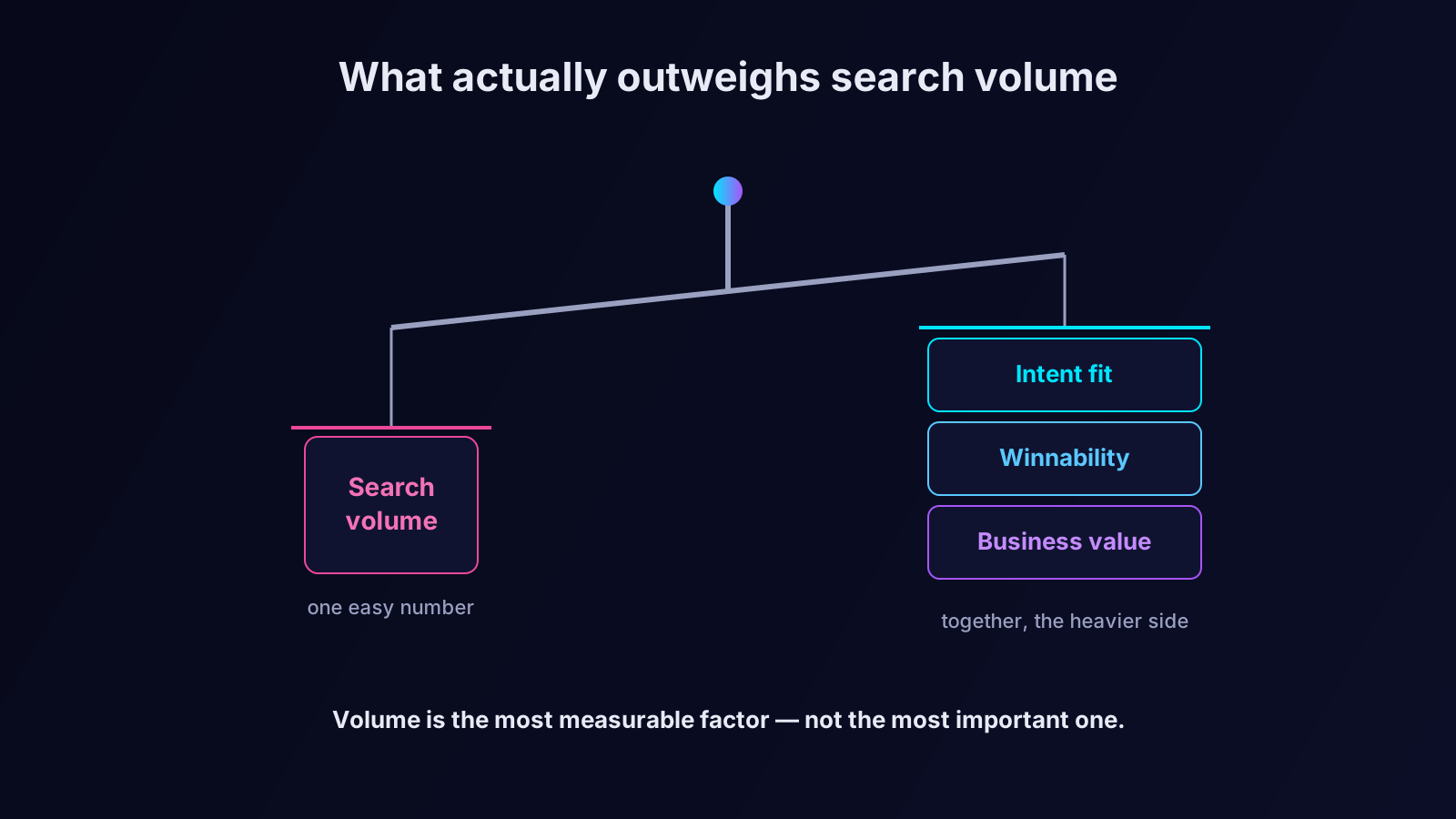
Volume is the first number a tool shows you because it is the easiest to measure — not because it is the most important. Treating "most measurable" as "most important" is the original sin of keyword research.
"Higher difficulty means better keywords — that's where the value is"
This one wears a contrarian disguise, which makes it more dangerous. The reasoning: high-difficulty keywords are hard because they are valuable, so a brave team should run at them.
Sometimes the premise holds — some hard keywords are hard because they are lucrative. But "hard" and "valuable" are not the same axis, and a young site charging at maximum difficulty is not being brave; it is being impatient. You do not win the hard keywords by attacking them head-on. You win them by building a cluster of attainable, related keywords until your site has the authority to make the hard term realistic. As the saying goes:
"You cannot climb a ladder by leaping at the top rung."
Difficulty is information about sequence, not a dare. The valuable hard keyword stays on the map — it just is not where you start.
"More keywords is always better — cover everything"
The instinct that a bigger keyword list is a stronger position feels intuitive and is mostly wrong. A list of two hundred keywords with no selection logic applied is not an asset; it is two hundred unmade decisions. Acting on all of them produces a sprawling site of mediocre pages, many competing with each other for the same intent.
Coverage is not the goal. Relevant coverage, in a deliberate structure, is the goal. As the design principle puts it:
"Perfection is achieved not when there is nothing more to add, but when there is nothing left to take away."
A focused set of keywords you can genuinely win, organised into clusters, beats an exhaustive set you merely listed. (We made the full case for this in why keyword research is 80% throwing keywords away.)
"If a competitor ranks for it, we should target it too"
Competitive keyword research is genuinely useful — but "they rank for it, so we must too" is not research, it is mimicry. Your competitor may rank for that keyword because of authority you do not have, an audience segment you do not serve, or a product feature you do not offer. Copying their keyword without their context is copying the visible move while missing the position behind it.
"Amateurs copy the move. Professionals understand the position."
Use competitor data to find gaps — valuable terms they have missed, or terms where their content is weak enough to beat — not as a list to imitate row by row.
"Get the keyword in, and the ranking will follow"
The oldest myth: that ranking is mainly about placing the keyword correctly — in the title, the headings, a few times in the body — and the position follows mechanically. It treats SEO as a fill-in-the-blanks exercise.
Modern search ranks pages on whether they satisfy the intent behind the query — completely, better than the alternatives. Keyword placement is hygiene, not strategy. A page perfectly "optimised" for a keyword whose intent it does not actually serve will not rank, because the engine measures outcomes, not keyword density.
"Optimise for the searcher's goal, not for the search box."
"Long-tail keywords aren't worth the effort"
The flip side of the volume obsession is open contempt for the long tail. "Thirty searches a month? We'd spend a whole article to capture thirty visits. Not worth it." The arithmetic feels airtight.
It is not, on three counts. A focused long-tail page does not rank for one phrase — it harvests dozens of close variants, so the real traffic is several times the named keyword's volume. The visits it brings are far more qualified, because the specificity of a long-tail query is buying intent spelled out. And the page keeps working for years at no further cost, while the head-term gamble produces nothing the entire time. The long tail looks unimpressive only when you judge one keyword, in isolation, on its launch day.
"Despise the small win often enough and you will look up to find a competitor built an empire out of them."
"Once you've done keyword research, you're done"
Keyword research gets treated as a project with an end — a sprint you complete, file, and move on from. So a team does the research once, builds a plan, and never revisits it.
But search demand is not static. New queries appear as a market evolves. Intent shifts as products enter a category. Your own Search Console fills, month after month, with real phrases you are getting impressions for that were nowhere in the original export. A keyword plan frozen on the day it was made starts drifting out of date immediately.
"A map is not the territory — and the territory keeps moving."
Keyword research is not a project. It is a process that runs as long as the site does.
"Target the highest commercial intent and skip the rest"
The revenue-focused version of bad advice: only chase commercial and transactional keywords, because those are the ones near the money. Informational keywords "don't convert," so why bother?
Because the buyer who searches a commercial keyword today was an informational searcher last month — and the brand that taught them, patiently, with no pitch, is the brand they now trust enough to consider. A site with only bottom-of-funnel pages has no way to be discovered early, no topical authority feeding its commercial pages, and no relationship with anyone who is not already shopping. Skipping informational content does not sharpen your funnel. It saws off the top of it.
"You cannot harvest a field you refused to plant."
"Write the keyword exactly as people type it"
A relic of older SEO that refuses to die: the belief that you must place the keyword in its exact form — same words, same order — in the title, the headings, and a fixed number of times in the body, or the page "won't be optimised."
This produces the unmistakable house style of bad SEO content: sentences bent into unnatural shapes to fit an exact phrase, headings that read like a robot wrote them, the same clumsy string repeated until the prose creaks. Search engines stopped needing that years ago. They understand synonyms, related concepts, and natural variation; they reward a page that covers a topic thoroughly in fluent language far above one that chants an exact phrase. Writing for the phrase instead of the reader does not optimise the page — it just makes it worse to read, which the engine also notices.
"Write for the person. The algorithm has learned to read like one."
"If a keyword shows zero volume, it's worthless"
Keyword tools frequently report "0" or "no data" for a phrase — and teams take that as proof nobody searches it. For long-tail and local queries especially, that is a mistake.
A tool reporting zero volume often means the phrase falls below the tool's measurement threshold or its dataset is too thin to register — not that the search demand is genuinely zero. This is acute for non-English markets and for very specific phrasings, where real, recurring searches simply do not produce enough sample for the tool to see. The proof lies elsewhere: your own Search Console will show "zero-volume" phrases quietly delivering impressions and clicks, month after month. Trust a tool's zero absolutely and you discard a whole category of winnable, high-intent keywords on the word of an instrument that admitted it could not see.
"Absence of evidence in a tool is not evidence of absence in the world."
The single question underneath all of it
Every piece of bad keyword advice above shares one root: it replaces a hard, multi-dimensional judgement with a single easy proxy. Volume. Difficulty. Count. Imitation. Placement. Each proxy is attractive because it is simple and measurable, and each one fails because keyword selection is not simple.
A keyword worth targeting has to satisfy several things at once. You can realistically rank for it. Its intent matches a page you can genuinely build. The people behind it have a path to becoming customers. And it does not duplicate something you have already published. No single metric captures that. The honest question is not "which keyword has the most volume?" but "which keyword can this site win, for searchers we can serve, who matter to the business?"
Why the bad advice survives — and where an agent helps
The simple proxies persist for an unglamorous reason: the real evaluation is hard work. Judging winnability, reading intent from the SERP, tracing business value, checking for overlap with existing content — doing that honestly for a whole keyword list is slow. "Sort by volume, pick the top rows" takes ten seconds. Under deadline pressure, the ten-second method wins, and the expensive advice gets followed one more time.
This is where an SEO AI agent changes the economics. Orova runs the multi-dimensional evaluation at the speed of the lazy shortcut — weighing each keyword on winnability for your specific site, intent fit, business relevance, and overlap with what you have already published, instead of just sorting a volume column. The proper judgement stops being the slow option, so there is no longer a reason to fall back on the proxy.
"The advice that is easiest to follow is rarely the advice that was worth following."
None of this advice is malicious. It survives because it is memorable — short, confident, easy to repeat in a meeting and easy to act on before lunch. Good keyword judgement has the opposite shape: it is conditional, it depends on your specific site, and it resists being compressed into a slogan. So the slogans win the retelling, and the careful thinking loses, one onboarding doc at a time. Recognising that pattern is half the defence — when a piece of keyword advice sounds clean enough to cross-stitch onto a pillow, treat the cleanliness itself as the warning.
The next time someone says "just pick the keyword with the most volume," hear it for what it is: not a strategy, but the absence of one, dressed in a number. Pick the keyword you can win, for people you can serve, who can become customers. It is harder to say in five words. It is the only version that works.
Let an AI Agent handle your SEO
Orova plans, writes, optimizes, and tracks rankings on its own — you just read the results.
Try it free