
Keyword Research Is 80% Throwing Keywords Away
Open any beginner's guide to keyword research and you will find the same promise: here is how to find keywords. Plug a seed term into a tool, export the list, sort by volume, and there it is — a spreadsheet with four thousand rows, glowing with possibility. It feels like progress. It feels like work.
It is, in fact, the easy part. And mistaking the easy part for the whole job is why so many content programs stall.
Here is the claim I want to defend in this article: keyword research is roughly 80% throwing keywords away. The value you create as an SEO is not in the rows you collect — a tool collects those in seconds — but in the rows you delete with full confidence. The discipline of rejection is the actual skill. Almost nobody teaches it, because "I found 4,000 keywords" makes a better screenshot than "I rejected 3,200 of them, and here is exactly why."
The myth of the big list
A large keyword list is treated as an asset. It should be treated as raw ore. Nobody builds a bridge out of ore; they build it out of the small fraction of refined metal left after most of the rock is discarded. A keyword export is the rock.
The myth persists because the big list looks like strategy. It has numbers in it. It can be filtered, colour-coded, and pasted into a slide. A manager who sees 4,000 keywords assumes 4,000 articles' worth of opportunity. But a list with no rejection logic applied to it is not a plan — it is a backlog of unmade decisions. Every row in it is a question you have not yet answered: should we, or should we not?
Worse, the big list quietly sets the wrong goal. Once the number exists, the team's instinct is to "work through" it. Coverage becomes the metric. You start writing the article because it is the next row, not because it is the right thing to publish. That is how a blog ends up with 600 posts and 40 that earn traffic.
A keyword you keep without a reason is a keyword you will regret. A keyword you reject with a reason is a decision you never have to revisit.
Why throwing away is the actual skill
Anyone can generate keywords. The tools have won that battle decisively — Search Console, Keyword Planner, and every third-party suite will hand you more terms than you could write about in a decade. Generation is a solved problem. Scarcity has moved.
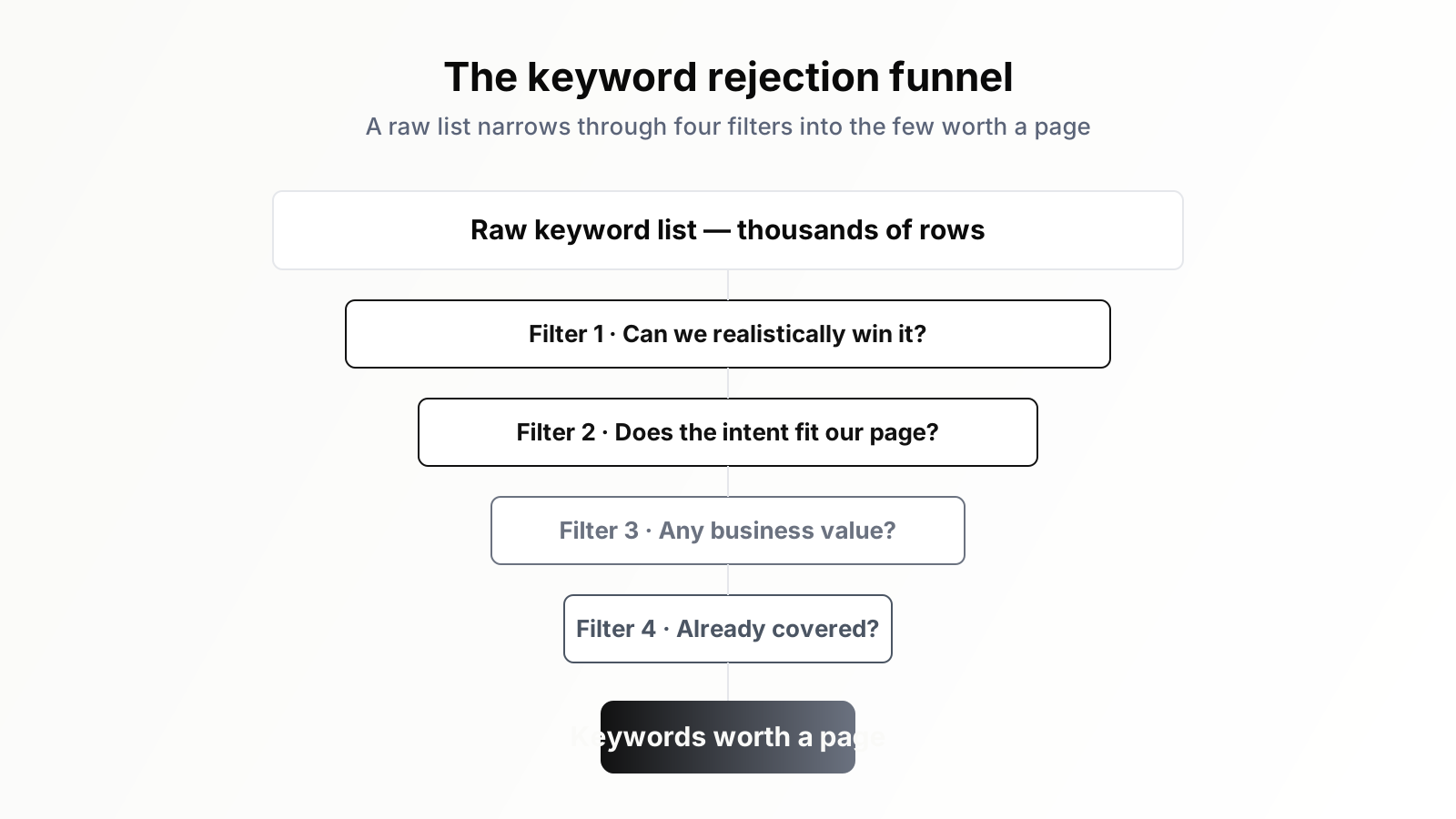
The scarce resource is judgement: the ability to look at a plausible-looking keyword and say "not us, not now, not worth it" — and be right. That judgement is what separates a content program that compounds from one that just accumulates. Let me break the rejection job into the four cuts that matter.
1. Reject keywords you cannot realistically win
Some keywords are simply not available to you yet. A two-year-old SaaS site does not rank for "project management software" against incumbents with twenty years of links and a thousand pages of topical depth. You can write the best article on earth for that term and finish on page six.
This is not pessimism; it is sequencing. You reject the head term now and earn the right to compete for it later, after the cluster of attainable sub-topics around it has built your authority. Rejecting a keyword is rarely permanent. It is a "not yet" with a condition attached.
The mistake teams make is treating difficulty as a single number from a tool. Difficulty is relative to you: your domain's authority, your existing coverage of the surrounding topic, and how much link equity you can route to the page. The same keyword can be a reject for one site and an easy win for another. A score in a tool cannot know that. You can.
2. Reject keywords whose intent you cannot serve
A keyword carries an intent — the job the searcher is trying to get done. If your page cannot do that job, ranking for the term is worthless, and you usually will not rank anyway because the engine measures whether searchers got what they came for.
A SaaS company selling SEO software has no business targeting "free keyword tool" if it does not offer a free tool. The searcher wants a free tool; you want a signup. The intent and your capability do not meet. You can rank briefly, watch everyone bounce, and slide back down. Reject it.
This cut is uncomfortable because the rejected keywords often have lovely volume. That is exactly the trap. Volume measures how many people search; it says nothing about whether those people are searching for what you can give them.
3. Reject keywords with no path to business value
Some keywords are winnable and intent-aligned and still worth rejecting, because the people behind them will never become customers or advocates. Traffic that cannot be connected — even loosely, even over six months — to revenue, signups, or genuine brand authority is a cost, not a win. It costs a writer's time, an editor's review, a slot in your publishing calendar, and a sliver of your site's crawl attention.
The honest test is a sentence: "If this article ranks #1 and gets every click, what good thing happens for the business?" If you cannot finish the sentence without hand-waving, reject the keyword. Note that "builds topical authority that supports a commercial cluster" is a perfectly valid answer — not every page must convert directly. But "it would get traffic" is not an answer. It just restates the keyword.
4. Reject keywords you have already covered
The fourth cut is the one teams skip most, and it causes the most damage: rejecting keywords that duplicate something you have already published. Two pages targeting the same intent do not double your chances. They split your signals, confuse the engine about which page to rank, and frequently leave both stranded. This is keyword cannibalization, and a sprawling keyword list is its natural breeding ground.
Before any keyword survives, it has to be checked against everything the site already covers. On a small blog that is a quick mental scan. On a site with hundreds of posts and years of history, no human reliably remembers the full catalogue — which is precisely why duplication creeps in, and why this cut is the first one a system should automate.
What "keeping" a keyword should actually mean
If 80% of the work is rejection, the surviving 20% deserves a real bar. A keyword you keep is not "a keyword you might write about." It is a commitment. Keeping it should mean you can state, in one breath:
- The intent — the specific job the searcher wants done, and the page format that does it (guide, comparison, definition, tutorial).
- The angle — why your version will be the most useful result, not the tenth near-identical one.
- The fit — which existing cluster it belongs to, what it links to, and what links to it.
- The payoff — the concrete good thing that happens to the business if it ranks.
If a keyword cannot carry those four sentences, it is not kept — it is merely "not rejected yet," which is a different and far weaker status. Most big lists are full of "not rejected yet" masquerading as a plan.
A rejection-first workflow
Flip the usual order. Instead of "find keywords, then maybe filter," make filtering the spine of the process.
Step one — gather widely, with no attachment. Pull from Search Console (what you already get impressions for), Keyword Planner, autocomplete, "People Also Ask," and competitor pages. Do not evaluate yet. The goal here is breadth, and you should feel no loyalty to anything you collect.
Step two — run the four cuts, hardest first. Winnability, intent fit, business value, uniqueness. Run them as a gauntlet: a keyword that fails any one cut is gone, and you stop evaluating it. Order matters — the cheapest, most decisive cuts go first so you spend judgement only on survivors.
Step three — write the rejection reason down. This is the step nobody does, and it is the one that compounds. A rejected keyword with a logged reason ("too competitive until cluster matures," "no free tool to match intent") never has to be re-evaluated. A rejected keyword with no note will quietly reappear in next quarter's list, and someone will waste an hour rediscovering why it was a bad idea. Your rejection log becomes institutional memory.
Step four — only now, prioritise the survivors. The keywords that made it through all four cuts are the ones worth sequencing by effort and payoff. Notice that prioritisation — the step most guides start with — is the last step here, and it operates on a list that is already 80% smaller and entirely defensible.
A fair objection: does all this rejection not slow the program down? In practice it does the opposite. A team working from a small, defended list moves faster, because every brief starts from a keyword whose intent, angle, and payoff are already settled — no mid-draft second-guessing, no "wait, should we even be writing this?" The slow programs are the ones grinding through an un-rejected list, rediscovering each keyword's problems one expensive article at a time. Rejection is not a tax on speed. It is what makes speed safe.
One more discipline worth adopting: treat the rejection log as a living document, not a graveyard. Conditions change. A keyword you rejected as "too competitive" becomes winnable once its cluster matures; a keyword rejected for "no matching page" becomes viable the day you ship the feature it describes. Revisit the log each quarter and you will find that a handful of yesterday's rejects have quietly become today's best opportunities — already vetted, already explained, waiting.
The cost of skipping the rejection
Skip the cuts and the costs do not disappear — they move downstream, where they are far more expensive. A keyword that should have been rejected in a spreadsheet instead becomes a commissioned brief, a drafted article, an editor's afternoon, a published URL, and a line in next quarter's "why isn't this ranking?" review. You paid the full production cost to learn what one minute of judgement would have told you for free.
Multiply that by a content calendar's worth of un-rejected keywords and you get the familiar SaaS-blog graph: output climbing steadily, traffic flat, and a growing archive of pages nobody links to, refreshes, or remembers. The team is busy. The blog is not working. The root cause is almost never bad writing. It is the rejection that never happened.
You cannot out-write a bad keyword list. The best article in the world, aimed at a keyword you should have thrown away, is still a page that will not perform.
Where an AI agent changes the maths
Here is the practical problem with everything above: rejection at the cuts is genuinely hard, repetitive work. Checking winnability means weighing your authority against each result. Checking intent means reading the live SERP. Checking uniqueness means holding your entire published catalogue in your head. Doing that honestly for thousands of rows is exhausting — so people skip it, and the big list survives intact.
This is the kind of structured, high-volume judgement an SEO AI agent is built to carry. Orova can take a raw keyword set and run the cuts at scale — flagging terms that clash with intent, surfacing overlaps with content you have already published so you do not cannibalise yourself, and grouping the survivors into clusters with the rejection reasons attached. It does not remove your judgement; it removes the fatigue that makes you abandon your judgement. (For how those survivors become a publishing plan, see our guide on going from keywords to a content plan.)
The mindset is the part you should keep regardless of tools. Stop measuring a research session by what you collected. Measure it by what you were willing to throw away, and how clearly you can defend it. The spreadsheet with 4,000 rows is not your work. The 800 you kept — and the 3,200 you can explain rejecting — that is the work.
Find keywords like everyone else. Then do the part almost nobody does: throw most of them away, on purpose, with reasons. That is keyword research.
Run your business with AI Agents
Orova is the always-on Biz AI Agent — it plans, runs, and optimizes the work for you. Save time, unlock productivity.
Try it free