
How to Design URLs That Both Google and Humans Like
The URL is one of the smallest pieces of a web page and one of the most overlooked. It is a single line of text, often generated automatically, often never looked at again after a page is published. And yet that single line is read by two very different audiences — search engines and human beings — and a URL that serves one well often serves the other badly. This is an analytical breakdown of what makes a URL good, where the tension between the two audiences lies, and how to design URLs that satisfy both without compromise.
What a URL is doing
To design URLs well, it helps to be precise about what a URL is actually for. It is not merely an address. It does several jobs at once, and a good URL does all of them.
It is a locator: it tells a browser, unambiguously, which resource to fetch. It is a label: when it appears in search results, in a shared link, in a bookmark, or pasted into a chat, it is a short description of what the page contains. It is a structural signal: its path reflects, or should reflect, where the page sits in the site's architecture. And it is a permanent commitment: once a URL is published and links accumulate to it, changing it carries a real cost. A URL is a promise you are making to keep an address stable.
Most URL mistakes come from treating the URL as only a locator and ignoring the other three jobs.
The two audiences and what each one wants
A URL is read by search engines and by humans, and the analytical core of good URL design is understanding where their preferences align and where they diverge.
Search engines want URLs that are stable — so the index does not have to keep reconciling moved pages — and descriptive, because the words in a URL are a minor but real signal about the page's topic. They want URLs that are canonical and singular, so the same content is not reachable through many different addresses. They are largely indifferent to length and to aesthetics; a long, ugly URL ranks fine if it is stable and singular.
Humans want URLs that are readable — words they recognise, not codes — and short enough to take in at a glance. They want URLs that are guessable and trustworthy: a URL that looks clean and logical inspires more confidence, in a search result or a shared link, than one full of parameters and random strings. Humans are largely indifferent to whether a URL is technically canonical; they never see the duplicate-content machinery.
The good news for design is that these two sets of preferences overlap far more than they conflict. A short, readable, descriptive, stable URL serves both audiences. The tension is narrow and specific, and we will come to it.
The anatomy of a good URL
A well-designed URL has a small number of identifiable qualities. Each one is worth examining on its own.
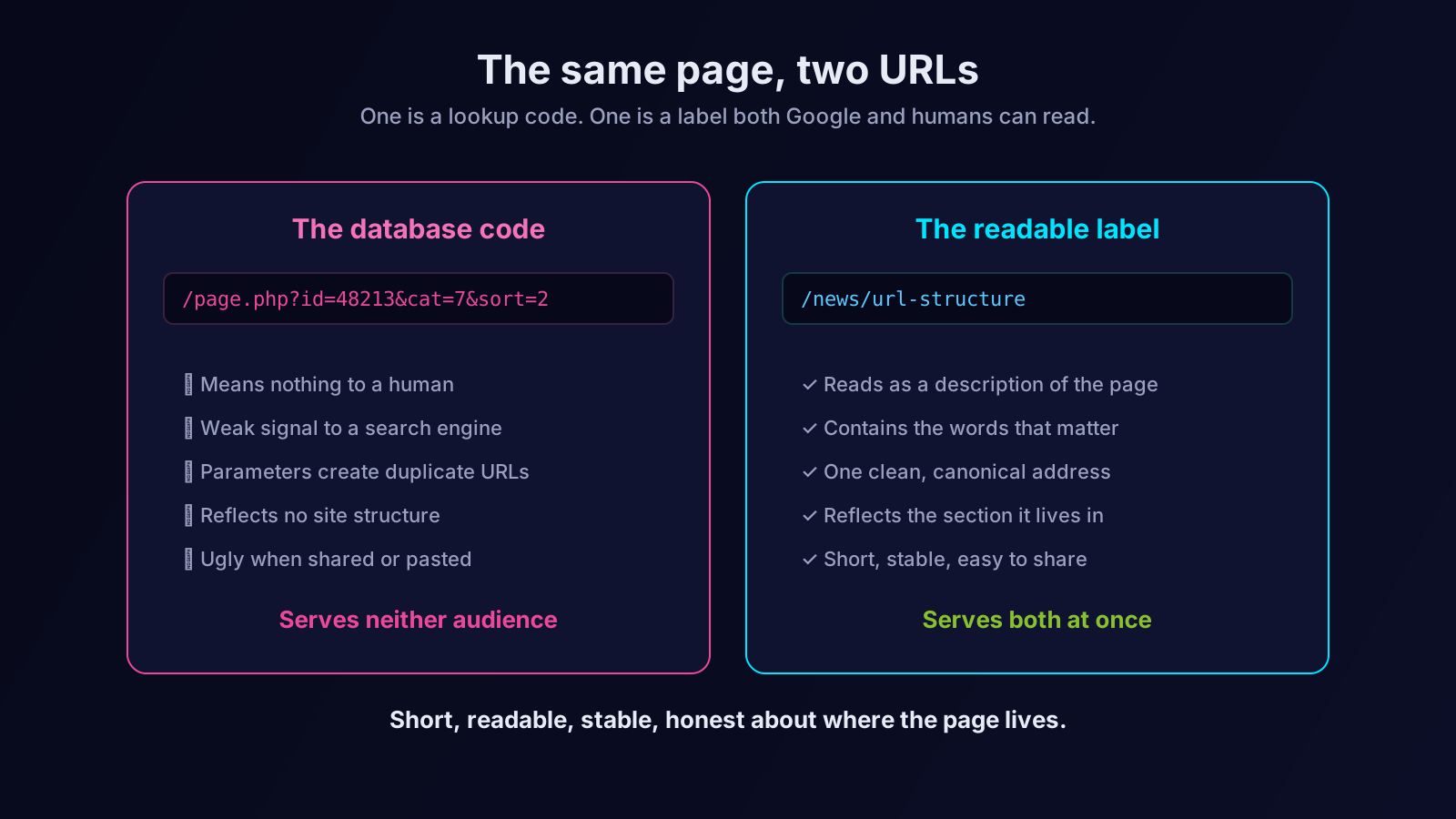
It is readable. The path uses real words, separated by hyphens, in lower case. A reader can look at the URL and form an accurate expectation of the page. Compare a path like /news/url-structure with one like /p?id=48213&cat=7. The first is a label; the second is a lookup code that means nothing to anyone outside the database.
It is concise. It contains the words that matter and nothing else. Stop words, repeated category names, dates that will not age well, and decorative filler are all removed. Concise is not the same as cryptic — the goal is to keep the meaningful words and cut the noise.
It reflects the architecture. The path mirrors where the page sits. A page in the technical-SEO cluster lives under a path that makes that membership visible. The URL becomes a second expression of site architecture — read the URL and you know which corridor of the building you are in.
It is consistent. Every URL on the site follows the same pattern: the same depth conventions, the same word separators, the same casing, the same handling of categories. Consistency makes the whole set of URLs predictable, which helps both crawlers and humans.
It is stable. Once published, it does not change. The words chosen are general enough to survive content updates — a URL built around a year or a transient detail will look wrong within months, and the temptation to change it will create the very instability good URLs avoid.
The mistakes, examined one by one
It is more instructive to look at specific URL mistakes than to list virtues, because the mistakes are concrete and common.
The database-code URL. A path that is a numeric ID or a random string. It is perfectly functional as a locator and fails completely as a label. It tells a human nothing and a search engine almost nothing. This is the most common mistake on sites built without attention to URLs.
The kitchen-sink URL. A path so long it includes the full title, the category, a date, and several stop words. It is descriptive to a fault — so long that it is hard to read, hard to share, and prone to truncation in search results. Descriptiveness has diminishing returns; past a point, more words subtract clarity.
The unstable URL. A path built around something that will change — a year, a price, a campaign name, a word like "new." When the underlying content updates, the URL is now wrong, and whoever maintains the site faces a bad choice: leave a misleading URL, or change it and break every link pointing to it.
The parameter sprawl. A page reachable through many URLs that differ only by tracking parameters, sort orders, or filter combinations. To a human these look like one page; to a search engine they look like many near-identical pages competing with each other. This is one of the most common causes of accidental duplication, and it is an architectural problem wearing a URL costume.
The inconsistent set. Not a single bad URL but a collection that follows no shared pattern — some with dates, some without, some with category folders, some flat, mixed casing, mixed separators. Each URL might be defensible alone; together they are a mess that makes the whole site harder to crawl and reason about.
Where the two audiences genuinely conflict
Having said the preferences mostly overlap, it is worth being precise about the narrow places they do not.
The clearest conflict is over descriptive length. A search engine is mildly happier with a few more relevant words in the path; a human is happier with a shorter path that is easier to read and share. The resolution is a judgement call, and the rule that resolves it well is: include the words that genuinely identify the page, and stop. The keyword the page targets belongs in the URL. The third synonym for it does not.
A second, subtler conflict is over category folders. Nesting a page inside category folders makes the architecture visible in the path, which both audiences appreciate — but deep nesting also makes URLs longer and can imply a crawl depth the site does not actually have. The resolution is to keep nesting shallow: one category level is usually enough to signal structure without bloating the path or implying false depth.
A third conflict is over change. A human looking at an outdated URL would prefer it were corrected. A search engine would strongly prefer it never change. Here the search engine should almost always win, because the cost of instability is real and ongoing while the cost of a slightly imperfect URL is cosmetic. This is why choosing stable words at publication time matters so much — it removes the temptation to change later.
Designing a URL scheme, step by step
URL design is best done once, deliberately, as a scheme that every future page inherits. The steps are sequential.
First, decide the overall pattern. Will pages sit under category folders, or at a single shallow level? For most content sites, a shallow pattern — a single section folder plus a descriptive slug — is the cleanest. Decide this and write it down.
Second, decide the conventions: lower case always, hyphens as word separators, no underscores, no spaces, no capital letters, no trailing parameters in the canonical URL. These are not matters of taste; they are matters of consistency, and consistency is the whole point of a scheme.
Third, decide the slug rules. The slug is built from the page's core topic — typically a condensed form of the target keyword — with stop words and filler removed, kept short, and chosen from stable vocabulary. Write a short, clear rule for how a slug is derived from a title so that every page is treated the same way.
Fourth, decide how parameters are handled. Tracking parameters, sort orders, and filters should never produce indexable duplicate URLs; the canonical version of every page is the clean, parameter-free path. Decide the rule and enforce it technically.
Fifth, decide the redirect policy. When a URL must change — and occasionally one genuinely must — there is exactly one correct response: a permanent redirect from the old address to the new one, so accumulated links and authority are preserved. A URL that changes without a redirect is a URL that throws away everything it had earned.
Why URLs are worth this much attention
It is fair to ask whether a single line of text deserves a whole framework. The answer is that the URL is small but permanent, and permanence amplifies small things.
A good URL is not a dramatic ranking factor. It will not, on its own, lift a page from page two to page one. But a URL is touched by everything: every search result, every shared link, every internal link, every bookmark, every crawl. A small quality, multiplied across every interaction with the page for the entire life of the page, becomes a meaningful quality. And a small mistake — an unstable URL, a parameter sprawl, an inconsistent scheme — multiplied the same way becomes a meaningful drag.
The economics of URL design are also unusually favourable. Designed well at the start, a URL costs nothing to maintain — it just sits there, working, forever. Designed badly, it costs either an ongoing trickle of confusion or an expensive, link-breaking correction later. Few SEO decisions have a cleaner return for the effort.
The special cases that break the rules
A URL scheme handles the ordinary page well. It is worth thinking through the few categories of page that need deliberate exceptions, because handling them carelessly is a common source of trouble.
The first is the filtered or faceted page — the kind produced when a visitor narrows a list by category, price, colour, or sort order. Each combination can generate a unique URL, and a site with several filters can spawn thousands of these. Most of them are near-duplicates with no independent search value. The rule here is that the scheme must decide, deliberately, which filtered combinations deserve to be indexable pages with clean URLs and which should be treated as the same canonical page. Letting every filter combination become its own indexable URL is one of the fastest ways to bury a site under accidental duplication.
The second is the paginated series — page two, page three, and so on of an archive or list. These need a consistent, predictable URL pattern, and the scheme should be explicit about how they are handled so they neither compete with the first page nor strand the content listed deep within them.
The third is the multilingual or multi-region page. When the same content exists in several languages, the URL scheme has to make the language or region visible in the path in a consistent way, so that each version has its own clean, stable address and the relationship between them is unambiguous. Inconsistent language handling in URLs is a recurring headache on international sites.
The fourth is the campaign landing page. These often arrive with tracking parameters bolted on, and they are frequently temporary. The scheme should treat the clean path as canonical and never let the campaign-tagged variants become the indexed version — and it should be honest about whether a temporary page deserves a permanent URL at all.
The common thread across all four is that exceptions should be decided by the scheme, in advance, not improvised page by page. A URL scheme that only covers the easy case is not really a scheme; it is a default that collapses the moment a real site's complexity arrives.
Where an AI agent helps
The hard part of URL design is not knowing the rules — they fit on a single page. The hard part is applying them with perfect consistency across hundreds of pages and over years, including the pages published in a hurry, by different people, after the scheme was half-forgotten. URL quality erodes the same way architecture erodes: not through disagreement, but through inattention.
This is where an SEO AI agent is genuinely useful. Orova applies a URL scheme consistently, derives clean, stable slugs from page topics, flags parameter sprawl and inconsistent patterns across an existing site, and catches the URL that was about to be built around a transient word. The single line of text that everyone overlooks gets designed with the same care every time, instead of depending on whoever happened to publish the page.
Designing URLs that both Google and humans like is, in the end, not a compromise at all. The two audiences want almost the same thing — something short, readable, stable, and honest about where the page lives. Give them that, consistently, and the smallest line on the page quietly does its job for as long as the page exists.
Let an AI Agent handle your SEO
Orova plans, writes, optimizes, and tracks rankings on its own — you just read the results.
Try it free