
Site Architecture: The SEO Lever Nobody Talks About
Most SEO conversations circle the same few topics: keywords, backlinks, content quality, and whatever the latest algorithm rumour happens to be. Site architecture almost never comes up. It is not glamorous, it does not produce a satisfying before-and-after screenshot, and it cannot be bought in a tool subscription. And yet, of all the levers available to an SEO team, the structure of the site is one of the most powerful — and one of the most consistently neglected. This is a working guide to what site architecture actually is, why it moves rankings, and how to design or repair it deliberately rather than letting it accumulate by accident.
What site architecture actually means
Site architecture is the way the pages of a website are organised and connected. It is the answer to a deceptively simple question: starting from the homepage, how does a visitor — or a search engine crawler — get to any given page, and how many steps does it take?
It is tempting to think of architecture as a visual thing, a navigation menu or a sitemap diagram. It is not. Architecture is the underlying graph of relationships: which pages link to which, which pages are grouped together, which pages sit close to the front door and which sit in the far back rooms. The navigation menu is one expression of that graph. So is the internal linking inside body content, the breadcrumb trail, the footer, and the URL path. Architecture is the sum of all of them.
A useful mental model is to picture the site as a building. The homepage is the lobby. Category and hub pages are the corridors. Individual articles and product pages are the rooms. Good architecture means a visitor can find any room quickly, the related rooms are near each other, and nothing is walled off in a wing with no door. Bad architecture means rooms scattered at random, dead-end corridors, and rooms that exist on the floor plan but have no way in at all.
Why architecture moves rankings
Architecture is not a cosmetic concern. It affects rankings through several concrete mechanisms, and understanding each one is what separates deliberate design from decoration.
The first mechanism is crawlability. Search engines discover pages by following links. A page that is well-connected — linked to from several relevant places, reachable in a few clicks from the homepage — gets found quickly and re-crawled often. A page buried deep, linked from only one obscure place, may be crawled rarely or, in the worst case, never. If a crawler cannot reach a page, that page cannot rank. Architecture is, before anything else, the system that decides what gets discovered.
The second mechanism is the distribution of authority. When other sites link to yours, that authority flows in and then spreads internally through your link graph. A page that sits close to well-linked pages, and is connected to many relevant siblings, receives a healthy share of that internal flow. A page stranded at the edge of the graph receives almost none. Architecture is the plumbing that decides where authority pools and where it runs dry.
The third mechanism is topical clarity. When you group related pages together and link them densely, you send a clear, repeated signal about what your site is about and how deeply it covers each subject. A site organised into coherent clusters reads, to a search engine, as an authority on those clusters. A site that is a flat heap of unconnected pages reads as a collection of unrelated documents. This is the architectural foundation of the topic cluster model — clusters are not just a content idea, they are an architectural one.
The fourth mechanism is user experience, which feeds back into rankings indirectly. A visitor who lands on a page and can immediately see related, relevant next steps stays longer, reads more, and is more likely to convert. A visitor who lands on a dead-end page leaves. Architecture shapes the paths people take through your site, and those paths shape the behavioural signals search engines observe.
The vocabulary you need
Before designing anything, it helps to share a precise vocabulary, because vague terms lead to vague architecture.
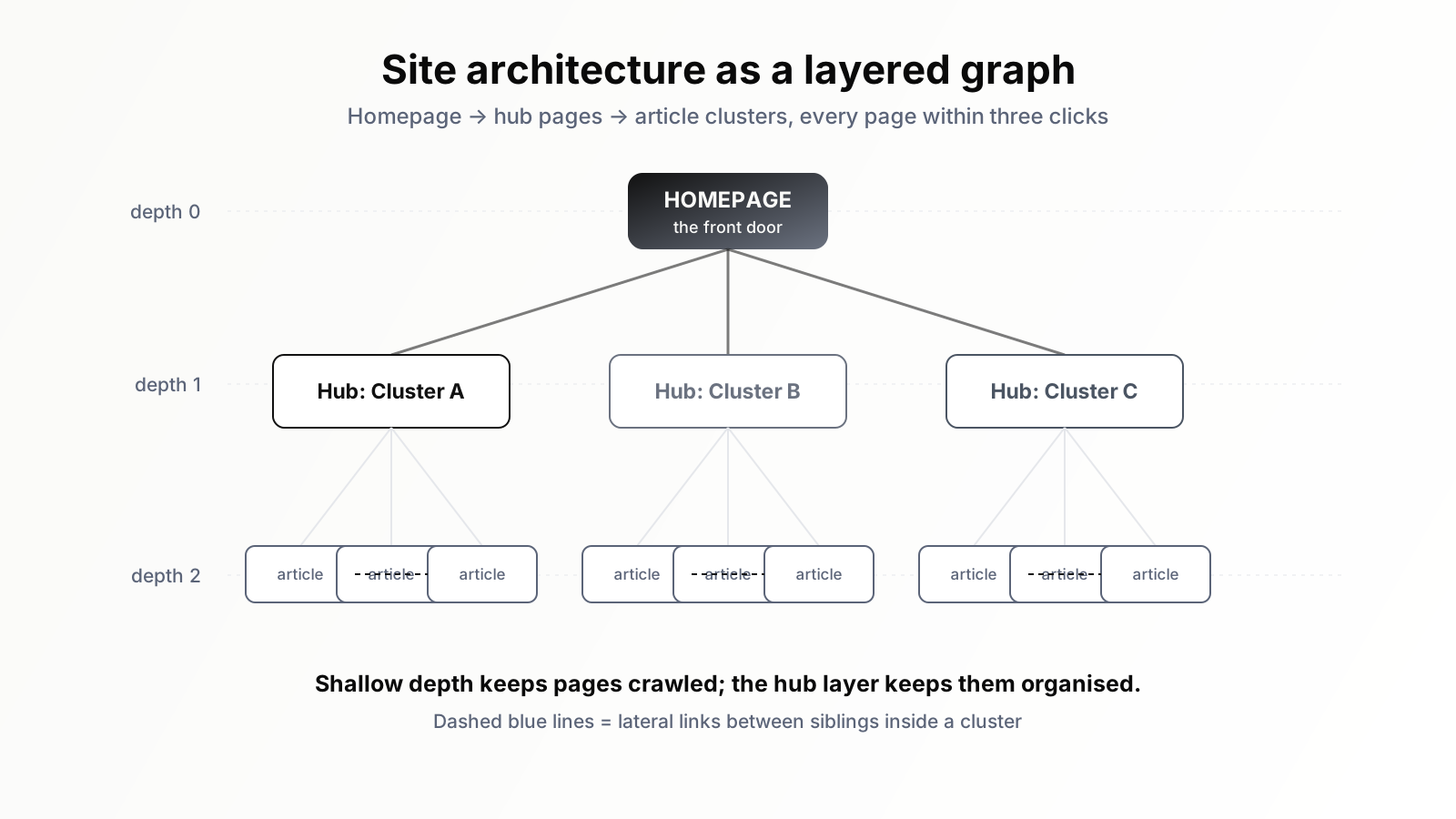
Crawl depth is the number of clicks from the homepage to a given page, following the shortest path. A page two clicks deep is at depth two. Depth is one of the single most useful architectural metrics, because it correlates strongly with how often a page is crawled and how much authority it receives.
Hub pages — also called pillar or category pages — are pages whose job is to organise and link to a set of related pages. A hub does not need to rank for a competitive term itself, although the good ones do; its primary architectural role is to be a corridor.
Clusters are groups of pages that cover one topic from many angles, linked to each other and to a shared hub. A cluster is the basic unit of a well-architected content site.
Orphan pages are pages with no internal links pointing to them. They exist, but the link graph does not connect to them. They are, architecturally speaking, rooms with no door.
Link equity or authority flow is the value passed from page to page through links. Architecture is the system that routes it.
The principles of good architecture
With the vocabulary in place, the principles of sound architecture are straightforward to state — and the discipline is in applying them consistently.
Keep important pages shallow. Your most valuable pages — the ones you most want to rank — should be reachable in as few clicks as possible from the homepage. As a working rule, no page that matters should be more than three clicks deep, and your priority pages should be closer than that. Depth is a budget, and your best pages deserve to be spent near the front.
Group by topic, not by date or format. The single most common architectural mistake on content sites is organising the blog as a reverse-chronological stream — newest first, everything mixed together. Chronology is convenient for the publisher and useless for the reader and the crawler. Organise by subject instead. A visitor interested in technical SEO should find every technical SEO article gathered in one place, linked together, not scattered across eighteen months of an undifferentiated feed.
Make every page connected. No page should be an orphan. If a page is worth publishing, it is worth linking to from at least its hub and ideally from a few relevant siblings. If a page genuinely does not deserve a single internal link, that is a strong signal the page should not exist.
Link siblings to siblings. Pages within the same cluster should link to each other where it is genuinely useful, not only up to the hub and down from it. Lateral links inside a cluster strengthen the topical signal and give readers natural next steps.
Keep the structure consistent. A predictable structure — every cluster organised the same way, every URL following the same pattern, every breadcrumb behaving the same — is easier for crawlers to interpret and easier for humans to navigate. Inconsistency is a tax paid on every page.
How to design architecture for a new site
Designing architecture for a site that does not yet exist is the easy case, because you have no legacy to fight. The work is sequential.
Start with the topics, not the pages. List the major subject areas your site will cover — these become your top-level clusters and your hub pages. For a focused SaaS site this might be a handful of clusters; for a broad publication it might be more. Resist the urge to over-segment. A small number of strong, well-populated clusters beats a large number of thin ones.
For each cluster, plan the hub page and the set of articles it will contain. The hub introduces and links to every article; the articles link back to the hub and across to relevant siblings. This is the same workflow described in turning keywords into a content plan — the keyword map and the architecture are two views of the same structure.
Then decide the URL pattern. URLs should mirror the architecture: a logical, readable path that reflects which cluster a page belongs to. Decide this once, early, and apply it everywhere — retrofitting a URL scheme later is painful.
Finally, plan the navigation and internal linking rules. Decide what appears in the main menu, how breadcrumbs behave, and what the standard cross-linking pattern within a cluster will be. Write these rules down. Architecture that lives only in someone's head erodes the moment that person is busy.
How to repair architecture on an existing site
Most of the time you are not designing a new site — you are inheriting one that grew organically, which is a polite way of saying it grew without a plan. Repair is harder than design, but it follows a clear sequence.
Begin with an audit. Crawl the site and map its actual structure: the real crawl depth of every page, the orphan pages, the clusters that exist and the ones that should. The goal of the audit is an honest picture of the building as it stands, including the walled-off wings.
Then identify the gap between the structure you have and the structure you want. Which important pages are buried too deep? Which pages are orphaned? Which topics are scattered and should be gathered into clusters? Which hub pages are missing entirely?
Repair in priority order. Pull your most valuable buried pages closer to the surface first by linking to them from shallow, well-connected pages. Connect the orphans. Build the missing hub pages and route the relevant articles through them. Add the lateral links that knit each cluster together. Architecture repair is rarely a single dramatic project; it is a sequence of deliberate moves, and the early moves on the highest-value pages produce the most visible return.
The mistakes that quietly accumulate
Architecture rarely fails in one catastrophic decision. It fails through small mistakes that compound over years.
The most common is simple neglect: publishing page after page without ever asking where each one sits in the structure. Each individual page seems fine. The cumulative result, after a few hundred pages, is a sprawl with no shape.
Another is over-reliance on the navigation menu as the only structure. The menu is one expression of architecture, but a menu can only hold so many links. Most of a site's architecture has to live in body-content internal links and hub pages, not in the header.
A third is pagination drift — important pages sliding deeper and deeper as newer content pushes them down a paginated archive, until a page that was once one click deep is now six clicks deep and effectively invisible. Chronological archives do this silently and continuously.
A fourth is the abandoned cluster: a topic area that received attention for a while, then stopped, leaving a half-built hub and a few stranded articles. Half-built architecture sends a confused signal.
How to know your architecture is working
Architecture is hard to feel by intuition, so you need signals. A well-architected site shows a healthy crawl-depth distribution — most pages shallow, few pages buried. It shows few or no orphan pages. It shows search engines crawling new pages quickly after publication, because the link graph leads to them. It shows clusters where the hub and the articles all rank for related terms, reinforcing each other. And it shows visitors moving through the site along sensible paths, from one related page to the next, rather than landing and bouncing.
When those signals are absent, the cause is often architectural even when it looks like something else. A page that will not rank despite good content may simply be too deep, or orphaned, or stranded outside any cluster. The content is not the problem. The plumbing is.
Where an AI agent helps
The reason architecture is neglected is not that teams disagree it matters — it is that maintaining it is relentless, unglamorous work. Every new page raises the same questions: which cluster does this belong to, what should it link to, what should link to it, how deep does it sit. Answered well, every time, those questions keep a site coherent. Answered carelessly, or skipped under deadline, the sprawl creeps back. And auditing an existing site for depth problems and orphans by hand is slow enough that it rarely gets done.
This is where an SEO AI agent earns its place. Orova treats architecture as a living system rather than a one-off project: it maps the real structure of a site, flags pages that are too deep or orphaned, suggests where each new page belongs and what it should connect to, and keeps the link graph coherent as the site grows. The unglamorous maintenance that quietly decides whether your content ever gets discovered stops depending on whether someone remembered to do it.
Site architecture is the lever nobody talks about precisely because it is invisible when it works. You do not see good plumbing; you only notice the bad kind, when something floods. But the sites that rank consistently, year after year, are almost always the ones whose structure was designed on purpose — and the ones that struggle are, more often than anyone admits, just badly built. Pull the lever. It is one of the few that is entirely within your control.
Run your business with AI Agents
Orova is the always-on Biz AI Agent — it plans, runs, and optimizes the work for you. Save time, unlock productivity.
Try it free