
Flat vs Deep Site Structure: Which Wins?

Ask two SEO professionals how a website should be structured and you may get two confident, opposite answers. One will tell you to keep it flat — every page just a click or two from the homepage. The other will tell you that some depth is natural and necessary, that hierarchy is how meaning gets organised. Both are partly right, and the disagreement is more interesting than either slogan. This is an analytical breakdown of flat versus deep site structure: what each one actually is, what each one costs and earns, and how to decide which your site needs.
Defining the terms precisely
Before comparing them, the two terms have to be pinned down, because they are often used loosely.
A flat structure is one in which most pages sit a small number of clicks from the homepage — typically one to three. The hierarchy is wide and shallow: the homepage links to many sections, and the sections link to many pages, but the chain of clicks from front door to any given page is short. Picture a bungalow — a lot of rooms, all on one or two floors.
A deep structure is one in which pages are organised into many nested levels, so reaching a given page may take five, six, or more clicks. The hierarchy is narrow and tall: each level has relatively few children, but the chain of levels is long. Picture a tower — fewer rooms per floor, but many floors.
The key metric underneath both is crawl depth: the number of clicks on the shortest path from the homepage to a page. Flat and deep are really just descriptions of how that depth is distributed across a site. And it is worth saying immediately: flat versus deep is not a binary. It is a spectrum, and the right question is not "which camp am I in" but "where on the spectrum should this particular site sit."
Why depth matters at all
Depth is not a cosmetic property of a site. It connects to ranking through two well-understood mechanisms.
The first is crawl behaviour. Search engines tend to crawl shallow pages more readily and more often than deep ones. A page close to the homepage is reached early and revisited frequently; a page many levels down is reached later and revisited less. Depth, in practice, correlates with how much crawl attention a page receives — and crawl attention is a prerequisite for ranking and for reflecting updates promptly.
The second is authority distribution. The homepage is typically the most authoritative page on a site, because it attracts the most links. Authority flows outward from it through internal links, and it dilutes with each hop. A page one click from the homepage sits in a strong current of that authority. A page six clicks down sits in a trickle — most of the authority has been dispersed across the intervening levels. Depth, then, also correlates with how much internal authority a page can accumulate.
Both mechanisms point the same way: shallower pages have a structural advantage. This is the kernel of truth in the "keep it flat" argument, and it is a real truth. But it is not the whole picture, which is why the argument does not end there.
The case for flat structure
The flat-structure argument, stated fairly, is strong.
Shallow pages get crawled more and inherit more authority — so a flat site gives more of its pages the structural advantage. On a flat site, your hundredth-most-important page is still only two or three clicks deep, still in reach of crawlers and authority. On a deep site, that same page might be stranded six levels down, structurally starved.
Flat structures are also more resilient. There are fewer levels in which a page can get buried, fewer paginated archives quietly pushing pages downward, fewer opportunities for a page to drift out of reach. A flat structure has less room to decay.
And flat structures tend to be simpler for visitors. Fewer clicks to anything means less navigation friction. The path from intent to content is short.
This is why "keep it flat" has become near-orthodoxy in SEO advice. As a default instinct, it is a good one. The structural advantages are real and they apply to most sites most of the time.
The case against pure flatness
But push flatness to its logical extreme and it breaks, which is where the contrarian half of the analysis comes in.
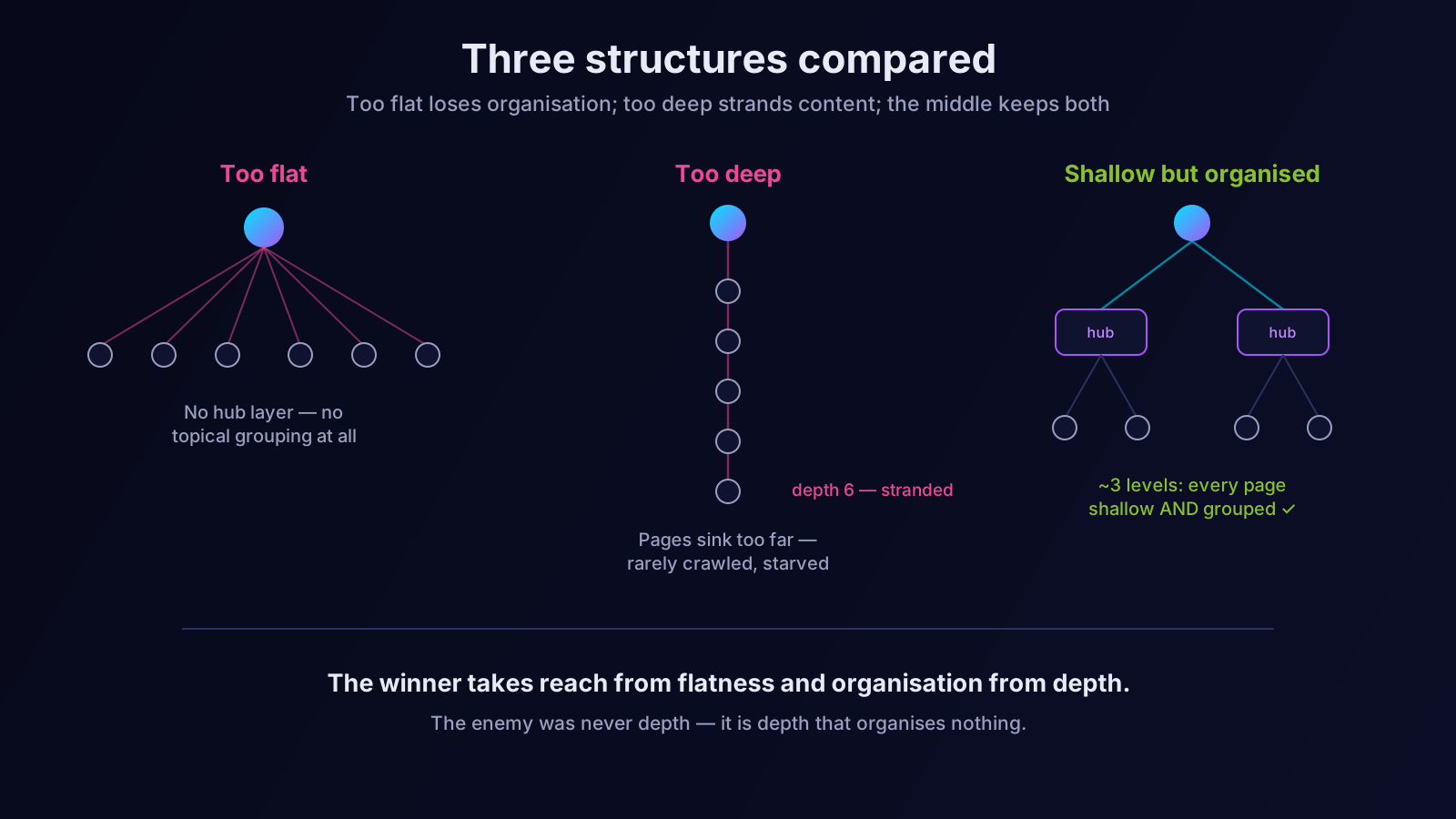
A perfectly flat site — every page exactly one click from the homepage — is not actually well-structured. It is unstructured. If the homepage links directly to all five hundred pages, then the homepage's authority is split five hundred ways, each page getting a vanishingly thin slice. The navigation becomes an unusable wall of links. And, crucially, the site has thrown away hierarchy entirely — there is no grouping, no indication of which pages relate to which, no topical organisation. A radically flat site is a heap.
This reveals something the simple "flat is good" slogan obscures: depth is not only a cost. Depth is also structure. The intermediate levels in a site — the section pages, the hub pages, the category pages — are not just obstacles between the homepage and the content. They are the organising layer. They are how related pages get grouped, how topical clusters get expressed, how a visitor and a crawler understand what the site is about and how it is divided.
Remove all depth and you remove all of that. A click from homepage to hub to article is not wasted depth — that middle click is the hub page doing the essential work of organising a cluster. The relevant topic cluster model is itself a structure with depth: homepage, pillar, supporting articles. That is three levels, on purpose, and the middle level is the point.
The case against excessive depth
If pure flatness fails at one extreme, excessive depth fails at the other, and the failure is the one the flat-structure camp correctly warns about.
A site with too many nested levels strands its content. Pages sink six, seven, eight clicks down — crawled rarely, starved of authority, effectively invisible no matter how good their content. Excessive depth also tends to be excessive segmentation: a deep site is usually one that has been chopped into too many narrow sub-categories, each holding only a handful of thin pages. The hierarchy is tall because it is over-divided, and over-division produces clusters too small to have any weight.
Deep structures decay faster, too. Every level is another place a page can get buried, another paginated archive doing its silent downward work. And deep structures impose more friction on visitors — more clicks, more navigation, more chances to give up before reaching the content.
So excessive depth is genuinely bad. The flat camp is right about that. They are only wrong in concluding that the answer is therefore the opposite extreme.
The resolution: shallow but organised
The honest answer to "flat versus deep" is that the question contains a false choice. The two things that flatness and depth each provide — reach and organisation — are not opposites you must trade between. A well-structured site has both.
The target is a site that is shallow but organised. Concretely, that usually means a structure of about three meaningful levels. The homepage. A layer of hub or section pages, each one organising a coherent cluster of related content. And the individual content pages themselves, sitting under their hub. Three levels keeps every page within roughly three clicks of the homepage — shallow enough for the crawl and authority advantages — while the middle layer of hubs provides the organisation, the grouping, the topical structure that pure flatness destroys.
This is not a compromise in the sense of giving up something from each side. It is the recognition that the middle level was never the enemy. The hub layer is depth, technically — but it is depth that does productive work. The depth worth eliminating is the unproductive kind: extra levels that exist because the site was over-segmented, paginated archives that bury pages, nesting that organises nothing. Cut that depth ruthlessly. Keep the one organising layer.
How to decide for your specific site
"About three levels" is a default, not a law. How a particular site should sit on the spectrum depends on its scale and nature.
A small site — a few dozen pages — can and should be nearly flat. There is not enough content to need much organising structure; one section layer is plenty, and some pages can sit directly off the homepage. Forcing deep hierarchy onto a small site is over-engineering.
A large site — thousands of pages — genuinely needs more structure. You cannot organise thousands of pages with a single hub layer; you will need sub-categories, a second level of grouping. The goal is still to keep the productive depth and cut the unproductive, but a large site's "shallow" will legitimately be a little deeper than a small site's.
The decision, in practice, comes from auditing the depth distribution you actually have. Crawl the site, measure the real crawl depth of every page, and look at the shape. If your important pages are sitting five or six clicks down, you are too deep — flatten by improving internal linking and trimming over-segmentation. If your homepage is firehosing links to hundreds of pages with no organising layer, you are too flat — introduce hub pages. The data tells you which problem you have, and most sites have one or the other rather than neither.
Which wins, then?
So: flat versus deep — which wins? The accurate answer is that the framing loses. Neither extreme wins. A radically flat site wins on reach and loses all organisation. A deeply nested site wins on organisation and strands its content. The site that actually wins is the one that takes reach from flatness and organisation from depth: shallow enough that every page is within a few clicks and a healthy share of authority, structured enough that a layer of hubs groups the content into coherent, weighty clusters.
If forced to pick a default bias, lean shallow — because the most common real-world failure is sites drifting too deep, not too flat. But hold the bias loosely, and never let it talk you into destroying the hub layer that does the organising. The enemy was never depth. The enemy is depth that organises nothing.
Depth is not the same as clicks in the menu
There is a subtle confusion buried in the flat-versus-deep debate that is worth untangling on its own, because it leads people to misdiagnose their own sites.
When people picture crawl depth, they usually picture the navigation menu: homepage, click a menu item, click a submenu item, arrive. By that picture, depth is purely a matter of how many menu levels you have to descend. But crawl depth is the length of the shortest path through any link, not just menu links. A page that is six menu levels down but also linked directly from a related article one click off the homepage is not at depth six. It is at depth two, because the article gives it a shorter path.
This distinction matters enormously in practice. It means you can flatten a site's effective depth without restructuring the navigation menu at all — simply by adding internal links in body content that create shorter paths to important buried pages. A deep-looking site, in menu terms, can have a shallow effective depth if its internal linking is generous. And a flat-looking site, in menu terms, can have surprisingly deep effective depth if its pages barely link to each other and the only paths run through the menu.
It also reframes the repair work. When an audit shows important pages stranded at depth six, the instinct is to reorganise the navigation — a large, disruptive project. Often the faster and less disruptive fix is to leave the menu alone and add a handful of well-placed body-content links from shallow, well-connected pages. Those links create new short paths, and the effective depth of the buried pages collapses overnight. The menu is one set of paths. Internal links in content are another, and they are usually the cheaper lever.
So when you measure your site's depth distribution, measure the real shortest-path depth, accounting for every internal link — not the menu-descent depth. The two numbers can be very different, and only the first one is the one that matters to crawlers and to authority flow.
Where an AI agent helps
The reason this question stays unresolved in practice is not that the answer is hard to state — it is that measuring and maintaining the right depth distribution is ongoing work. A site's depth profile drifts: archives paginate, sections fragment, pages sink. Keeping a site shallow-but-organised means continuously auditing the real crawl depth, spotting the pages that have sunk too far, and watching that the hub layer stays coherent rather than over-multiplying.
This is where an SEO AI agent earns its keep. Orova maps the real depth distribution of a site, flags the important pages that have drifted too deep, spots over-segmentation and missing hub structure, and recommends the specific internal-linking moves that flatten the unproductive depth while preserving the organising layer. The structure stays in the shallow-but-organised zone by design, instead of slowly decaying toward whichever extreme neglect happens to push it.
Flat versus deep is one of those debates that survives because both sides are defending something real. End the debate by taking both: the reach of a shallow site and the organisation of a structured one. That combination is not a fence-sitting compromise — it is simply what a well-built site looks like.
Let an AI Agent handle your SEO
Orova plans, writes, optimizes, and tracks rankings on its own — you just read the results.
Try it free