
Digital PR: How to Earn Links Without Begging
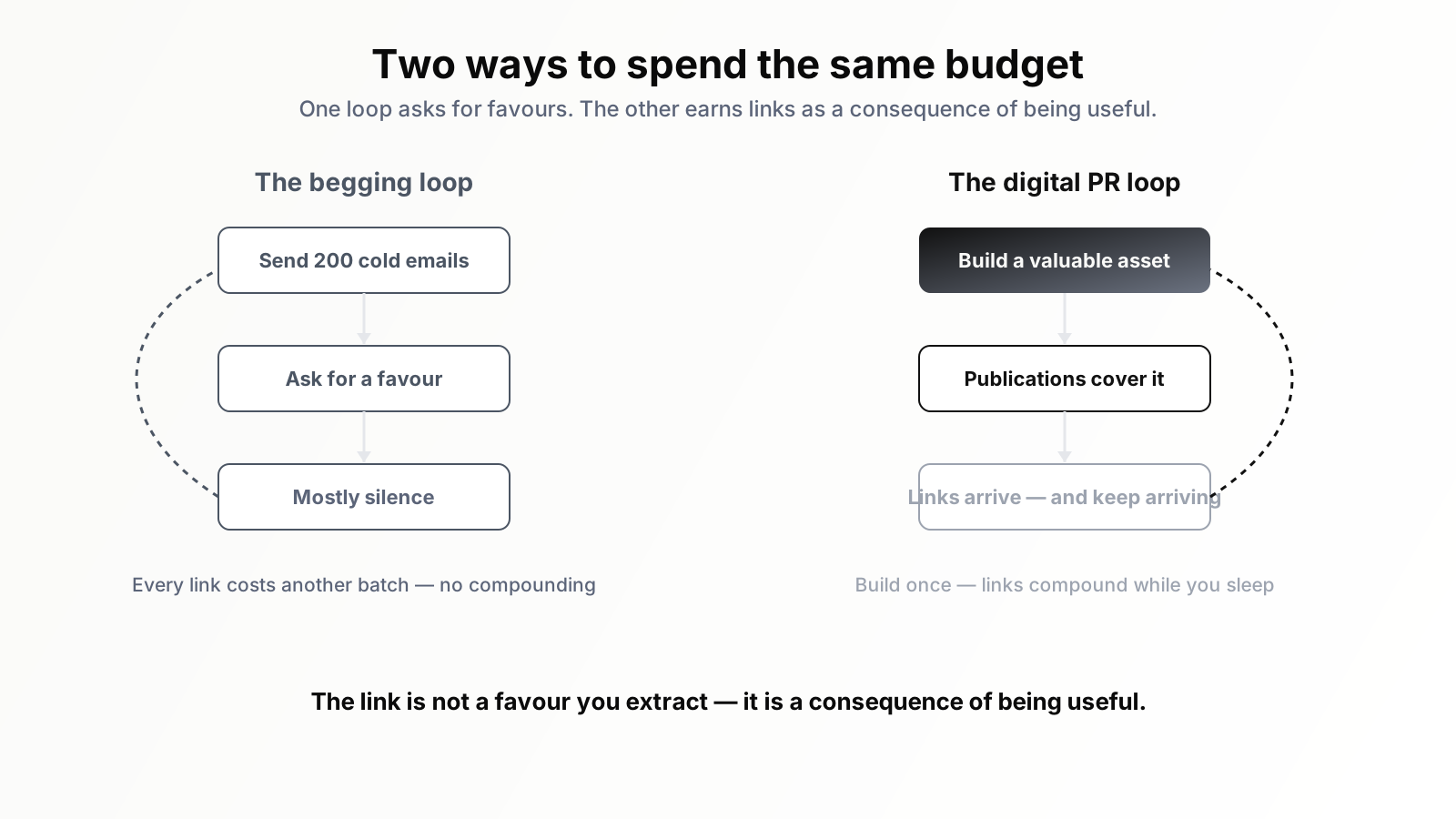
There is a moment every link-building campaign reaches, and it is not a proud one. You have a spreadsheet of two hundred bloggers, a templated email that opens with "I hope this finds you well," and a small, quiet hope that this batch will perform better than the last one. It will not. You will send the two hundred emails, you will get four polite declines and one hundred and ninety-six silences, and you will tell yourself that link building is just a numbers game. It is not a numbers game. It is a value game wearing a numbers game's clothing, and the reason your outreach fails is that you are asking people to do you a favour instead of giving them a reason.
This article is a pitch, and I will not pretend otherwise. The product being pitched is a different way of earning links — one called digital PR, where you stop begging for placements and start creating things that publications actively want to write about. If your link profile has stalled, if your outreach reply rate is a rounding error, if you are tired of feeling like a telemarketer with a content calendar, then read on. There is a better way to spend the same budget, and it compounds.
Why begging stopped working
For a few years, manual outreach worked because it was rare. When journalists and bloggers received a handful of pitches a month, a decent one stood out. Now they receive dozens a day, most of them automated, most of them transparently self-serving, and the human response to that volume is a hard, fast filter. Your "quick question" email is not being read and rejected. It is not being read at all.
The deeper problem is structural, not tactical. Begging-based link building treats the link as the goal and the recipient as an obstacle to be worn down. The recipient feels exactly that, because people are good at sensing when they are being used. No amount of email-copy optimisation fixes a fundamentally extractive request. You can A/B test your subject lines forever and you are still, underneath, asking a stranger to spend their credibility on your benefit for nothing in return.
Digital PR inverts the whole arrangement. Instead of asking publications to do something for you, you create something that makes their job easier — a story, a dataset, a tool, an expert quote they genuinely need. The link is not a favour you extract. It is a natural consequence of you having been useful. That inversion is the entire pitch, and everything below is how to execute it.
What digital PR actually is
Digital PR is the practice of earning coverage and links from online publications by giving them content worth covering. It borrows the mindset of traditional public relations — be newsworthy, build relationships, think like an editor — and points it at the specific goal of earning relevant, authoritative links and brand mentions.
It is worth being precise about what it is not. It is not buying links, which is a slow-motion disaster dressed as a shortcut. It is not mass guest-post spam. It is not paying for sponsored placements that carry no real editorial weight. Digital PR is editorial: a real person at a real publication decides, of their own accord, that your thing is worth referencing. That decision is what makes the resulting link valuable, because it is exactly the decision search engines are trying to detect and reward.
The mental shift is from "how do I get a link from this site" to "what would make this site want to mention me." Once you are asking the second question, you are doing digital PR, and you have stopped begging.
The currency of digital PR is the story
Publications do not publish links. They publish stories. A link is just a thing that sometimes rides along inside a story. So the unit of work in digital PR is not the email — it is the story you can offer.
A story, in this context, is anything a journalist or editor can build an article around. The most reliable kinds are these. A piece of original data — something you measured that nobody else has. A surprising finding — a result that contradicts what people assume. A timely angle — your perspective on something already in the news. A genuinely useful free resource — a tool, a calculator, a template that their readers would thank them for sharing. An expert opinion — a credible, quotable take on a question their audience cares about.
Notice the common thread. Every one of these gives the publication something its readers will value. You are not asking the editor to care about your product. You are handing the editor a way to serve their own audience, and the link back to you is simply how they attribute the source. Get the story right and the outreach becomes easy, because you are no longer asking for a favour. You are offering one.
The five engines of earned links
Digital PR is not one tactic but a small family of them, each suited to a different kind of business and budget. Here are the five that reliably work.
The data study. You collect, analyse, and publish original data on a question your industry argues about. Journalists love data because it makes their articles credible and citable, and a single strong study can earn coverage for years as people keep referencing the number. This is the heaviest engine to build and the highest-returning one.
The linkable asset. You build a free resource so genuinely useful that people link to it without being asked — a calculator, a template library, an interactive tool, a definitive guide. It earns links passively, forever, with no outreach at all once it is discovered. Our companion piece on linkable assets — content people actually cite goes deep on how to design one.
Expert commentary. You make your knowledgeable people available as quotable sources for journalists writing on deadline. Services exist that connect reporters to experts; when you respond fast with a sharp, genuinely useful quote, you earn a link from a real news outlet. Low cost, fast, and it compounds your team's authority.
The newsjack. When something relevant breaks in the news, you publish a fast, substantive perspective on it and pitch that perspective to journalists already covering the story. Timing is everything; this engine rewards speed and a genuine point of view.
The grown-up guest post. Guest posting is not dead — it simply grew up. Done right, it means contributing a genuinely excellent article to a relevant, respected publication because you have real expertise their audience needs. Done wrong, it is the spam everyone rightly ignores. The difference is whether the article would be worth publishing even without the link.
Why digital PR beats the begging spreadsheet on every metric
Here is the commercial comparison, stated plainly, because the case for switching is strongest when you put the two approaches side by side.
Link quality. Begging tends to win links from whoever is desperate or indifferent enough to say yes — often low-authority, low-relevance sites. Digital PR wins links from publications that chose to cover you, which skews toward higher authority and tighter relevance, because good publications only cover things worth covering.
Cost per link over time. Outreach has a brutal unit economics problem: every link costs another batch of emails, forever. A digital PR asset has high fixed cost and near-zero marginal cost — the data study you publish this quarter keeps earning links next year while you do nothing. The cost per link falls every month it stays live.
Brand value. A begged link is a link and nothing else. An earned mention in a respected publication is a link plus brand awareness, plus credibility, plus a clipping your sales team can use. You are buying more than SEO; you are buying reputation.
Durability. Begged links are fragile — bought or low-quality links are exactly what algorithm updates and manual reviews target. Editorially earned links are the safest links there are, because they are the genuine signal the whole system is built to reward.
Morale. This is rarely mentioned and it matters. Sending two hundred ignored emails is demoralising work that burns out teams. Publishing something people genuinely want to cite is energising work that attracts good people. The approach you choose shapes the kind of marketing team you can keep.
A realistic campaign, start to finish
Let me walk through a single digital PR campaign so the abstraction becomes concrete. Suppose you sell project management software, and your industry has a vague, much-repeated assumption that "remote teams are less productive." Nobody has measured it carefully. That gap is your opportunity.
You design a study. You survey a few thousand knowledge workers — or you analyse anonymised, aggregated usage data from your own product — on how remote, hybrid, and in-office work actually correlate with project completion. You do the analysis honestly, and you report whatever you find, including the parts that are inconvenient for your marketing. Honesty is not a virtue here; it is a requirement, because a study that is obviously slanted toward selling software earns nothing.
You package the findings as a clean, well-designed report with clear charts, a plain-language summary, and a few quotable headline findings. You give it a permanent home on your site. Then you build a short, specific media list — not two hundred random bloggers, but the twenty or thirty journalists and publications that have written about remote work and productivity in the last year. These people have already proven they cover this subject.
Your outreach to them is short and generous. You do not ask for a link. You say: I ran a study on a question you write about, here are the three most surprising findings, here is the full data and the charts if they are useful, happy to provide a quote or answer questions. That email is welcome, because it hands a working journalist a ready-made story.
Some will cover it. Each one that does links to your report as the source. Other writers, researching the same topic later, find the study through that coverage and cite it too. A year on, the report is still earning links from people you never contacted, because it became the reference on its question. That is the whole shape of digital PR: build the thing once, pitch it narrowly and generously, and let usefulness do the compounding.
The honest catch — and how to remove it
I promised a pitch, not a fairy tale, so here is the honest catch. Digital PR is more work up front than firing off outreach emails. A real data study takes time to design, run, and present. A linkable asset takes time to build. Monitoring the news for newsjacking opportunities, finding the right journalists, responding to reporter queries fast enough to matter — all of it is ongoing, attentive effort. This is precisely why many teams default to the begging spreadsheet: it feels easier, even though it does not work.
That up-front cost is exactly where an SEO AI agent changes the maths. Orova can run the laborious, repetitive layers of a digital PR program — surfacing the questions in your industry that lack a definitive answer and would make strong studies, drafting the report and pitch copy around your data, building a focused, relevant media list instead of a bloated one, monitoring for timely newsjacking angles, and keeping the linkable assets on your site connected through a coherent internal-linking structure so the earned authority flows where it should. The strategy in this article does not change. The agent simply removes the workload that stops most teams from ever starting — turning digital PR from an ambitious plan into a program that actually ships.
So here is the offer one more time. Stop sending emails that beg. Start building things worth covering. Earn links from publications that chose you, links that are higher quality, lower cost over time, more durable, and that bring brand value a begged link never will. The price of admission is a shift in mindset — from "give me a link" to "here is something useful" — and the return on that shift is a link profile that grows while you sleep. Put the spreadsheet of two hundred strangers away. You were never going to win that way, and now you do not have to.
Run your business with AI Agents
Orova is the always-on Biz AI Agent — it plans, runs, and optimizes the work for you. Save time, unlock productivity.
Try it free