
The Linkable Asset: Content People Actually Cite
Most of the content a company publishes is not built to be linked to, and that is not a flaw — it is the design. A how-to article exists to be read by someone with a problem, to answer the question, and to send that reader toward a product. It does its job whether or not another website ever points at it. The vast majority of a content library is, and should be, this kind of page: useful, conversion-oriented, self-contained.
But a small number of pages can do something different. They can become the thing other people reference when they write about your subject — the page a journalist links as a source, the resource a blogger sends their readers to, the tool a forum thread keeps recommending. These are linkable assets, and they operate by a completely different logic from the rest of your content. This article is a practitioner's guide to building them: what they are, why they earn links when ordinary pages do not, the main types worth building, and the discipline that separates an asset that compounds from a page that quietly does nothing.
What makes an asset "linkable"
A linkable asset is a page so genuinely valuable, in a specific way, that other people choose to link to it without being asked or paid. That last clause is the entire definition. If a link requires outreach, a transaction, or a favour, the page is not yet a linkable asset — it is a page you are marketing. A true linkable asset attracts links as a side effect of existing, because people encounter it, find it useful, and reference it in their own work.
To understand why some pages earn links and most do not, you have to think about why anyone links out at all. A writer links to another page for one of a few reasons: to cite evidence for a claim, to point readers toward a fuller explanation, to credit a source, or to recommend a tool the reader will thank them for. Every one of those is the writer doing a job for their own reader. Nobody links out of generosity toward you. They link because the link improves their own work.
So the design question for a linkable asset is precise: what could I publish that makes another writer's article better when they reference it? Answer that, and you are building an asset. Skip it, and you are building another page that will need to be begged on behalf of.
Why ordinary content does not earn links
It is worth being blunt about why a normal, good article rarely earns a link, because the reason explains everything about how to build an asset.
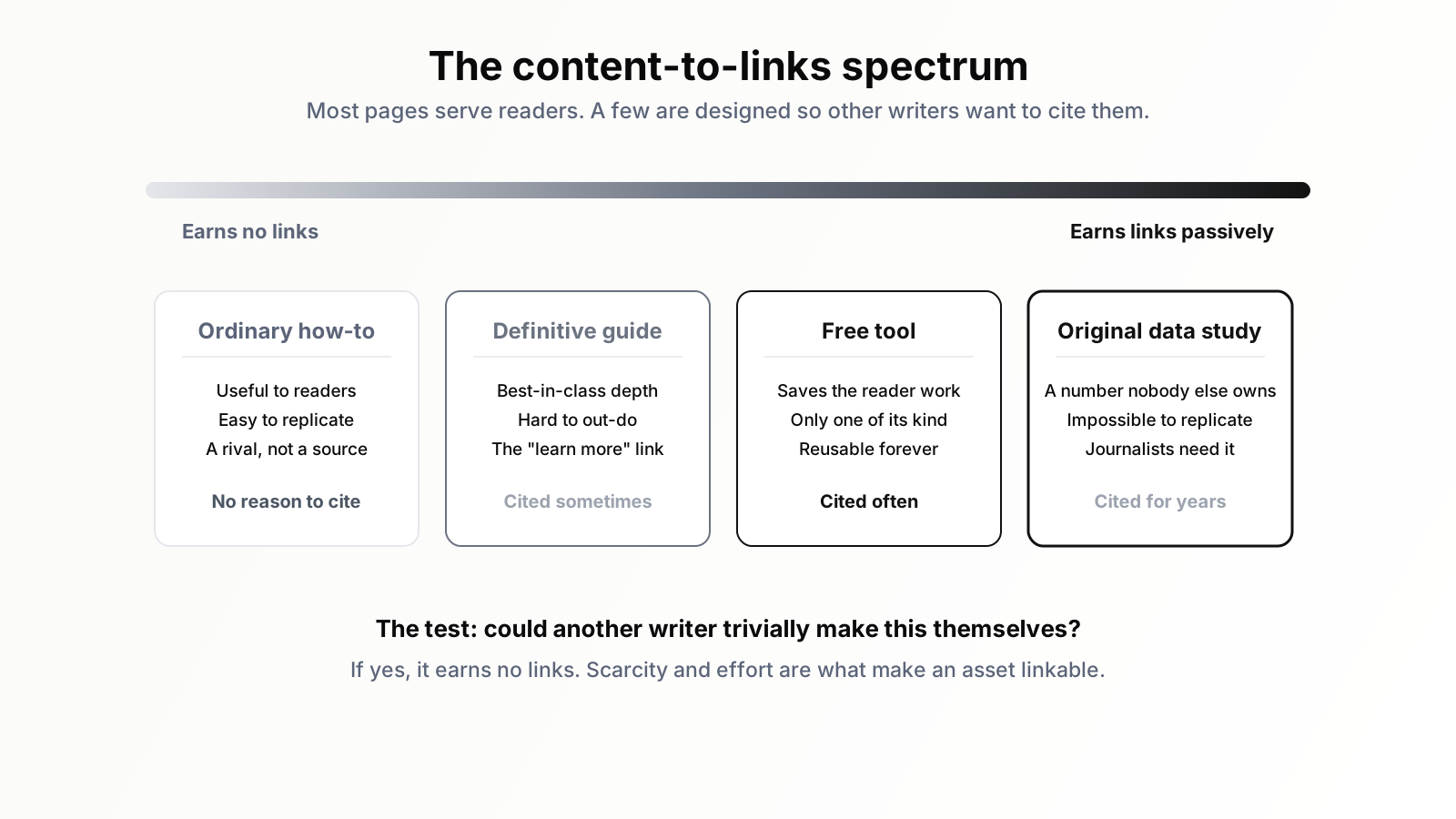
A standard how-to article — "how to do X" — is genuinely useful to a reader. But to another writer covering the same subject, it is a competitor, not a resource. They are writing their own "how to do X." They have no reason to send their readers to yours, and citing it does nothing for their article. Good ordinary content saturates the web; there is nothing scarce about one more competent explainer, so there is nothing to link to.
Linkable assets break this trap by being something a writer cannot easily replicate and would not want to. They cannot quickly run their own original study, so they cite yours. They cannot build their own interactive calculator, so they link to yours. They do not want to re-derive a definitive reference, so they point at yours. Scarcity and effort are what make an asset linkable. If another writer could trivially make the same thing themselves, they will — and your page earns nothing.
The main types of linkable asset
Linkable assets are not infinitely varied. In practice they cluster into a handful of proven types, and choosing the right one for your business is the first real decision.
Original research and data studies. The most reliable linkable asset of all. You measure something nobody else has measured and publish the findings. Writers cite data constantly because data makes their claims credible, and there is only one source for your number — you. A strong study earns links for years. It is also the heaviest type to produce, which is precisely why the links it earns are hard for competitors to match.
Free tools and calculators. An interactive thing that does a useful job — a calculator, a generator, a checker, an estimator. People link to tools because the link saves their reader real effort. A tool is reusable forever and tends to earn links passively once it is discovered, with no further work.
Definitive reference guides. Not another quick explainer, but the most thorough, best-organised, most genuinely complete resource on a specific subject — the page that becomes the obvious thing to link when someone wants their reader to "learn more." This works only if the guide is dramatically better than the competent average, because a merely good guide is the ordinary content that earns nothing.
Templates, frameworks, and free resources. A ready-to-use template, a named framework, a checklist, a swipe file — something that saves the reader work. Writers link to these because recommending a useful free resource makes them look helpful to their own audience.
Visual and explanatory assets. A diagram, a map, a visualisation that explains something complex unusually well — the kind of image other articles embed and credit. Harder to do well, but a genuinely clarifying visual gets reused widely.
The four tests every linkable asset must pass
Before you commit budget to building an asset, run it through four tests. An asset that fails any one of them will quietly underperform, and you usually cannot tell which one it failed until months of silence have passed.
The uniqueness test. Does this already exist, in roughly this form, somewhere with more authority than you? If a near-identical resource already ranks and earns links, yours will struggle to displace it. An asset must offer something the existing options do not — newer data, a better interface, a more complete scope, a sharper angle.
The reference test. Imagine a writer covering your topic. Is there a natural sentence in their article where linking to your asset genuinely helps their reader? If you cannot picture that sentence, the asset has no hook to be cited from. The whole design should be aimed at being the obvious answer to "where can I learn more / check this / do this."
The findability test. Writers can only link to assets they can find. The asset needs a permanent, stable home — a clean URL that will not change — and it needs to rank for the searches a researching writer would run. An invisible asset earns nothing, no matter how good it is. An asset and its discoverability are one project, not two.
The durability test. Will this still be worth linking to in two years? A study tied to a fast-moving statistic decays quickly; a calculator or a well-scoped reference can earn for years. Durability is what turns an asset from a one-quarter spike into a compounding source of authority. Favour assets that age slowly.
How to build a data study, the highest-return asset
Because original research is the most powerful linkable asset, it is worth walking through how to build one properly. The process has five stages.
Find the question. The best study answers a question your industry argues about, or simply assumes, without ever having measured. Look for the "everyone knows that..." statements in your field — the received wisdom nobody has actually checked. Those are study-shaped gaps. The question must also be one you can credibly answer with data you can realistically obtain.
Choose your data source. You have three honest options: survey a relevant population, analyse a public dataset in a new way, or analyse your own product's anonymised, aggregated usage data. Proprietary product data is often the strongest, because no competitor can reproduce it. Whatever the source, it must be large and representative enough to support real conclusions.
Analyse honestly. Report what the data actually shows, including findings that are inconvenient or that do not flatter your product. A study visibly bent toward a marketing conclusion earns nothing, because experienced writers can smell it and will not stake their credibility on it. Honesty is not optional; it is the mechanism that makes the study citable.
Package for citation. Present the findings so they are easy to reference. A few clear, quotable headline statistics. Clean, well-labelled charts a writer could embed. A plain-language summary near the top. A described methodology, so the study reads as serious rather than promotional. You are designing the page to make a journalist's job easy.
Give it a permanent home and seed it. Publish the study at a stable URL on your own domain — never only as a downloadable file, because a file cannot accumulate links or rank. Then do a small, focused round of outreach to the specific writers who already cover the topic, not to announce a favour but to hand them a ready story. After that initial seeding, a good study earns links on its own as researchers keep discovering it.
The mistake that wastes most asset budgets
The single most common failure is building something that is merely good. A team invests in a "comprehensive guide" or a "useful tool," ships something genuinely competent, and then waits for links that never arrive. The asset was not bad. It was ordinary, and ordinary earns nothing.
The bar for a linkable asset is not "good." It is "noticeably better than anything else available, in a way a writer would specifically choose to point at." That is a much higher and more uncomfortable bar, and most asset projects fail because they aim at the lower one. A guide that is the tenth-best on its topic is invisible. A guide that is unmistakably the best, or a tool that is the only one of its kind, or a study with a number that exists nowhere else — those earn links, because they have crossed from ordinary into scarce.
This has a practical implication for planning: build fewer assets, and make each one excellent. Three genuinely exceptional assets will out-earn a dozen merely-good ones, every time, because only the exceptional ones cross the threshold where linking becomes worthwhile. Concentrate the budget. Do not spread it thin.
How assets fit your wider link strategy
Linkable assets are not a replacement for the rest of your SEO work; they are the engine that makes the rest of it stronger. The authority an asset earns does not stay trapped on that one page. Through internal linking, it flows to the other pages on your site — which is why an asset should be deliberately connected to the commercial and informational pages it can lift. Treat the asset as a power source and your internal links as the wiring. Our guide to internal linking strategy for SEO covers how to route that authority where it does the most good, and the broader topic cluster model explains how an asset can anchor a whole subject area on your site.
Seen this way, a linkable asset is a high-leverage investment: one excellent page that earns external authority, which then propagates internally to lift everything it connects to. That leverage is why assets deserve a disproportionate share of attention even though they are a small share of your total pages.
Where an AI agent makes asset-building practical
Building linkable assets is the right strategy and an undeniably demanding one. Finding the un-measured questions worth a study, scoping a reference guide thoroughly enough to beat the competition, analysing data honestly, packaging it for citation, and wiring the asset into your internal structure — that is real, sustained work, and it is exactly the work that gets postponed in favour of easier, ordinary content.
This is where an SEO AI agent earns its place. Orova can surface the questions in your industry that lack a definitive answer and would make strong studies, audit the existing assets ranking for a topic so you build something genuinely better rather than merely another competent page, draft the structure and citable summary around your data, and keep your assets connected to the rest of your site through a coherent internal-linking plan so their earned authority flows where it should. The judgement — which asset to build, whether the data is honest, whether it clears the bar — stays with you. The agent removes the heavy, repetitive work that otherwise keeps the best assets stuck on the someday list.
The principle to carry away is simple. Most of your content should serve readers and convert them, and that is enough for it to be worth publishing. But a few pages can do more — they can earn the links that lift everything else. Those pages are not written the way ordinary content is written. They are designed, against a higher bar, to be the thing other people want to cite. Build a small number of them, build them properly, and they will keep paying you back long after the work is done.
Run your business with AI Agents
Orova is the always-on Biz AI Agent — it plans, runs, and optimizes the work for you. Save time, unlock productivity.
Try it free