
"Evergreen Content" Still Needs Watering
"Evergreen content" is one of the most comforting phrases in marketing, and like most comforting phrases, it is doing some quiet lying. The word paints a picture of a tree that stays green through every winter without anyone lifting a finger — content you write once, publish, and then enjoy forever while you sip something warm and watch the traffic roll in. Set it and forget it. Plant it and walk away.
It is a lovely image. It is also why a great many "evergreen" articles are, right now, browning quietly at the edges while their owners assume they are thriving. Real evergreen trees, the kind that actually exist in actual forests, do not survive on the strength of their branding. They survive because something keeps watering them. Your content is the same. This article is about the watering — the part the comforting phrase conveniently leaves out.
The fantasy of the self-sustaining article
The promise embedded in "evergreen" is seductive precisely because it offers the one thing content marketers crave most: leverage without ongoing effort. Write the definitive guide to X once, and it ranks for X forever. The work is front-loaded; the reward is perpetual. It is the content equivalent of passive income, and people want to believe in it for the same reasons they want to believe in passive income.
The trouble is that the fantasy quietly assumes the world holds still. It assumes the topic does not change, the competition does not improve, the search engine does not update, and what searchers want from the query never shifts. Hold all of that constant and yes, your article could coast indefinitely. But none of it holds constant. The world is the opposite of still. And an article designed for a world that stopped moving will, in a world that keeps moving, slowly fall behind it.
So the honest definition: evergreen content is not content that needs no maintenance. It is content about a topic with durable, lasting demand. The demand is evergreen. The article is not. Those are two very different things, and conflating them is how good pages quietly die of neglect.
How a healthy-looking page browns
The cruel part of content decay is that it is invisible from a distance. The page is still there. It still loads. It still says "evergreen guide" at the top. Nobody walks past and sees it wilting, because wilting content does not look wilted — it looks exactly the same as the day you published it. That sameness is the problem. The page froze; the world did not.
Decay creeps in through a few predictable cracks. The facts go stale — the page describes tools, prices, processes, or interfaces as they were, not as they are, and a reader who knows the current reality loses trust in seconds. The competition laps you — rivals publish deeper, fresher, better pages on the same topic, and yours slides relative to them without changing a word. And the question itself moves — what searchers want from the query evolves, and your page keeps answering the version of the question that was being asked when you wrote it.
Notice that in none of these cases did your article get worse on its own. It simply stood still while everything around it moved. That is the entire mechanism of content decay, and it is why "I wrote a great page" and "I have a great page" are statements about two different points in time.
The gardener's mindset
If the tree metaphor is going to be used — and marketers will use it forever, so we may as well use it honestly — then it has to be used all the way. Trees do not maintain themselves. Forests have ecosystems; gardens have gardeners. A tree in a garden that nobody waters, prunes, or protects does not stay green out of loyalty to its label.
The mindset shift is from publisher to gardener. A publisher's job ends at publication: the work is done, the page is filed, attention moves to the next thing. A gardener's job never ends, because a garden is a living thing that requires continuous, modest attention — a little watering here, some pruning there, the occasional serious intervention when something is genuinely struggling. The gardener does not replant the whole garden every season. But the gardener also never assumes a plant will thrive simply because it was healthy last year.
Adopt the gardener's mindset and the archive stops being a graveyard of finished work and becomes what it actually is: a living collection of assets, each one either being maintained or quietly declining. There is no third state. There is no "stable." There is tended, and there is browning.
The four kinds of watering
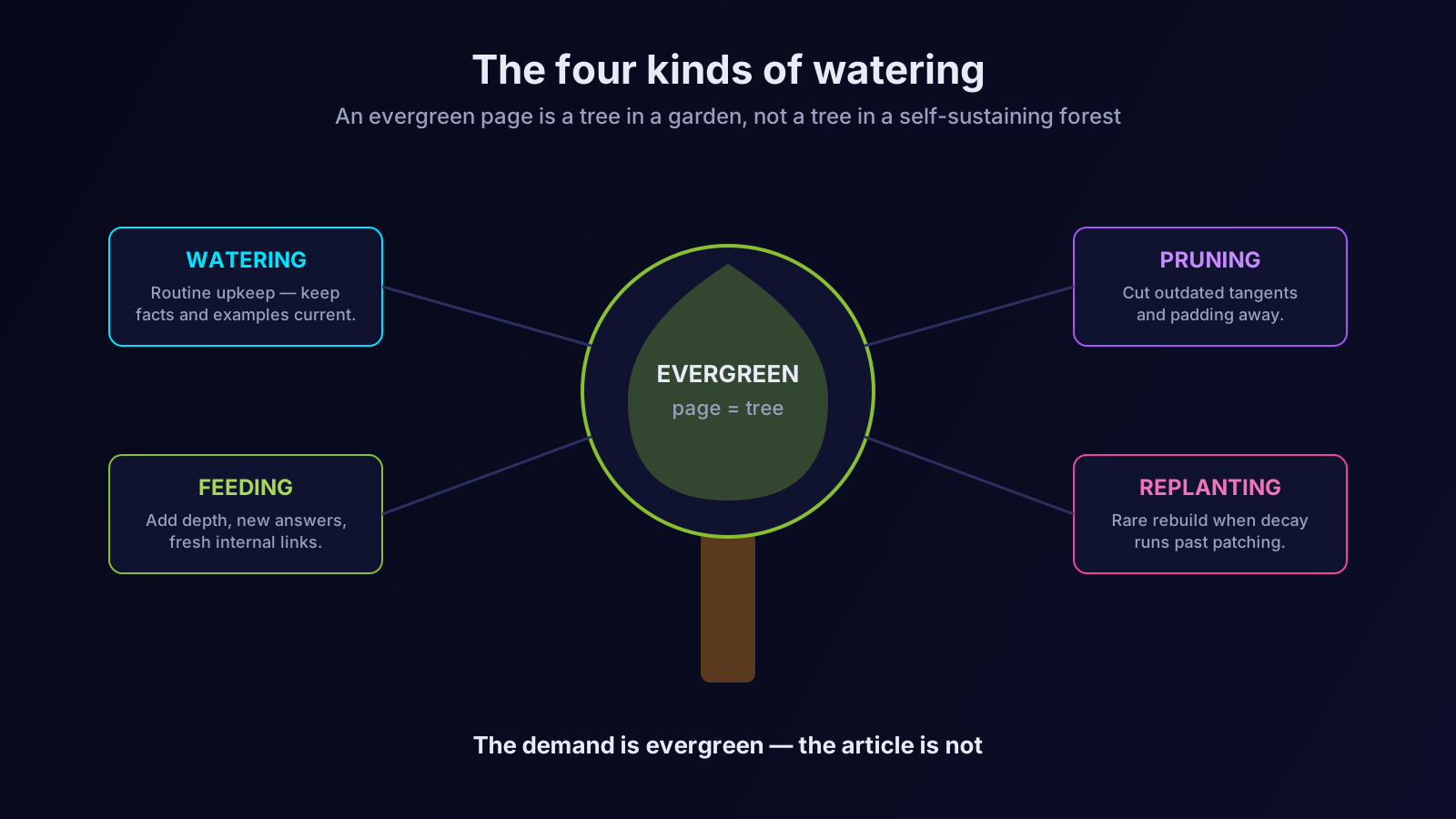
If maintenance is the price of evergreen, it helps to know exactly what maintenance involves. Carrying the garden metaphor properly, there are four distinct kinds of care, each matching a real content task.
Watering is the routine, low-effort upkeep: keeping facts current, swapping outdated screenshots, fixing a broken link, refreshing an example that has aged. It is small and frequent, and skipping it for too long is what lets a page brown.
Pruning is cutting away what no longer serves the page: the outdated tangent, the section about a feature that no longer exists, the padding that has accumulated. Pruning keeps a page sharp; an unpruned page sprawls and dilutes.
Feeding is active strengthening: adding depth, answering newly important follow-up questions, improving structure, pointing fresh internal links at the page so it gains support. Feeding is what turns a maintained page into a growing one.
Replanting is the rare, serious intervention: when a page has decayed past patching, or the query has moved so far that the old page no longer fits, you rebuild it substantially or rewrite it from the roots. Replanting is not failure — it is what a good gardener does when watering is no longer enough.
Most pages, most of the time, need only watering. But every page needs to be watched closely enough that you know which of the four it needs, and when.
"But I don't have time to maintain everything"
The honest objection at this point is one of capacity. If every page needs continuous care, and the archive has hundreds of pages, the gardener's mindset sounds like an infinite, unwinnable workload.
It is not, because gardens are not maintained uniformly. A good gardener does not give every plant identical attention. The struggling plant near the path gets immediate care; the thriving tree at the back gets a glance and a nod. The same triage applies to content. The pages that deserve active watering are the ones that matter and are slipping: a page that drives real traffic and has started to decline, a page sitting just outside the top results that a little feeding could push over. The page nobody visits and nobody links to does not need watering — it needs the pruning shears, or honestly, removal. Maintenance is not "tend everything equally." It is "know the state of everything, and direct effort where it changes the outcome." That is a finite, manageable job. It only feels infinite when you have no idea which pages are browning, so you imagine you would have to check them all by hand.
The pages that brown fastest
Not every evergreen page ages at the same speed, and knowing which ones brown fastest is what makes the gardener's triage practical rather than overwhelming.
The fastest to decay are pages tied to anything that changes quickly. A guide that names specific tools, lists prices, describes a software interface, or summarises a current landscape is decaying almost from the day it is published, because the things it describes will not hold still. These pages need frequent watering — they are the seedlings near the path that wilt first. By contrast, a page explaining a durable principle, a concept, or a stable process ages far more slowly. The idea it describes does not change much, so the page stays accurate for years with only occasional attention. The practical implication is that "evergreen" is a spectrum, not a category. Some evergreen pages are evergreen in the sense of needing little water; others carry the label but actually need watering constantly because their subject matter is anything but stable. A gardener who understands this does not water uniformly. They water the fast-decaying pages often and the slow-decaying pages rarely — and they never assume a page is low-maintenance just because someone once stuck an "evergreen" label on it.
Watering is cheaper than replanting
There is a strong economic argument for watering regularly rather than waiting, and it comes down to a simple comparison between the cost of small, frequent care and the cost of a large, late rescue.
A page that is watered consistently never drifts far from accurate. Each maintenance pass is small — a fact updated here, a screenshot swapped there — because the page was only slightly out of date to begin with. The total effort is modest and spread thinly over time. A page that is neglected for years is a different story. By the time anyone notices, it has decayed so far that watering is no longer enough; it needs replanting — a substantial rebuild or a rewrite from the roots. Replanting is expensive, and worse, the page spent those neglected years steadily losing rankings and traffic, so the neglect cost you visibility the whole time as well. The arithmetic is plain. Frequent, cheap watering keeps a page healthy and ranking continuously. Rare, expensive replanting fixes a page only after it has already cost you traffic for years. A gardener who waters is not just being diligent — they are choosing the far cheaper of two paths. Skipping the watering does not save effort. It defers a larger bill and adds an interest charge in lost traffic.
What neglect actually costs
It is worth being blunt about the price of believing the comfortable version of "evergreen," because the cost is sneaky. It does not arrive as a dramatic crash. It arrives as a slow leak.
A neglected archive does not collapse; it erodes. Each page slips a position or two, a little at a time, none of it alarming on its own. But across hundreds of pages, those small slips add up to a meaningful, steady decline in total traffic — a decline that is easy to misread. The team sees flat or sinking traffic, assumes the fix is to publish more, and pours effort into new pages while the existing ones keep quietly browning underneath. The new pages cannot outrun the leak, because the leak is the whole archive depreciating at once. That is the real cost of "set it and forget it": not one dead page, but an entire library aging in unison while everyone looks the other way.
Where an AI agent fits
The gardener's mindset is clearly correct and clearly demanding. The reason it so rarely gets practised is not laziness — it is that watching an entire archive closely enough to know which pages are browning, and which kind of care each one needs, is a genuinely large and never-ending job. Doing that by hand across hundreds of pages is the part nobody has time for, which is exactly why "evergreen" decays into "abandoned."
That continuous watching is what an SEO AI agent is built to do. Orova can keep an eye on an entire archive at once — noticing when a page starts to slip, when its facts have likely gone stale, when competitors have moved ahead, when a query's intent has shifted — and tell you which pages need watering, which need feeding, and which have decayed far enough to need replanting. The gardening itself stays yours: the judgement, the editing, the writing. What the agent removes is the impossible part — knowing the live state of every plant in a garden too large to walk every day.
Keep the metaphor. It is a good one. Just use the whole of it. Evergreen content is real, and durable topics genuinely can pay you back for years. But the green does not come free, and it does not come from the label. It comes from the watering. Pick up the can.
Let an AI Agent handle your SEO
Orova plans, writes, optimizes, and tracks rankings on its own — you just read the results.
Try it free