
"Just Add a CDN" and Other Speed Myths

"Just add a CDN." Four words, delivered with the confidence of someone closing a ticket, and one of the most quietly misleading pieces of advice in the entire performance conversation. It is not wrong, exactly. A content delivery network is a real and useful thing. But the word "just" is doing an enormous amount of dishonest work — it implies that website speed is a problem you solve by flipping one switch, and that belief has sent more teams down the wrong road than almost any other.
Website performance is thick with these tidy, confident sayings. They survive because they are short, they sound technical, and they let whoever repeats them feel like the conversation is handled. This article takes the most common of them, one memorable line at a time, and examines what each one gets right, what it quietly gets wrong, and what you should believe instead. Speed work goes badly when it is guided by slogans. It goes well when the slogans are unpacked.
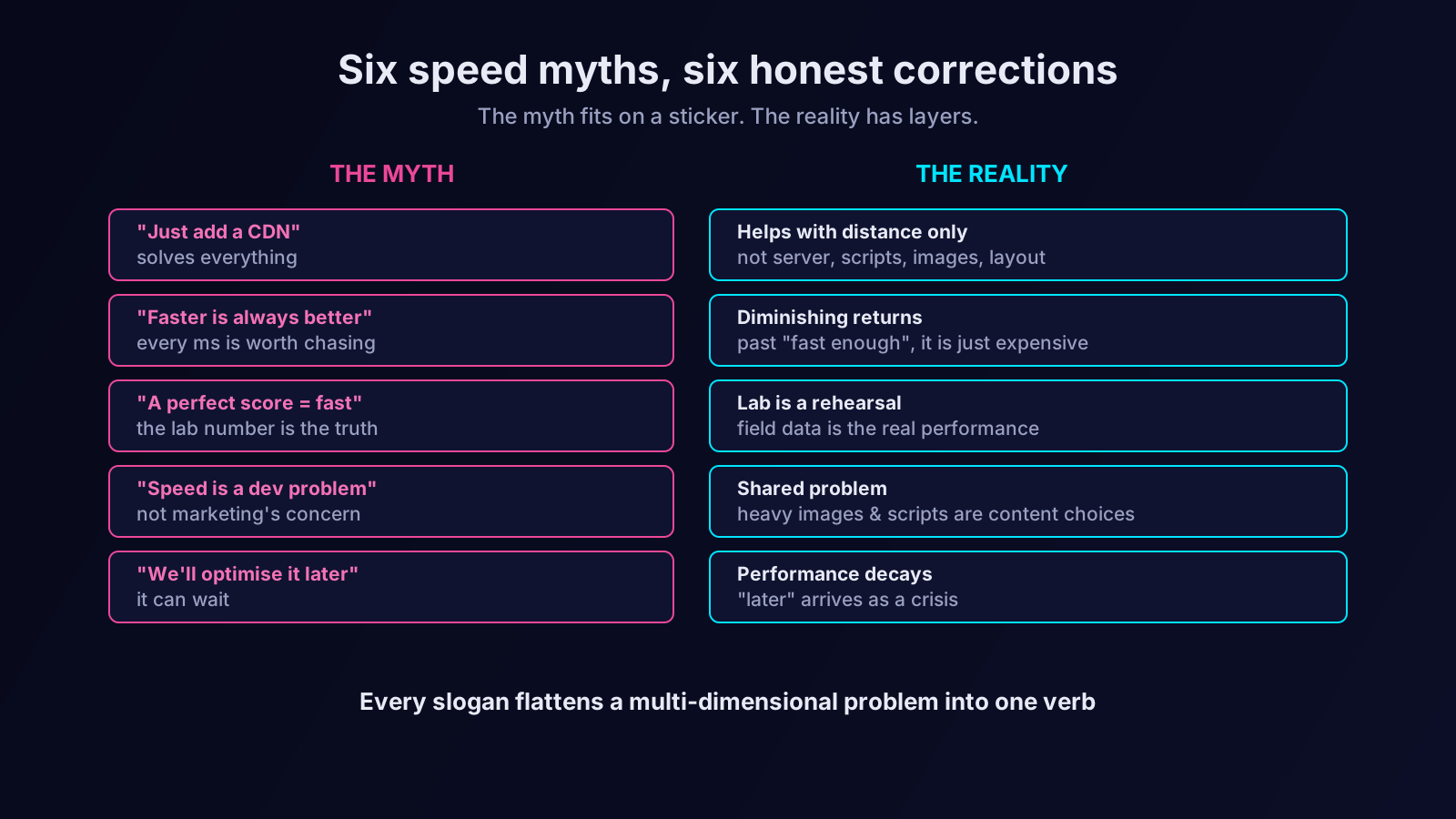
"Just add a CDN"
Start with the one in the title. A content delivery network keeps copies of your files on servers spread around the world, so a visitor downloads them from somewhere physically near them rather than from one distant origin server. For the right kind of slowness — visitors geographically far from your server, waiting on static files travelling a long way — a CDN genuinely helps. The advice is not nonsense.
What the word "just" hides is everything a CDN does not touch. A CDN does not make your server respond faster to the initial request — if the slowness is in your database queries or your server-side rendering, the CDN was never in that path. It does not make your JavaScript bundle smaller or faster to execute. It does not stop your layout from jumping around. It does not compress an oversized hero image into a sensible one. A CDN addresses the distance a file travels; it does nothing about a file that is too heavy, a server that is too slow, or a page that is too busy. So "just add a CDN" is good advice for precisely one cause of slowness and irrelevant to most of the others. The honest version is: "if your slowness is a distance problem, a CDN helps with the distance part." Considerably less catchy, considerably more true.
"Faster is always better"
This one sounds unarguable, which is what makes it dangerous. Of course faster is better — who would argue for slower? But "faster is always better" smuggles in a second claim: that every increment of speed is worth pursuing, indefinitely, because more of a good thing is always good.
That second claim is false, and it is false because of diminishing returns. The gap between a genuinely slow page and an acceptably fast one is enormous — it is the difference between losing visitors at the door and keeping them. The gap between an acceptably fast page and a slightly faster one is, to the visitor and to Google's ranking, almost imperceptible. Yet the effort required to extract that last sliver of speed is often greater than the effort that got you to "acceptably fast" in the first place. "Faster is always better" treats a curve with a flattening top as if it were a straight line, and teams who believe it pour their most expensive engineering hours into the flat part. The truer saying: faster is better until it is fast enough, and then it is mostly just expensive.
"A perfect score means a fast site"
Performance tools hand out scores, and scores are intoxicating. A big number near one hundred feels like an achievement, a finish line, proof. So "a perfect score means a fast site" becomes the unspoken goal, and teams optimise toward the number.
The problem is that the score is generated by a tool running a simulated page load on a standardised pretend device under controlled conditions. It is a useful, repeatable diagnostic — but it is a rehearsal, not the performance. Your real visitors are not the standardised pretend device. They are on a spread of phones, some of them old and slow, on a spread of networks, some of them congested. A page can earn a glowing lab score and still feel mediocre to a meaningful share of real visitors, because the lab measured an ideal that most of your audience does not live in. The saying should be: a good score means the page loads well under ideal conditions — now go check whether your actual visitors experience it that way. Field data, not the lab score, is the thing that tells you the truth, and it is also the thing Google uses for ranking.
"Speed is a developer problem"
This saying is popular with marketers because it is comforting — it makes performance someone else's department. And it is partly true: many speed fixes do require a developer. Compressing the rendering path, splitting JavaScript bundles, tuning the server — that is engineering work.
But the framing quietly excuses marketers from the causes they themselves create. The oversized hero image was uploaded by a content team, not a developer. The third chat widget, the second analytics tool, the new A/B testing script — each was added by marketing, and each one taxes the page. The video embedded in the post, the carousel of high-resolution images, the font chosen for its looks without a thought for how it loads: all marketing decisions, all performance costs. "Speed is a developer problem" lets the people generating a large share of the slowness walk away from it. The honest version: speed is a shared problem, and a good deal of it is created — and therefore preventable — on the content side, before a developer is ever involved.
"We'll optimise it later"
The most human myth on the list. "Later" feels responsible — it acknowledges the problem, it just defers it. The trouble is what happens in the meantime, because performance does not hold still while you wait. It decays.
Every week that "later" is deferred, more is added to the page. Another script, a heavier image, a new embed. Slowness is not a fixed debt sitting patiently until you choose to pay it; it compounds, quietly, with every change. And "later" tends to arrive only as a crisis — when rankings dip or conversions sag and someone finally demands an investigation. By then the page carries a year of accumulated weight, and the cleanup is far larger than the steady, small maintenance would ever have been. The honest replacement is not "optimise it later" but "do not let it rot in the first place" — treat performance as something you watch continuously, so it never gets the chance to become a project.
"Mobile speed and desktop speed are basically the same"
A myth of omission — most teams test on the device in front of them, which is a fast desktop on a fast office connection, and quietly assume the result generalises. It does not. The mobile experience is a different world: less processing power to execute JavaScript, a smaller and more variable network, a screen where layout shifts are more disruptive because there is less room to absorb them.
This matters because for most sites the majority of visitors are on mobile, which means the experience you are not testing is the experience most of your audience actually has. A page that feels instant on your desktop can be genuinely sluggish on a mid-range phone, and you will never know if you only ever test on the desktop. The discipline is simple and almost nobody follows it: test on mobile, on a mid-range device, on a normal connection — because that is your real audience, not the comfortable conditions of your own desk.
The thread running through all of them
Step back from the individual myths and the same flaw runs through every one. Each saying takes website performance — which is genuinely several different problems with several different causes — and collapses it into one simple thing with one simple answer. "Just add a CDN" collapses it into distance. "Faster is always better" collapses it into a single dial. "A perfect score means a fast site" collapses it into one number. The myths are not so much wrong as they are flat: they flatten a multi-dimensional problem into a slogan.
So the real lesson is not a better slogan to replace the bad ones. It is a posture: distrust any speed advice short enough to fit on a sticker. Performance is server response and resource loading and image weight and script execution and layout stability and the gap between lab and field and the difference between mobile and desktop. Any sentence that claims to handle all of that with one verb is, by construction, hiding most of the problem. The useful response to a tidy speed saying is always the same unglamorous question: which specific cause does this address, and which ones is it quietly ignoring? (Our piece on how to find what's slowing your pages down walks through those specific causes one by one.)
What to believe instead
If the myths are flat, the truer model is layered. Believe that website speed is several distinct problems, not one. Believe that each problem has a specific cause and a specific fix, and that diagnosis must come before any fix. Believe that "fast enough" is a real and reachable destination, and that effort past it earns little. Believe that the lab score is a rehearsal and field data is the performance. Believe that a meaningful share of slowness is created by content decisions, which means it is preventable by content decisions. And believe that performance decays without attention, so it is something you maintain, not something you fix once.
None of those fit on a sticker, which is exactly the point. Good speed work is not guided by sayings. It is guided by diagnosis, by honest measurement of real visitors, and by knowing where "fast enough" sits so you can stop. The teams who do speed well are not the ones who know the most slogans. They are the ones who stopped trusting slogans.
Where an SEO AI agent fits
The hardest myth to resist is "we'll optimise it later," because resisting it requires continuous attention, and continuous attention is exactly what humans run out of. Nobody is checking, every week, whether a page has quietly slipped, whether a new script taxed the main thread, whether the mobile experience diverged from the desktop one. So the rot sets in, and "later" becomes a crisis.
This is where an SEO AI agent earns its place. Orova provides the continuous attention the myths assume you do not have — monitoring your site's performance over time, watching real-world field data rather than a one-off lab score, and flagging a page when it genuinely degrades, with the likely cause attached. It will not let "later" quietly become a year of accumulated weight, because it is looking when you are not. The judgement in this article still matters — knowing that "fast enough" is a destination, knowing which causes are real — but the agent supplies the tireless watching that turns that judgement into something maintained rather than something forgotten. If you want the broader context for tools that work this way, our overview of what an SEO AI agent is explains the shift.
"Just add a CDN" and its cousins survive because they are short and confident, and short confident things are easy to repeat. But website speed was never simple enough for a slogan. Unpack every tidy saying into its honest, less catchy version, and you will make better decisions than anyone still flipping the single switch the myths promised would be enough.
Let an AI Agent handle your SEO
Orova plans, writes, optimizes, and tracks rankings on its own — you just read the results.
Try it free