
Site Speed Is a Ranking Factor — But Not the Way You Think
"Site speed is a ranking factor" is one of those sentences the SEO industry repeats so often it has stopped being examined. It is on every audit checklist, in every agency pitch deck, and at the top of every "why your site isn't ranking" listicle. And it is true — speed is, technically, a ranking factor. But the way the sentence is used has quietly drifted into something misleading, and that drift costs teams real money and real attention.
The misleading version goes like this: your site is slow, that is why you are not ranking, make it faster and the rankings will come. This is wrong often enough, and expensively enough, that it deserves a proper rebuttal. Speed matters — but not in the simple, linear, "faster equals higher" way the checklist culture implies. This article is about the gap between what people believe site speed does and what it actually does.
The belief that needs dismantling
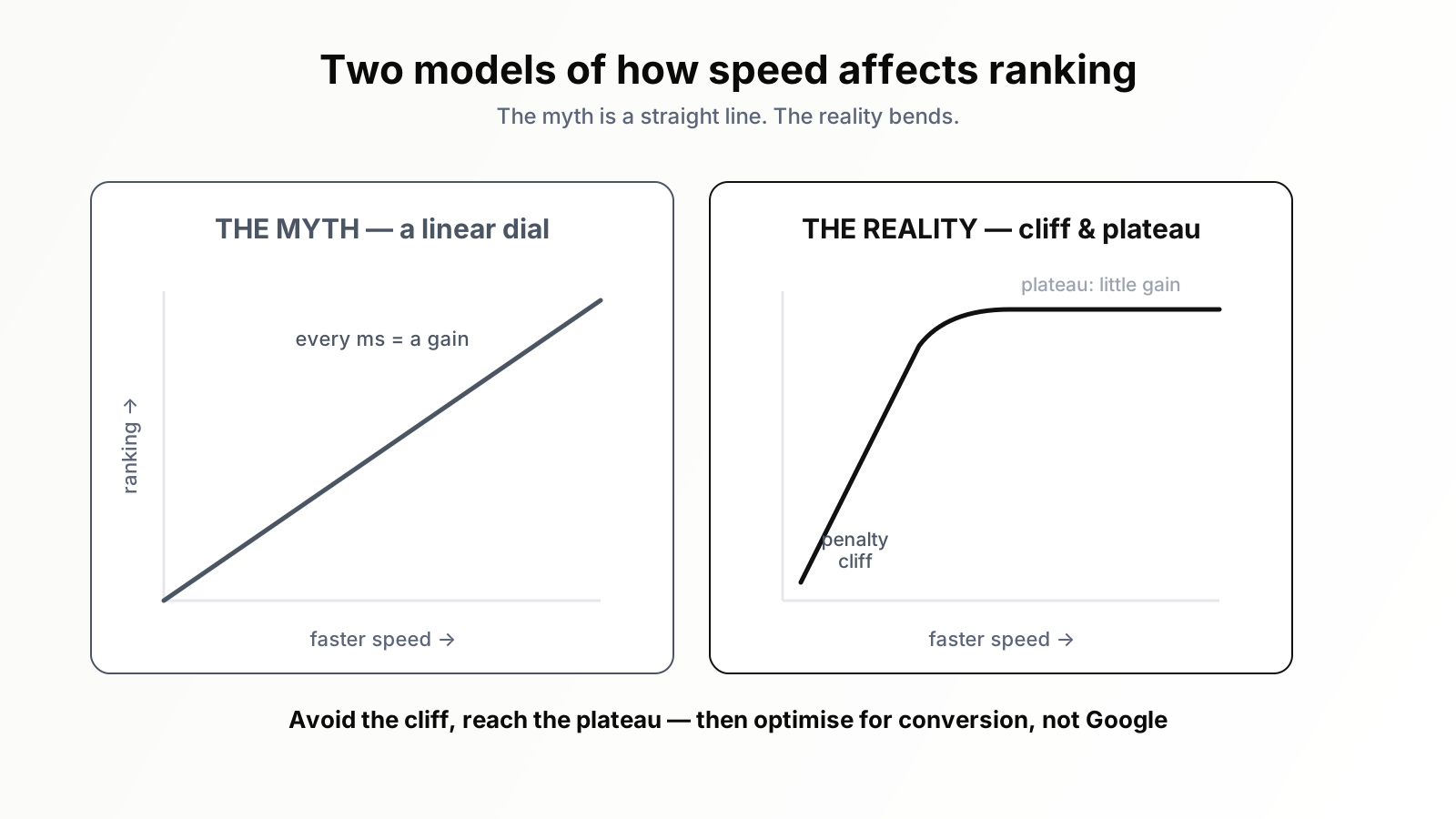
Walk into most marketing teams and you will find a shared mental model of site speed that looks roughly like a dial. Turn the dial toward "faster" and rankings climb. Turn it toward "slow" and they fall. Speed, in this model, is a continuous lever with a continuous effect, and the implication is that every millisecond you shave off earns you a fraction of a position.
This model is wrong, and it is wrong in a way that produces specific bad decisions. It leads teams to spend weeks chasing a load time from 1.8 seconds to 1.4 seconds in the belief that those 400 milliseconds are buying ranking gains. They are not. It leads teams to treat a speed audit as a growth strategy. It is not. And it leads teams to ignore the actual mechanism by which speed affects their results — which is real, but is not the dial they imagine.
How site speed actually works as a ranking signal
Here is the more accurate picture. Google does not reward speed on a sliding scale. It uses speed — primarily through Core Web Vitals — as something much closer to a threshold with a tie-breaker attached.
The threshold part: there is a band of "acceptably fast." If your page loads at a reasonable pace and responds to interaction without obvious lag, you are inside the band, and Google has essentially no further interest in exactly how fast you are. A page that loads in 1.2 seconds and a page that loads in 2.1 seconds are, from Google's ranking perspective, treated as roughly equivalent — both are fine. The obsessive optimisation that moves you from "fine" to "slightly faster but still fine" produces no ranking change, because there was no ranking penalty to remove in the first place.
The tie-breaker part: speed comes into play meaningfully when two pages are otherwise closely matched on the things Google actually cares about most — relevance, content quality, authority. When the algorithm is choosing between near-equals, a clearly better experience can nudge one ahead. That is real. But notice the precondition: you have to already be a near-equal contender on the substantive signals. Speed does not promote a weak page. It can, at the margin, separate two strong ones.
And the genuine penalty: this all flips when your site is not merely "not optimised" but actually bad. A page that takes eight seconds to become usable, that ignores taps for half a second, that reshuffles itself while the visitor reads — that page is outside the acceptable band, and being outside the band is a real, demonstrable drag on visibility. So the honest model is not a smooth dial. It is a cliff and a plateau: catastrophic slowness genuinely hurts you, and once you climb back onto the plateau of "acceptably fast," further speed buys you very little on the ranking side.
Why the misunderstanding is expensive
If the worst outcome of the "faster always means higher" belief were a few wasted afternoons, it would not be worth a whole article. But the misunderstanding is expensive in three concrete ways.
The first cost is misallocated engineering time. Performance optimisation past the "acceptably fast" point is genuinely difficult work — it absorbs senior developer hours, the most expensive resource a team has. Spending that resource to move from good to marginally-better-but-still-good, in the belief that rankings depend on it, is spending your scarcest asset on a return that does not exist.
The second cost is the diagnostic dead end. When a page is not ranking and the team's mental model says "slow sites do not rank," the team investigates speed. They run the audit, they find the page is acceptably fast, and now they are stuck — their model has no other explanation. The real cause, almost always, is on the content and relevance side: the page does not match intent well enough, it lacks depth, it has no authority behind it. But the speed myth sent the investigation down a corridor with no door at the end, and the real problem goes unexamined.
The third cost is the false sense of completion. A team passes its Core Web Vitals, ticks the box, and feels it has "done SEO." Speed is the most visible, most measurable, most checklist-friendly part of SEO, which makes it dangerously satisfying. It produces a green score and a feeling of accomplishment while the harder, fuzzier, far more important work — actually being the best answer to the query — sits untouched.
The reason to care about speed that has nothing to do with Google
So far this reads like an argument against caring about site speed. It is not. It is an argument against caring about site speed for the wrong reason. Because there is an excellent reason to care, and it is far more reliable than the ranking effect: conversion.
The relationship between speed and conversion is real, well-documented across the industry as a consistent qualitative pattern, and — crucially — it does not have a plateau in the same way the ranking effect does. Slow pages lose visitors before the page even finishes loading. Unresponsive pages frustrate people mid-task. Pages that lurch around cause mis-taps and abandonment. Every one of those is a person who arrived, formed an intention, and then leaked out of your funnel because the page got in their way.
This matters because of where it sits relative to ranking. Ranking gets the visitor to the page. Conversion decides whether that visit was worth anything. A fast page that ranks tenth and converts well can easily be worth more than a slow page that ranks third and bleeds visitors at the door. So the correct reason to invest in speed is not "Google will reward me" — it is "my visitors, the ones I worked to attract, will actually complete the thing I want them to complete." That reason holds whether or not Core Web Vitals exist, and it does not stop paying off at an arbitrary threshold.
What "fast enough" actually looks like
If the goal is the plateau rather than the dial, you need a concrete sense of where the plateau begins. Core Web Vitals give you exactly that, and the thresholds are public: the "good" band for each of the three metrics is the edge of the plateau. Reaching it is the goal. Exceeding it is optional and rarely worth obsessing over for ranking purposes.
Practically, this means your speed work has a clear finish line. Get your real-world field data — not lab data, the data from actual visitors — into the "good" range for the largest content element loading, for interaction responsiveness, and for layout stability. Once a page is comfortably inside those bands, declare that page done from a ranking perspective and move your attention elsewhere. The temptation to keep polishing is strong because polishing produces visible numbers, but a page already on the plateau has nothing more to give you on the ranking side.
The exception, again, is conversion. If a page is critical to revenue — a pricing page, a high-traffic landing page, a checkout flow — additional speed work past the plateau can still be justified, not because Google will notice but because your conversion rate will. Make that a deliberate, conversion-driven decision, not a reflexive pursuit of a greener score.
Where the speed myth comes from
It is worth pausing on why this particular misunderstanding is so durable, because understanding its origin makes it easier to resist. The "faster always means higher" belief did not appear from nowhere — it grew from a few real things, each of them true on its own, that combined into a false conclusion.
The first root is that speed is unusually easy to measure. Most of what determines a ranking — relevance, content quality, authority, how well a page matches intent — is fuzzy, qualitative, and hard to put a number on. Speed, by contrast, produces a clean stopwatch figure. Human attention flows toward what is measurable, and a metric that yields a tidy number gets treated as more important than messier factors simply because it can be tracked on a dashboard. The myth survives partly because speed is the part of SEO that looks most like a science.
The second root is that the tools reinforce it. Performance tools hand out a single score, often colour-coded, and a score invites you to maximise it. Nothing in the tool says "stop here, you have reached the plateau." The interface implies that a higher number is always a better outcome, and most people, reasonably, trust the interface. The tool was built to diagnose, but it is used as a scoreboard, and a scoreboard makes the linear-dial model feel correct.
The third root is genuine history. Years ago, the web was slower on average, and the gap between a fast site and a slow one was both larger and more common. In that environment, "make it faster" was more often the right advice, because more sites were genuinely on the wrong side of the cliff. The advice was sound for its time and then simply outlived the conditions that made it sound — the web got faster, most sites climbed onto the plateau, and the advice kept being repeated as if nothing had changed. Recognising these three roots does not make the myth true. It makes it predictable, and a predictable error is one you can catch yourself making.
The diagnostic order this implies
The practical payoff of getting the model right is a better diagnostic order when a page underperforms. The wrong order — the one the speed myth produces — is "check speed first." The right order treats speed as the thing you rule in or out quickly, not the thing you start with.
When a page is not ranking, ask the substantive questions first. Does the page genuinely match the intent behind the query — is it the kind of page the searcher wanted, or merely a page on the right topic? Is it as deep and useful as the pages currently winning? Does the site have enough authority and internal support behind the page for it to compete? Is the page even being indexed and crawled properly? These are where ranking problems actually live, the overwhelming majority of the time.
Then, separately, check whether the page is catastrophically slow — outside the acceptable band. If it is, fix that, because catastrophic slowness is a real drag. If it is merely "not perfectly optimised but acceptably fast," speed is not your ranking problem, and the model that told you otherwise was the false dial. Cross it off and go back to the substantive questions. Speed is a quick check, not a starting point. (For a structured walk through finding genuine slowness when it does exist, see our piece on how to find what's slowing your pages down.)
Where an SEO AI agent fits
The trouble with getting site speed right is that it requires holding two ideas at once: monitor speed continuously so you catch a page falling off the plateau, but do not let speed dominate your attention or your diagnosis. Humans are bad at that balance. We either ignore speed until it is a crisis, or we over-fixate on it because it produces tidy numbers.
An SEO AI agent holds the balance more naturally. Orova watches your site's technical health continuously — including whether pages are slipping out of the acceptable speed band — and flags it when something genuinely degrades, without turning every minor fluctuation into an alarm. Just as importantly, it weighs speed alongside everything else: relevance, content depth, internal linking, indexing. So when a page underperforms, you get a diagnosis that considers all the real causes in proportion, rather than a checklist that sends you straight to the speed corridor with no door at the end. The agent treats speed as what it is — one signal among many, worth watching, not worth worshipping.
Site speed is a ranking factor. But it is a cliff and a plateau, not a dial. Avoid the cliff, reach the plateau, and then stop optimising for Google and start optimising for the visitor — because that is the version of "fast" that never stops paying you back.
Run your business with AI Agents
Orova is the always-on Biz AI Agent — it plans, runs, and optimizes the work for you. Save time, unlock productivity.
Try it free