
From 40 Tools to One Agent: The Case for Consolidation
Open your team's billing dashboard and count the SEO and content tools you pay for. A keyword research subscription. A rank tracker. A site crawler. A backlink tool. A content optimisation tool. An AI writing assistant. A schema generator. An analytics add-on. A reporting tool. A SERP monitor. A few browser extensions on annual plans you forgot about. By the time you have listed everything — including the ones only one person uses and the ones nobody has opened in months — the number is rarely small. For many marketing teams it lands somewhere around forty.
This article makes a direct commercial argument: that sprawling stack is costing you far more than the invoices show, and consolidating it around a single SEO AI agent is one of the highest-return decisions a content team can make this year. This is a sales pitch, and it will be transparent about being one — but the case rests on arithmetic you can run yourself, so read it as a calculation, not a slogan.
The cost you see, and the cost you don't
The visible cost of a forty-tool stack is the subscription total, and it is already uncomfortable. Add up the per-seat fees, the annual plans, the "we only need the premium tier for one feature" upgrades, and the figure is real money — often a meaningful share of the marketing budget, spent before a single article is written.
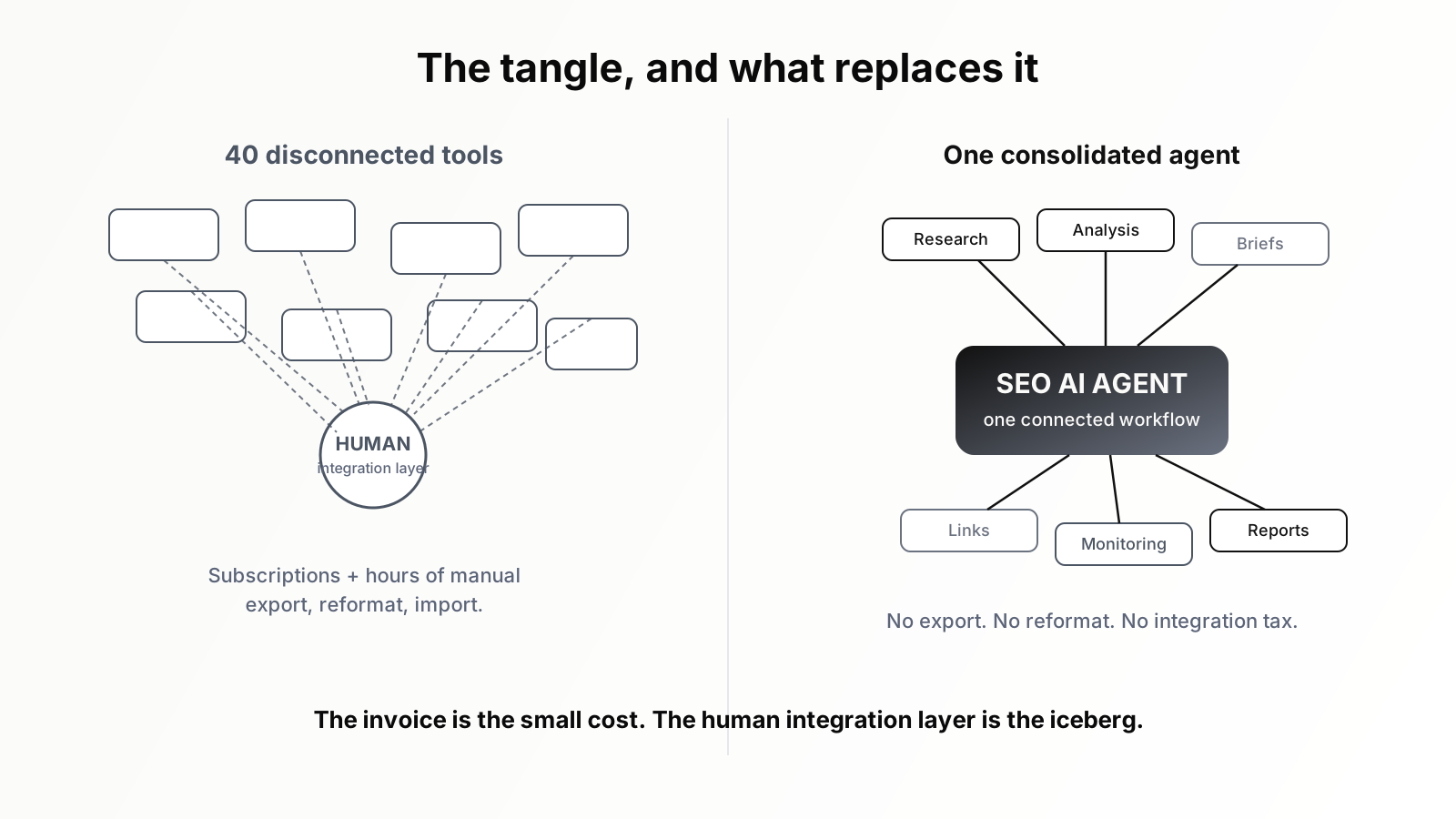
But the subscription total is the small cost. The expensive costs are the ones that never appear on an invoice. There is the integration tax: the human hours spent every week exporting data from one tool, reformatting it, and importing it into the next, because the forty tools do not talk to each other. There is the context-switching tax: the cognitive cost of a workflow spread across forty logins, forty interfaces, and forty mental models, where simply remembering which tool does what is itself a skill. There is the onboarding tax: every new hire must learn the whole zoo before they are productive. There is the decision tax: time lost to "which tool should I use for this?" And there is the overlap tax — because in a stack that large, you are almost certainly paying two or three vendors for the same capability without realising it. The invoice is the tip. The iceberg is the human time the fragmented stack silently consumes.
Why the stack grew this big in the first place
No one set out to assemble forty tools. The stack grew the way clutter always grows — one reasonable decision at a time. A specific problem appeared, someone found a specific tool that solved it, and the tool was added. Repeat that sensible move forty times over a few years, across several team members who each adopted their own favourites, and you arrive at sprawl without anyone ever making a sprawl decision.
Each individual tool was justified on the day it was bought. What was never evaluated is the system — the compounding cost of forty separately reasonable choices sitting side by side, unintegrated. The stack was optimised tool by tool and never once optimised as a whole. That is why consolidation feels daunting: there is no single bad decision to reverse, just forty small ones whose combined weight nobody ever weighed.
The hidden tax in detail: the human as integration layer
It is worth dwelling on the largest hidden cost, because it is the one most teams have stopped noticing. In a fragmented stack, the tools do not connect to each other. So who connects them? A person.
Your most skilled SEO spends a substantial share of their week being human middleware: pulling a keyword list out of tool A, cleaning it up in a spreadsheet, feeding it into tool B for intent, exporting that, cross-referencing it against tool C for difficulty, then carrying the survivors into tool D to brief them. None of that is SEO thinking. It is data logistics — copy, paste, reformat, repeat — and it is being done by an expensive specialist you hired for their judgement, not their clipboard. The forty-tool stack does not just cost subscription money. It quietly converts your highest-value people into data-entry clerks for a portion of every week. That is the real price, and it does not show up anywhere you would think to look.
What consolidation around an agent actually changes
Here is the offer, stated plainly. Instead of forty disconnected tools stitched together by human effort, you run one SEO AI agent that performs the connected workflow as a single system. The keyword research, the intent classification, the competitor analysis, the content gap detection, the brief generation, the internal-link planning, the rank monitoring, the reporting — these stop being forty separate destinations and become one continuous process inside one product.
The change is not merely "fewer logins," though that is real. The deeper change is the elimination of the integration layer. When the workflow lives inside one agent, the output of each step flows automatically into the next. Nobody exports. Nobody reformats. Nobody copies a keyword list into a spreadsheet at nine on a Tuesday. The data logistics — the single largest hidden cost of the old stack — simply cease to exist as a job, because there are no longer forty separate things to integrate. There is one thing.
The objection: "but our specialised tools are better at their one thing"
The strongest objection to consolidation deserves a straight answer: "our dedicated rank tracker is better at rank tracking than any all-in-one will ever be." Often, that is true. A focused, specialised tool frequently does its single job a little better than a consolidated platform does that same slice.
But the objection compares the wrong things. It measures tool against tool, feature against feature — and on that narrow axis the specialist may win by a margin. What it ignores is the system. The relevant comparison is not "best rank tracker vs adequate rank tracker." It is "forty best-in-class tools that do not connect, plus a human burning hours integrating them" against "one agent, slightly less dazzling on any single feature, that runs the whole workflow with zero integration cost." For most teams, a workflow that is ninety percent as good on each feature but a hundred percent integrated and self-running beats forty disconnected excellences by a wide margin. You are not buying features. You are buying outcomes, and outcomes are a property of the system, not of any one tool.
The arithmetic, so you can check it yourself
A pitch should be falsifiable, so here is the calculation to run on your own numbers. On the cost side, add three things. First, the subscription total of every SEO and content tool you currently pay for — and be thorough, include the forgotten annual plans. Second, an honest estimate of the human hours per week your team spends on tool-to-tool data logistics — exporting, reformatting, importing — multiplied by a loaded hourly cost. Third, the onboarding time for new hires to learn the full stack. Sum those three. That is the true cost of the fragmented stack, and it is invariably far larger than the first number alone.
Now compare it to the cost of one consolidated agent: its subscription, plus a much shorter onboarding, plus a near-zero integration cost because the workflow no longer needs integrating. For most teams the gap is not marginal — it is large enough that the cost saving alone justifies the move, before you have counted the upside of your specialists spending their reclaimed hours on actual strategy. We make the related case for automating the right tasks in the SEO tasks you should automate first; consolidation is what makes that automation coherent rather than another tool in the pile.
What you gain beyond the saving
The cost reduction is the headline, but it is not the whole return. Consolidation also buys you things the fragmented stack could never provide.
It buys coherence. When one agent runs the whole workflow, it holds context across every step — your keyword research knows about your existing content, your briefs know about your clusters, your monitoring knows your history. Forty disconnected tools each see a sliver; one agent sees the whole picture, and recommendations made with the whole picture are simply better. It buys speed: a workflow with no manual hand-offs runs in a fraction of the time. It buys resilience: when the workflow lives in a system rather than in one specialist's head and habits, it survives that specialist going on holiday or leaving. And it buys focus: your team stops thinking about tools and starts thinking about strategy, because there is now one place the work happens instead of forty.
How to consolidate without chaos
Consolidation does not have to be a risky, big-bang migration, and pretending otherwise would be dishonest. The sane approach is staged. Start by auditing the real stack — list every tool, its cost, and what it is genuinely used for, and you will almost certainly find duplicates and dormant subscriptions you can cut on day one with no replacement at all. Then identify the core workflow the agent will absorb: keyword research through to brief, monitoring, reporting. Move that workflow onto the agent and run it in parallel with the old tools for a short period, so you can compare outcomes with your own eyes rather than on faith. As confidence builds, retire the tools the agent has replaced, one cluster of capability at a time. You may well keep one or two genuine specialists for edge cases — consolidation does not have to mean a literal single login. It means collapsing the forty-tool tangle into one agent plus, at most, a small, deliberate handful of exceptions.
The morale cost nobody puts in the spreadsheet
There is one more cost of the fragmented stack that deserves its own heading, because it never reaches a finance review and yet it shapes whether your SEO program survives at all: the effect on the people doing the work.
Skilled marketers and SEOs do not stay in jobs where most of their week is data logistics. They were hired to think — to find opportunities, shape strategy, judge quality — and a forty-tool stack quietly converts a large share of their time into tab-switching and copy-paste. That is demoralising in a way that compounds. The most capable people notice first, because they are the ones most aware of how their time should be spent, and they are also the ones most able to leave. So the fragmented stack does not merely waste hours. It actively pushes your best people toward the door, and every departure costs you a hire, a ramp-up, and the institutional knowledge that walked out with them.
Consolidation reverses the dynamic. When the agent absorbs the logistics, the human's week refills with the work that drew them to the job in the first place. That is not a soft benefit to wave at vaguely. Retention is one of the most expensive variables in any team's budget, and a stack that improves it is doing real financial work — it simply does it in a column the spreadsheet does not have.
A note on data and the single source of truth
One under-appreciated consequence of consolidation is what it does to your data. In a forty-tool stack, your SEO data is scattered across forty places, and worse, it frequently disagrees with itself. Two tools report slightly different rankings for the same keyword. Three tools count traffic differently. Your reporting tool and your analytics tool tell mildly different stories. The team spends real energy reconciling these discrepancies, and decisions get made on numbers nobody fully trusts.
When one agent runs the workflow, the data has one home and one definition. The keyword research, the monitoring, the gap analysis, and the reporting all draw on the same underlying picture, so they cannot contradict one another. A single source of truth is not a glamorous feature, but it removes a steady, low-grade friction from every decision the team makes — and it means that when the agent recommends something, the recommendation rests on data the whole workflow agrees with rather than on whichever tool happened to be open.
The decision in front of you
Strip the pitch down to its core and the choice is simple. You can keep paying for forty tools and keep paying the much larger, invisible tax of the human integration layer that holds them together. Or you can consolidate around a single SEO AI agent that runs the workflow as one connected system, eliminates the data-logistics job, gives you coherence and speed the old stack never could, and costs less once you count honestly.
The SEO AI agent built for exactly this is Orova — one product that absorbs the keyword research, intent classification, competitor analysis, gap detection, briefing, internal-link planning, monitoring, and reporting that your forty tools currently do in forty disconnected pieces, and runs them as a single self-connecting workflow. The point is not novelty. The point is the arithmetic: less spent, far less human time wasted, and a team finally free to do strategy instead of data entry. Run the calculation on your own stack. For most teams, the number makes the decision for you.
Run your business with AI Agents
Orova is the always-on Biz AI Agent — it plans, runs, and optimizes the work for you. Save time, unlock productivity.
Try it free