
The SEO Tasks You Should Automate First
When a team first decides to automate part of its SEO work, the instinct is to start with whatever feels most painful that week, or whatever the newest tool happens to advertise. That is the wrong way to choose. Automation is a sequence of decisions, and the order matters: automate the wrong task first and you spend effort for little return, or worse, you automate a job that should never have been handed to a machine at all. This article is an analytical breakdown of how to decide what to automate first — a framework rather than a checklist, because the right answer depends on your situation, and a framework travels where a checklist does not.
The two axes that decide everything
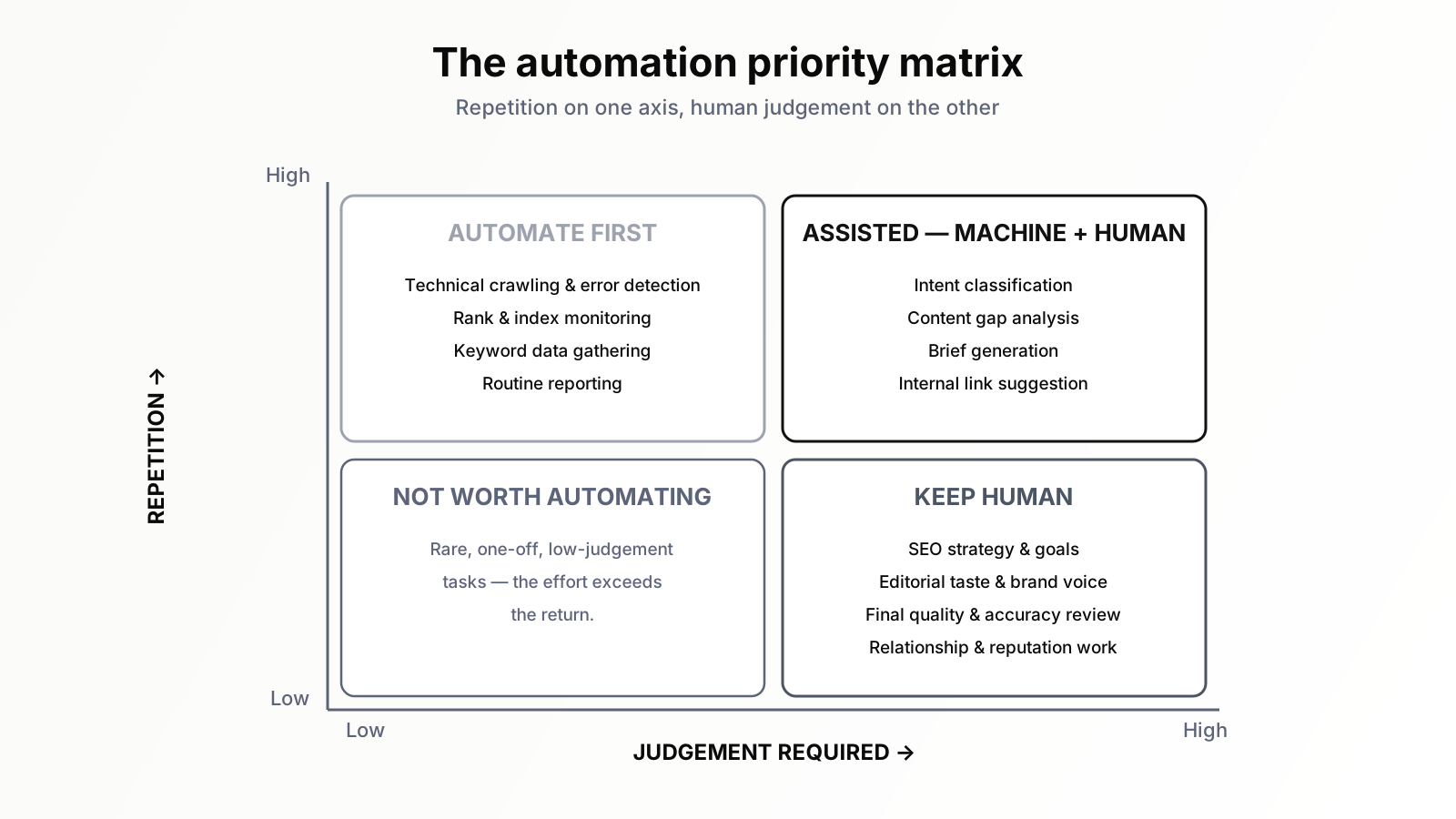
Every SEO task can be placed on a simple grid built from two questions. The first: how repetitive and rule-based is the task? Some tasks are the same procedure performed over and over, with clear inputs and a definable "correct" output. Others are different every time, shaped by context, and resist being reduced to a rule. The second: how much human judgement does the task genuinely require? Some tasks need taste, strategy, business context, or editorial sensibility that a machine cannot supply. Others need none — they need accuracy and consistency, which a machine supplies better than a human.
Plot tasks on those two axes and four quadrants appear. High-repetition, low-judgement tasks are the automation gold — automate these first. High-repetition, high-judgement tasks are candidates for assisted automation, where the machine does the heavy lifting and a human reviews. Low-repetition, low-judgement tasks are rare and not worth the effort of automating. Low-repetition, high-judgement tasks are the ones to keep firmly human. The whole framework is: find the first quadrant, automate it, then move carefully into the second. The order of this article follows that order.
Quadrant one: the tasks to automate first
The clearest wins — the tasks to hand to a machine before anything else — are repetitive, rule-based, and need no judgement. They share a profile: a human performs them frequently, the procedure is essentially the same each time, the "right answer" is well-defined, and the work is more about thoroughness and consistency than about insight. Crucially, these are also the tasks where humans are worst: repetitive work is where people get bored, cut corners, and make mistakes, while a machine does the thousandth repetition exactly as carefully as the first.
Several core SEO tasks sit squarely here. Technical site crawling and error detection — checking thousands of pages for broken links, missing meta descriptions, redirect chains, orphan pages — is pure pattern-matching at volume, exactly what a machine does better than a tired human scrolling a spreadsheet. Rank and index monitoring — checking positions and index coverage on a schedule — is a task whose entire value is consistency and frequency, two things humans supply poorly and machines supply perfectly. Keyword data gathering — pulling volumes, collecting autocomplete and "People Also Ask" suggestions, assembling the raw list — is collection work, not thinking work. And routine reporting — assembling the same metrics into the same format every month — is a defined procedure with a defined output. These four are the front of the queue. They are where automation returns the most for the least, and where handing the work to a machine improves quality rather than merely speeding it up.
Quadrant two: the tasks to automate with a human in the loop
The second quadrant is more interesting and more frequently mishandled. These tasks are repetitive enough to be worth automating, but they carry real judgement — so the goal is not to remove the human but to change what the human does. The machine performs the laborious first pass; the human reviews, corrects, and approves. This is assisted automation, and getting the division of labour right is the whole skill.
Consider search intent classification. Labelling hundreds of keywords as informational, commercial, navigational, or transactional is repetitive, so automation helps — but intent is genuinely ambiguous at the margins, and some calls need human context. The right design: the machine classifies everything and flags the ambiguous cases; the human reviews the flags. Consider content gap analysis: comparing your coverage against competitors and surfacing missing topics is heavy, repetitive comparison work a machine does well — but deciding which gaps are worth filling is a strategic judgement that stays human. The machine produces the gap list; the human prioritises it. Consider content brief generation: assembling the structure, the questions to answer, the entities to mention, the competitor analysis is largely mechanical — but the angle, the strategic framing, the editorial intent need a person. The machine drafts the brief; the human shapes its strategy. And consider internal link suggestion: finding relevant linking opportunities across a large site is exactly the kind of exhaustive scan a machine should run, while the final call on anchor text and emphasis benefits from a human eye. In every case the pattern repeats — machine drafts, human directs. The mistake is treating these as quadrant one and removing the human entirely, or treating them as quadrant four and refusing to automate at all.
Quadrant four: the tasks to keep human — on purpose
An honest framework has to name the tasks that should not be automated first, or at all, and explain why. These are the low-repetition, high-judgement tasks — the work that is different every time and depends on context, taste, and business understanding that a machine does not have.
Several tasks belong here permanently. SEO strategy — deciding which markets to pursue, how content ladders into revenue, what the business is actually trying to achieve — is not a repeatable procedure; it is a judgement made with full business context, and it sets the goals that all the automated work serves. Editorial taste and brand voice — deciding whether a piece is genuinely good, whether it sounds like your brand, whether it says something worth saying — is judgement of a kind no current automation reliably supplies. Final quality and accuracy review — the decision that a piece is true, sound, and ready to publish under your name — must rest with an accountable human. And relationship and reputation work — the human side of digital PR and partnerships — is human by nature. Keeping these human is not a limitation of the technology to be apologised for. It is the correct division of labour. The point of automating quadrants one and two is precisely to free human time for quadrant four — so the strategist strategises instead of crawling pages, and the editor edits instead of compiling reports.
The sequencing logic: why order matters
Why automate in this specific order rather than all at once? Three analytical reasons.
First, return on effort. Quadrant-one tasks give the largest, fastest, lowest-risk return. Automating them first means the program shows value early, which builds the confidence and the mandate to tackle the harder quadrant-two work. Start with the difficult, judgement-heavy tasks and you risk an early, visible failure that poisons the whole initiative.
Second, risk containment. Quadrant-one tasks have a well-defined "right answer," so when automation makes a mistake there it is easy to detect and the consequences are small. Quadrant-two tasks carry judgement, so mistakes are subtler and costlier. Building your automation muscle on low-risk tasks first means you learn the failure modes — how the machine errs, where it needs guardrails — before you apply it to work where errors matter more.
Third, trust. Automation only delivers value if the team actually relies on it, and trust is earned by watching the easy wins succeed. A team that has seen automation handle crawling and monitoring flawlessly for a quarter will trust it with intent classification. A team whose first experience of automation was a botched content strategy will reject it entirely — including the quadrant-one tasks it should have had from the start. Sequencing is not just efficiency. It is change management.
A common mistake: automating the visible task instead of the right one
One failure pattern is worth calling out because it is so frequent. Teams often automate the task that is most visible rather than the one that best fits quadrant one. Content writing is the obvious example: it is the most visible part of SEO, so it is the first thing teams try to automate — even though final-draft writing carries heavy editorial judgement and belongs in quadrant two at best, often quadrant four.
Meanwhile the genuinely ideal first targets — crawling, monitoring, data gathering, reporting — get ignored because they are unglamorous and invisible. The result is a team wrestling with the hard, judgement-heavy automation of writing while their specialists still manually crawl the site and assemble reports by hand. The visible task is not the right task. The framework, not the spotlight, should choose what gets automated first. The same caution applies when scaling output, a theme we examine in how to scale to 100 articles a month without making junk — volume without the right division of labour produces volume of the wrong kind.
Putting the framework to work
To apply this to your own team, run a short exercise. List every recurring SEO task your team performs. For each, score it on the two axes — how repetitive, how judgement-heavy — and place it in a quadrant. The quadrant-one tasks are your immediate automation backlog: do those first, in roughly the order of how much time they currently consume. The quadrant-two tasks are your next phase, automated as assisted workflows with the human-review step explicitly designed in. The quadrant-four tasks you protect: those are where your people should be spending the time that automation gives back. The exercise takes an afternoon and replaces guesswork with a defensible sequence.
Quadrant three: the tasks not worth automating
The framework has a fourth quadrant that is easy to skip past, and skipping it causes wasted effort, so it earns a paragraph of its own. These are the low-repetition, low-judgement tasks — work that does not happen often and does not need much thinking. A one-off data pull for a specific board meeting. A particular page checked once because someone asked. A small, ad-hoc fix that will not recur.
The temptation, once a team has automation momentum, is to automate everything — including these. That is a mistake of a quieter kind than automating the wrong high-stakes task, but it is still a mistake. Automation has a setup cost: someone has to configure it, test it, and maintain it. For a task that happens twice a year and takes ten minutes by hand, the setup cost will never be repaid. The honest answer for quadrant-three tasks is to leave them manual. They are infrequent enough that doing them by hand, when they arise, is genuinely the efficient choice. A mature automation program is defined as much by what it deliberately leaves alone as by what it automates.
How to know automation is working
A framework for choosing what to automate should be paired with a way to tell whether the automation is actually helping, because automation that is not measured tends to drift into either neglect or overreach.
Three signals are worth watching. The first is reclaimed time spent well. The point of automating quadrants one and two is to free human hours — so the test is not just "did hours get freed" but "did those hours move to quadrant-four work." If your specialists stopped crawling the site but the freed time vanished into more meetings, the automation succeeded technically and failed in purpose. The second signal is error rate. Automation should make quadrant-one work more accurate, not less; if errors rise after automating a task, the task was either misclassified or the automation needs tighter guardrails. The third is trust and adoption. Automation only delivers value if the team relies on its output rather than quietly redoing the work by hand "to be sure." If people are double-checking everything, the automation is costing time rather than saving it, and the cause — usually a real reliability gap or a task that needed more human involvement than it was given — needs to be found and fixed. Measuring these three keeps the program honest and stops it from becoming a set of automations nobody quite believes in.
Where an agent fits the framework
The natural way to execute this framework is with an SEO AI agent, because an agent can span both of the first two quadrants in a single coherent system. Orova handles the quadrant-one work outright — crawling for technical errors, monitoring rankings and index coverage, gathering keyword data, assembling routine reports — and runs the quadrant-two work as assisted automation, classifying intent and flagging the ambiguous cases, producing content gap lists and briefs for a human to direct, and surfacing internal-link opportunities for a human to approve. It does not touch quadrant four, and it should not: strategy, editorial taste, and final accountability stay with your team. That is the framework working as designed — the machine takes the repetitive and the rule-bound, the human keeps the judgement, and the order of adoption follows the matrix. Automate first what the matrix says to automate first, and the rest of the program builds on solid ground.
Run your business with AI Agents
Orova is the always-on Biz AI Agent — it plans, runs, and optimizes the work for you. Save time, unlock productivity.
Try it free