
llms.txt: What It Is, What It Isn't, Should You Bother
Every few years the SEO industry finds a small text file to argue about. For two decades it was robots.txt, with its strange politics of voluntary compliance. Then came sitemap.xml, which everyone adopted because the benefit was obvious and immediate. Now the argument has a new subject: llms.txt, a proposed file that is supposed to help large language models understand your website — and that has generated more conference talks, LinkedIn threads, and agency upsells than perhaps any single markdown file in history.
The noise around llms.txt has reached the point where the basic facts get lost. Some marketers describe it as a mandatory standard that every site must implement immediately or vanish from AI search. Some engineers dismiss it as cargo-cult SEO with zero evidence behind it. Both camps are reacting to each other rather than to the file itself, and the truth — as it usually is with proposed standards — sits in a less exciting middle: llms.txt is a cheap, reasonable, completely unproven idea that no major AI engine has committed to using.
This article is an analysis, not a sales pitch in either direction. We will walk through what llms.txt actually is, where it came from, what problem it claims to solve, what it explicitly is not, what the adoption picture really looks like in 2026, and — the only question that matters for your roadmap — whether you should spend any of your limited time on it.
llms.txt is a community-proposed markdown file placed at your site's root that gives AI systems a curated, plain-text overview of your most important content. It is not an official standard, it does not control crawler access like robots.txt, and no major AI engine — Google, OpenAI, Anthropic, or Perplexity — has publicly committed to using it. It costs little to add, but expect no measurable benefit yet.
What llms.txt actually is
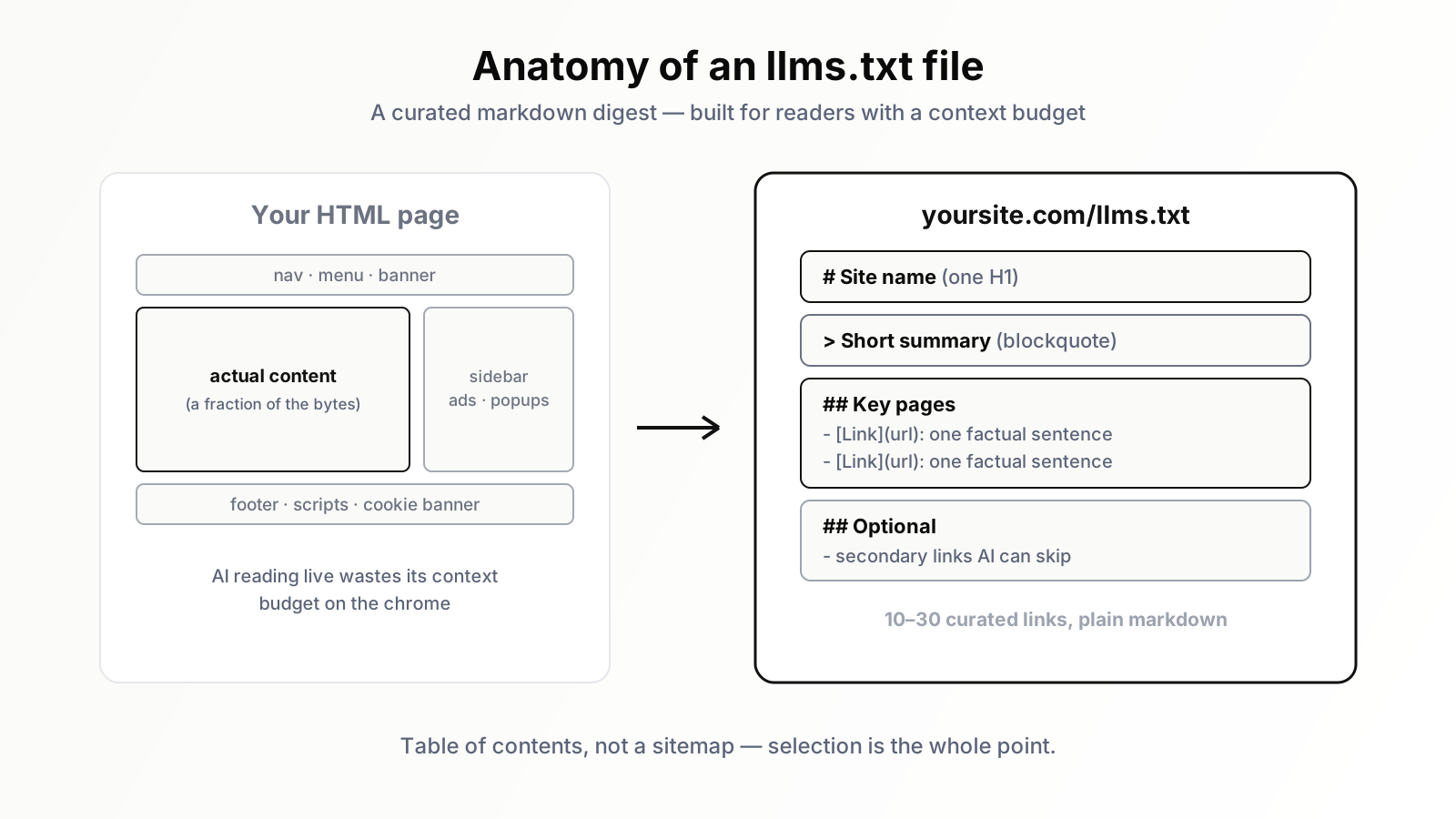
The proposal originated in September 2024 from Jeremy Howard, the co-founder of Answer.AI and a well-known figure in the machine learning community. His observation was straightforward: language models increasingly read websites at inference time — when a user asks a question and the assistant fetches pages to answer it — but websites are built for browsers, not for models. A typical modern page wraps a few hundred words of useful content in navigation menus, cookie banners, JavaScript payloads, footers, sidebars, pop-ups, and advertising markup. A model with a limited context window wastes most of its reading budget on chrome rather than content.
The proposed fix is a single file at the root of your domain — yoursite.com/llms.txt — written in plain markdown. The format is deliberately simple and human-readable. It contains, in order: a single H1 with the name of the site or project, a blockquote with a short summary of what the site is about, optionally a few paragraphs of context, and then one or more H2 sections containing lists of links to your key pages, each with a one-line description. An optional final section, conventionally titled "Optional," lists secondary links that a model can skip when its context budget is tight.
The proposal also describes a companion convention: markdown versions of individual pages, served at the same URL with .md appended, and an llms-full.txt file that concatenates the full text of your important content into one large document a model can ingest in a single fetch. Think of llms.txt as a curated table of contents and llms-full.txt as the whole book in plain text.
If the shape of this sounds familiar, it should. llms.txt is to AI assistants what sitemap.xml was supposed to be for search crawlers — a machine-friendly map of what matters on your site — with one important difference. A sitemap is an exhaustive inventory built for crawlers with effectively unlimited patience. llms.txt is a selective, opinionated digest built for readers with a hard budget. The design assumes the consumer cannot read everything, so the publisher should say what is worth reading first.
The problem it claims to solve is real
Before we get to the skepticism, it is worth granting the premise, because the premise is sound. The way AI systems consume the web genuinely is different from the way search crawlers do, and the difference creates a real inefficiency.
A traditional search crawler downloads your HTML, renders it, strips the boilerplate using mature extraction algorithms refined over twenty years, indexes the result, and moves on. It does this at leisure, ahead of time, across your whole site. Storage is cheap and time is abundant. Whether your page carries 50 kilobytes of template markup around 5 kilobytes of content barely matters.
An AI assistant answering a live question works under completely different constraints. It fetches a handful of pages in the seconds between the user's question and its answer. Every token of navigation markup it reads is a token of actual content it cannot read. Extraction has to happen in real time, and it is imperfect — anyone who has watched an AI assistant quote a cookie banner or a related-posts widget as though it were the article has seen the failure mode firsthand. From the publisher's side, the failure is invisible and costly: the assistant read your page, missed your point, and synthesized its answer from a competitor whose content was easier to parse.
So the diagnosis behind llms.txt is correct: the web is hostile to machine readers operating under context constraints, and publishers have an interest in being easy to read. The open question was never whether the problem exists. It is whether this particular file is the mechanism that solves it — and that depends entirely on whether the machines choose to read it.
What llms.txt is not
Most of the bad decision-making around llms.txt comes from confusing it with things it superficially resembles. Four distinctions matter.
It is not robots.txt, and it controls nothing
robots.txt is a directive file: it tells crawlers what they may and may not fetch, and the major crawlers — GPTBot, ClaudeBot, PerplexityBot and their siblings — at least nominally obey it. llms.txt grants no permissions and revokes none. It cannot stop a model from training on your content, cannot stop a crawler from fetching pages you left out of it, and cannot protect anything. It is an offer of information, not an access policy. If your actual concern is controlling which AI systems use your content, llms.txt is the wrong file entirely; that conversation lives in robots.txt and at your CDN.
It is not a standard — it is a proposal
The word "standard" gets used loosely here, and the looseness misleads. Web standards in the meaningful sense are specifications that major implementers commit to honoring. robots.txt spent decades as a de facto convention before finally being formalized, but it was honored by every major crawler the whole time — that honoring is what made it real. llms.txt has the specification but not the honoring. It is a community proposal with a website, a spec, and a growing list of sites that publish the file. What it does not have, as of mid-2026, is a single major AI engine that has publicly committed to consuming it.
It is not used by the engines you care about
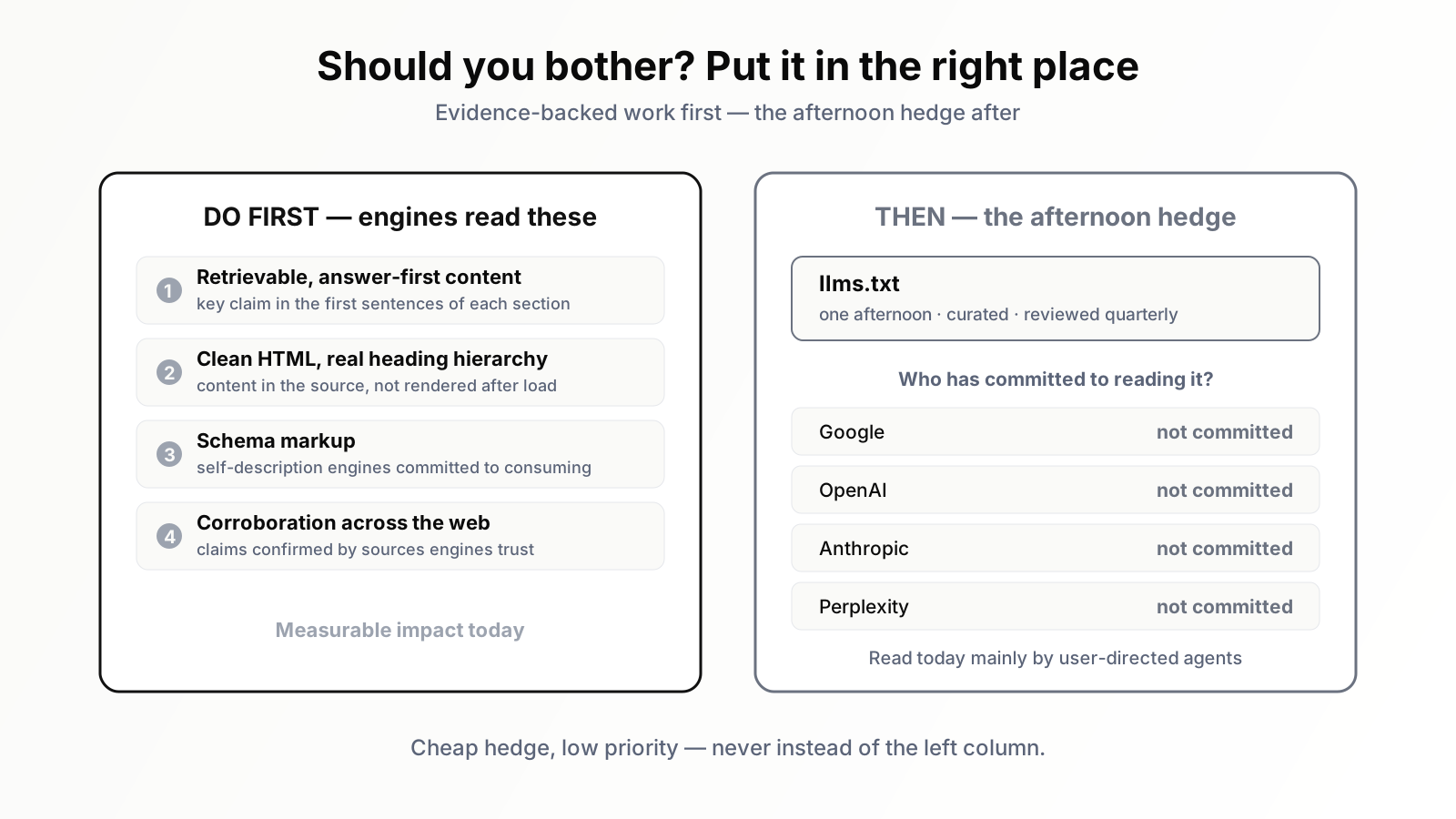
This is the load-bearing fact, so let us be precise about it. Google has not adopted llms.txt for Search, for AI Overviews, or for Gemini — and Google's John Mueller publicly compared the file to the keywords meta tag, the canonical example of publisher-supplied metadata that engines learned to ignore because it was unverified self-description. OpenAI has not announced support for ChatGPT or its crawlers. Anthropic publishes an llms.txt file for its own documentation site — which tells you the company finds the format congenial for its docs — but has made no commitment that its crawlers consume the file on yours. Perplexity has likewise announced nothing. Server-log analyses published by various SEO practitioners through 2025 found that AI crawlers rarely requested the file unprompted. The most honest summary: publishers are producing llms.txt files in meaningful numbers, and there is no public evidence that the major engines are consuming them.
It is not a ranking signal, a citation booster, or an AI-visibility hack
Because no major engine reads the file, no measurable outcome can currently flow from it. Anyone selling llms.txt implementation as a way to increase your citations in ChatGPT or your inclusion in AI Overviews is selling ahead of the evidence. Visibility in AI answers, as far as anyone can measure in 2026, is driven by the things it has always been driven by: whether your content is retrievable, whether it is structured so an extractive system can lift answers from it, and whether your brand and claims are corroborated across the wider web. Those mechanics are covered in depth in our Generative Engine Optimization playbook, and none of them route through llms.txt.
Where adoption actually stands
The adoption picture in 2026 has a curious shape: enthusiastic on the publishing side, silent on the consuming side.
On the publishing side, llms.txt found a genuine early niche in developer documentation. Documentation platforms added one-click generation of llms.txt and markdown page variants, and thousands of developer-tool companies now serve the files. This made sense for a specific reason: developers paste documentation into AI coding assistants constantly, and a clean markdown version of your docs is useful to a human-driven workflow today, regardless of whether any crawler fetches it autonomously. The file earns its keep through deliberate, user-initiated consumption — a developer or an agent told explicitly to go read it.
Beyond documentation, adoption is mostly speculative. Marketing sites, SaaS blogs, e-commerce stores, and publishers have added the file on the logic of a cheap lottery ticket: minimal cost, possible future payoff if an engine starts reading it. There is nothing wrong with that logic as long as it is named honestly — it is a hedge, not an optimization.
On the consuming side, the silence is informative. The major engines have had two years to announce support, and the format could not be easier to parse. Their hesitance likely comes down to the same problem that killed the keywords meta tag: self-description is unverified description. An llms.txt file says what the publisher wants the model to believe the site says. The moment engines reward the file, the file gets gamed — stuffed with keywords, exaggerated claims, links to pages whose HTML says something different. Engines have spent twenty-five years learning to trust independent extraction over publisher self-reporting, and llms.txt asks them to reverse that lesson. They may eventually accept the trade for efficiency reasons, perhaps with verification layered on top. They have not yet.
The honest case for bothering anyway
Given all that, the case for implementing llms.txt is thinner than the hype suggests but not empty. It rests on four legs.
First, the cost is genuinely trivial. For a site with a clear structure, writing a good llms.txt is an afternoon of work — an hour if your content inventory is already documented. The format is plain markdown; there is no tooling to buy and nothing to break. Low cost changes the math on speculative bets.
Second, user-directed AI consumption is real today. Autonomous crawlers may ignore the file, but agents that a human points at your site do not. When a prospect tells their assistant "read orova.vn and summarize what they do," an assistant that checks for llms.txt — and agent frameworks increasingly do — gets your curated, accurate self-summary instead of whatever it salvages from your homepage hero section. That is a small but real audience, and it is growing as agentic browsing grows.
Third, the exercise produces a useful artifact regardless. Writing llms.txt forces you to answer questions most teams have never answered crisply: What are the ten pages that define this site? How would you describe each in one factual sentence? What is the one-paragraph summary of who you are? That curated inventory improves your navigation, your onboarding emails, and your pitch — even if no machine ever fetches the file.
Fourth, the asymmetry favors early movers slightly. If an engine ever does adopt the convention, the sites with accurate, well-maintained files are positioned on day one. If none ever does, you spent an afternoon. The downside is bounded and small; the upside is uncertain but nonzero.
The equally honest case against urgency
Now the other side, which matters more for prioritization. Everything llms.txt might someday do for your AI visibility, other work does measurably today — and that work should come first in every plan.
If an AI assistant misreads your pages, the robust fix is cleaner page architecture: real headings in a logical hierarchy, the substance of each page present in the HTML rather than rendered by JavaScript after load, boilerplate kept out of the main content area, and an answer-first structure where the key claim of each section appears in its first sentences. That helps every consumer of your content — Googlebot, GPTBot, screen readers, skimming humans — not just the hypothetical future reader of one markdown file.
If you want machines to understand what your pages are, schema markup is the publisher-supplied metadata that engines actually committed to consuming — the contrast with llms.txt could not be sharper. If you want to appear in AI answers, the levers are the ones laid out in our guide to ranking in Google AI Overviews and our breakdown of how to get cited by ChatGPT, Gemini, and Perplexity: passage-level answerability, corroborated claims, and presence on the third-party sources that answer engines retrieve and trust.
There is also a quiet maintenance cost that the lottery-ticket framing omits. An llms.txt that drifts out of date — linking to retired pages, describing products you renamed, summarizing a positioning you abandoned — is worse than none, because the one scenario where the file gets read is precisely the scenario where you want it accurate. A stale self-description handed directly to an AI assistant is misinformation you wrote about yourself. If you ship the file, it needs an owner and a review cadence, like anything else you publish.
And finally, beware the displacement effect, because it is the real cost of hype. Teams have finite attention. Every hour spent debating, implementing, and reporting on llms.txt is an hour not spent on the unglamorous work that moves AI visibility now. The file is an afternoon — but only if you treat it as an afternoon. The moment it becomes a project, a deliverable, a line item an agency bills monthly, its cost has exceeded any defensible estimate of its value.
If you do it, do it properly
For teams that decide the afternoon is worth spending, the implementation guidance is short.
Keep the file curated, not exhaustive. Ten to thirty links beats three hundred; the entire point of the format is selection, and a dump of your sitemap into markdown defeats it. Lead with the pages that answer "what is this company and what does it sell," then your pillar content, then your documentation or help center if you have one. Write each link description as one factual sentence — what the page covers, not how excited you are about it. Put genuinely secondary material under the Optional section or leave it out.
Write the blockquote summary as if it will be quoted verbatim, because the assistants that do read the file will treat it as ground truth about you. State what you are, who you serve, and what you offer in plain declarative sentences. Skip superlatives; a model relaying "the leading revolutionary platform" to a user helps no one, and retrieval systems increasingly discount unverifiable puffery anyway.
Serve the file as plain text at the root of the domain, keep it in version control next to your other site assets, and add a quarterly review to whatever checklist governs your site hygiene. If your platform can generate markdown variants of key pages cheaply, the .md convention is a reasonable companion; if it cannot, do not build infrastructure for it. And resist the temptation to stuff: the file is read, when it is read at all, by systems specifically designed to detect the difference between description and promotion.
How to think about proposed standards in general
Step back from this one file and there is a transferable lesson, because llms.txt will not be the last proposed convention to sweep through the industry in the AI-search era. New file formats, new meta tags, new protocols for agent-to-site communication are arriving quarterly, each with advocates announcing that early adoption is existential.
The evaluation framework that serves you well is three questions. Who has committed to consuming this — names, not vibes? What does it cost to adopt, including maintenance and the attention it displaces? And what is the floor value if no consumer ever materializes? llms.txt scores: nobody major yet; an afternoon plus light upkeep; a useful content inventory. That profile says "cheap hedge, low priority" — do it in the gap between real projects, never instead of one. A proposal that scored "nobody yet, six engineering weeks, zero floor value" would say "wait," no matter how loud the conference talks get. Standards become real when implementers commit, not when publishers comply, and confusing those two is how budgets get burned.
It is also worth watching the space honestly rather than dismissively. The underlying pressure — machines need efficient, trustworthy access to web content, and rendering ad-laden HTML is a bad answer — is not going away. Something will eventually formalize the publisher-to-model interface, whether it is llms.txt, an evolution of it with verification attached, or a different mechanism from the engines themselves. The teams that win that transition will be the ones whose content was already clean, structured, and machine-legible — for whom any new interface is a formatting change rather than a content overhaul.
The bottom line
llms.txt is neither the future of SEO nor a scam. It is a sensible, simple, unadopted proposal: a curated markdown map of your site that no major engine currently reads, that costs an afternoon to create, that serves a small real audience of user-directed agents today, and that might or might not ever matter at machine scale. Implement it if the afternoon is genuinely spare, keep it accurate if you do, and let nobody convince you it belongs ahead of retrievable content, answer-first structure, schema, and corroboration in your priority list — because those are the things the engines have actually committed to reading.
The deeper discipline here is separating signal from ceremony, and that discipline takes monitoring — which engines crawl you, what they cite, what actually drives your AI-era visibility. That is the kind of continuous, evidence-over-hype watching that Orova does as a matter of course: tracking how your content performs across classic search and AI surfaces alike, so decisions like "should we bother with llms.txt" get made from your own data rather than from someone else's conference slide.
Let Orova SEO handle the repetitive part
Keyword research, drafting, refreshing old posts and rank tracking — running automatically on your own site.
Explore Orova SEO