
Reviews Are Local SEO's Compound Interest
Most local SEO tactics behave like simple interest. You build a citation, you earn a fixed increment of value, and the value sits there. You fix your categories, you get a one-time step up in relevance. The work and the reward have a linear relationship, which is why local SEO checklists feel so finishable: do the thing, bank the gain, move on. Reviews do not behave this way, and the failure to see the difference is why most businesses systematically underinvest in the one local signal that grows on its own.
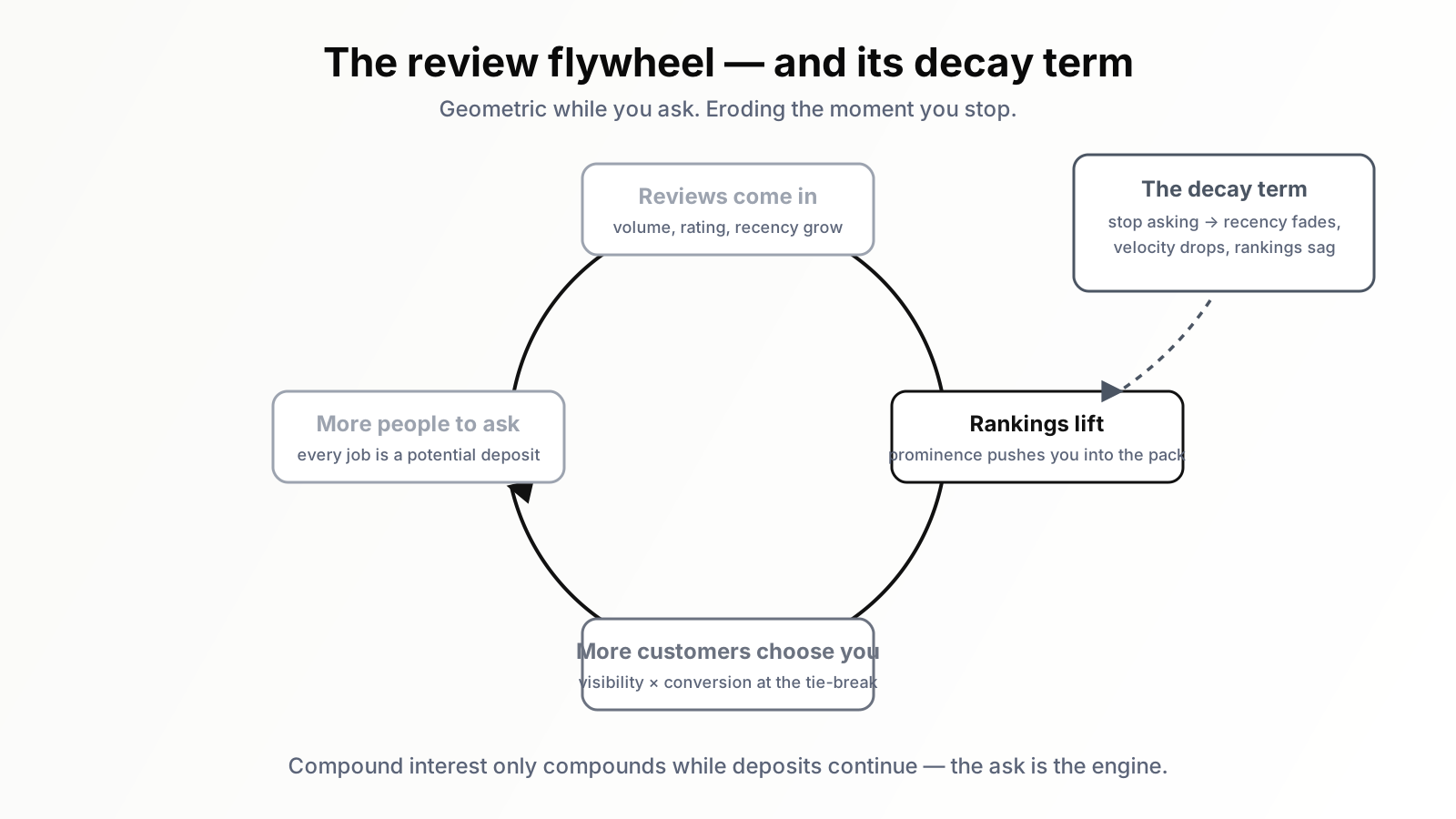
Reviews compound. Each review makes the next customer marginally more likely to choose you; that customer becomes a potential reviewer; the growing corpus improves your rankings, which produces more customers, who produce more reviews. The output of the system feeds back into its input, and anything with that structure rewards early, consistent contribution and punishes late starts — exactly like interest that earns interest. This piece is an analysis of that machine: the distinct mechanisms through which reviews create value, why the compounding holds up mathematically and behaviourally, where it breaks, and what an operator should conclude about where review effort sits in the priority stack.
Why are reviews local SEO's compound interest? Because they feed a loop: reviews lift rankings and conversion, which brings more customers, who leave more reviews. Review count, recency, velocity, text content, and owner replies all feed Google's relevance and prominence signals — and the corpus keeps working long after each review is written.
One asset, five separate yield streams
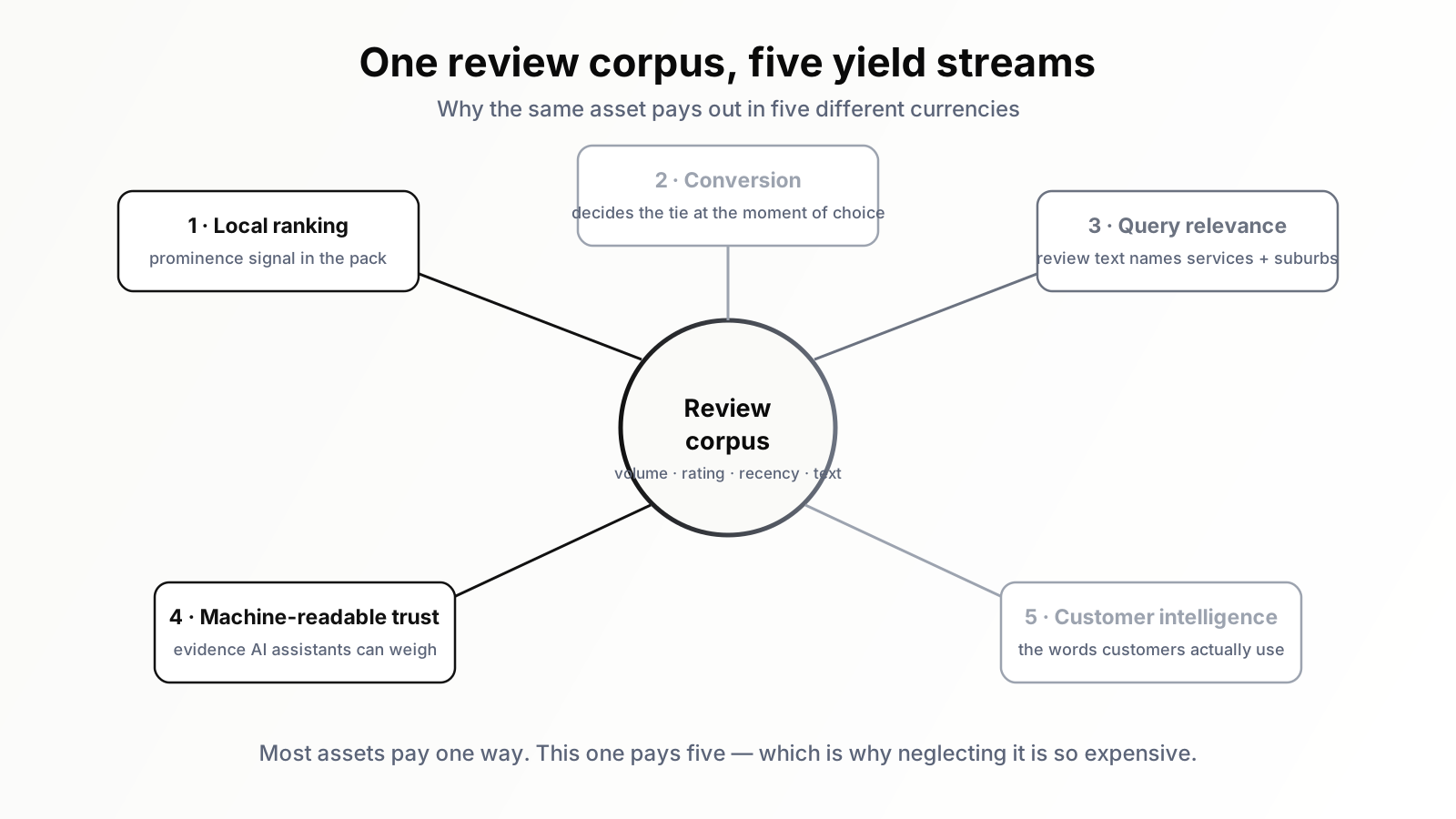
The first analytical step is to stop treating "reviews help" as a single claim. A review corpus pays out through at least five distinguishable mechanisms, and they have different dynamics.
Ranking yield. Google's own documentation on improving local ranking says it plainly: review count and review score factor into local search ranking. Prominence — one third of the relevance-distance-prominence triad — is substantially a measure of how much the world appears to value your business, and reviews are the most legible evidence of that available to an algorithm. Every major industry study of local pack rankings has placed review signals among the strongest correlates, year after year. This is the yield people mean when they talk about reviews and SEO, and it is arguably not even the largest one.
Conversion yield. Inside the local pack, ratings are the comparison interface. Three businesses, three star numbers, displayed side by side at the moment of choice. The click-through and call differences between a 4.0 and a 4.7, and between 12 reviews and 200, are large and well documented in consumer research — most buyers report a rating threshold below which a business is simply excluded from consideration. This yield is independent of ranking: even at a fixed pack position, a stronger review profile converts more of the same impressions.
Relevance yield. Review text is content. When customers write "fixed our heat pump the same afternoon" or "handled the visa paperwork for our Singapore entity," they are annotating your business with query language — including long-tail and neighbourhood-level vocabulary you would never think to target. Google has confirmed that review content can influence the queries a profile surfaces for. In our own client data, profiles with rich review text consistently appear for service-plus-suburb queries that their websites never mention. Your customers are writing your keyword strategy, in their own words, for free.
Trust yield beyond Google. The review corpus is read by more than the pack algorithm. It feeds the knowledge panel on brand searches, third-party platforms that syndicate or cite ratings, and — increasingly decisive — AI assistants asked for recommendations. A machine assembling "three well-regarded providers near you" weighs review volume, sentiment, and consistency because those are the verifiable signals available to it. The mechanics resemble what we described in how to get cited by AI engines: systems recommend entities whose reputation is machine-checkable. A thousand customer testimonies are the most machine-checkable reputation a local business can own.
Intelligence yield. The least discussed stream: reviews are unsolicited, timestamped customer research. They tell you which services drive delight, which staff get named, where the operational failures cluster, and what vocabulary customers use — which feeds everything from your question-keyword content to your hiring. A business that reads its reviews analytically is running a free, always-on focus group.
The flywheel: why the growth is geometric, not linear
Now connect the streams and the compounding structure appears. Ranking yield and conversion yield both increase the number of customers you serve per month. Customers are the raw material of reviews; at any stable ask-rate, more customers mean more reviews per month — higher velocity. Velocity feeds recency and count, which feed ranking and conversion again. The loop has no natural stopping point short of market saturation or operational capacity, which is precisely what the owners in our three-location case study hit: the constraint moved from demand to technicians.
Two properties of this flywheel deserve emphasis because they drive the strategic conclusions.
The early reviews are worth the most. Like any compounding asset, time-in-market dominates. The move from 8 reviews to 40 changes a business's fate — it crosses the credibility thresholds buyers actually use and gives the algorithm a signal where there was noise. The move from 400 to 432 changes almost nothing visible, but the machine those 400 built keeps spinning. This asymmetry means the highest-return review work any business will ever do is the work it does when it has almost no reviews — which is exactly when most businesses, demoralised by the empty profile, do nothing.
The gap compounds too. If you and a competitor convert similar customer volumes but you ask systematically and they ask occasionally, your velocity advantage produces a count advantage, which produces ranking and conversion advantages, which produce a customer-volume advantage, which widens the velocity gap. Review leads in a local market tend to become entrenched for the same reason early leads in compounding systems generally do. The chain in our case study could not close a review gap with any amount of head-office budget, because the gap was being fed at the point of service, monthly, forever.
A worked model: two identical businesses, one habit apart
Abstractions persuade analysts; arithmetic persuades owners. So run the model with conservative numbers. Two service businesses, identical at the start: 60 customers a month, 20 lifetime reviews, the same rating, the same pack position. Business A installs a systematic ask — every completed job triggers a direct review link — and converts a realistic 10 percent of customers into reviewers: six reviews a month. Business B asks when someone remembers, which in practice yields one a month.
Month six: A has roughly 56 reviews to B's 26, and — at least as important — A's last ten reviews are all under eight weeks old. A crosses the visual credibility line where a profile stops looking marginal; its conversion from the same impressions improves, and the recency and velocity signals nudge its pack appearances upward. Suppose those effects produce something modest — 10 percent more customers by the second quarter. Now A serves 66 customers a month, which at the same 10 percent ask-rate yields not six but nearly seven reviews a month. The contribution rate itself has grown, which is the signature of compounding: the deposits get bigger because of the interest.
Month eighteen: A sits somewhere above 150 reviews with unbroken recency; B has crawled to the high 30s with visible gaps. They are no longer comparable businesses in the eyes of either the algorithm or a buyer comparing three pack results — and the divergence came from no budget, no campaign, and no tactic B could not have copied at any point. The model's deliberately boring inputs are the argument: nothing about A's behaviour was heroic. The entire gap is one workflow decision, left running. Real markets add noise — seasonality, a competitor's collapse, a viral disaster — but the underlying divergence dynamic is robust to noise, because it operates on every single transaction.
The model also clarifies what "too late" means and does not mean. A business entering a market where the incumbent holds 800 reviews cannot out-count them in a year, and does not need to. Buyers read rating, recency, and the last page of reviews far more than they read totals; algorithms weight velocity and freshness alongside count. A challenger generating 15 fresh reviews a month against an incumbent coasting on history is winning the signals that move, even while losing the one that is finished moving. Compounding favours the early, but it favours the consistent over the early-and-stopped — which is the single most hopeful fact in local SEO for late entrants.
Concentrate or diversify: where the deposits should go
A portfolio question follows naturally: should review effort concentrate on Google or spread across platforms? The analysis says concentrate first, diversify deliberately later.
Concentration wins early because every yield stream described above has threshold effects on Google specifically — the pack, the panel, the assistant recommendations all read the Google corpus first, and a business below the credibility thresholds there gains little from scattering its scarce early reviews across four platforms. While a profile has fewer than roughly a hundred reviews, the default destination for every ask should be Google, full stop.
Diversification earns its place later, for three reasons. First, some categories have a second platform that buyers genuinely consult — industry marketplaces, booking platforms, B2B software directories — and absence there becomes its own red flag once you are visible enough to be looked up. Second, AI assistants triangulate: a reputation that exists on exactly one platform is weaker evidence to a machine than the same sentiment echoed across several independent sources, the same cross-source logic that governs entity trust generally. Third, platform risk is real — profiles get suspended by mistake, reviews get eaten by filter updates, and a business whose entire social proof lives in one company's database has handed that company a single point of failure. The mature posture: Google as the compounding core, one or two category-relevant platforms fed at a lower rate, and your own website displaying the corpus — with the caveat that marking up your own reviews of your own business stopped earning stars in Google results years ago, so the on-site display is for humans, not rich results.
A note on the ask itself, because conversion rates from ask to review vary fourfold with mechanics. Timing dominates: the ask lands best inside the gratitude window, within hours of the delivered outcome, not in a month-end batch email. Friction kills: every step between the message and the open review form sheds respondents, which is why a direct link — and in person-to-person businesses, a QR code at handover — beats instructions to "find us on Google." Personalisation helps: an ask naming the technician or the project outperforms a templated blast. And the person asking matters more than the channel: a request from the human who delivered the service carries social weight no automated sequence matches. Automate the trigger and the link; keep the voice human.
The decay term: why the asset needs deposits
An honest model includes the minus sign. Reviews depreciate, on two clocks.
The first clock is behavioural. Buyers discount old reviews steeply — consumer surveys consistently find that a large majority give little weight to reviews older than a few months, and a profile whose most recent review is a year old reads as a business in decline regardless of its lifetime count. The second clock is algorithmic: recency and velocity are signals in their own right, and a corpus that stopped growing stops signalling. The practical consequence is that a review profile is not a trophy cabinet but a balance that erodes without deposits. Fifty reviews arriving over five years and fifty arriving over five months are entirely different assets, even though every count-based comparison treats them as identical.
This decay term is what makes "we did a review push last spring" a non-strategy. Pushes produce spikes; spikes age; six months later the profile is stale again, and — worse — a sawtooth pattern of bursts followed by silence is exactly the velocity signature that review-fraud filters scrutinise, because it is also the signature of bought batches. The steady drip of a systematic ask outperforms the burst on every axis: recency stays fresh, velocity stays credible, and the operational habit survives staff turnover. In compound-interest terms: regular contributions beat lump sums, and the worst plan is contributions that stop.
Replies: the multiplier on every deposit
Owner responses deserve their own analysis, because they multiply several yield streams at once and cost minutes. Google explicitly recommends responding to reviews and frames it as a signal that the business values its customers — the closest thing to an engraved invitation the company publishes. But the reply's larger work is on the conversion stream. Every future prospect who opens your profile reads your replies as a free sample of what being your customer is like. A specific, warm reply to praise demonstrates attention. A calm, accountable, solution-oriented reply to a one-star review demonstrates how you handle failure — which is the precise question a nervous buyer is trying to answer. In categories where every provider has a handful of angry reviews (every category), the replies are often the only differentiating text on the page.
Replies also protect the asset. A reasoned response to an unfair review contains the damage for every subsequent reader; silence ratifies the accusation. And the discipline of replying forces someone at the business to actually read the corpus, which is how the intelligence yield gets collected instead of accumulating unread. Reply rate is, in our experience, the single best one-number proxy for whether a business's whole review system is alive.
Where the model breaks: gates, fakes, and gravity
Three failure modes, in ascending order of severity.
Review gating — surveying customers first and steering only the satisfied toward Google — feels like clever funnel design and is in fact a policy violation that platforms detect and penalise, as well as an increasingly common target of consumer-protection enforcement. Beyond the rules, gating poisons the asset: a wall of unblemished five-star reviews triggers exactly the scepticism in readers that it was built to prevent. A 4.7 with visible, well-handled negatives outsells a suspicious 5.0.
Fake and incentivised reviews are the asset-destroying version. Regulators now treat purchased and fabricated reviews as deceptive practice with real fines attached; platforms filter them with steadily improving fraud models; and detection does not merely remove the fakes but can suppress or suspend the profile they were meant to inflate. Buying reviews is borrowing against the asset at loan-shark rates.
Gravity is the subtle one: the review corpus ultimately cannot outrun the service it describes. A business with an operational quality problem that fixes its ask-rate gets more reviews — including more articulate negative ones, faster. The flywheel amplifies whatever the truth is. This is not a flaw in the strategy; it is the strategy's integrity constraint, and it is why review systems belong partly to operations rather than wholly to marketing. The compounding only works in your favour if the underlying product would survive being documented at scale.
What this means for businesses without storefronts
A common objection from SaaS and B2B service readers: "our buyers don't choose from a map, so does any of this apply?" The compounding analysis transfers almost intact; only the platforms change. For software companies, the review corpus lives on software directories and marketplaces as well as Google; the flywheel runs through comparison pages and analyst-style roundups instead of the pack, and through AI assistants asked "what's the best tool for X" — which cite review platforms constantly. For B2B services, the Google corpus still matters more than most expect, because due diligence on a shortlisted vendor almost always includes a brand search, and the knowledge panel's rating is read as a proxy for delivery quality even by buyers who found you through referral. The structural lesson is identical everywhere: reputation that accrues review by review, asked for systematically at the moment of delivered value, compounds — and reputation assembled in bursts, or never asked for, decays. The map is just where the math is easiest to watch.
The operator's conclusions
Pull the analysis together and the directives almost write themselves. First, reprioritise: if reviews compound and most other local tactics do not, reviews deserve a standing system, not leftover attention — build the ask into the moment of service completion, link directly to the review form, ask every customer without gating, and reply to everything within days. Second, start before you feel ready: the compounding math makes the empty-profile phase the highest-return period you will ever have, and every month of delay is a month a competitor's gap widens. Third, protect velocity through operational change — written cadence, named owner, a number in the monthly report — because the case-study evidence is unambiguous that the system halts the moment it depends on one person's memory. Fourth, never buy what the flywheel must earn; the shortcut and the asset cannot coexist.
For the broader context of where reviews sit among categories, profiles, and location pages, our guide to local SEO for SaaS and service businesses maps the full stack. But if the stack must be ranked, rank it by behaviour: do first the thing that earns interest while you sleep. Reviews are the only line item on the local SEO checklist with that property — and like all compounding systems, they reward the operator who automates the contributions and watches the curve. That watching, at least, is delegable: Orova tracks how your local pages and branded queries respond as the corpus grows, keeping the feedback loop visible so the one asset that compounds never quietly stops. The best time to start the flywheel was when you opened. The second-best time is this week's completed jobs.
Run your business with AI Agents
Orova is the always-on Biz AI Agent — it plans, runs, and optimizes the work for you. Save time, unlock productivity.
Try it free