
How a Three-Location Business Beat a National Chain on Local Queries
The brief sounded like a setup for a polite failure. A family-run home services company with three locations across two neighbouring provinces wanted to compete on local searches against a national chain — a brand with hundreds of branches, a TV budget, a domain that had been accumulating authority since the 2000s, and an in-house marketing department larger than our client's entire office staff. The owners did not ask us whether they could outrank the chain everywhere. They asked a sharper question: could they win the searches that happen within driving distance of their three buildings?
Nine months later the answer was yes, and the margin surprised us. This article is the full account of that engagement: the baseline we measured, the eleven interventions we ran, which ones moved the numbers, which ones did nothing, and what the result says about how local ranking actually works in 2026. Per our usual practice, the business is anonymised and the category lightly blurred — the company has competitors who read this blog — but every number is real, pulled from Google Business Profile performance reports, Search Console, and call tracking. Where we guessed wrong, we say so, because the failed interventions taught us as much as the successful ones.
Can a small multi-location business beat a national chain on local searches? Yes. In our nine-month engagement, a three-location company grew local pack appearances 212 percent and profile-driven calls 174 percent, overtaking a national chain on the majority of tracked local queries — by exploiting the one thing a chain cannot scale: genuine, location-specific presence.
The starting position: why the chain looked unbeatable
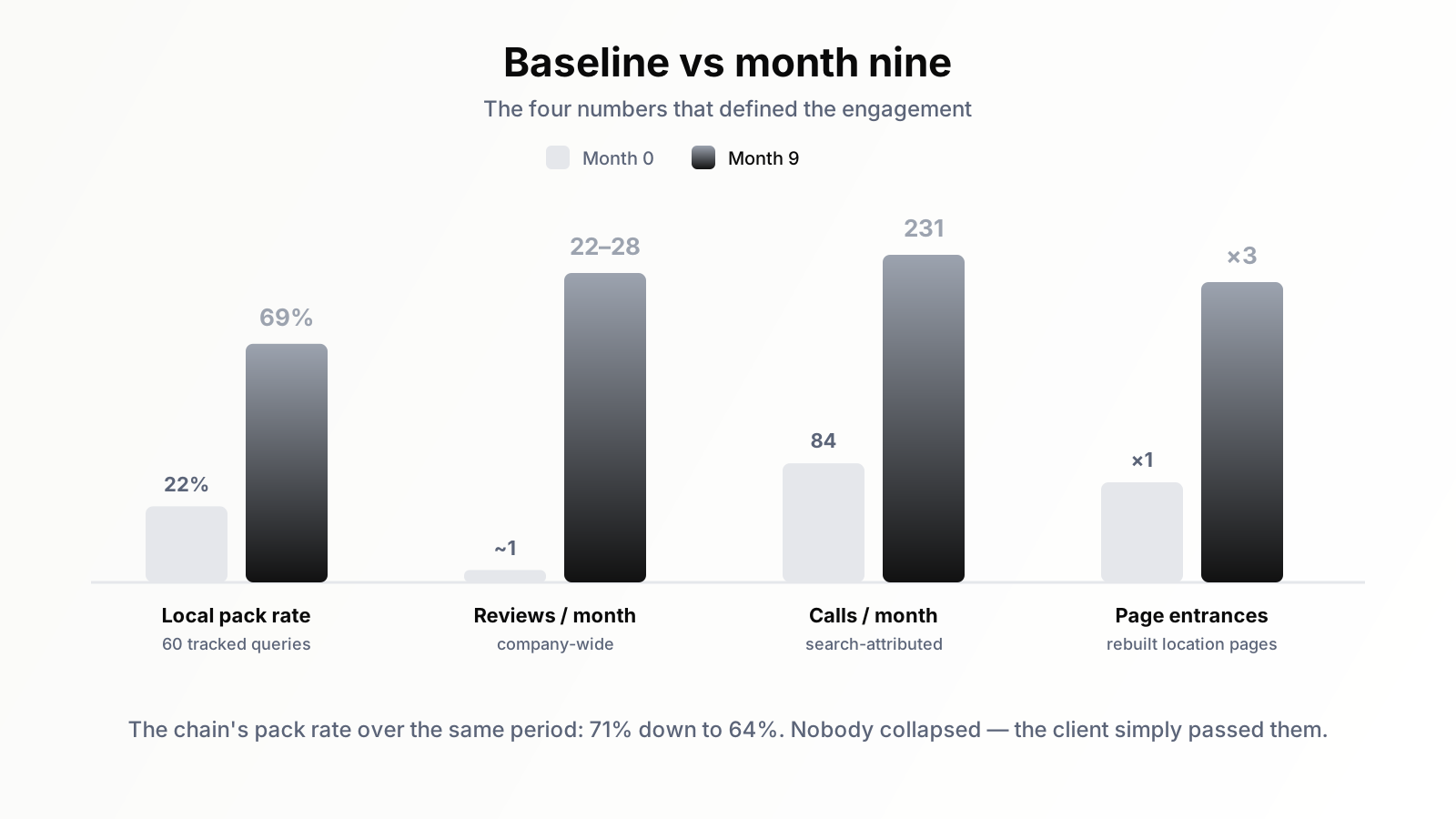
We began with a four-week measurement baseline before changing anything, because improvement claims without baselines are theatre. The picture in month zero: the chain's local branches appeared in the local pack for 71 percent of our 60 tracked commercial queries across the three service areas; our client appeared for 22 percent. The client's website received around 1,900 organic sessions a month, mostly brand searches. Call tracking showed 84 calls a month attributable to search, profile interactions included. The three Google Business Profiles had been claimed years earlier and then left alone — 31 reviews across all three locations, an average rating of 4.2, photos from a single upload session in the late 2010s, no Q&A activity, and one location whose pin sat on the wrong building.
The chain's advantages were structural: domain authority our client could not approach, branded search volume that signalled prominence, and a profile for every branch. But the audit also revealed the weakness we would spend nine months exploiting. The chain's local presence was templated. Every branch profile had the same stock photos, the same boilerplate description with the city swapped, no owner replies to any review at any branch we checked, and branch pages on the national site that were doorway templates — interchangeable paragraphs around an address. The chain was everywhere and present nowhere. Local ranking, as Google describes it, weighs relevance, distance, and prominence; the chain had prominence locked, but relevance and the engagement layer of prominence — reviews, replies, activity, local signals — were wide open. That asymmetry became the entire strategy, the same one we recommend in our guide to local SEO for SaaS and service businesses: do the things that require actually being somewhere.
How we measured: the unglamorous methodology section
Because "we grew local visibility" is the kind of claim this industry makes constantly and substantiates rarely, here is the measurement design in enough detail to replicate or to attack.
The query set. We built a tracked set of 60 commercial queries before the engagement started: 20 per service area, drawn from three sources — the client's Search Console data, the autocomplete and related-search suggestions for the core service terms in each city, and the call logs, which told us the words customers actually used (which differed from the industry's preferred vocabulary more than the owners expected). Each query was checked weekly for local pack composition from a device located in, or geo-set to, the relevant service area, because local results without location control are noise. We logged which businesses held the three pack slots, not just whether our client did — which is how we could state the chain's 71 percent baseline and watch it erode.
The conversion plumbing. Calls were the business's real currency, so we put tracked numbers on the website's location pages while keeping the verified business number on the profiles themselves consistent with the NAP standard — call volume from profiles came from Google's own performance reports instead, which distinguish calls initiated from the listing. Profile website clicks carried UTM parameters per location, so GA4 could segment profile-originated sessions from organic landings. It is the same separation of surfaces we recommend in GA4 for SEOs: the profile and the website are different doors, and averaging them hides whichever one is moving.
The control we wished we had. With three locations there is an obvious temptation to call one a control group, change nothing there, and attribute differences to the program. We considered it and declined — the locations shared a brand, a website, and a review-asking culture once it existed, so contamination was guaranteed, and the owners were understandably unwilling to deliberately neglect a branch for science. What we did instead was stagger: the second location received each intervention four to six weeks after the first, and the third after the second. The improvement curves repeated with the stagger, location by location, which is as close to causal evidence as a live business engagement honestly gets. When the review system reached location two, its pack appearances followed the same S-curve location one had traced six weeks earlier. Patterns that replicate on a schedule you control are the field equivalent of an experiment.
What we deliberately did not track. We dropped grid-style rank tracking — the heat-map screenshots of rankings at every street corner that local SEO tools love — after the first month. They photographed well and informed nothing; every decision we made came from the pack-composition log, the profile reports, and the call numbers. Measurement that does not change decisions is decoration, and decoration was the chain's specialty, not ours.
The interventions, in the order we ran them
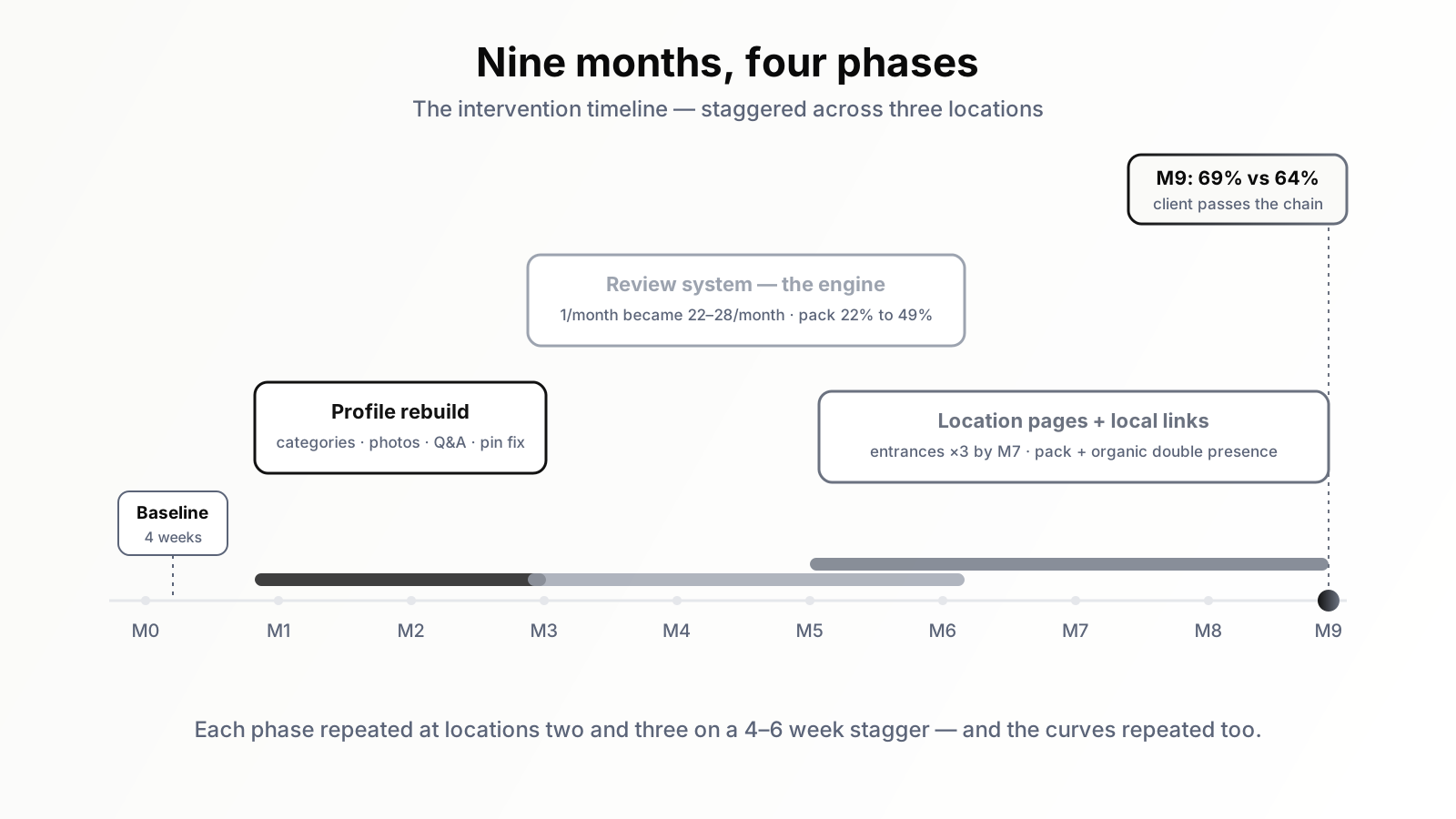
Months 1–2: data integrity and profile completion. We fixed the misplaced pin, rebuilt all three profiles field by field — primary category changed to the most specific available match (the old one was a broader parent category), services itemised in customer language, attributes completed, descriptions rewritten, fresh photography of each premises, team, and completed work uploaded on a monthly schedule. We claimed and merged two duplicate listings that had been splitting reviews for the second location. We standardised name, address, and phone across the website, the profiles, and the 14 directories that mattered in this market, and added LocalBusiness schema to each location page, following the implementation pattern from our structured data guide.
Months 2–3: the review system. The company served roughly 220 customers a month but had collected 31 reviews in its lifetime — not because customers were unhappy, but because nobody asked. We built the ask into the completion workflow: when a job closed, the customer received a message thanking them and linking directly to the review form for the branch that served them. Every customer, every job, no gating, no incentives. Technicians mentioned it at handover. The owner committed to replying to every review within two business days, personally, including the critical ones.
Months 3–5: location pages that could not have been written about anywhere else. We replaced three thin location pages with genuinely local ones: the team at that branch by name and photo, the services and response times specific to that area, photos of recognisable local work, answers to the questions that branch's customers actually asked (drawn from call logs), directions and parking quirks, and a feed of that branch's recent reviews. Nothing on any page could be copy-pasted to another city without becoming false. Each profile's website link pointed to its own location page, UTM-tagged.
Months 4–9: local prominence the chain could not template. The owner sponsored two community sports clubs and a vocational school program — things the company had quietly done before without any digital trace. We made sure the digital trace existed: mentions and links from the clubs, the school, the local business association, and two regional news pieces that covered the vocational program. Six links in nine months. Not a campaign anyone would brag about at a conference, and the most effective link building we have done per unit of effort.
What the numbers did
Local SEO results arrive in a recognisable sequence, and this engagement followed it almost exactly.
Weeks 2–6: the data fixes registered first. The corrected pin and rebuilt profiles produced an immediate lift in profile views for the second location — it had been losing proximity battles it should have won simply because Google had it in the wrong place. The category change broadened the query set all three profiles appeared for; Search Console impressions for non-brand local queries rose 38 percent by week six while clicks barely moved. Impressions lead, clicks lag; we had written about that pattern before and it held here.
Months 3–6: reviews became the engine. Review volume went from roughly one per month company-wide to 22–28 per month. By month six the three locations held 214 reviews averaging 4.7, with reply rates near 100 percent. Local pack appearances across tracked queries climbed from 22 percent to 49 percent in this window — the steepest section of the whole curve, and it coincided with review velocity, not with any content we shipped. Review text also did relevance work we had not fully priced in: customers kept naming specific services and neighbourhoods, and the profiles began surfacing for "service + small suburb" queries we had never targeted. The compounding mechanics at work are exactly the ones analysed in Reviews Are Local SEO's Compound Interest, and watching them operate in live data was the most convincing demonstration of that thesis we have seen.
Months 5–9: the location pages and links finished the job. The rebuilt location pages tripled their organic entrances by month seven and began ranking in regular organic results beneath the pack — which mattered more than expected, because for about a third of tracked queries our client now occupied both a pack slot and a first-page organic slot while the chain held only the pack. By month nine: local pack appearance on 69 percent of tracked queries against the chain's 64 percent (the chain did not collapse; we simply passed them on more queries than not), profile actions — calls, direction requests, bookings — up 174 percent against baseline, and search-attributed calls at 231 per month against the baseline 84. Revenue attribution in a family business is imprecise, but the owners hired two additional technicians in month eight and told us the constraint had moved from demand to capacity.
What did not work
Three interventions underperformed, and the honest accounting matters.
Google Posts did almost nothing measurable. We ran a disciplined weekly posting schedule for three months at one location and monthly at the others as a controlled comparison. The weekly location showed no detectable advantage in views, actions, or rankings over the monthly ones. We kept a monthly rhythm for conversion-surface reasons and stopped pretending it was a ranking tactic.
City-blog content was a waste of two months. Following conventional local-content advice, we published eight "guides" of the local-events-and-tips genre. They earned a trickle of impressions, near-zero conversions, and no detectable effect on the rankings of the pages that mattered. The location pages — boring, specific, commercial — outperformed them by every measure. We would skip the genre entirely next time.
Citation building beyond the core 14 directories produced nothing. We tested a further 40 long-tail directory submissions for one location. No movement attributable in any metric. Consistency on the major platforms appears to be a threshold requirement, not a ladder you keep climbing.
Why the chain lost: an autopsy of templated presence
It is worth being precise about why this worked, because the lesson generalises beyond home services. The chain lost on the signals that cannot be produced centrally. Its branch profiles could not reply to reviews with the name of the technician who did the job, because no one at headquarters knew. Its branch pages could not describe the parking situation or the local team, because they were generated from a template that had to be true everywhere and was therefore vivid nowhere. Its review velocity per branch was a fraction of our client's, because asking requires a workflow touching actual service delivery, and its photos were stock because licensing one image set for 300 branches is what scale demands.
Every one of those constraints is the shadow side of the chain's structural advantages. Centralisation buys domain authority and brand volume; it sells off specificity, responsiveness, and authenticity — and Google's local systems, weighing relevance and engagement alongside prominence, price those in. The practical rule for any small business staring at a national competitor: list the signals that require physical presence and human attention, and concentrate there, because those are precisely the ones head office cannot fix with a memo. This is the local-search version of an argument we keep encountering across SEO — that demonstrated first-hand experience is the moat machine-scaled content cannot cross.
Did the chain respond — and what happened after month nine?
Two questions everyone asks about this study, answered honestly.
The chain noticed, eventually, and its response proved the thesis. Around month seven, the branch profiles in our client's areas began posting weekly updates — identical text across all branches, city name substituted — and a batch of new photos appeared, watermarked stock from the same shoot. Review volume at the chain's branches did not change, because review volume cannot be ordered from headquarters; it has to be asked for at thousands of points of service by people who care whether it happens. The templated counterattack moved nothing in our tracked queries. If anything it sharpened the contrast: side by side in the same pack, one profile answered by an owner who names the technician, one profile posting the same sentence as 300 siblings. The chain did the things that scale, because that is what chains are built to do. The whole point of the engagement was that the deciding signals do not scale.
The results held, with one wobble. We handed the program to the client's office manager at month nine with a one-page cadence — the weekly review replies and Q&A checks, the monthly photo and report review, the quarterly audit. At a twelve-month check-in, pack appearance had drifted between 66 and 72 percent and calls had plateaued at capacity, which was the constraint the owners wanted. The wobble: when a branch manager left in month eleven, review velocity at that location halved within six weeks, and pack appearances for its queries sagged a few points two months later — a clean, slightly painful natural experiment confirming which input drives the system. The ask depends on a human remembering; the human depends on the workflow; the workflow survives personnel change only if it is written down and checked. Local SEO is not a project that finishes. It is a metabolism, and it slows the moment nobody is watching the numbers.
One more post-engagement observation deserves recording. From around month eight, the client began receiving customers who said an AI assistant had recommended them — not many, a handful a month, but the owners had never heard it before. We cannot fully attribute it, and we will not pretend to a precision we lack. But the inputs an assistant weighs when asked "who is a good [service] company near me" — review corpus, rating, data consistency, an entity that checks out across sources — are exactly what the nine months had built. The work that wins the local pack and the work that gets you named by a machine appear, on this evidence, to be substantially the same work.
What we would tell a team replicating this
A note on budget, since every small business asks. Excluding our fees, the program's hard costs were a photographer for three half-days, two community sponsorships the owners half-intended anyway, and the call-tracking subscription. The scarce resource was never money; it was the roughly four hours a week of owner and office-manager attention the cadence consumed. Any small business weighing this should budget attention first and treat everything else as rounding.
Measure for a month before touching anything, or you will never be able to separate your effect from seasonality. Fix data integrity first — it is the cheapest win and everything else builds on it. Build the review ask into service delivery, not into marketing; the difference between asking sometimes and asking always was the single largest factor in this entire engagement. Make location pages that would be false if copied to another city. Convert your real community presence into its digital trace. Give it three quarters before judging, and keep the failed-experiment list honest, because the discipline of admitting what did nothing is what keeps the next engagement lean.
And track it like a channel, not a project. The reporting stack here was unglamorous — profile performance exports, Search Console segments for each location page, call tracking — but reviewing it monthly is what caught the duplicate listing, the pin drift, and the moment review velocity dipped when a branch manager changed. That recurring watchfulness is exactly the kind of work worth automating: Orova keeps the per-page search performance, the query-level shifts, and the scheduled checks running in the background, so a three-person marketing effort — or a no-person one, in a family business — notices in days what we only caught because we were paid to look. The chain had more of everything except attention. Attention, it turns out, still ranks.
Run your business with AI Agents
Orova is the always-on Biz AI Agent — it plans, runs, and optimizes the work for you. Save time, unlock productivity.
Try it free