
The Honest State of AI Content in 2026
It is worth pausing, in 2026, to take an honest measurement of where AI content actually stands — not the version sold in launch keynotes, and not the version dismissed in cynical hot takes, but the working reality on the ground for teams producing content for search. Both extreme narratives are wrong in instructive ways. The optimists promised a world where content writes itself and everyone wins. The pessimists promised a flood of slop that would poison the web and tank rankings. Neither happened. What happened instead is more nuanced, more demanding, and more interesting — and getting it clear is genuinely useful for anyone deciding how to run a content program this year.
This is an analytical breakdown, not a verdict. The aim is to separate what is settled from what is still in motion, and to describe the patterns honestly without inflating them into statistics they cannot support.
What is now settled: AI content is normal
The first thing to state plainly is that the argument about whether to use AI in content production is over. It ended quietly, without a ceremony. In practice, a large share of content teams now use AI somewhere in their workflow — for research, for drafting, for outlining, for editing assistance — and the share that uses it nowhere is small and shrinking. This is no longer a frontier behaviour. It is the baseline.
That settledness changes the strategic question. A few years ago the question was "should we use AI?" and a team could gain an edge simply by answering yes before its competitors did. That edge is gone. When everyone has the tool, having the tool is not an advantage — it is table stakes. The interesting question in 2026 is no longer whether you use AI but how well, and the gap between teams using it well and teams using it badly is now far wider and far more consequential than the gap between users and non-users ever was. The competition moved up a level.
What is settled: the penalty panic was misplaced
The second settled point is that the great fear of the early AI-content era — that search engines would detect and punish AI-assisted content as a category — did not materialise, and the reason it did not is worth understanding because it shapes everything else.
Search engines never committed to penalising AI content as such. Their stated and observed position is consistent: they evaluate content on whether it is helpful, accurate, and genuinely satisfies the searcher — and they are indifferent to the production method. A useful page produced with heavy AI assistance and a useful page produced entirely by hand are treated the same. An unhelpful page is treated as unhelpful regardless of how it was made.
This is not a loophole and it should not be read as one. It does not mean "AI content is safe." It means the safety question was always the wrong question. The thing that gets content suppressed is being unhelpful, thin, derivative, or untrustworthy — and AI makes it dramatically easier to produce content with exactly those qualities at scale. So the risk is real, but it is not a category risk. It is a quality risk, and it has always been a quality risk. The settled conclusion: stop asking whether AI content is penalised and start asking whether your content is good, because that is the question that was being graded the whole time.
The pattern that defines 2026: a widening quality gap
Now to the part that is still in motion. The dominant pattern in AI content right now is not a uniform flood and not a uniform improvement. It is a widening split — a divergence between two populations of AI-assisted content that are pulling further apart.
At one end is a large and growing body of low-effort AI content: produced fast, lightly supervised or unsupervised, generic in angle, accurate-ish, and indistinguishable from a thousand other pages saying the same thing in the same flat voice. It exists because AI made it nearly free to produce, and "nearly free" is an irresistible temptation to anyone optimising for output count. At the other end is a smaller body of high-effort AI-assisted content: AI used for speed and leverage, but wrapped in real human strategy, real expertise, real editing, and a genuine point of view. From the outside this content does not read as "AI content" at all. It reads as good content that happened to be produced efficiently.
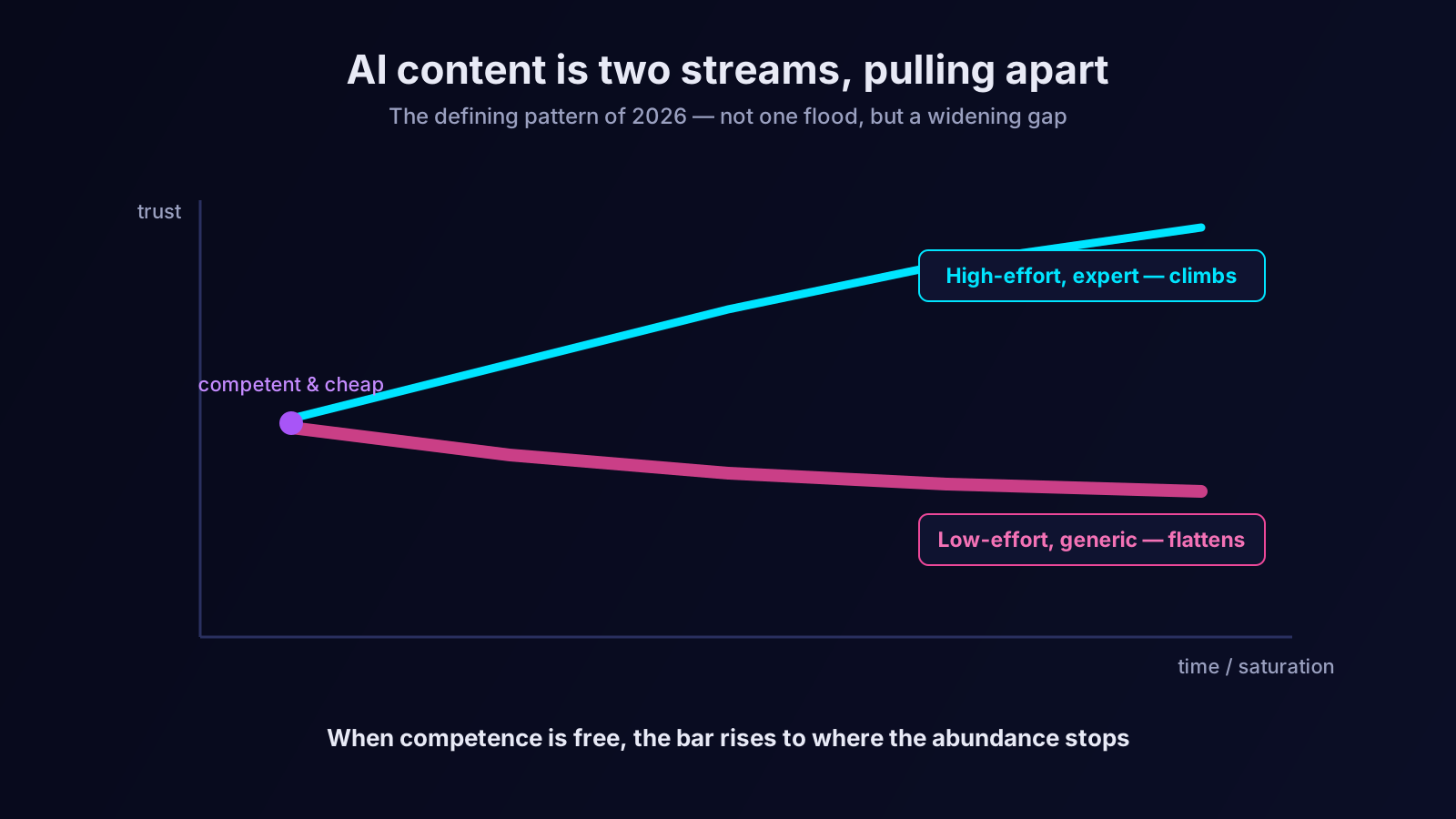
The strategically important observation is what is happening to each stream. The low-effort stream is getting less effective over time, not because of a penalty but because of saturation: when a query is answered by hundreds of near-identical generic pages, none of them stands out, and search engines reward the ones that demonstrably do something more. The high-effort stream is holding and often improving, because genuine expertise and a distinct point of view become more valuable, not less, as generic content becomes abundant. Scarcity moved. What is scarce in 2026 is not content — it is content worth trusting.
Why "good enough" stopped being good enough
An analytical point underlies that divergence and deserves to be drawn out. AI is very good at producing content that is "good enough" — competent, correct, readable, on-topic. For a brief window, "good enough" was genuinely enough to rank, because plenty of the existing competition was worse.
That window is closing, and the mechanism is simple. When "good enough" content is expensive to produce, it is also rare, and rare competent content ranks. When "good enough" content becomes nearly free to produce, it becomes abundant, and abundant competent content does not rank — it just fills the middle of the results page where nobody clicks. The bar rises automatically to wherever the abundance stops. In 2026 the abundance has reached "competent and generic," which means competent and generic is now the floor, not a competitive position. To rank, content has to clear the floor — and clearing it requires the things AI cannot supply on its own: original insight, real experience, a specific point of view, demonstrated first-hand expertise. This is the practical meaning of the much-discussed emphasis on experience and trust. It is not a moralistic preference for human writers. It is the market consequence of competence becoming cheap.
What AI in 2026 is genuinely good at
An honest assessment has to credit what works, and several things genuinely do. AI is excellent at research synthesis — pulling together what is known about a topic into a usable starting point far faster than manual reading. It is excellent at structure — turning a messy brief into a clean, logical outline. It is excellent at first drafts of well-defined sections, at reformatting and repackaging existing material, at the mechanical layer of optimisation, and at the assembly of reports. These are real capabilities and they are not minor — together they remove a large fraction of the hours a content program used to consume.
The honest framing is that AI has become a superb accelerator of the parts of content work that were always closer to labour than to thought. That is a genuine and durable gain. It just is not the same thing as "AI writes your content," and conflating the two is the source of most disappointment.
What AI in 2026 still cannot do alone
The other half of the honest assessment is the persistent limitations, and they have been stubborn. AI still cannot reliably supply genuine first-hand experience — it has not run the campaign, made the mistake, or sat with the failed result, and content that pretends otherwise reads hollow to the reader and signals thin to a search engine. It cannot reliably generate a genuinely original point of view; left alone it regresses toward the consensus average of its training data, which is the definition of generic. It cannot be trusted on facts without verification — it remains capable of stating something false with complete fluency. And it cannot own accountability: when a published claim is wrong, a model cannot be the responsible party.
Notice that this list has barely changed in the last couple of years even as the models have clearly improved. That stability is itself a finding. These are not gaps that the next release predictably closes, because they are not really capability gaps — they are structural. Experience, accountability, and a genuine point of view come from being a situated human with something at stake. That is why the workflow conclusion has been so consistent: AI handles the layer of content that is labour; humans must still own the layer that is judgement, experience, and responsibility.
The reader has changed too
One pattern gets less attention than it deserves: the audience adapted. After a few years of exposure, readers have developed a real, if informal, sensitivity to generic AI-flavoured content — the over-smooth phrasing, the throat-clearing introductions, the conclusions that restate without adding, the unfailingly balanced tone that commits to nothing. People may not name it precisely, but they increasingly recognise the texture, and recognising it, they trust it less and leave faster.
This matters because reader behaviour feeds back into search performance. Content that makes people bounce, that fails to satisfy, that does not earn the next click or the return visit, sends exactly the signals that erode ranking over time. So generic AI content carries a slow, compounding penalty — not an algorithmic one imposed from above, but a behavioural one earned from below, one disappointed reader at a time. Content that genuinely helps earns the opposite: engagement, trust, return visits, links. The reader became a quality filter, and that filter does not care how the content was made either.
The honest bottom line for 2026
Pulled together, the assessment is neither the optimist's dream nor the pessimist's nightmare. AI content is normal, unremarkable, and here permanently. It did not get penalised as a category and never will be. It made competent content nearly free, which sounds like a gift but functions as a pressure: it raised the bar to wherever the abundance stops, and the abundance has reached "competent and generic." That leaves a clear, demanding strategy. Use AI fully and unapologetically for what it is genuinely good at — research, structure, drafting, the labour layer — and invest the time it frees into the things that now decide everything: real expertise, genuine experience, a distinct point of view, and rigorous human review. The teams winning in 2026 are not the ones using AI the most or the least. They are the ones who understood which half of the work it could take, and refused to let it touch the other half.
Where an agent fits the 2026 reality
If the strategy is "let AI own the labour layer, protect the judgement layer," then the tool you want is one built around exactly that division — not one that pretends to do the whole job and quietly lowers your quality bar, and not a scatter of point tools that each shave a few minutes off one task.
This is the role an SEO AI agent is meant to play. Orova takes on the labour layer this assessment describes — the research synthesis, the topic and keyword expansion, the structured drafting, the reporting — at the speed that makes a serious program viable, while leaving the strategy, the expertise, the point of view, and the final editorial judgement firmly with the human team. It is built for the 2026 reality, not the 2023 fantasy: AI as the accelerator of the work that is labour, and the human as the owner of the work that is trust. That is the only version of AI content that is actually working this year — and it is the only version worth building a program on.
Let an AI Agent handle your SEO
Orova plans, writes, optimizes, and tracks rankings on its own — you just read the results.
Try it free