
How AI Changes Keyword Research, Writing, and Reporting
Most discussion of AI in SEO stays at the altitude of slogans — "AI is transforming search," "the future is here." Useful for a conference stage, useless on a Monday morning when you actually have to do the work. This article comes down to ground level. It walks through the three phases that make up the bulk of an SEO's week — keyword research, content writing, and reporting — and describes, concretely and in order, what changes in each one when AI enters the workflow, what stays the human's job, and how to set the new process up so it produces better work rather than just faster mistakes.
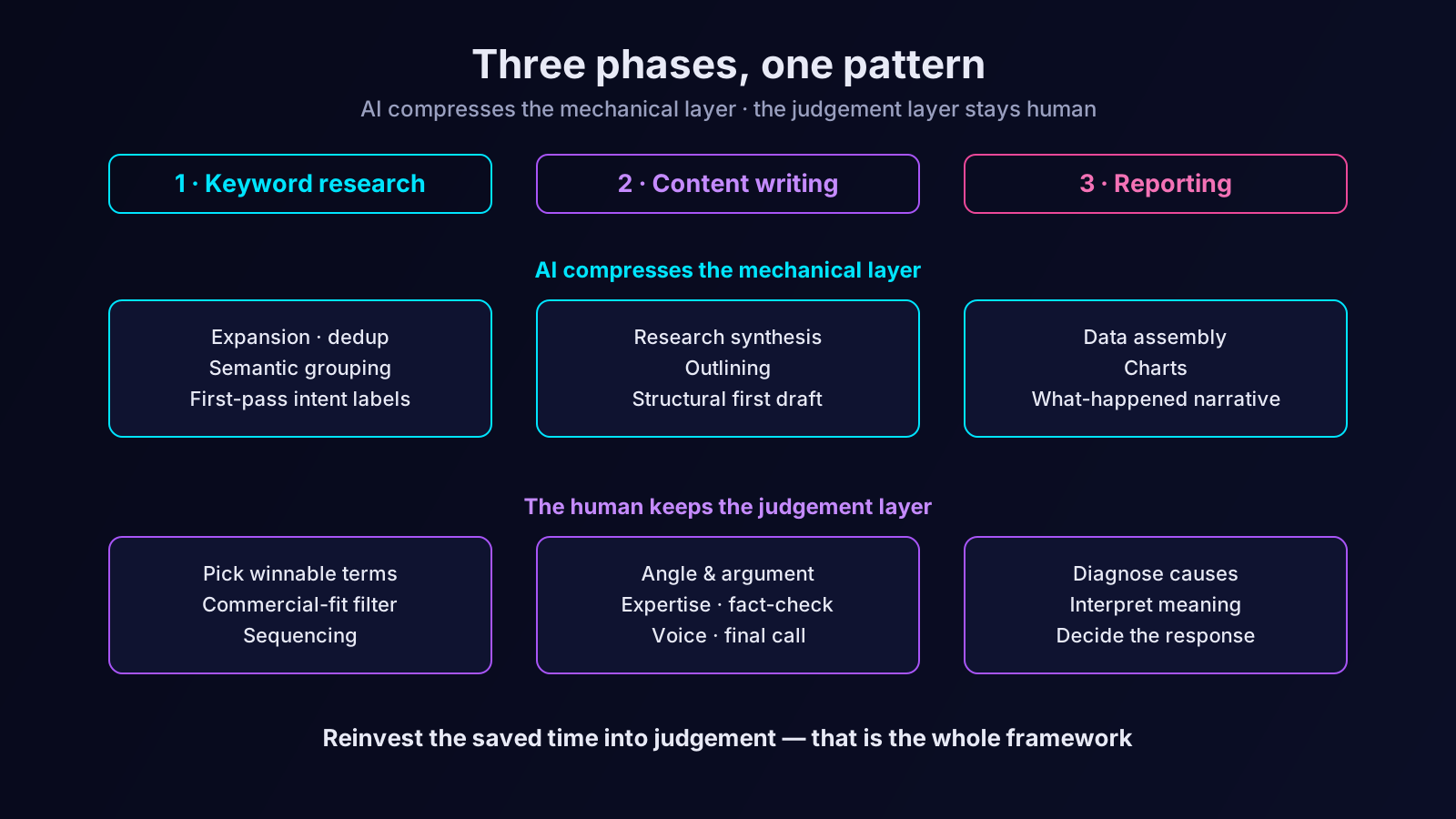
The throughline is simple and worth stating before the detail: in every phase, AI compresses the mechanical work and intensifies the judgement work. The hours move out of execution and into decision-making. A team that understands that shift redesigns its process around it. A team that does not just runs the old process faster and is puzzled when the results barely improve.
Phase one: keyword research
Keyword research is where AI's effect is most immediate, because traditional keyword research is heavily mechanical — and mechanical work is exactly what AI absorbs.
What used to take the time
The old keyword research process was a sequence of slow, manual steps. You gathered seed terms. You ran them through tools and exported large lists. You manually deduplicated and grouped them. You eyeballed each one trying to guess intent. You opened results pages one at a time to read the competition. You hand-built a keyword map matching terms to pages. For any serious site this was days of work, and it was tedious enough that people cut it short — settling for a shallow list because the thorough version was too painful to finish.
What AI changes
AI collapses the mechanical layer almost entirely. Seed expansion, deduplication, semantic grouping, first-pass intent labelling, clustering related terms — these are pattern tasks, and AI does them in minutes at a scale a human would not attempt by hand. A single seed keyword can be expanded into a structured, grouped, intent-labelled map of hundreds of terms in the time it used to take to set up the spreadsheet. The painful part of keyword research effectively disappears.
What stays human
What does not change is the judgement that makes keyword research strategic rather than clerical. The machine produces the map; the human decides which parts of it to pursue. That decision draws on things the model cannot see: how authoritative your specific site is and therefore what is realistically winnable, which keywords sit close enough to a purchase to matter commercially, how a term fits the brand and the product, and which to sequence first. A keyword list is not a strategy. Turning the list into a plan is judgement work — and that part remains firmly the human's. (Our walkthrough on turning keywords into a content plan covers that decision layer in depth.)
How to set it up
The right new process is: let AI do the expansion, grouping, and first-pass labelling fast and broad, then spend your freed time on the part that decides everything — reviewing the map with a critical eye, applying the winnability and commercial-fit filters, and sequencing. The mistake is to treat the AI output as the finished plan. The point of the speed-up is not to skip the strategic review. It is to give you more time and energy for it.
Phase two: content writing
Writing is where opinion runs hottest, so this section is the most important to get concrete. The reality is neither "AI writes your content" nor "AI is useless for writing." It is a specific division of labour, and naming it precisely is the whole game.
What used to take the time
The traditional writing process: research the topic by reading widely, build an outline, write a first draft from a blank page, then edit it into shape. The blank-page first draft was the slowest, most effortful part — the stage where projects stalled and writers procrastinated.
What AI changes
AI is genuinely transformative at three points in this process. Research synthesis: it pulls together what is known about a topic into a usable starting brief far faster than manual reading. Outlining: it turns a brief into a clean, logical structure quickly. And first drafts of well-defined sections: given a specific section with a clear brief, it produces a competent draft in a fraction of the time a blank page costs. The slowest part of writing — getting from nothing to a workable draft — is the part AI compresses most.
What stays human
The limits are specific and stubborn. AI cannot supply genuine first-hand experience — the worked example you actually lived, the mistake you actually made — and that experience is exactly what separates content that ranks from content that fills space. It cannot reliably generate an original point of view; unsupervised, it drifts toward the consensus average, which reads as generic. It cannot be trusted on facts without verification. And it cannot own the brand voice without firm direction. So the human owns: the angle and the argument, the genuine expertise and experience woven through, the fact-checking, the voice, and the final judgement of whether the piece is actually good. The human is the author and editor. AI is the drafting assistant. That distinction is not semantic — it is the operating model.
How to set it up
The effective writing process becomes: a human sets the angle and writes a strong brief; AI handles research synthesis and the structural draft; the human then does the high-value work — injecting real expertise and experience, sharpening the point of view, verifying every claim, fixing the voice, and making the final call. Done this way, AI removes the drudgery of the blank page and the human spends their hours on the parts that actually determine quality. Done the wrong way — AI drafts, a human skims, publish — you get fast generic content, which in a saturated market is the same as invisible content.
Phase three: reporting
Reporting gets the least attention and is, quietly, where AI delivers some of the cleanest gains — because reporting is almost pure mechanical labour with a thin, valuable layer of interpretation on top.
What used to take the time
The old reporting process: log into several tools, export data from each, paste it into a spreadsheet or slide deck, build the charts, write up what happened, and reformat the whole thing for whoever is reading. For many teams this consumed a recurring, dreaded block of time every single month — hours of assembly that produced no new insight, just a presentable artefact.
What AI changes
AI collapses the assembly layer. Pulling data together, computing period-over-period changes, generating charts, drafting a plain-language narrative of what moved and by how much, formatting it for the audience — all of this is mechanical and all of it can be automated. The monthly report stops being a chore a person assembles and becomes an artefact that is largely generated, ready for review.
What stays human
What AI does not own is the part of reporting that was always the only part that mattered: deciding what the data means and what to do about it. A report can tell you traffic fell on a set of pages. It takes human judgement — informed by context the data does not contain — to diagnose why, to distinguish an algorithm update from a tracking bug from a seasonal dip, and to decide the response. AI hands you a clear, accurate description of what happened. The interpretation and the decision stay human.
How to set it up
Let AI generate the descriptive report — the data, the charts, the what-happened narrative — automatically and on schedule. Then the human spends their time, no longer on assembly, on the analytical layer: reading the report critically, diagnosing causes, and turning observations into decisions. The reframe is the goal: reporting should stop being "spend a day building the report" and become "spend an hour thinking about what the report means." That hour is the part with the value in it.
The pattern across all three phases
Step back and the three phases tell one story. In every case, AI compresses the mechanical layer — expansion and grouping in research, research synthesis and structural drafting in writing, data assembly in reporting — and in every case the judgement layer stays human: choosing which keywords to pursue, owning the argument and expertise in the writing, interpreting the report and deciding the response.
That pattern is the whole framework. It tells you how to redesign any SEO process for AI: identify the mechanical layer and hand it over without hesitation; identify the judgement layer and protect it deliberately; and consciously move the time you save out of execution and into decision-making. The teams that get worse results from AI usually skipped the last step — they sped up execution and let the judgement layer get skimped, because the speed felt like enough. It is not. The speed is only valuable if the time it returns is reinvested in judgement. The full topic-cluster planning that ties these phases together is covered in our guide to structuring content in clusters.
A fourth phase the framework also fixes: internal linking
The three phases above are the bulk of the week, but the same pattern applies cleanly to a fourth task that is easy to neglect: internal linking and content maintenance. It is worth a short section because it is where the framework pays off almost invisibly.
Internal linking has always been one of the highest-value, lowest-glamour jobs in SEO. Every time you publish a new article, older articles should link to it where relevant, and the new article should link out to the right siblings — that is how a site signals structure and spreads authority. The mechanical layer here is real drudgery: scanning an entire content library to find every page that should reference a new piece, and checking that the new piece links sensibly into its cluster. Done by hand it is slow enough that most teams simply skip it, and the site's internal structure quietly decays.
The framework handles this exactly as it handles the other three phases. The mechanical layer — scanning the library, surfacing every relevant linking opportunity, proposing anchor text — is pattern work that AI does fast and thoroughly. The judgement layer stays human: deciding which proposed links genuinely serve the reader, which anchor text is honest rather than keyword-stuffed, and which links to skip because they would clutter more than they help. The result is that internal linking stops being the job everyone means to do and never does, and becomes a routine, reviewed step. Our internal linking strategy guide covers the judgement side of this in detail.
The mistake of automating the wrong layer
Before moving on, it is worth naming the single most common way teams get the AI transition wrong, because it is subtle and it follows directly from the framework.
The framework says: hand the mechanical layer to AI, protect the judgement layer. The mistake is doing the opposite by accident — automating into the judgement layer because it is tempting and the tool will happily oblige. It looks like this. Instead of using AI to expand keywords and then personally deciding which to pursue, a team lets the tool's output stand as the plan, and the strategic decision quietly never gets made. Instead of using AI for a structural draft and then personally injecting expertise and checking facts, a team treats the draft as final, and the judgement layer silently gets skipped. Instead of using AI to assemble the report and then personally interpreting it, a team forwards the auto-generated summary, and the analysis never happens.
In each case the team has not just failed to gain from AI — it has actively lost something, because the judgement work that used to happen, however slowly, now does not happen at all. The mechanical layer got automated and the judgement layer got automated away. The framework is a discipline precisely because the tool will let you cross the line without warning you. Automating the mechanical layer is the goal. Automating the judgement layer is the failure mode that wears the same clothes.
The skill that matters most now
One implication is worth making explicit because it should shape how SEOs develop themselves. If AI now does the mechanical layer of all three phases, then the SEO's value is concentrated almost entirely in the judgement layer. The competitive skill is no longer the ability to execute keyword research, writing, or reporting quickly by hand — a machine does that. It is the ability to make good decisions on top of what the machine produces: to read a keyword map and pick the winners, to read a draft and know whether it is genuinely good, to read a report and know what it means.
That is a more senior, more interesting, and more durable skill set than the execution it replaces. SEOs who lean into it — who deliberately become better strategists, editors, and analysts — become more valuable as AI improves. SEOs who define themselves by execution speed are competing directly with the thing that does execution best. The phase-by-phase shift is, in the end, a career instruction: move up the stack, toward judgement.
Putting the new workflow into practice
This redesigned, three-phase workflow is the right way to run SEO in 2026 — but stitching it together from separate tools is its own friction. A keyword tool, a writing tool, an analytics export, a reporting tool: each handles one mechanical layer, none of them connect, and the human spends real effort just moving work between them.
This is the gap an SEO AI agent is built to close. Orova runs the mechanical layer of all three phases as one connected workflow — expanding and clustering keywords, synthesising research and drafting structured content, and assembling reporting — so the handoffs disappear and the human is left with a clean, continuous surface of judgement work: choosing the keywords, owning the expertise and the argument, interpreting the results. It implements exactly the division this article describes — machine on the mechanical layer, human on the judgement layer — across the whole of an SEO's week, instead of one task at a time. The workflow is the point. The agent is just what makes it hold together.
Let an AI Agent handle your SEO
Orova plans, writes, optimizes, and tracks rankings on its own — you just read the results.
Try it free