
AI SEO in Practice: I Let AI Run My SEO for 30 Days — Here's the Data
The premise was deliberately provocative: for thirty days, hand the SEO work to an AI agent and watch what happens. Not "use AI to help" — every team does that now — but genuinely let the agent drive the operational work, with a human stepping back into a supervisory role, and observe the outcome closely enough to learn something honest from it. This article reports what that experiment revealed. It is framed as research because it was run like research — a clear setup, consistent observation, and conclusions drawn only from patterns that actually repeated. It contains no invented metrics. SEO outcomes over thirty days are not a clean dataset, and dressing rough observation in precise-looking numbers would be exactly the dishonesty this piece is meant to avoid. What follows is the qualitative pattern, reported plainly.
The setup: what "letting AI run it" meant
To make the findings interpretable, the design matters. "Letting AI run my SEO" did not mean abandoning the site to a black box. It meant a specific division: the AI agent handled the operational pipeline — keyword research and expansion, topic clustering, content briefs, drafting, on-page optimisation, and reporting — while a human held a supervisory role: approving strategy at the start, reviewing outputs before anything went live, and verifying facts. The thirty days were a continuous content production cycle on an established site with existing rankings, so the experiment measured the agent against a real baseline, not a blank slate.
One honesty note up front: thirty days is short for SEO. Real ranking and traffic movement plays out over months. So the experiment could not credibly measure final ranking outcomes. What it could measure — and what it was actually designed to measure — was the process: how much work the agent absorbed, where its output was strong, where it failed, and how the human's role changed. The findings below are about the workflow, because that is what thirty days can honestly show.
Finding one: the speed difference was not incremental
The first and most unambiguous observation: the volume of operational work the agent completed, in the time available, was not a modest improvement over the manual baseline. It was a different order of magnitude.
Work that had previously defined the pace of a content cycle — expanding keywords, building a clustered plan, producing briefs, generating first drafts, assembling reports — moved fast enough that it effectively stopped being the constraint. By the end of the first week, the experiment had run into a problem I did not expect: the production pipeline was no longer the bottleneck, and there was nothing in the old process designed to handle that. The pattern here was clear and consistent. AI does not make the production layer somewhat faster. It removes production speed as a limiting factor almost entirely.
Finding two: the bottleneck moved to review — immediately
That first finding produced the second, and the second was the most important lesson of the whole month.
Within days, the constraint on the operation was no longer how fast content could be produced. It was how fast a human could competently review it. The agent could generate drafts faster than I could properly read, fact-check, edit, and approve them. The bottleneck did not disappear when AI removed the production constraint — it moved, instantly and visibly, to human review. And review does not scale the way production does: I could not parallelise my own judgement, and skimming faster just meant reviewing worse.
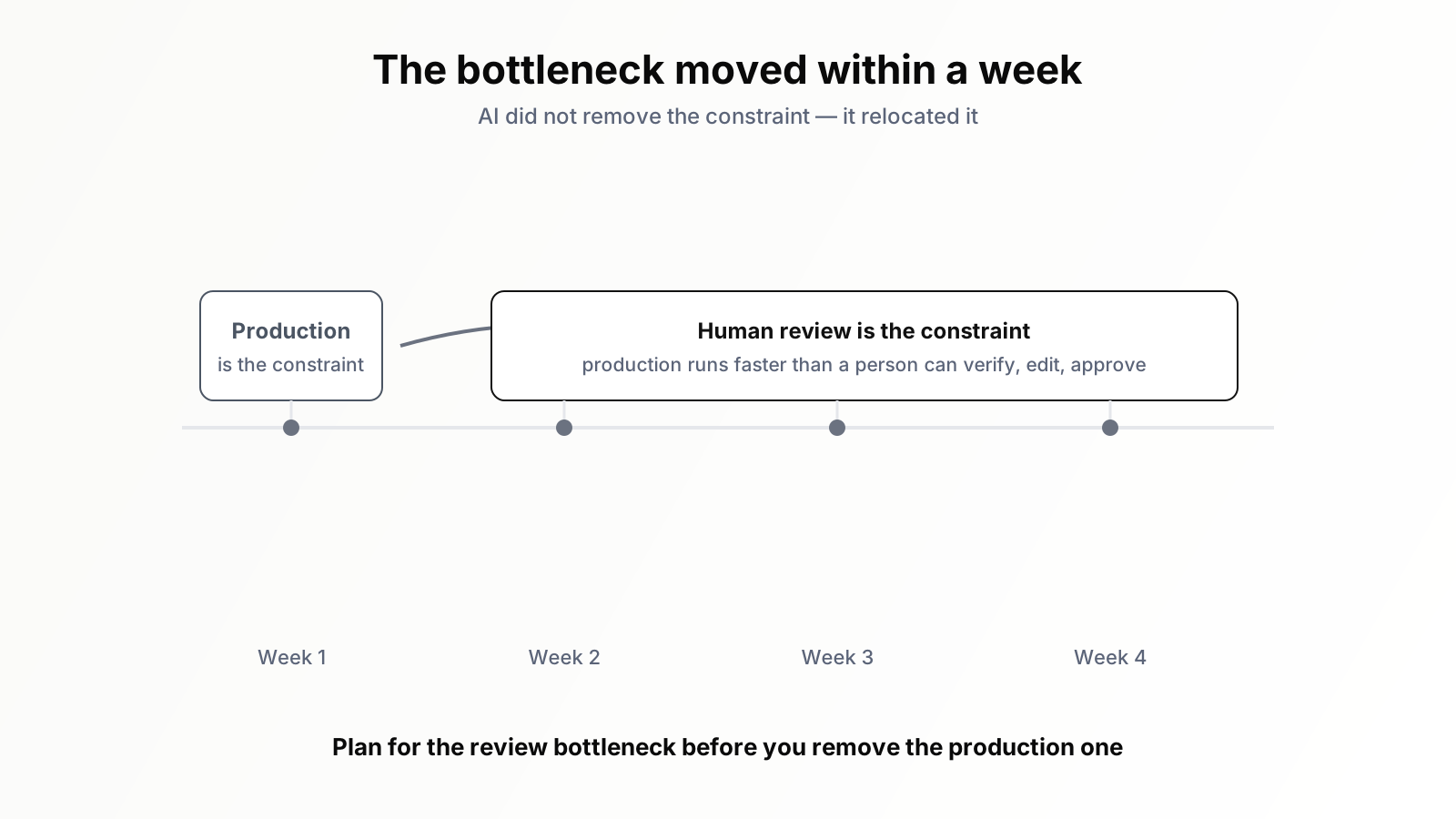
This reframed the entire experiment. The interesting question stopped being "how much can AI produce?" — the answer was "more than enough" — and became "how do you scale trustworthy human review to keep up?" Any team planning to lean heavily on an AI agent should expect this exact pattern and plan for it. The day you remove the production bottleneck is the day the review bottleneck becomes your real problem. Pretending otherwise just means publishing unreviewed work, which the next finding shows is not safe.
Finding three: where the agent's output was genuinely strong
The experiment produced a consistent picture of where the agent's work needed little correction and where it needed a lot. Both halves are useful.
The agent was reliably strong on structured, well-defined tasks. Keyword expansion and clustering were excellent — fast, thorough, sensibly organised, and rarely needing rework. Content briefs and outlines were consistently solid; the logical skeleton of a piece was dependable. First drafts of well-scoped sections were competent — correct, on-topic, readable, a real and usable starting point. And the reporting was clean: accurate data assembly with a serviceable plain-language summary of what moved. Across all of these, the common factor was that the task was structured and the success criteria were clear. Where the task had a defined shape, the agent filled it well.
Finding four: where the agent's output needed the most correction
The weaknesses were equally consistent, and they clustered around the things that are not structured tasks.
The most reliable weakness was originality of angle. Left to itself, the agent produced content that was competent and generic — accurate, well-formed, and indistinguishable from the existing consensus on the topic. It did not contribute a distinct point of view, because it had none to contribute. Every piece needed human work to give it an angle worth reading. The second weakness was first-hand experience: the agent could not supply the lived example, the specific worked case, the genuine "here is what happened when I tried this" — and drafts that gestured at experience they did not have read hollow. The third was factual reliability: most facts the agent stated were correct, but a minority were confidently wrong, with no tonal difference between the two, which made verification non-negotiable on every claim. The fourth was brand voice, which drifted toward a neutral default and needed correcting back.
The pattern is worth stating cleanly: the agent was strong on structure and labour, and weak on judgement, experience, originality, and truth-verification. That is the same line the broader industry keeps drawing — and the experiment, run honestly, drew it again without being told to.
Finding five: the human role did not shrink — it changed shape
Before the experiment, my private expectation was that "letting AI run it" would mean less work for me. That expectation was wrong, and the way it was wrong is the most useful finding for anyone considering this.
My workload over the thirty days did not shrink. It changed character completely. I spent essentially no time on production — no keyword spreadsheets, no blank-page drafting, no report assembly. Instead I spent the whole month on a different and more demanding set of activities: setting and adjusting strategy, reviewing every output critically, fact-checking, injecting genuine expertise and experience into drafts, sharpening angles, correcting voice, and deciding what was good enough to publish. The hours did not go down. They moved — out of execution and into judgement — and the judgement work was more intense, more continuous, and frankly more tiring than the execution it replaced, because there was no longer any low-effort mechanical work to rest in between the hard decisions.
So the honest finding is not "AI runs your SEO and you relax." It is "AI runs the execution and you are promoted, whether you want to be or not, into a full-time role of strategist, editor, and quality controller." For some people that is a better job. It is not a smaller one.
Finding six: unsupervised, the agent would have caused damage
One finding came not from what happened but from what was prevented, and it is the most important safety lesson of the month.
At several points the agent produced output that looked entirely publishable on a quick read — well-structured, fluent, confident — and contained a real problem on a careful read: a factual error stated with total assurance, a section that circled the search intent without actually satisfying it, an angle so generic it would have been invisible in a competitive results page. None of these were caught by skimming. All of them were caught by genuine review. Extrapolate that across thirty days of high-volume output and the conclusion is stark: an unsupervised agent, publishing directly, would have put a meaningful amount of flawed content live under my name. Not because the agent is bad — it is genuinely capable — but because "looks publishable" and "is publishable" are different standards, and only a human applying real attention can tell them apart. The experiment did not show that AI cannot run SEO. It showed that AI cannot run SEO alone, and that the supervising human is the load-bearing part of the arrangement.
Finding seven: the quality of my briefs decided the quality of the output
One pattern emerged that I had not set out to measure but that turned out to be among the most actionable of the month. The single biggest variable in how good the agent's output was — bigger than anything about the agent itself — was the quality of the brief I gave it.
When I handed the agent a vague instruction — "write an article about this topic" — it produced exactly what you would expect: a competent, generic, shapeless piece that needed heavy reworking. When I handed it a genuinely good brief — a clear angle, the specific intent to satisfy, the points that had to be covered, the experience or expertise to weave in, the voice to hit — the output was dramatically closer to publishable, and my review time dropped sharply. Same agent, same model, completely different result, and the only thing that changed was the quality of the input.
This sharpened a lesson the wider industry keeps repeating: in an AI workflow, the human's effort is best spent at the front of the pipeline. An hour spent writing an excellent brief saved me far more than an hour of downstream editing, because it prevented the generic draft from being generated in the first place. The teams that will struggle with AI agents are the ones that treat the brief as a formality and expect the agent to supply the thinking. It cannot. The brief is the thinking, and the agent only executes it.
Finding eight: consistency was a genuine, underrated win
One benefit surfaced quietly and deserves naming, because it is the kind of thing that does not show up in a dramatic before-and-after but matters over months.
A human team's output quality varies. People have good weeks and bad weeks; the article written under deadline pressure on a Friday afternoon is not the article written fresh on a Tuesday morning; energy and attention fluctuate. Across the thirty days, the agent's output did not vary that way. Its work had a steady floor — the structured tasks were done to the same standard on day twenty-eight as on day two, regardless of the hour or the workload. It never had an off day.
This consistency is easy to undervalue and genuinely useful. It does not mean the floor was high enough to publish unreviewed — the earlier findings are clear that it was not. But a reliable floor makes the human's review job more predictable: I knew what kind of issues to look for, because the agent failed in consistent, recognisable ways rather than in random ones. A predictable collaborator, even an imperfect one, is easier to build a process around than an unpredictable one. The consistency did not replace review. It made review more efficient.
What thirty days could not show — and what it could
Intellectual honesty requires being clear about the limits of the experiment. Thirty days cannot show final ranking outcomes; those take months, and anyone who claims a clean traffic figure from a month-long AI test is showing you noise dressed as signal. The experiment also ran on one site in one niche with one supervising human — it is a case study, not a controlled trial, and its findings are patterns to test against your own situation, not laws.
But within those limits, the experiment showed something real and repeatable about process: that AI removes the production bottleneck almost completely, that the bottleneck moves immediately to human review, that the agent is strong on structure and weak on judgement, that the human's role does not shrink but transforms into pure judgement work, and that supervision is not optional but structural. Those findings did not depend on precise metrics. They were the consistent shape of thirty days of close observation — and that shape is the honest result.
What I would tell someone about to try this
If you are considering handing your SEO operation to an AI agent, the experiment yields concrete advice. Expect production to stop being your constraint within days, and plan for the review bottleneck before you hit it — decide in advance how you will scale trustworthy human judgement. Do not interpret "AI runs it" as "I do less"; interpret it as "I do only the hard parts, continuously." Use the agent confidently for structured work — keyword expansion, clustering, briefs, drafts, reports — and never trust it unreviewed on angle, experience, or facts. And treat the supervising human as the most important component of the system, not an afterthought. Run that way, and the arrangement is genuinely powerful: a small team produces at a scale that used to require a large one, without sacrificing the quality that actually determines results.
The tool that ran the experiment
The agent in this thirty-day experiment was an SEO AI agent built for exactly this division of labour. Orova handles the operational pipeline these findings describe — keyword research and clustering, briefs, structured drafting, optimisation, and reporting — at the speed that made the production bottleneck vanish, while assuming from the start that a human owns the strategy, the review, and the final call. It is not designed to run your SEO without you. It is designed to run the execution so completely that your whole attention is freed for the judgement work the experiment proved still belongs to a person. That is the honest version of "letting AI run your SEO" — and, run honestly, it is the version that works.
Let Orova SEO handle the repetitive part
Keyword research, drafting, refreshing old posts and rank tracking — running automatically on your own site.
Explore Orova SEO