
How Often Should You Really Publish? The Honest Answer
Ask the internet how often you should publish and you will get a number back almost immediately. Two posts a week. One a day. Four a month. The numbers are confident, specific, and quoted as if they were settled science. They are not. They are the single most over-prescribed figure in content marketing, and the confidence with which they are repeated is the first sign that something is wrong. A publishing frequency is not a universal constant. It is the output of your particular situation — your resources, your topic, your site's current authority, your goals — and any answer that arrives before someone has asked about those things is, by definition, guessing.
This article is not going to give you a number either, because giving you a number would be the same mistake. What it will do is take apart the question itself — why the popular answers are wrong, what actually determines a sensible cadence, and how to find yours by reasoning rather than by copying. The honest answer to "how often should I publish" is "it depends," and the useful part is understanding precisely what it depends on.
Why the popular numbers are wrong
Start with where the famous frequencies come from, because their origins explain their uselessness. Most of the widely-quoted publishing cadences trace back to one of two sources, and neither one applies to you.
The first source is large content studies — surveys that observe that companies publishing more often tend, on average, to get more traffic, and conclude that you should publish more often. The correlation is real. The causal reading is broken. Companies that publish sixteen times a month are not a random sample of businesses; they are companies with large content teams, mature processes, and budget. They get more traffic partly because of frequency and largely because of everything else that comes bundled with being a company that can sustain sixteen posts a month. Copying the frequency without copying the team, the process, and the budget copies the symptom and not the cause.
The second source is even weaker: it is simply repetition. A number gets quoted in one popular article, the next article quotes that one, and after a dozen iterations "publish twice a week" has the texture of established fact despite never having been established at all. It is folklore wearing a lab coat. The specificity is what makes it dangerous — "twice a week" sounds measured and evidence-based in a way that "publish a reasonable amount" does not, even though the second statement is more honest.
The deeper problem is that a frequency, on its own, is a meaningless instruction. It tells you how many times to do something without saying anything about what that something is or whether you can sustain it. Two genuinely useful articles a month will beat eight thin ones every time — so the same number, "publish less," can be terrible advice for one team and excellent advice for another. The number is not the strategy. It never was.
What actually determines your cadence
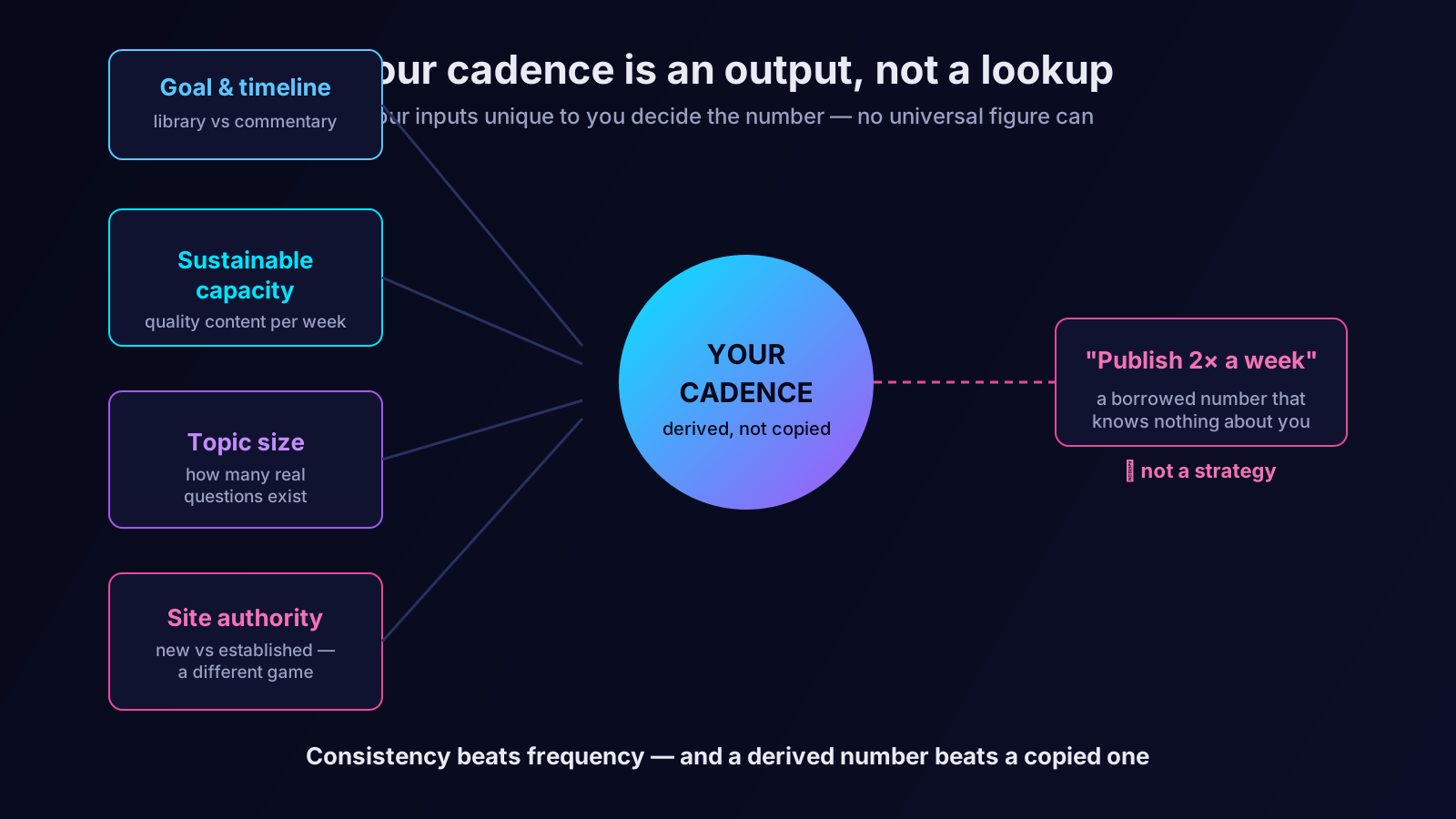
If the right frequency is not a universal number, it is the output of a handful of real variables. Here are the ones that actually matter — and notice that none of them appear in the headline of a "how often to publish" article, because none of them are the same for two different businesses.
Your sustainable capacity
The first and most under-discussed variable is simply how much quality content your team can produce without the quality collapsing. Every team has a ceiling — the point past which writing more means writing worse, or means burning out the people writing. That ceiling is set by headcount, by skill, by how much of the work is research versus drafting, and by whatever else those people are also responsible for. The single most common publishing mistake is setting a cadence above the sustainable ceiling, hitting it for a month or two on adrenaline, and then watching both the quality and the schedule fall apart together. Your real maximum frequency is not what you can do in a sprint. It is what you can do, at quality, in month seven, when the novelty is gone.
The size and freshness of your topic
Some subjects support a high cadence and some do not. A broad, fast-moving field with a deep well of genuine questions can absorb frequent publishing for years without running dry. A narrow, stable niche cannot — push the frequency too high and you exhaust the real questions and start manufacturing thin pages to fill the schedule. The topic itself sets a ceiling on how often you can publish something that genuinely deserves to exist. Working out how many real articles your subject actually contains is its own exercise; our piece on turning keywords into a content plan is one way to size it honestly before you commit to a frequency.
Your site's current authority
A new site and an established one are not playing the same game, and they should not publish at the same rhythm. A site with little authority will rank slowly no matter how often it posts; for it, the priority is depth and topical coverage in a focused area, not raw output spread thin. An established site with accumulated authority can publish more and see each piece rank faster, because the domain is doing some of the lifting. Frequency advice that ignores where your site is on that curve is advice for a site that is not yours.
Your goal and your timeline
Finally, cadence depends on what you are actually trying to do and by when. Building a foundational library of evergreen pages is a different job — and a different rhythm — from maintaining a steady stream of timely commentary. A patient, long-horizon goal tolerates a slower, more deliberate cadence. An aggressive timeline forces a faster one and a different set of trade-offs. The frequency is downstream of the objective, and the objective is yours alone.
The trap of the borrowed number
It is worth dwelling on exactly how borrowing a frequency goes wrong, because the failure is not dramatic — it is quiet, slow, and easy to misdiagnose, which is why it is so common.
A team reads that the winners publish twice a week. They commit to twice a week. For the first month it works, because the first month always works — the backlog of good ideas is full and the energy is high. By month three the backlog is empty and the schedule is not, so the team starts publishing whatever is ready rather than whatever is good. Quality drifts down, quietly, one slightly-thinner article at a time. By month six the blog is a stream of forgettable pages, the writers are exhausted, and the traffic the cadence was supposed to produce has not appeared — because thin pages do not rank, regardless of how punctually they are published.
Then comes the misdiagnosis. The team does not conclude "we picked an unsustainable frequency." They conclude "content marketing does not work for us," and they cut the program. The borrowed number did not just fail to deliver. It poisoned the team against the entire channel. The real lesson — that the frequency was wrong, not the strategy — gets missed, because the frequency was never examined as a variable. It was treated as a given, handed down from an article, and givens do not get blamed.
The honest answer, as a method
So here is the honest answer, and it is a method rather than a number. To find your real cadence, work through the variables in order.
Start with capacity, because it is the hard constraint. Be brutally realistic about how much genuinely good content your team can produce, at quality, indefinitely — not in a sprint, in a steady state. That number is your ceiling. Then look at your topic and ask whether it can supply enough real article ideas to fill that ceiling without padding; if it cannot, the topic lowers your ceiling further. Then factor in your site's authority and your goal to decide where, beneath that ceiling, you should actually sit — a newer site building depth in one cluster may deliberately publish well below its capacity in order to concentrate. The frequency you arrive at is whatever survives all four filters. It might be eight a month. It might be three. The number is not the point. The point is that it is derived from your situation rather than copied from someone else's.
And then — this is the part most advice omits — you treat that number as provisional. You publish at it for a few months, you watch what happens to both quality and results, and you adjust. If quality is holding and the topic still has room, you can test a higher cadence. If quality is slipping, the number was too high and you bring it down without guilt. Your cadence is not a vow. It is a setting, and settings get tuned.
Why consistency beats frequency
There is one thing the frequency obsession gets genuinely backwards, and it is worth stating plainly: consistency matters more than frequency. A site that publishes one solid article every single week, for two years, will almost always outperform a site that publishes five in a burst and then nothing for two months and then three more in a panic.
The reasons are practical. A steady rhythm is something a team can build a process around — research, drafting, editing, and publishing all settle into a sustainable loop. A bursty rhythm means the process is rebuilt from cold every time, which is exhausting and error-prone. Search engines, too, respond better to a site that demonstrates steady, ongoing investment in a subject than to one that goes quiet for long stretches. And a steady cadence compounds: each article joins a growing, interlinked library on a predictable schedule, and the library's authority builds in a smooth line rather than a jagged one.
So if you must fixate on something, fixate on consistency, not on hitting an impressive number. A modest cadence you never miss is worth far more than an ambitious one you keep abandoning. The question is not "what is the most I can publish?" It is "what is the most I can publish, at quality, every single week, without fail?" — and that question answers itself far more honestly than any article quoting a number ever will.
The quality floor is non-negotiable
One principle has to sit underneath everything above, or the whole method collapses: there is a quality floor, and the cadence is never allowed to push a piece below it. Every article you publish should be something a real reader would find genuinely useful — something that answers its question better than the pages already ranking for it. If a deadline is about to force out a piece that does not clear that floor, the deadline loses. You delay, or you skip, or you reduce the cadence. You do not ship the thin one.
This sounds obvious and is almost never honoured under pressure, because a frequency commitment creates a powerful incentive to publish something on schedule even when the something is not ready. That is exactly how the borrowed-number trap springs shut. The defence is to treat the quality floor as the senior commitment and the cadence as the junior one. When they conflict — and over a long enough run they always will — the floor wins. A blog that occasionally misses its rhythm but never publishes a weak page stays healthy. A blog that always hits its rhythm by lowering its standards quietly rots, one punctual, forgettable article at a time.
Where an AI agent changes the math
Everything above assumes a fixed capacity ceiling — that there is a hard limit on how much quality content your team can produce, and that the cadence has to live beneath it. That assumption is what the frequency debate has always taken for granted. It is also the assumption that an SEO AI agent changes.
The capacity ceiling exists because the work behind each article — researching the topic, understanding what already ranks, drafting, structuring, checking it does not overlap existing pages — is slow human work, and there is only so much of it a team can do per week. An SEO AI agent does not remove the human role, but it shifts where the human time goes. When the research, the first structured draft, and the consistency checks are handled by the agent, your people spend their hours on judgement, editing, expertise, and quality control rather than on building each piece from a blank page. That raises the real ceiling — the amount of genuinely good content you can sustain — without lowering the quality floor, which is the trade every frequency strategy has historically been forced to make.
This is the work Orova is built to do: take the slow, repeatable parts of producing a steady stream of content off the team's plate, so a sustainable, consistent cadence becomes easier to hold and the honest answer to "how often should we publish" can simply be "more than we used to, without anyone burning out." The method in this article does not change — you still derive your cadence from your real situation. The agent just moves where your situation's ceiling sits. Stop asking the internet for a number. Ask your own constraints, answer honestly, and then look for ways to raise the ceiling those constraints describe.
Let an AI Agent handle your SEO
Orova plans, writes, optimizes, and tracks rankings on its own — you just read the results.
Try it free