
Keyword Cannibalization: The Silent Traffic Killer
Most SEO problems announce themselves. A penalty drops your traffic off a cliff. A botched migration throws errors. A thin page simply never ranks. You notice, you diagnose, you fix. Keyword cannibalization is not like that. It does its damage quietly, over months, on sites that are doing almost everything else right — and that is precisely why it is so dangerous. It is the traffic killer you do not see, because nothing ever visibly breaks.
Here is the uncomfortable truth most content teams have not internalised: the more you publish, the more likely you are to cannibalize. Cannibalization is not a beginner's mistake. It is a mistake of momentum — the natural by-product of a productive team writing a lot about a subject it cares about. And the standard advice, "just publish more," makes it worse. This article makes the contrarian case: that on many sites, the next ten articles will hurt rankings more than help them, and that the fix is not more content but more discipline.
What cannibalization actually is
Keyword cannibalization happens when two or more pages on your own site target the same search intent. They are not complementing each other. They are competing — for the same query, in the same search results, against each other.
The word "cannibalization" is exact and worth taking seriously. These pages are consuming each other. Every signal that should accumulate on one authoritative page — internal links, backlinks, user engagement, topical relevance — is instead divided between two or more pages, each of which ends up weaker than the single combined page would have been. You did not expand your coverage of the topic. You fractured it.
And note what cannibalization is not. It is not having many pages about a broad subject — that is a topic cluster, and it is good. A site can have fifty pages about email marketing without any cannibalization at all, provided each page targets a distinct intent. Cannibalization is specifically two pages chasing the same intent. The distinction is the entire game, and we will return to it.
Why it is silent
The defining feature of cannibalization is that it produces no alarm. Understand why, and you understand why it goes unfixed for so long.
When you cannibalize, your traffic does not crash. Both pages still rank — just lower than one consolidated page would. You still get visits. Nothing in your analytics flashes red. There is no error, no warning, no penalty notification. The cost is entirely an opportunity cost: the rankings you should have had and did not. And opportunity cost is invisible. You cannot see the position three you are missing while you sit at position eight. You only see position eight, and position eight looks like a page that simply needs a little more work.
So the team's instinct, faced with a topic stuck on page two, is to write more about it. Another article. A fresh angle. More internal links to the topic. Every one of those well-intentioned actions, if the underlying problem is cannibalization, makes it worse — adding another competing page, splitting the signals further. The team is treating the disease with the thing that causes it. That feedback loop, invisible and self-reinforcing, is why cannibalization is the silent killer.
How productive teams cause it
Cannibalization is rarely one bad decision. It is the accumulation of many reasonable ones. Here is how a good team does it to themselves.
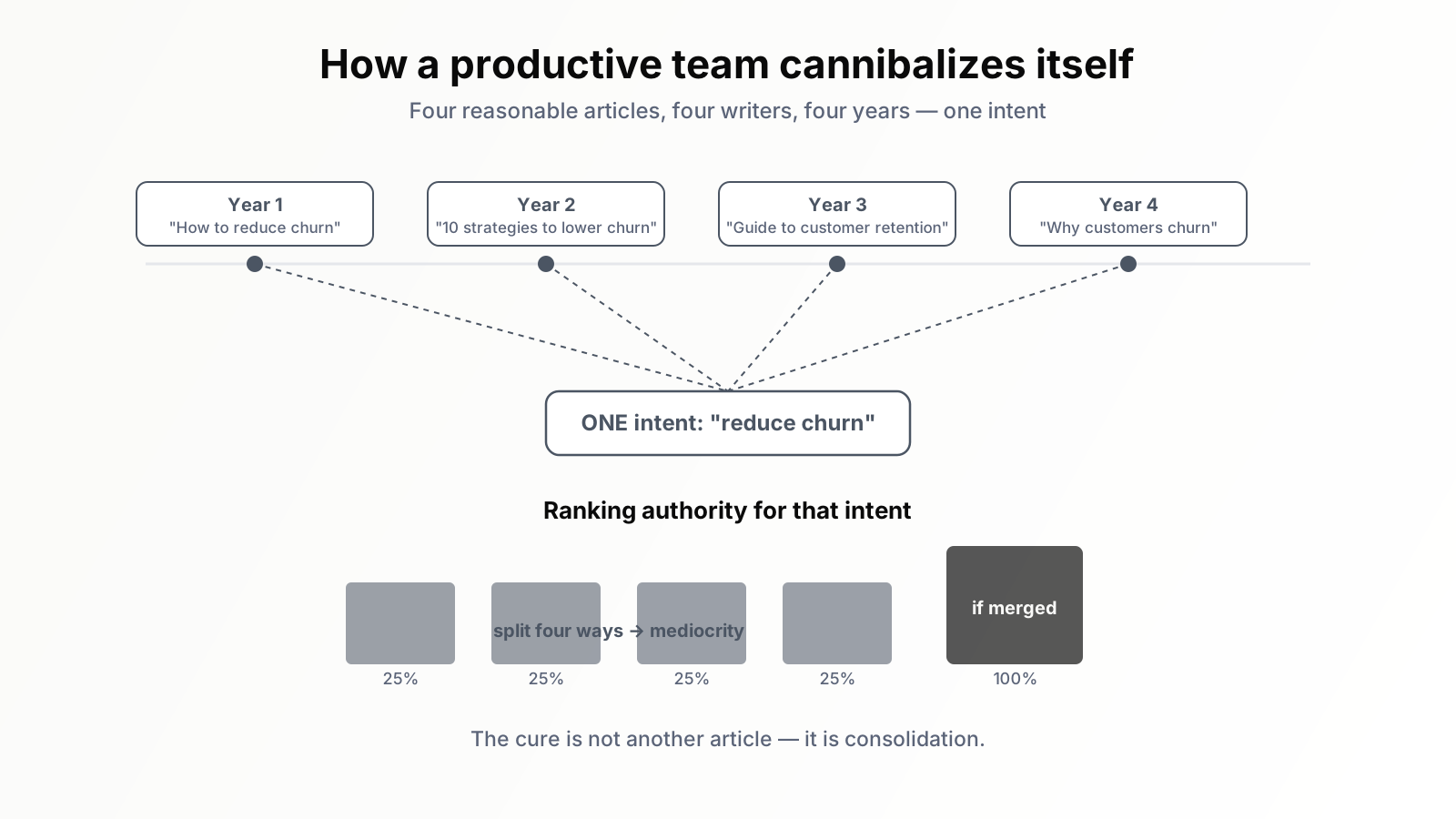
Year one: someone writes "How to reduce customer churn." Solid article, ranks decently. Year two: a different writer, who has never read the year-one article, writes "10 strategies to lower churn rate." Also solid. Nobody connected them. Year three: marketing wants a piece for a campaign, so someone writes "The complete guide to customer retention" — overlapping heavily with both. Year four: the team refreshes content and adds "Why customers churn and how to stop it." Four pages. One intent. Four writers, four reasonable decisions, four different points in time, and no single moment where anyone chose to create a problem.
This is why cannibalization correlates with productivity. A team that publishes nothing never cannibalizes. A team that publishes constantly, without a system to check new content against old, cannibalizes as a near-certainty. The cause is not carelessness — it is volume without coordination. Which is exactly why "just publish more" is such dangerous advice for a site that already has history: it accelerates the rate at which reasonable decisions pile into a problem.
The symptoms, if you know what to look for
Cannibalization is silent, but it is not invisible — if you go looking. There are clear symptoms.
Rank flux on a single query. Open Search Console, filter to one important query, check the Pages tab. If Google shows two or more of your URLs for that query, and especially if it alternates which one it ranks across the weeks, that instability is Google telling you it cannot decide which of your pages is the answer. A clean topic has one stable URL per query. Flux means competition.
A topic that plateaus despite effort. You have written extensively about a subject, you have built links to it, and it is still stuck on page two. Effort is going in; rankings are not coming out. That mismatch is a classic cannibalization signature — the effort is real but it is being divided.
The wrong page ranking. You search your target query and Google shows an old, weaker page instead of the comprehensive one you wrote to rank. Google picked a page you did not intend. That is cannibalization choosing for you, and choosing badly.
Near-duplicate titles in your inventory. Scan your content list. Two pages titled "How to reduce churn" and "Reducing customer churn: a complete guide" are a violation you have not confirmed yet. Title overlap is the cheapest early-warning signal you have.
The fix is consolidation, not creation
Here is the contrarian core of this article. The instinct, when a topic underperforms, is to create. The cure for cannibalization is almost always the opposite: to consolidate, and sometimes to delete.
When you find several pages competing for one intent, you merge them. Choose the strongest URL — the one with the best links and rankings — and fold the best content from the others into it, making the survivor genuinely the most complete page on that intent anywhere on your site. Then permanently redirect the weaker URLs to the survivor, so every signal they earned flows into the page you kept. Four mediocre pages become one strong one. The authority that was split four ways is now concentrated. The page that was stuck on page two has a real chance at page one — not because you added anything, but because you stopped dividing what you already had.
This is genuinely hard for content teams to accept, because it feels like going backwards. You are reducing your page count. You are deleting work that people wrote. Publishing feels like progress; consolidating feels like retreat. But ranking is not a function of how many pages you have on a topic — it is a function of how much concentrated authority your best page on that topic carries. Four pages at thirty percent strength each lose to one page at a hundred. Deleting three of them is not destroying work. It is rescuing it.
Cannibalization versus topic clusters: the line that matters
The objection writes itself: "But you constantly tell us to build topic clusters with dozens of pages on one subject. Isn't that cannibalization?" No — and the difference is the single most important concept here.
A topic cluster is many pages on one subject, each targeting a distinct intent. Cannibalization is many pages targeting the same intent. A churn cluster might have "what is churn rate," "how to calculate churn rate," "how to reduce churn," "churn rate benchmarks by industry," and "best churn-prevention software" — five pages, one subject, five completely different intents. Nothing competes. Each page owns its query; together they signal genuine depth. That is the cluster model, and it is exactly what you want. Our guide to topic clusters and how to structure content for SEO covers building them properly.
Cannibalization is when, inside that cluster, you also have "ways to lower your churn rate" and "reducing customer churn: a guide" — two pages both chasing the reduce-churn intent. The cluster is healthy; the duplication inside it is the disease. So the test for every page is never "do we already have content about this subject?" It is "do we already have a page targeting this exact intent?" Same subject is fine and good. Same intent is the problem. Hold that line and you can build large clusters without ever cannibalizing.
Prevention beats cure
Fixing cannibalization is painful — merges, redirects, deleting work. Preventing it is cheap. The prevention mechanism is a keyword map: a single document with one row per page, recording the intent that page owns. Before any new article is commissioned, you check the map. If a page already owns that intent, you do not write a competitor — you improve the existing page. Only a genuinely new intent earns a new page.
That one checkpoint, applied without exception, makes cannibalization structurally impossible. The reason most sites cannibalize is not that they lack the keyword map — it is that, under deadline pressure, checking it feels slower than just writing the article. It is slower, by a few minutes. Skipping it costs months of suppressed rankings later. The maths is not close.
Why "just publish more" is the wrong reflex
Step back and the broader critique comes into focus. The content marketing industry has a near-religious belief in volume — more articles, more frequency, more output. For a brand-new site with no history, that belief is roughly correct. For an established site with hundreds of pages, it is actively dangerous.
On a site with history, your next ten articles are not landing on empty ground. They are landing in a field already full of your own pages, and unless every one of them is checked against the keyword map, some of them will overlap something you already published. "Publish more" without "check first" is a recipe for steady, invisible cannibalization. The mature version of the advice is not "publish more." It is "publish more distinct intents, and for intents you already cover, consolidate instead of duplicate." Less satisfying as a slogan. Far more accurate as a strategy.
The kinds of cannibalization people overlook
Most teams, once they learn the concept, picture cannibalization as two obvious twin articles — and they miss the subtler forms that are just as damaging.
Pillar-eats-cluster. You build a broad pillar page on a subject and a set of narrower supporting pages beneath it. If the pillar is written too thoroughly — covering every sub-question in full depth itself — it starts ranking for the queries the supporting pages were meant to own. The pillar is not supposed to win the specific queries; it is supposed to win the broad one and hand the specific ones to its cluster pages. An over-stuffed pillar quietly cannibalizes its own cluster. The fix is restraint: the pillar summarises each sub-topic and links down, rather than exhausting it.
Category-page-eats-article. On many sites, a tag page, a category archive, or a filtered listing page is indexable and accumulates enough text to compete with a real article on the same theme. Google then has to choose between your thin category page and your substantial article — and sometimes it picks the category page. This is cannibalization between a content page and a structural page, and it is invisible unless you check which URL type is ranking.
Old-page-eats-new-page. You publish a fresh, comprehensive article to replace an ageing one but never redirect or update the old URL. The old page has years of accumulated links and history; the new page has none. Google keeps ranking the old, weaker page out of inertia. You wrote the replacement and the replacement never gets a chance. The fix is to treat replacement as replacement — redirect the old URL into the new one so its equity transfers.
Naming these variants matters because a team that only watches for obvious twin articles will keep a clean keyword map and still cannibalize through the side doors. Cannibalization is any situation where two URLs compete for one intent — regardless of what type of page either URL happens to be.
Why cannibalization is worse now than it used to be
There is a reason this problem deserves more attention today than it did a few years ago, and it is worth stating plainly.
Search results have become more consolidated. There is simply less room on the first page than there used to be — more of the space is taken by features, by the top few results, by answer panels. When the available real estate shrinks, the cost of splitting your own authority rises. Two pages at half-strength might both have scraped onto a generous first page years ago; today, half-strength often means neither makes it, because the bar to appear at all has moved up. The same cannibalization that was a mild drag in a looser results page is now the difference between visible and invisible.
At the same time, the industry-wide push toward higher content volume means sites are accumulating pages faster than ever — and faster accumulation, without a keyword map, means faster cannibalization. The two trends compound. More pages produced, less room to rank them, and the same old habit of not checking new content against old. A site that publishes aggressively today, without discipline, builds a cannibalization problem faster than a site did five years ago, and pays a steeper price for it. That combination is why the silent killer is louder now, even though most teams still cannot hear it.
Where an SEO AI agent fits
Cannibalization is silent because catching it requires something humans are bad at: holding an entire site's worth of pages and intents in mind at once, and checking every new idea against all of it. No writer can remember three hundred URLs. That memory gap is the whole reason productive teams cannibalize themselves.
This is where an SEO AI agent changes the equation. Orova can audit an existing site for cannibalization — finding pages with overlapping intent, near-duplicate titles, and queries where Google is alternating between your URLs — and surface every violation for you to consolidate. Going forward, when you plan a new article, it checks the proposed intent against every page you have already published and tells you whether one already owns that ground. The silent killer becomes loud: the agent gives the problem the alarm it never had on its own. Publishing more stops being a risk, because every new page is verified to target an intent no existing page already holds.
Run your business with AI Agents
Orova is the always-on Biz AI Agent — it plans, runs, and optimizes the work for you. Save time, unlock productivity.
Try it free