
How to Steal Your Competitor's Best Keywords (Legally)
"Steal" is a strong word, so let us get the ethics out of the way before anyone calls a lawyer. You cannot copy a competitor's article. You cannot lift their words, their images, or their brand. But you absolutely can look at which search terms are sending them traffic, decide that you could serve those searchers better, and write your own pages to win those terms. That is not theft. That is competitive analysis, and every serious marketing team on earth does it. The only people who pretend otherwise are the ones too polite to admit they have a competitor tab permanently open.
So yes, this article is about stealing your competitor's best keywords — legally, openly, and without a flicker of guilt. Keywords are not owned by anyone. Google does not assign exclusive rights to "project management software" to whoever ranked first in 2019. The position is up for grabs every single day, and your competitor is sitting on a list of terms they have already proven are worth ranking for. That list is a gift. They paid for the research; you get to read the answer key.
Why a competitor's keywords are better than your brainstorm
Here is the uncomfortable truth about brainstorming keywords from scratch: you are guessing. You sit in a room, you think about your product, and you write down terms you hope people search. Some of them are real. Many of them are phrases that exist only in your own head and the heads of your colleagues, who all use the same internal jargon you do.
A competitor's ranking keywords are the opposite of a guess. They are demonstrated demand. If a rival company ranks on page one for a term, three things are already true. First, that term gets searched — Google does not surface pages for queries nobody types. Second, the term is winnable, because a company roughly your size already won it. Third, the term is commercially relevant to your space, because a company selling roughly what you sell decided it was worth a page. You have outsourced your market validation to a competitor who did not know they were volunteering.
This is why "steal the competitor's keywords" beats "brainstorm our own keywords" almost every time. One method produces a list of hopes. The other produces a list of facts. When you are deciding where to spend a quarter of content effort, facts are the cheaper input.
Step one: pick the right competitors to rob
Not every company you think of as a competitor is a useful target here, and this is where most teams immediately go wrong. They list the three biggest brands in their category and start there. Bad idea. The market leader ranks for everything, has a domain authority you cannot touch this year, and will hand you a keyword list full of terms you have no realistic chance of winning for eighteen months. Studying them is demoralising and unproductive.
The competitors worth studying are the ones in your weight class — companies whose website is roughly as established as yours, whose content program is a year or two ahead of yours rather than a decade. They are ranking for terms you could plausibly rank for too, because the gap between you is months of work, not a different universe. There is a second, sneakier category as well: search competitors who are not business competitors. The blog, the comparison site, the industry publication that ranks for your target terms without selling anything like your product. They are not after your customers, but they are sitting in the search positions you want, and their keyword list is just as instructive.
Pick four or five of these realistic targets. A focused robbery of the right vaults beats a scattered raid on every bank in town.
Step two: get the list without spending a fortune
This is the part where the SEO industry would like to sell you a four-figure annual subscription, and for a large enterprise that might be the right call. But you can get most of the value with a fraction of the spend, and sometimes none of it.
The paid keyword-research platforms do have a genuine feature: enter a competitor's domain and they return an estimate of the terms that domain ranks for, with rough positions. The word doing heavy lifting there is estimate — these numbers are modelled, not measured, and they can be wrong in both directions. They are directionally useful, not gospel. If you have access to one, use it as a starting map, not a final answer.
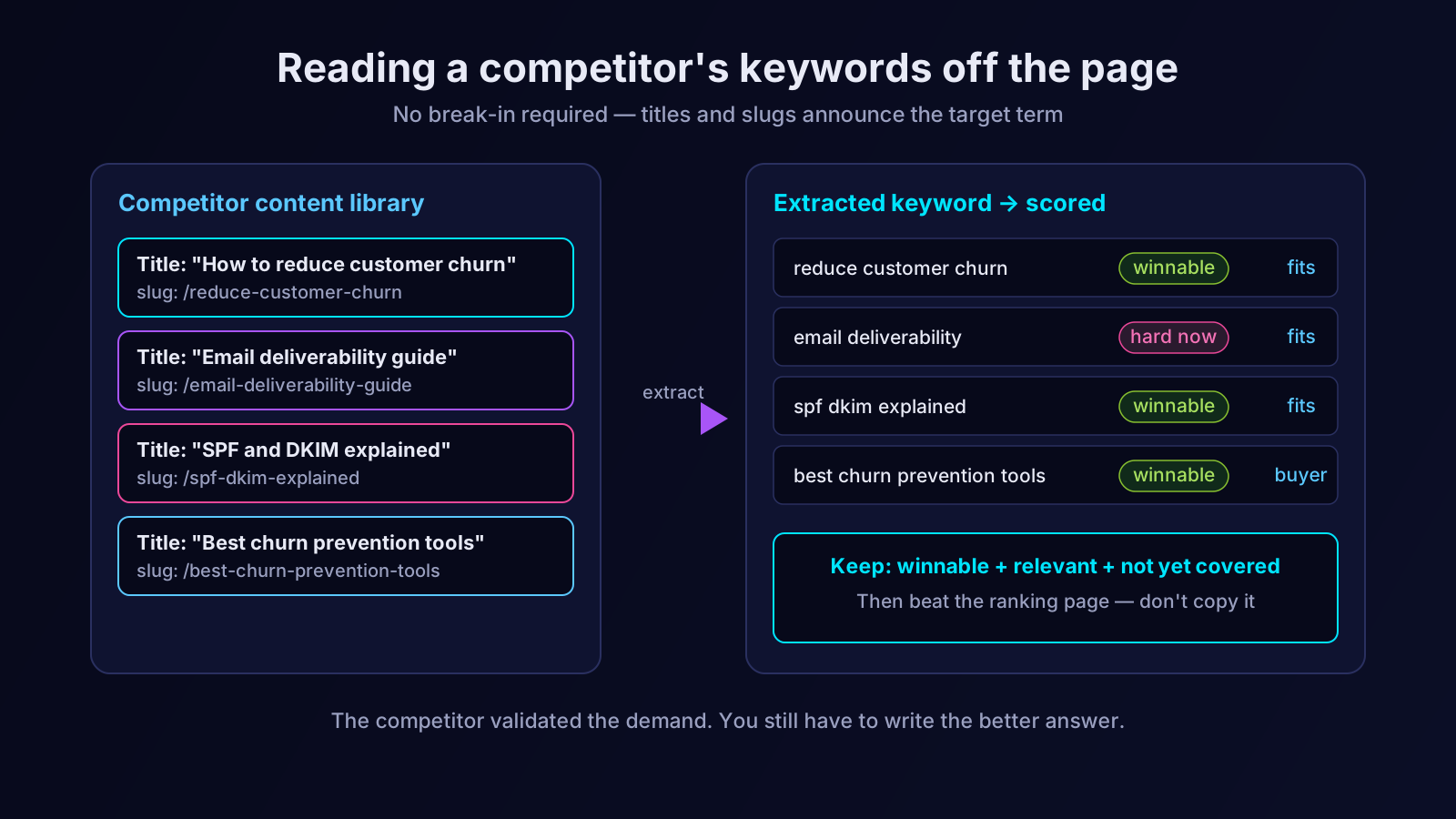
If you do not have access, the free route works surprisingly well; it just takes more clicking. Open your competitor's site and read it the way a search engine would. Their blog index, their resource hub, their help centre — every page title and every URL slug is a near-explicit statement of a keyword they are targeting. A post titled "How to reduce customer churn" is targeting "reduce customer churn." A URL ending in /email-deliverability-guide is targeting "email deliverability." You are not guessing their keywords; you are reading them off the page. Do this across a competitor's content library and you reconstruct most of their keyword strategy with nothing but a browser and an afternoon.
Step three: filter the haul — most of it is junk to you
Here is the trap that turns a clever idea into wasted months. You pull a competitor's keyword list, you see four hundred terms, and the temptation is to treat the whole thing as a to-do list. Do not. A competitor's keyword list is raw ore, and most of it is rock.
Three filters separate the gold from the rock. The first is winnability: can you realistically rank for this term given your site's current authority? If the competitor ranks first for it and they have ten times your domain strength, that term is a fantasy for now — set it aside, do not delete it, revisit it next year. The second is relevance: does this term attract someone who could buy what you sell? Competitors, especially larger ones, rank for plenty of broad terms that bring traffic with no purchase intent. Inheriting those means inheriting their bounce rate. The third is gap: do you already cover this term? If you have a page ranking for it, the keyword is not a new opportunity; it might be a signal to improve the page you have.
Run the four-hundred-term haul through those three filters and you might be left with sixty. That is not a disappointment — that is the point. Sixty winnable, relevant, uncovered keywords is a genuine quarter or two of content work, every item validated by a competitor who already proved the demand. Sixty real opportunities beats four hundred entries you will never action.
Step four: do not copy the page — beat it
Now you have your filtered list, and here is where the word "steal" finally stops applying. You are not going to copy the competitor's page. You are going to look at the page currently ranking for the term and build something a searcher would clearly prefer.
So read the ranking page critically. What question is the searcher actually asking, and does the current page fully answer it, or does it dance around the edges? Is it out of date? Is it thin — five hundred words where the topic deserves fifteen hundred? Is it badly structured, burying the answer under three paragraphs of preamble? Is it missing the example, the screenshot, the comparison table, the checklist that would make it genuinely useful? Every weakness you find is your opening. The competitor handed you the keyword and showed you the bar you have to clear. Clear it convincingly and the position is yours, because Google's whole job is to promote the better answer.
This is the difference between competitive analysis and plagiarism, and it is not subtle. Plagiarism copies the page and adds nothing — it deserves to fail and usually does. Competitive analysis copies the target and then does the work to deserve the position. One is lazy and illegal. The other is just good marketing.
Step five: watch what they do next
A competitor's keyword list is not a photograph; it is a live feed. The companies worth studying are still publishing, still updating, still chasing new terms. The smartest version of this practice is not a one-off raid but a standing habit.
Every month or so, revisit your chosen competitors. What did they publish since last time? A burst of new articles around a particular sub-topic is a competitor telling you, loudly, that they have spotted demand there and are moving in. You can decide to follow, to move faster, or to deliberately go somewhere else — but you can only decide if you are watching. The team that checks competitor activity quarterly is reacting to a year-old strategy. The team that checks monthly is reacting to last month's. In a channel where content takes months to mature, that lead time is the whole game.
The mirror works both ways
One closing thought that should keep you honest. If you can read a competitor's keyword strategy this easily — off their page titles, their URLs, their publishing pattern — then they can read yours just as easily. Every page you publish is a public statement of a keyword you want. You are not operating in secret, and neither are they.
That is not a reason to hide. It is a reason to be good. In a market where everyone can see everyone's targets, the winner is not whoever keeps the best secrets — there are no secrets. The winner is whoever executes the obvious strategy best: who picks the right terms, writes the genuinely superior page, links it sensibly into the rest of their site, and keeps it current. Competitive keyword analysis tells you where the contest is. It does not win the contest. The work still has to be done.
What this looks like when you do it well
A team that has internalised this does not have a "keyword brainstorm" on the calendar anymore. They have a competitor watchlist. They know which four or five companies are in their weight class. They have a reconstructed map of what those companies target, refreshed every month. When it is time to plan a quarter of content, they are not staring at a blank document — they are choosing from a filtered list of validated, winnable, relevant opportunities, every one of which a competitor has already de-risked for them.
And critically, they are not just copying. For each target keyword they have looked at the page currently ranking and written down, specifically, how they intend to beat it. The plan is not "write about competitor keywords." The plan is "write the better answer to these sixty validated questions, in this order." That is a content strategy that can be defended in a meeting and trusted to compound. If you want the structural side of how those sixty pages should fit together, our guide to topic clusters covers it, and the broader workflow from terms to a calendar is in keywords to a content plan.
Where an AI agent earns its keep
Everything described here is doable by hand. It is also tedious in a very specific way: it is repetitive, it is detailed, and it never ends. Reading five competitors' entire content libraries, extracting the implied keyword from every title and slug, scoring each term for winnability and relevance, cross-checking it against your own coverage, then doing the whole thing again next month — that is exactly the kind of work that gets started with enthusiasm and abandoned by the third competitor.
This is structured, repetitive analysis at volume, which is what an SEO AI agent is built for. Orova can scan your chosen competitors, extract the keywords their pages target, estimate which ones you could realistically win given your site's current strength, flag the terms you already cover, and keep the watchlist current month after month without anyone losing the will to live. The judgement stays yours — which competitors matter, which terms fit your business, how aggressively to chase them. The agent removes the clicking and the fatigue, so the analysis actually gets finished. And a competitive analysis you actually finish is worth infinitely more than the brilliant one you abandoned at competitor three.
Let an AI Agent handle your SEO
Orova plans, writes, optimizes, and tracks rankings on its own — you just read the results.
Try it free