
The Link-Building Tactics That Still Work (And Those That Don't)
Link building has a strange relationship with time. Tactics that worked spectacularly a decade ago now do nothing or actively cause harm, while a handful of approaches have quietly worked the entire time and will keep working. The problem is that the industry rarely retires anything cleanly. Old tactics keep getting sold, repackaged, and recommended long after they stopped delivering, so a team trying to build links honestly ends up sorting genuine advice from fossilised advice with no clear map.
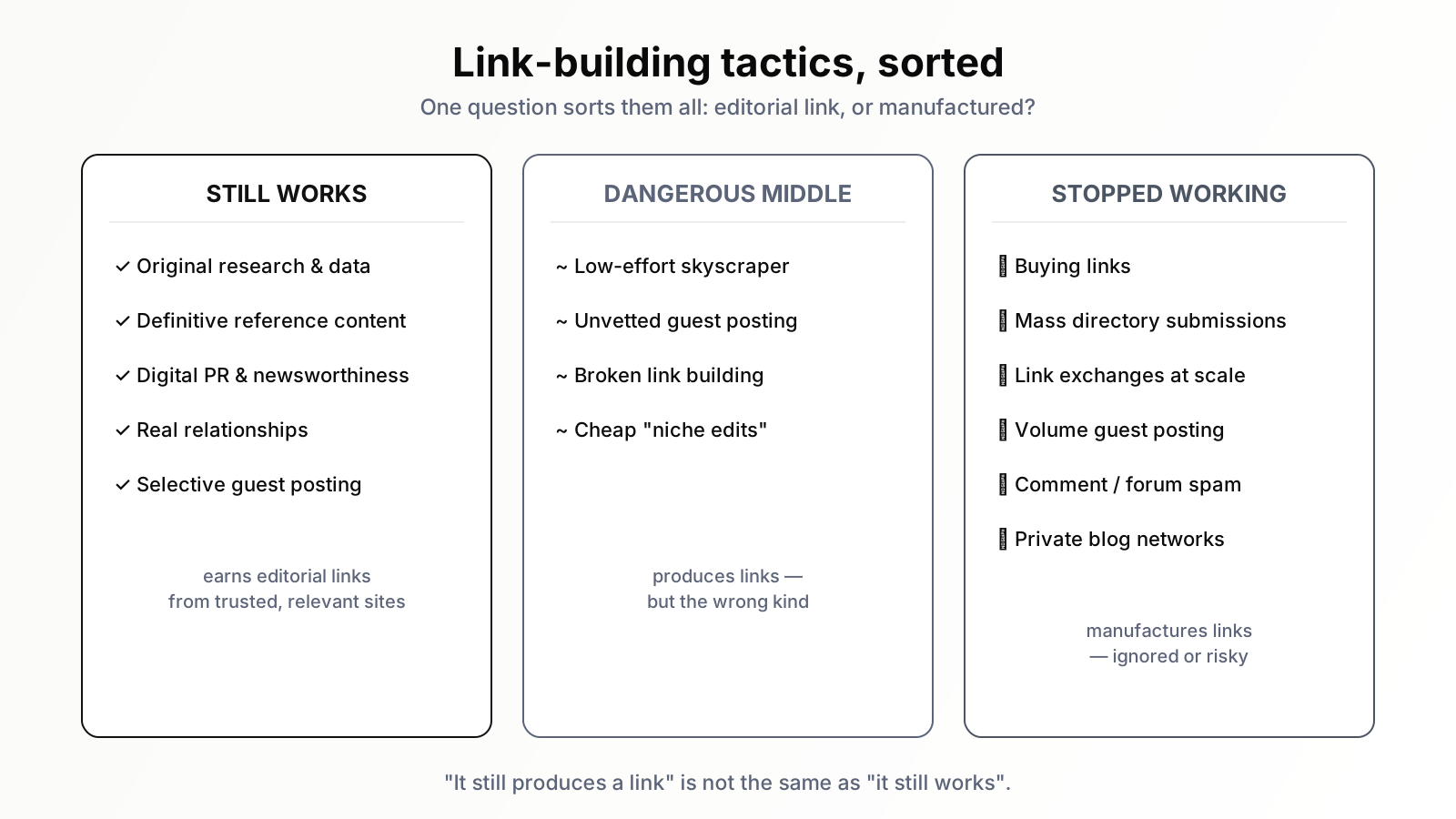
This article is that map. It is an analytical breakdown of link-building tactics divided into three groups: the ones that still work, the ones that have stopped working, and the ones in the dangerous middle — tactics that technically still produce links but produce the wrong kind. The aim is not to give you a checklist of moves. It is to give you the underlying logic, so that when a new tactic appears you can place it yourself.
The principle that sorts every tactic
Before the breakdown, the principle. Every link-building tactic can be judged by one question: does it produce editorial links from trusted, relevant sites — or does it manufacture the appearance of links without the substance?
An editorial link is one a publisher chose to place because it genuinely helped their reader. It is a real vote of confidence. A manufactured link is one that exists because money, a reciprocal favour, or an automated process put it there — the form of a vote with none of the meaning. Search engines have spent two decades getting better at telling these apart, and in the present day they are very good at it. So the tactics that still work are, without exception, the ones that produce editorial links. The tactics that have stopped working are the ones that manufacture links. This is the entire logic of the breakdown, and once you hold it, the three groups almost sort themselves.
What still works
Start with the good news, because it is more useful than the bad. A handful of tactics have worked for the entire history of search and show every sign of continuing to. They share a common shape: they all create a genuine reason for someone to link to you.
Original research and data
This is the most reliable link-building tactic that exists, and it works for a structural reason. When you publish a study, a survey, a benchmark, or an original analysis, you create a fact that exists nowhere else. Any writer in your field who wants to cite that fact has to point at the source — and the source is you. You have made linking to you the path of least resistance for other people doing their jobs. This tactic does not depend on outreach, persuasion, or favours. It depends only on producing something worth citing, and then the links accumulate as a natural consequence over months and years.
Definitive reference content
The second durable tactic is being the best available explanation of something. When a writer needs to reference a concept — "topic clusters," "search intent," "core web vitals" — they link to the clearest, most complete explanation rather than writing their own. If your page is that explanation, you become the default citation. Like original research, this works without ongoing effort: build the definitive resource once and it earns links passively for as long as it stays accurate.
Digital PR and genuine newsworthiness
The third is making something journalists and industry writers actually want to cover — a data story, a strong point of view, a notable launch, a genuinely useful free tool. Digital PR done well is not begging for coverage; it is producing something with real news value and making sure the right people know it exists. The links that result are high quality and relevant because they come from real publications writing real articles.
Real relationships and expert contribution
The fourth is the slowest and most durable: being a genuine, knowledgeable participant in your field. Contributing real expertise to respected publications, being a source journalists can quote, building relationships with other people who run sites in your space. Links that come from relationships are editorial by definition and relevant by definition, and they keep coming because the relationship persists.
Modern, selective guest posting
The fifth still works, but only in its grown-up form: contributing a genuinely good, original article to a respected, relevant publication whose audience you actually want to reach. This is a real editorial contribution, and the link inside it is a real link. It is the opposite of the volume guest-posting that sits in the failed group below.
Notice that every tactic in this group passes the principle. Each one produces editorial links from trusted, relevant sites. Each one works because it gives a publisher a genuine reason to link. None of them is fast, and that is not a flaw — it is the reason they keep working.
What has stopped working
Now the tactics that the search engines have retired. These are not borderline cases — they are dead, and the only reason to discuss them is that they are still actively sold.
Buying links
Paid links violate the principle completely: a link that was bought is not a vote of confidence, and search engines have trained themselves specifically to detect the patterns that paid links create. Buying links is not just ineffective; it is the clearest way to acquire a manipulative link pattern, which means the downside is risk on top of wasted budget.
Mass directory submissions
Submitting your site to hundreds of directories was a tactic when search engines counted links indiscriminately. Those directories have no quality — no audience, no editorial standard — and no relevance, since they list everything. Their links sit in the dead zone: ignored at best.
Link exchanges at scale
"Link to me and I'll link to you," repeated across dozens or hundreds of sites, creates a reciprocal pattern that is trivially easy to detect and is not editorial. A modest amount of natural reciprocal linking between genuinely related sites is normal and fine; organised exchange schemes are not.
Volume guest posting
The degraded form of guest posting — the same thin, keyword-stuffed article placed on dozens of unrelated sites that exist mainly to host paid posts — fails on every count. The articles are not good, the sites are not trusted, the placements are not relevant, and the links are not editorial. This is distinct from the selective guest posting in the working group; the difference is whether a real contribution was made to a real publication.
Comment, forum, and profile spam
Dropping links in blog comments, forum signatures, and profile pages. These links carry no editorial weight, are usually marked so they pass no authority at all, and signal low effort and low quality. They never worked well and now do nothing.
Private blog networks
Networks of sites built or bought purely to link to a target site. This is manufacturing links at industrial scale, and search engines have invested heavily in detecting and neutralising these networks. When a network is caught, every site relying on it can lose its rankings at once.
Every tactic in this group manufactures links instead of earning them. Every one fails the principle. The fact that some of them still produce a visible link in a backlink tool is exactly the trap — the link exists, but the search engine is not counting it, so the tool is showing you a number that means nothing.
The dangerous middle
The hardest group is the one between the other two: tactics that are not outright dead and not outright safe. They still produce links, sometimes even links that look reasonable, but they produce the wrong kind — links that do little, or links that quietly accumulate into a pattern you do not want.
Low-effort "skyscraper" outreach
The skyscraper technique — find a popular linked-to page, make something slightly better, and ask everyone linking to the original to link to you instead — can work in its careful form. But the volume version, mass emails to anyone who ever linked to a vaguely related page, has a near-zero response rate and, when it does land a link, often lands an irrelevant one. The tactic is not dead, but its common execution belongs in the middle.
Unvetted guest posting
Guest posting on a site that is neither clearly reputable nor clearly a paid-post farm. The link might help a little, might do nothing, might be on a site that gets flagged later. Without vetting the publication for genuine quality and relevance, you are guessing — and a guess belongs in the dangerous middle.
Broken link building
Finding dead links on other sites and suggesting your page as the replacement. Legitimate in principle, but in practice it often degenerates into mass irrelevant outreach, and a link earned only because a URL happened to break is a weak link if the relevance is not genuinely there.
Cheap "niche edits"
Paying to have a link inserted into an existing article on someone else's site. This is sold as a clean tactic but is functionally a bought link dressed up — it manufactures a placement that no editor chose. It edges toward the failed group, and the only safe treatment is to avoid it.
The lesson of the middle group is that "it still produces a link" is not the same as "it still works." A tactic that produces ignored links wastes your time; a tactic that produces risky links costs you more than time. When a tactic lands in the middle, the analytical move is to ask the principle's question again, honestly — and most middle-group tactics, asked honestly, turn out to be failing it.
How to choose your tactics
The breakdown points to a clear way to build a link strategy. Concentrate effort almost entirely on the working group, because those tactics produce the only links that count. Within that group, weight your effort toward original research and definitive content, because those two earn links passively and compound over time, while outreach-based tactics require continuous effort. Treat the dangerous middle as off-limits unless you can personally vouch for the quality and relevance of each specific link — and if you can, the tactic has effectively moved into the working group anyway. Ignore the failed group entirely, including when it is repackaged under a new name.
This produces a strategy with fewer links and slower growth than the old playbook promised, and that is correct. A link profile built from the working group is small, clean, relevant, and durable. A link profile built from the failed group is large, junk-heavy, and worthless or worse. The honest breakdown does not give you more links. It gives you the right ones.
Fitting link building into the bigger system
One closing point of perspective. Link building is not a standalone activity, and treating it as one is itself a kind of outdated tactic. The tactics that still work — research, reference content, digital PR — are all forms of content creation. The link is a by-product of publishing something genuinely valuable, which means link strategy and content strategy are the same strategy viewed from two angles.
Once external links arrive, a deliberate internal linking system spreads the authority they bring across your site, and organising your content into topic clusters ensures that authority lands where it can do the most good. The teams that struggle with link building usually struggle because they have isolated it from everything else. The teams that succeed treat it as one output of a content operation that was always going to produce link-worthy work.
Where an AI agent fits
Sorting tactics is the easy part; executing the surviving ones consistently is the hard part. The working tactics demand sustained, analytical effort — identifying research angles worth pursuing, finding the relevant trusted publications worth a relationship, spotting which of your existing pages are close to becoming link-worthy reference content, and continuously checking that no risky pattern is creeping into your profile. That is steady work that rarely feels urgent and therefore rarely gets done.
An SEO AI agent closes that gap. Orova can analyse your backlink profile and classify it against the three groups in this article, monitor link growth for the patterns that signal a failed-group tactic creeping in, identify the trusted and relevant sites in your field worth genuine outreach, and analyse your own content to flag the pages closest to becoming the kind of definitive resource that earns links on its own. It will not run a single failed-group tactic, because those do not work. It does the analytical, repetitive work that makes a working-group strategy something you actually sustain.
Link building has not got harder. It has got more honest. The tactics that still work are the ones that were always supposed to work — give publishers a genuine reason to link, and the links follow. Everything else was a shortcut, and the shortcuts have closed.
Run your business with AI Agents
Orova is the always-on Biz AI Agent — it plans, runs, and optimizes the work for you. Save time, unlock productivity.
Try it free