
What an SEO AI Agent Does That a Tool Can't
For two decades, "doing SEO" has meant operating tools. You log into a keyword research tool, then a rank tracker, then a crawler, then an analytics dashboard, then a writing assistant — and you, the human, are the connective tissue holding the workflow together. The tools each do one thing well. You do everything else: deciding what to look at, interpreting what it means, choosing what to do next, and carrying the output of one tool into the input of the next. That model is so familiar it can feel like the only possible one.
It is not. An SEO AI agent is a fundamentally different kind of software, and the difference is not "a smarter tool" or "a tool with a chat box bolted on." An agent does things a tool — however advanced — structurally cannot. This article is a careful, practical walkthrough of exactly what those things are, so you can tell the categories apart and judge what each is actually for.
The core distinction: tools wait, agents act
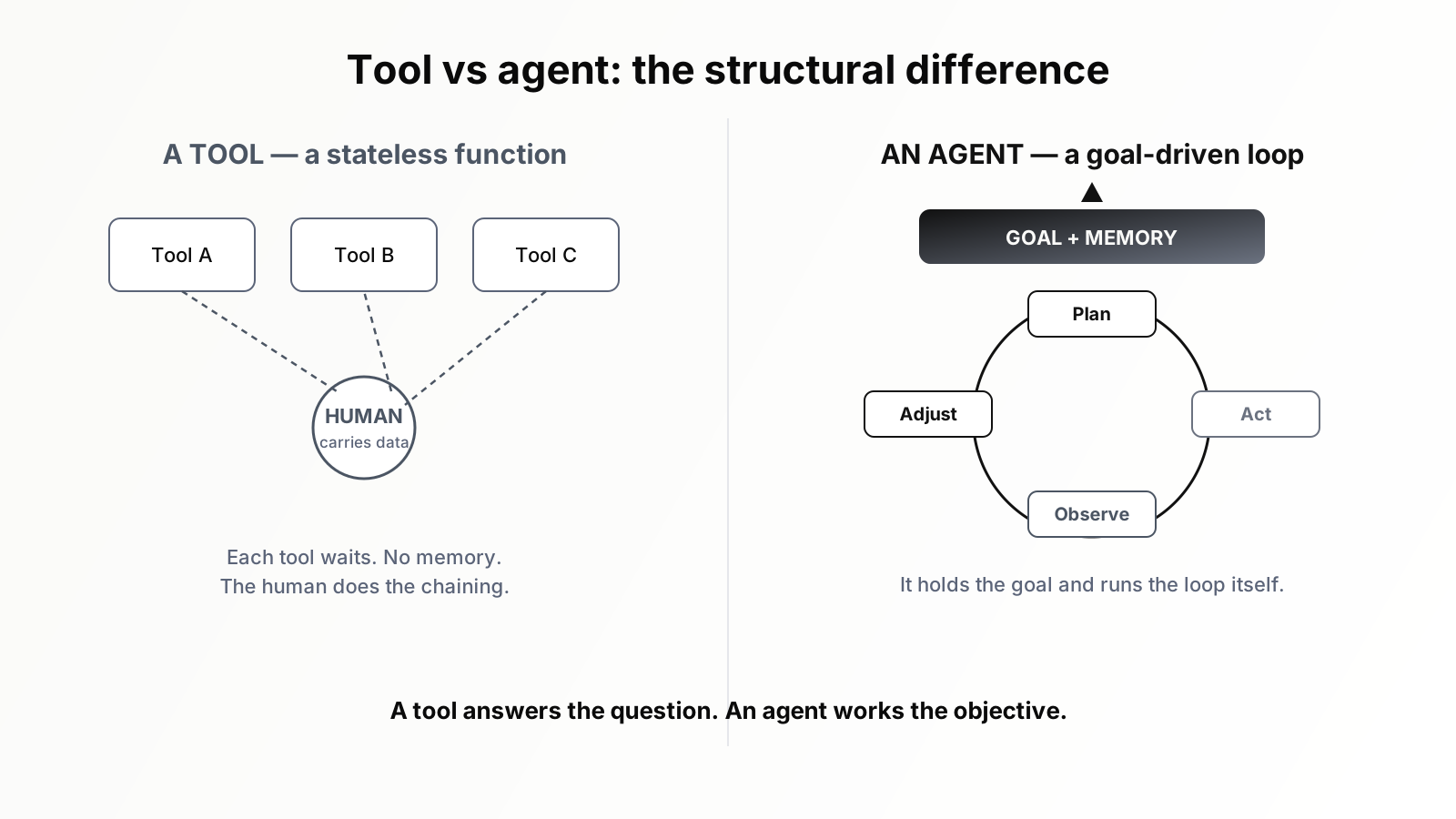
Start with the cleanest definition. A tool is a function. You give it an input, it returns an output, and then it stops. It has no memory of what you did yesterday, no view of your goal, no opinion about what should happen next. A keyword tool will happily hand you ten thousand keywords and feel no obligation to tell you which ones matter. The intelligence in a tool-based workflow lives entirely in the operator.
An agent is different in kind. An agent holds a goal, maintains context over time, decides which actions to take to advance that goal, executes those actions, observes the results, and adjusts. It does not wait to be told the next step — working out the next step is its job. A tool answers the question you asked. An agent works on the objective you set, including the parts you did not think to ask about.
Everything else in this article follows from that one distinction. The four capabilities below are not features an agent happens to have. They are direct consequences of being goal-driven rather than function-driven.
What a tool can't do, capability one: chain a multi-step workflow on its own
Real SEO work is almost never a single action. Take a routine objective: "find a content opportunity and turn it into a brief." Done properly, that involves keyword discovery, intent classification, competitor analysis on the current top results, a check of your own site for overlapping content, a difficulty assessment, and finally the assembly of a brief. Seven steps, and the output of each one shapes the input of the next.
A tool can perform any one of those steps. It cannot perform the sequence, because it has no concept of a sequence — it does not know that step two should follow step one, or that the result of step four should change what happens in step five. The chaining lives in the human operator. You run the keyword tool, read the result, decide it warrants intent analysis, open the next tool, copy the data across, interpret again, and so on. You are the workflow engine, and it is slow, tiring work.
An agent chains the steps itself. You state the objective once, and the agent runs the whole sequence — discovery, then classification, then competitor analysis, then the internal overlap check, then the difficulty call, then the brief — carrying context forward at every hand-off and adapting later steps to what earlier ones revealed. The human's job moves up a level: from operating each step to setting the objective and reviewing the finished result. That is not a faster tool. It is the removal of the tool-operating job entirely.
What a tool can't do, capability two: hold context across time and tasks
A tool is stateless. Every time you open your rank tracker it shows you numbers, but it does not remember that three weeks ago a cluster of pages slipped, that you refreshed two of them last Tuesday, or that the dip lined up with a known algorithm update. It has data; it has no memory. Reconstructing the story from the data is, again, the human's job — and humans forget, leave, and get reassigned, taking the context with them.
An agent maintains state. It carries a working memory of your site: which clusters exist, which pages belong to which, what was changed and when, what the goal of each section is, what has been tried and what resulted. Because it remembers, it can do things a stateless tool cannot. It can notice that a page you refreshed last month has not recovered and flag it for a different intervention. It can spot that a new draft would cannibalise a page published a year ago. It can connect today's traffic dip to last week's change. The value is not the data — tools have data. The value is continuity. An agent treats your site as an ongoing project with a history, not as a fresh query every time you log in.
What a tool can't do, capability three: make context-dependent judgements
This is the capability people most underestimate. A tool gives you the same answer regardless of who is asking. A keyword difficulty tool shows "difficulty: 64" to a brand-new blog and to an established authority site alike — the number is a property of the keyword, not of your situation. The judgement "is 64 winnable for us?" is left entirely to you, and it depends on context the tool has no access to: your domain's authority, your existing cluster depth, your publishing capacity, your timeline.
An agent can fold that context into the recommendation. Because it holds a model of your specific site — its authority, its clusters, its history, its current goals — it does not just report "difficulty 64." It can reason: "this keyword is difficult in the abstract, but it sits inside a cluster where you already have eight strong pages and demonstrated topical authority, so it is more winnable for you than the raw score suggests; here is where it should sit in the queue." That is a judgement, not a lookup. It is the kind of reasoning a good SEO consultant performs in their head — and it is precisely what a stateless, context-free tool cannot do, because the judgement depends on information the tool was never built to hold.
What a tool can't do, capability four: monitor continuously and act without prompting
A tool is something you go to. It sits idle until you open it, run a report, and read the result. If a problem appears the day after you last checked, the tool will not tell you — it has no mechanism to reach out, because being reached toward is its entire interaction model. Detection depends on a human remembering to look.
An agent can run continuously. It can watch your rankings, your index coverage, your Core Web Vitals, your internal link structure, and your traffic patterns on an ongoing basis — and when something meaningful changes, it can surface it, explain it, and propose a response without anyone having asked. A page drops out of the index; the agent notices, diagnoses the likely cause, and recommends a fix. A competitor publishes into a topic you own; the agent flags the gap. A cluster's internal links thin out as new pages are added; the agent proposes the links to add. The difference between "a report you must remember to run" and "a watcher that tells you when it matters" is the difference between hoping you catch problems and being told about them. Only an agent — something that acts on its own initiative — can occupy the second role.
Where tools are still the right answer
None of this means tools are obsolete, and an honest article has to say so. For a great many jobs, a tool is exactly right. When you want one specific number — the search volume of a single phrase, the current rank of one page, the load time of one URL — a tool answers cleanly and instantly, and wrapping that in an agent would be overcomplication. When you want raw data to interpret with your own expertise, a tool that simply hands you the data, unopinionated, is what you want. When a task is genuinely a single step with no sequence, no memory requirement, and no judgement, a tool fits the task perfectly.
The agent earns its place on the other kind of work: multi-step workflows, jobs that depend on memory and continuity, decisions that require context-dependent judgement, and anything that benefits from continuous monitoring. The two are not rivals so much as different shapes for different work. The mistake is not using tools — it is using tool-shaped thinking for agent-shaped problems, and quietly assigning all the chaining, remembering, and judging to an overstretched human because that human is the only part of the stack capable of it.
The shift in the human's role
The deepest change an agent introduces is not to the software. It is to the job. In the tool model, the SEO is an operator: their day is spent running tools, moving data, and being the connective intelligence between disconnected functions. A large share of that work is mechanical — necessary, but not where human judgement adds the most.
In the agent model, the agent does the operating, chaining, remembering, and first-pass judging. The human moves up to the work that genuinely needs a human: setting strategy and goals, exercising taste and editorial judgement, deciding what the business actually wants, reviewing the agent's reasoning, and handling the genuinely ambiguous calls. The job does not disappear — it gets better. Less spreadsheet wrangling, more strategy. That is the same theme explored in what an SEO AI agent is and why it changes content marketing, and it is the practical promise of the whole category.
How to tell what you are actually being sold
Because "agent" has become a marketing word, a closing test is useful. When a product calls itself an AI agent, ask four questions, each one drawn from a capability above. Does it execute multi-step workflows on its own, or does it perform single steps and leave the chaining to you? Does it hold memory of your site across time, or is every session a blank slate? Does it make context-dependent judgements that account for your specific situation, or does it return the same context-free output to everyone? Does it monitor continuously and surface things without being asked, or must you remember to run it?
A product that does the first half of each pair is an agent. A product that does the second half is a tool — possibly an excellent one, possibly with a chat interface, but a tool nonetheless. The distinction is not about how advanced the underlying model is. It is about whether the software is goal-driven or function-driven, whether it acts or waits. We explore the same boundary from the language side in "AI agent" vs "AI tool" — the difference that matters.
What this looks like in practice
An SEO AI agent is software built specifically to do the things a tool structurally cannot: to chain the multi-step workflows, hold the context, make the context-dependent calls, and watch the site continuously. Orova is built on exactly that model — you set the goal, and the agent runs the keyword research, the intent classification, the competitor analysis, the internal-overlap checks, and the drafting as one connected workflow; it remembers your clusters and your history so its recommendations account for where your site actually stands; and it watches your rankings and structure so problems reach you instead of waiting to be discovered. It does not replace the SEO. It replaces the tool-operating, data-shuffling, context-reconstructing part of the SEO's day, and hands the strategy and judgement back to the human, where they belong.
The next time you map your SEO stack, do not ask only "which tools do we have." Ask "who is doing the chaining, the remembering, and the judging." If the honest answer is "an overworked human, manually, between forty browser tabs," you have found the gap an agent is built to fill — and you have found the line that separates a tool from an agent.
Run your business with AI Agents
Orova is the always-on Biz AI Agent — it plans, runs, and optimizes the work for you. Save time, unlock productivity.
Try it free