
"AI Agent" vs "AI Tool" — The Difference That Matters
"A tool waits to be picked up. An agent is already working when you walk in." That single sentence holds the whole distinction this article is about — and it is a distinction worth getting right, because the word "agent" has been stretched, in barely two years, to cover almost any software with an AI feature inside it. When a term means everything, it means nothing, and a marketing team trying to decide what to actually buy is left squinting at brochures that all use the same word for different things.
So this is a piece built around aphorisms — short, memorable lines, each one a handle on a real idea. If you remember nothing else, remember the lines. They are designed to be the test you carry into the next vendor demo, the next stack review, the next time someone says "it's an AI agent" and you need to know whether that is true.
"A tool answers questions. An agent pursues goals."
Start with the most fundamental line, because every other distinction grows from it. A tool is built around questions. You bring a question — what is the volume of this keyword, what is the rank of this page, what does this site's structure look like — and the tool returns an answer. Then it stops. The unit of interaction is the question, and the tool has no concept of anything larger than the question in front of it.
An agent is built around goals. You bring a goal — improve this site's organic visibility, build out this topic cluster, keep this content library healthy — and the agent works on it. The unit of interaction is the goal, and the goal is larger than any single question; it spans many questions, many actions, and stretches across time. This is why "a tool answers questions, an agent pursues goals" is the root aphorism. Answering is bounded and momentary. Pursuing is open-ended and ongoing. Everything else is a consequence of that gap.
"A tool has no idea what you did yesterday."
The second line is about memory, and it is blunt on purpose. A tool is stateless. Every interaction starts from zero. Your keyword tool does not remember the searches you ran last week; your crawler does not remember last month's errors; your rank tracker shows numbers but does not remember the story behind them. Each session is an island. The tool has data but no memory, and the difference between data and memory is the difference between a filing cabinet and a colleague.
An agent has state. It remembers what it did, what you asked, what the situation was, what was tried and what resulted. That memory is not a nice-to-have feature — it is what makes goal-pursuit possible at all. You cannot pursue a goal across time without remembering where you are in pursuing it. A stateless thing can answer a question; only a thing with memory can carry a project. So when a product claims to be an agent, the memory line is the first quiet test: ask what it knows about yesterday. If the honest answer is "nothing," you are looking at a tool, however sophisticated its model.
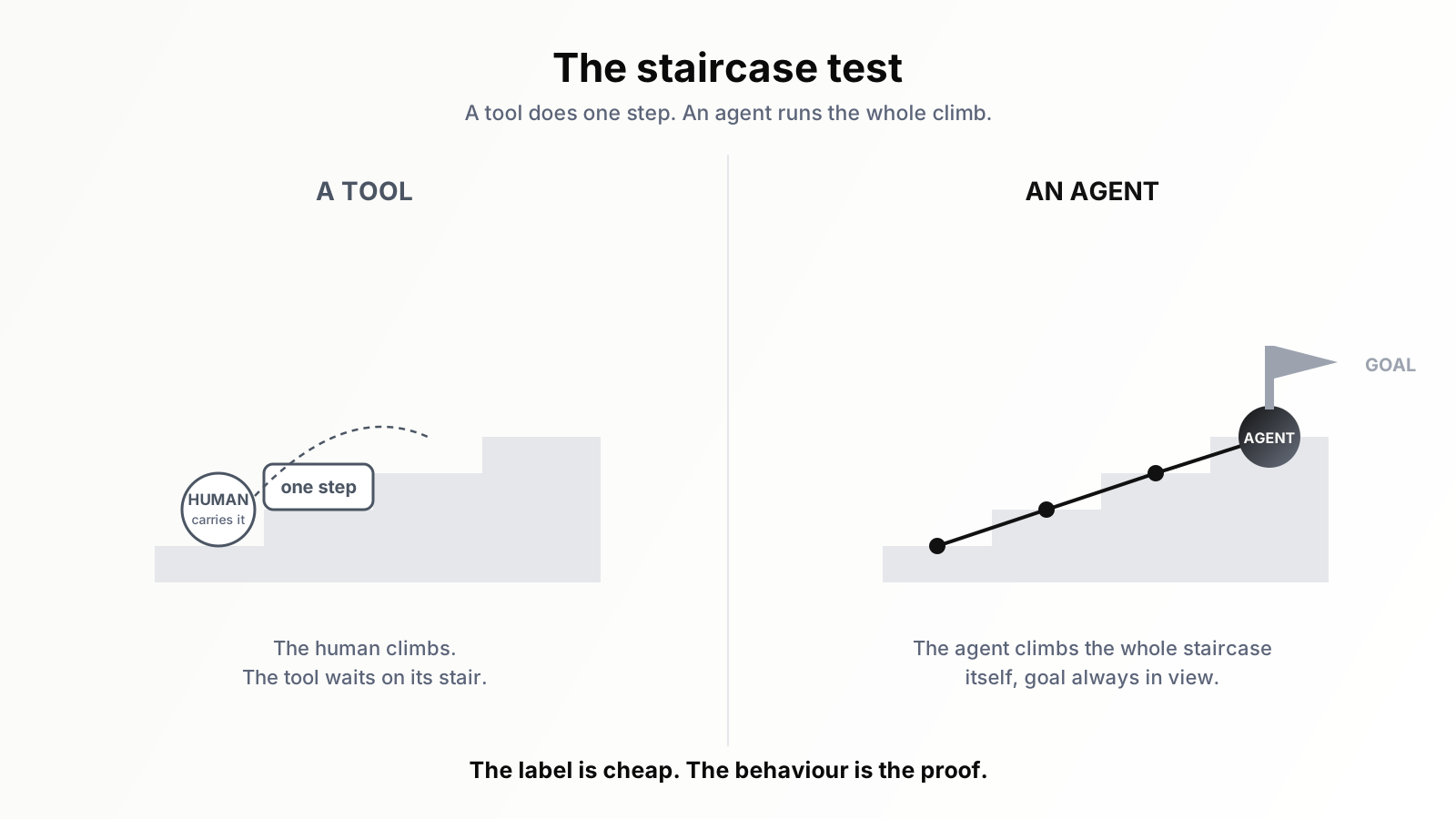
"A tool does one step. An agent runs the staircase."
The third aphorism is about sequence. Real work — in SEO and almost everywhere else — is rarely a single step. It is a staircase: discover, then analyse, then decide, then act, then check, then adjust. A tool does one step of that staircase, brilliantly perhaps, and then waits. The climbing of the staircase — moving from step to step, carrying what you learned on one step into the next — is done by a human.
An agent runs the staircase itself. It does step one, sees the result, decides step two follows, does it, and continues, without a human lifting the work from stair to stair. The line matters because it locates the labour. In a tool-based workflow, the human is the staircase-runner — the connective effort, the carrying, the remembering-where-you-are is all theirs. In an agent-based workflow, the agent runs the staircase and the human decides which staircase to build and where it should lead. That is not a small change in convenience. It is a change in what the human's job is. We trace the same shift in detail in what an SEO AI agent does that a tool can't.
"You go to a tool. An agent comes to you."
The fourth line is about initiative, and it captures something people feel before they can name it. A tool is a destination. It sits where it is, inert, until you decide to go to it — open it, log in, run something. It will never reach out. If a problem arises the moment after you close the tab, the tool will not tell you, because being-gone-to is the entirety of its interaction model. It cannot initiate; it can only respond.
An agent can come to you. Because it is pursuing a goal and holds memory and runs continuously, it can notice that something relevant has changed and surface it — unprompted. A page falls out of the index; the agent tells you. A competitor moves into your territory; the agent flags it. The direction of the first move is reversed. With a tool, the human always moves first. With an agent, the software can. "You go to a tool; an agent comes to you" is the line that separates passive software you must remember to consult from active software that watches on your behalf.
"A tool is a hammer. An agent is a contractor."
The fifth aphorism is the one to use when explaining the distinction to someone outside the field, because the analogy does the work instantly. A hammer is a tool. It is excellent at its one job. It has no idea what you are building, it will not pick itself up, it will not tell you the wall is crooked, and it certainly will not decide that the next task is to fetch the screwdriver. A hammer is pure capability with zero agency, and that is not a flaw — it is exactly what a hammer should be.
A contractor is an agent. You do not hand a contractor a question; you hand them a goal — "build me a kitchen" — and they hold that goal, plan the sequence, pick up whichever tools each step needs, notice problems, adjust, and keep going until the goal is met. A contractor uses tools; a contractor is not a tool. And this is the line that dissolves the false rivalry: an agent does not replace your tools any more than a contractor replaces hammers. The agent uses tools. The real comparison is never "tool versus agent" as competitors. It is "a pile of excellent tools and a human contractor" versus "a pile of excellent tools and a software contractor." The question is only who holds the goal and runs the job.
"The label is cheap. The behaviour is the proof."
The sixth line is the practical one, the one that protects you in a market where "agent" is on every brochure. The word is free. Any vendor can print it. The word tells you nothing; only the behaviour does. So do not evaluate the label — evaluate against the aphorisms, each of which is really a behavioural test.
Does it pursue goals or only answer questions? Does it remember yesterday or start every session blank? Does it run the whole staircase or perform one step and wait? Does it come to you with what matters, or must you always go to it? Does it behave like a contractor that holds the job, or like a hammer that holds nothing? Run those five tests and the truth is plain regardless of what the marketing says. A product can call itself an agent and fail every test — that is a tool with a costume. A product can quietly pass all five — that is an agent whether or not it shouts the word. The label is cheap. The behaviour is the proof.
"Use a tool for a task. Hire an agent for a job."
The seventh line settles the question of when each is right, because the distinction is not a verdict that agents are good and tools are bad. Tools are excellent — for tasks. A task is bounded, single-step, well-defined: get me this number, check this one page, generate this snippet. For a task, a tool is the correct, efficient, sensible choice, and reaching for an agent would be absurd overkill, like hiring a contractor to drive one nail.
An agent is right for a job. A job is open-ended, multi-step, ongoing, goal-shaped: keep this site's SEO healthy, build and maintain this content program, watch this library and improve it over time. For a job, a tool is the wrong shape — it forces a human to be the contractor, doing all the holding and chaining and remembering. "Use a tool for a task; hire an agent for a job" tells you which to reach for: name the thing in front of you, decide honestly whether it is a task or a job, and choose accordingly. Most teams own plenty of tools and have quietly been asking a human to be the agent. That theme — collapsing a sprawl of tools into something that holds the job — runs through from 40 tools to one agent: the case for consolidation.
"A tool is honest about being a tool. An agent must earn the name."
Here is an eighth line, and it is about the marketplace rather than the software. A tool, in the old sense, never had to pretend. A keyword research tool called itself a keyword research tool, and everyone knew what that meant — capability, bounded, operated by a human. There was no incentive to inflate the description, because "tool" was not a word that sold a premium.
"Agent" is a word that sells a premium, and that changes the incentives. A vendor whose product is, behaviourally, a tool now has every reason to print "agent" on it anyway, because the word commands attention and budget. This is why the category has become confusing — not because the distinction is genuinely hard, but because the labelling has become unreliable. The aphorism cuts through it: a tool can afford to be honest about being a tool, but anything calling itself an agent should be made to earn the name against the behavioural tests. Honesty is free for the tool and must be verified for the agent. So verify it. Do not extend the benefit of the doubt to a word that is now worth money to misuse.
"An agent fails differently — and that is worth knowing."
One more line, because an honest treatment must address how each kind of software fails. A tool fails simply and visibly. You ask it for a number, it gives you a wrong number or an error, and you notice immediately because the failure is right there in the single output you were looking at. Tool failures are contained: one bad answer, one task, easy to catch.
An agent fails differently. Because it runs multi-step workflows on its own, a mistake on step two can quietly propagate through steps three, four, and five before anyone sees the result. Because it acts with some autonomy, it can take a wrong action without a human in the moment to stop it. This is not an argument against agents — it is an argument for understanding them. An agent's autonomy is exactly what makes it valuable, and it is exactly what makes oversight non-optional. The right posture is not blind trust and not refusal, but designed review: the human sets the goal, the agent runs the work, and the human reviews the reasoning and the output at sensible checkpoints. "An agent fails differently" is the line that reminds you the relationship is supervisory, not hands-off. You are the contractor's client, and a good client still inspects the work.
The difference that matters
Why does any of this matter beyond tidy vocabulary? Because the words shape the buying decision, and the buying decision shapes the work. A team that does not grasp the distinction buys "an AI agent" that is really a tool with a chat box, is disappointed when it still leaves a human running the staircase, and concludes the whole category is hype. A team that does grasp it knows what to test for, buys for the behaviour rather than the label, and gets software that genuinely holds the job.
An SEO AI agent, in the full sense every aphorism here points at, is software that pursues the goal, remembers yesterday, runs the whole staircase, comes to you with what matters, behaves like a contractor rather than a hammer, and is hired for the job rather than the task. Orova is built to be exactly that — not a faster tool, but a contractor for your SEO: it holds the goal, carries the context, runs the multi-step workflows itself, and surfaces what needs your attention without waiting to be asked. Keep the seven lines. Carry them into the next demo. When a product says "agent," do not nod at the word — run it up the staircase and see whether it climbs.
Run your business with AI Agents
Orova is the always-on Biz AI Agent — it plans, runs, and optimizes the work for you. Save time, unlock productivity.
Try it free