
Best way to get backlinks for your website with digital PR
You've probably tried the usual routine: emailing site owners, guest posting, maybe even buying a few links you probably shouldn't have. And yet your rankings barely move. If you're searching for the best way to get backlinks for your website, chances are you've already burned hours on outreach that led nowhere.
The problem is that most link building starts backwards. You're asking strangers for a favor before you've given them any real reason to say yes. Chasing links one email at a time is slow, and worse, the sites you do land on often aren't ones that move the needle with Google or with real customers. That matters more than ever now that, according to SparkToro, 68% of US Google searches in the first four months of 2026 ended without a click, up from 60% in 2024, meaning the old game of chasing rankings for their own sake is losing ground fast.
This article flips that approach. Instead of chasing links, you'll learn how to build something worth linking to in the first place, and how to get journalists and bloggers to come to you. By the end, you'll understand exactly what makes a piece of content "linkable," how to pitch it so people actually respond, and how to judge whether an idea is even worth pursuing before you spend a dollar on it.
Picking up nails one by one, or holding a magnet?
Imagine you need to collect lots of iron nails scattered across a big yard. Option one: bend down and pick up each nail — backbreaking, slow, and a whole day yields little. Option two: hold a strong magnet and walk a lap — the nails pull themselves toward you, in bulk, no bending. Same goal "collect nails", but one way is hard labor, the other is letting the pull do the work for you.
Earning backlinks has the same two ways. Knocking on each website to ask for a link (like picking up each nail) is exhausting with a low success rate. The opposite way — Digital PR — is creating something so good that others voluntarily mention and link to it, including big publications. You stop begging; you become the magnet that pulls links in. That "magnet" has a name: linkable asset.
This guide shows how to build the magnet: what Digital PR and a linkable asset are, why "bait" beats begging, the assets worth investing in, what makes an asset newsworthy, the Digital PR process, how to pitch the press, and the pass standard.
What is Digital PR? Combining PR (press relations) with SEO: creating newsworthy content/stories, then pitching them to journalists, bloggers, and reputable sites so they publish and link back to you. Unlike traditional PR aiming only at "being mentioned", Digital PR also targets quality backlinks — fame and SEO at once.
Linkable asset: the "magnet" that pulls links
What is a linkable asset? Content so good/useful/notable that others voluntarily link to it without you asking — like original research, a free tool, a deeply thorough guide, an infographic, a data map. It's a "magnet": build it once, pull links for a long time.
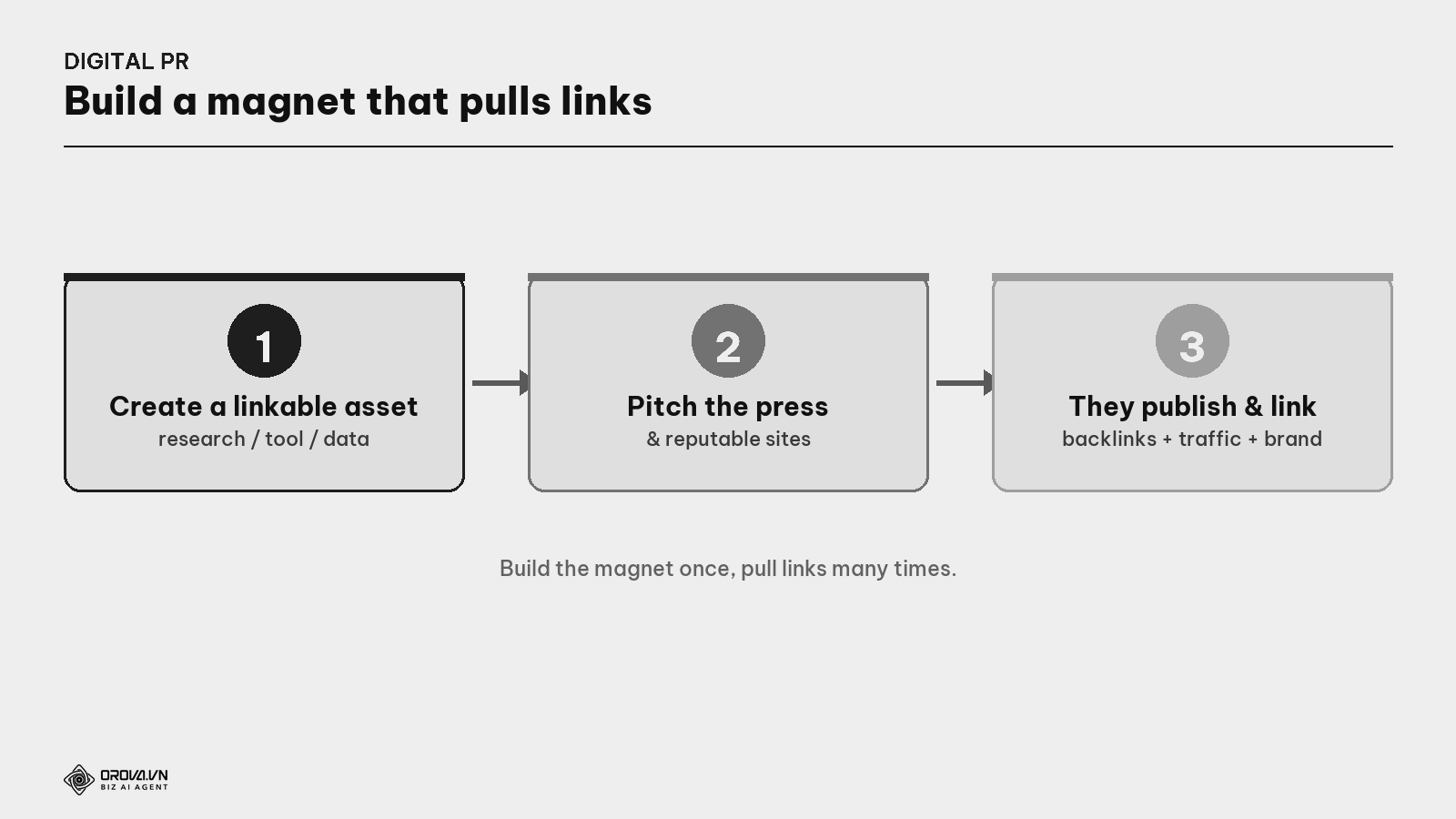
Why does "bait" beat begging? When you ask for a link, what does the other side get? Almost nothing — so rejection is high. When you have a truly newsworthy asset, the journalist gets great content for their readers — so they want to publish. You flip it: from "please link to me" to "I have something great for you". That's the difference between bending to pick up and letting a magnet pull.
Linkable assets worth investing in
Not all content is a magnet. Here are the types that pull links best.
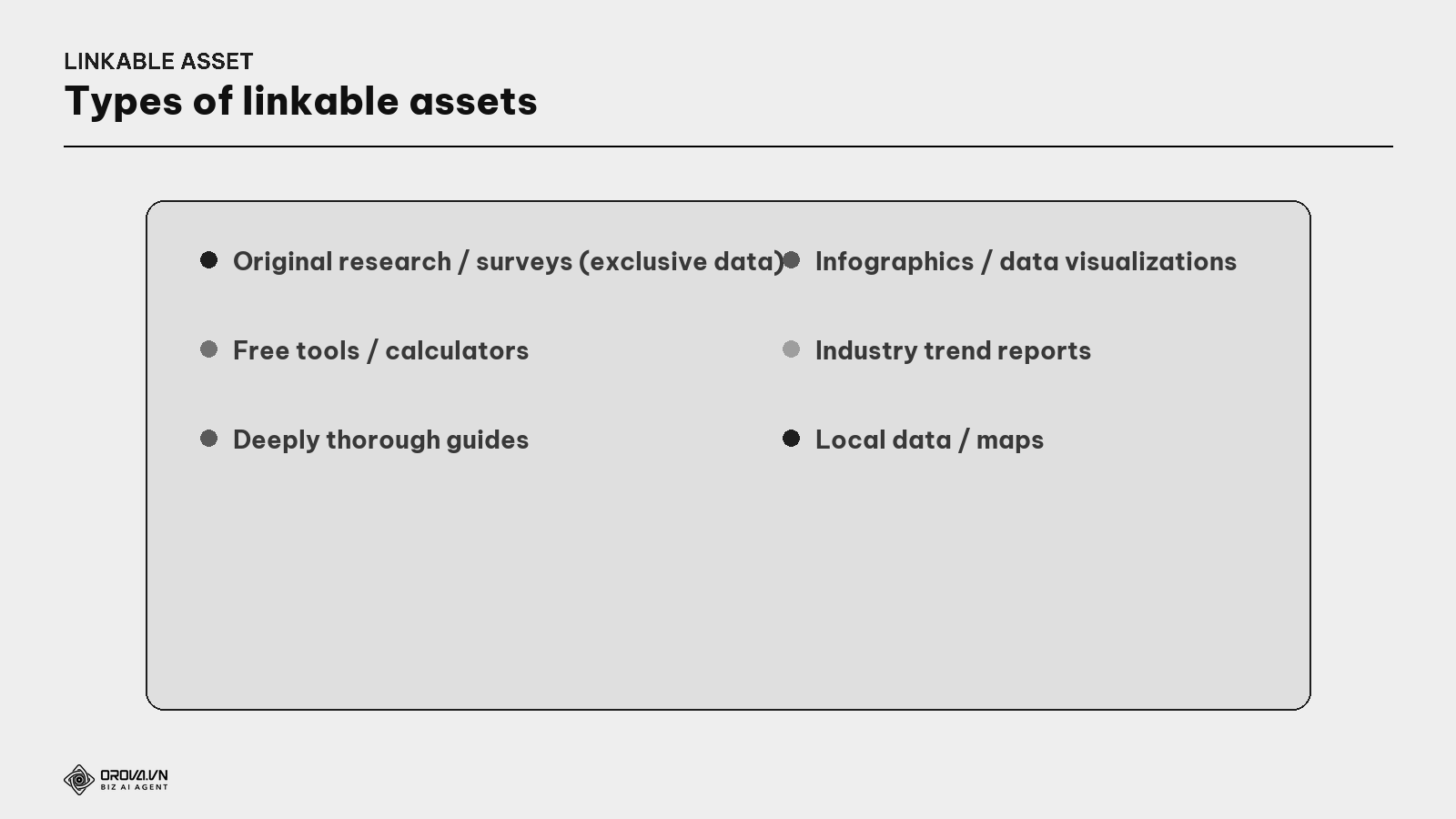
- Original research / surveys — your own data that the press wants to cite. The strongest link magnet, because everyone citing must credit you.
- Free tools / calculators — useful things people return to and recommend.
- Deeply thorough guides — pieces that go "all the way" on a topic, becoming reference material (like this very SEO guide series).
- Infographics / data visualizations — turn dry data into shareable visuals.
- Industry trend reports — newsworthy syntheses of trends.
- Local data — region-specific data/maps that attract local press.
What makes an asset newsworthy
Among research pieces, some get cited by a hundred outlets, some by none. The difference is four factors.
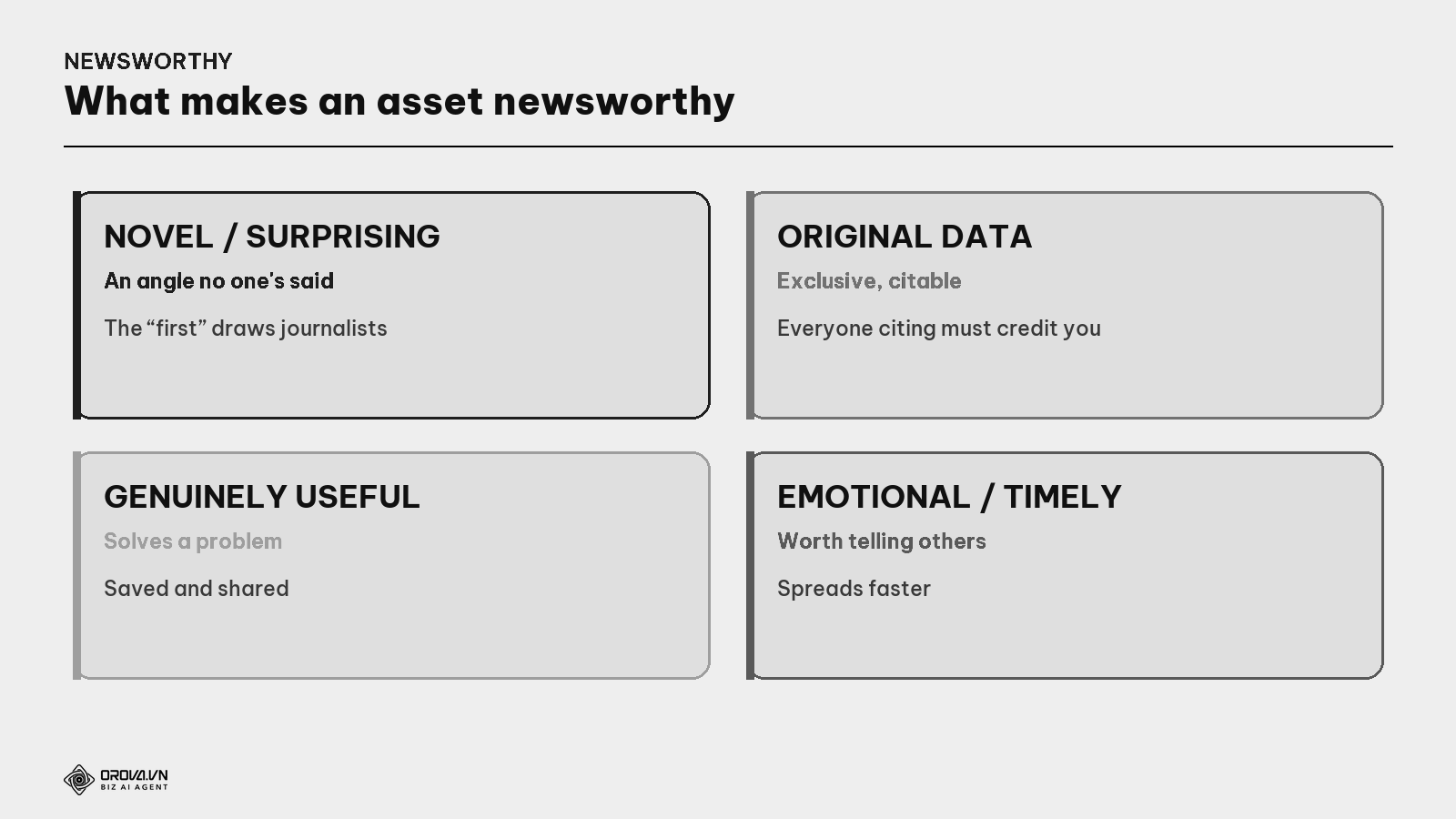
- Novel / surprising — an angle or number no one has said before. The "first" and "surprising" draw journalists.
- Original data — your exclusive data; everyone citing must credit you → natural backlinks.
- Genuinely useful — solves a real reader problem; useful things get saved and shared.
- Emotional / timely — tied to what people currently care about; "worth telling others" content spreads faster.
An asset with all four is a strong magnet; lacking all four, it's just an ordinary article.
How Digital PR differs from traditional PR and ordinary link building
What is traditional PR? Classic press relations aiming at being mentioned/covered to build brand — but usually indifferent to backlinks. Digital PR inherits PR's art of pitching, but ties it to SEO goals: being mentioned with a quality link.
Versus ordinary "begging" link building: ordinary link building focuses on earning each link; Digital PR focuses on creating something worth mentioning and letting links arrive in bulk. One is shot-by-shot tactics, the other is a strategy of creating pull. They complement each other (see the Link Building guide).
The Digital PR process
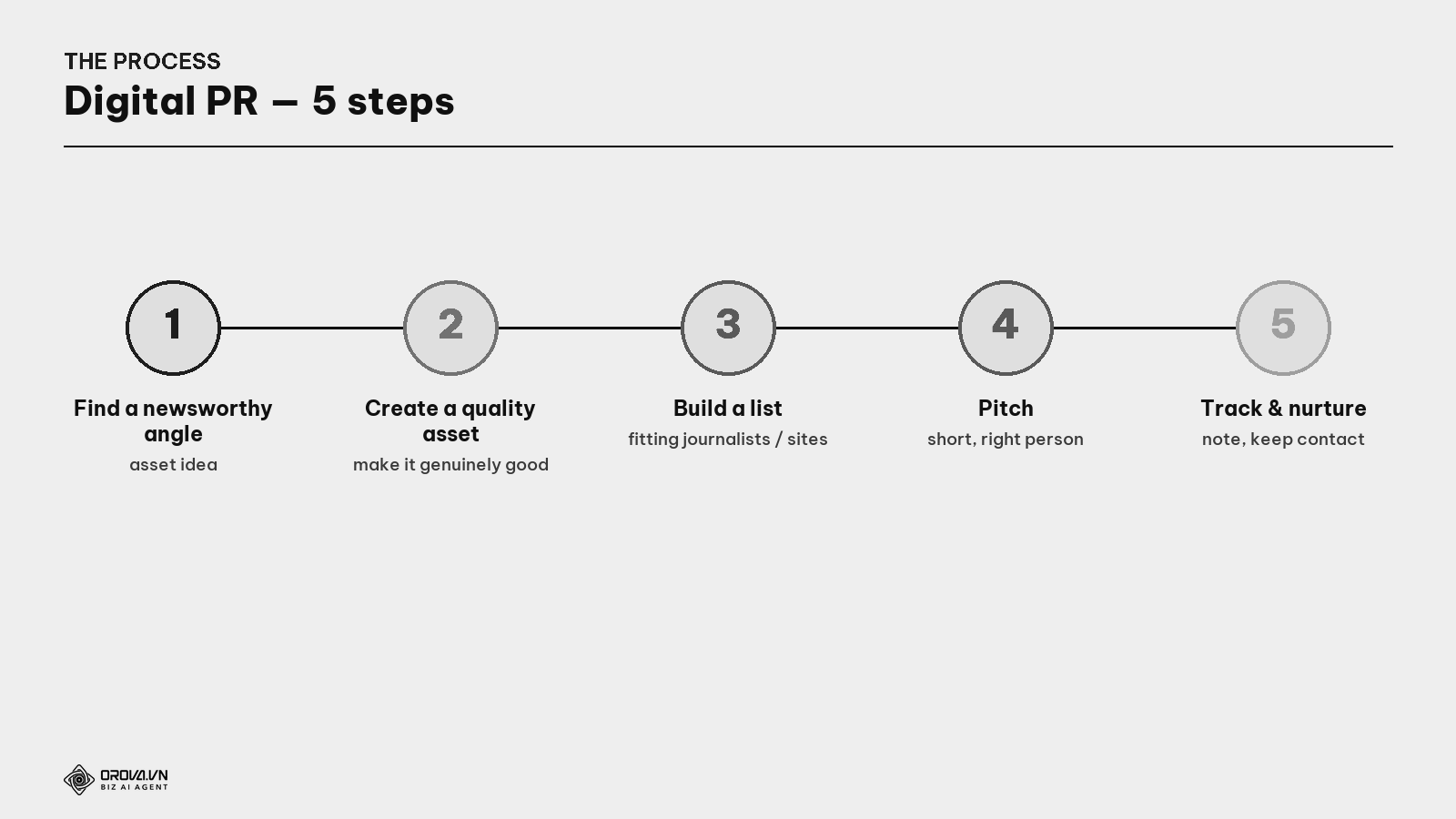
- Find a newsworthy angle — an asset idea with novelty/data/usefulness/timeliness (see the table above).
- Create a quality asset — make it genuinely good; a weak magnet pulls nothing.
- Build a list of journalists/sites who write about your topic, reputable and relevant.
- Pitch — a short, right-person email, clearly stating why this story is great for their readers.
- Track & nurture — note who published, thank them, keep the relationship for next time.
What is a pitch? The story offer you send a journalist/editor: short, to the point, stating your story/data and why it's worth publishing. A good pitch = right person + right angle + short enough to read in 30 seconds.
How to pitch the press effectively
A great asset with a poor pitch still fails. Four pitch principles.
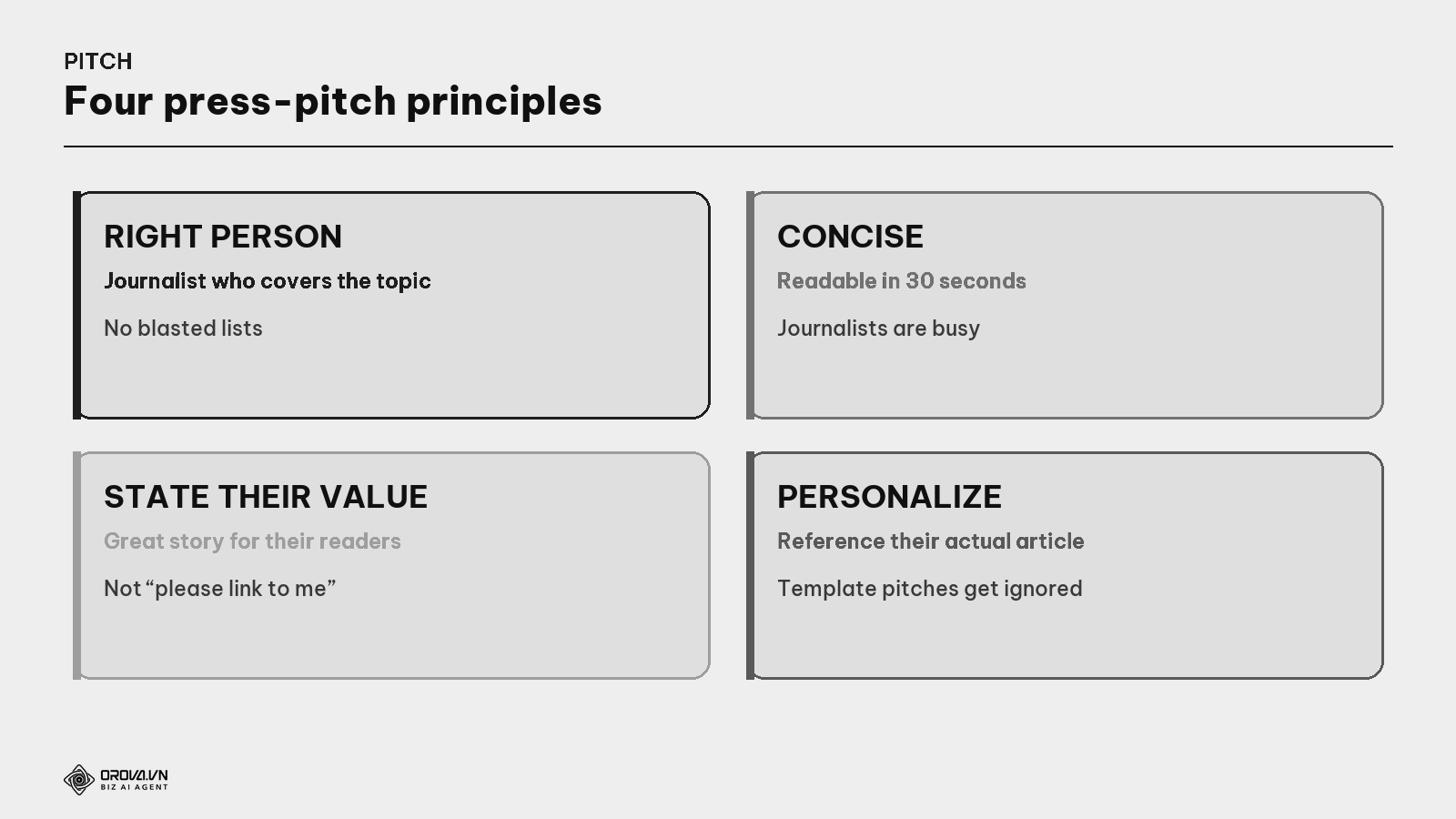
- Right person — send to a journalist who actually covers that topic, not a blasted list.
- Concise — clear email subject, body readable in 30 seconds; journalists are very busy.
- State their value — emphasize why this story is great for their readers, not "please link to me".
- Personalize — reference the actual article/topic they've written; mass-template pitches get ignored.
"Pass" standard
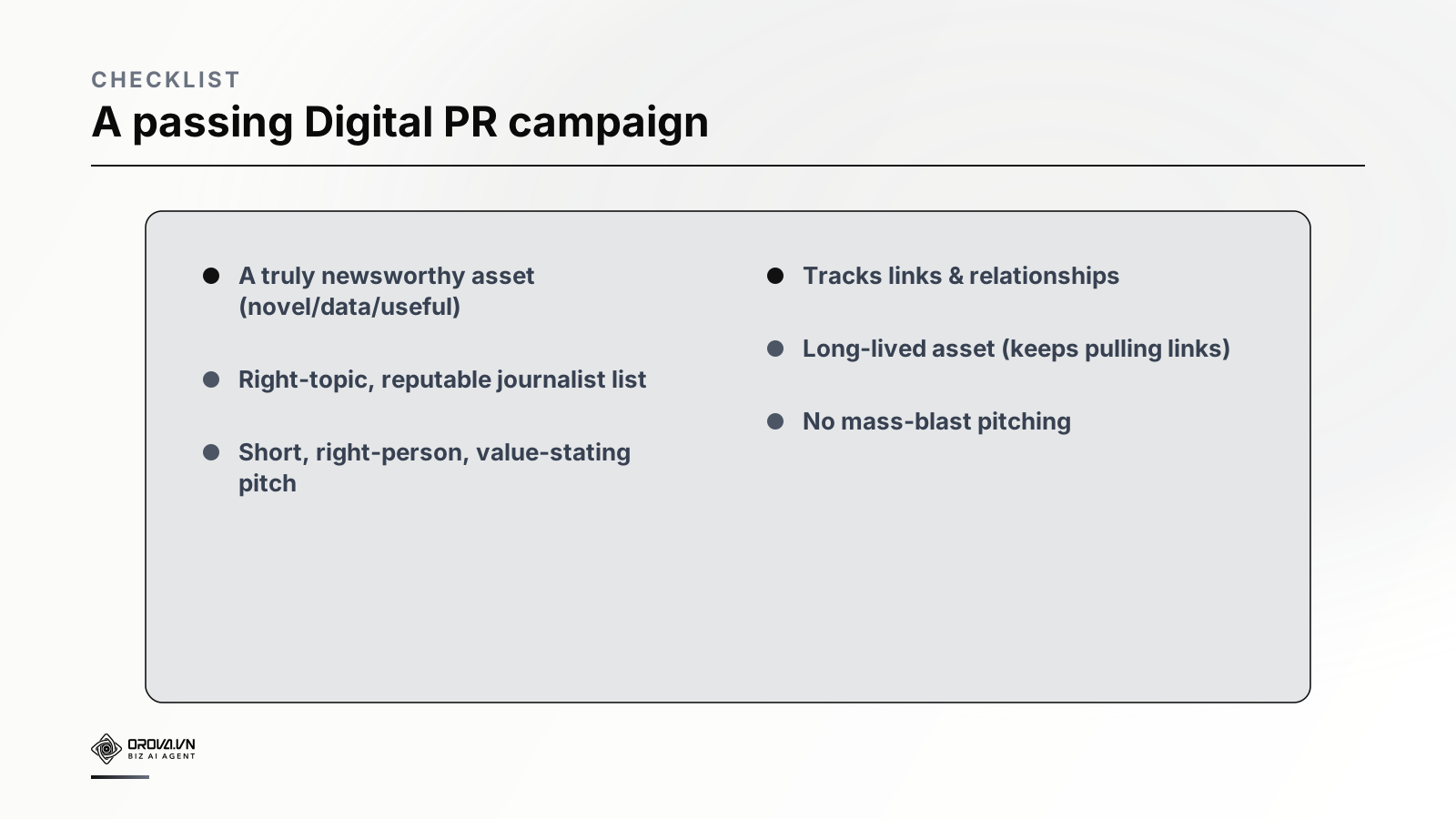
"Pass" standard: you have a truly newsworthy asset (at least one of: a novel angle, original data, clear usefulness, timeliness); a list of right-topic, reputable journalists/sites; a short, right-person pitch clearly stating their value; and you track the links earned + nurture relationships for next time. At this level, you're no longer bending for each link — you have a magnet steadily pulling authoritative links in.
Benefit: Digital PR gives three things at once from one effort: quality backlinks (SEO authority), referral traffic (real readers from the press), and brand awareness (mentioned at reputable places). More importantly, a good linkable asset lives long — built once, it keeps pulling links and citations for months, years. That's the difference between laboring for links shot-by-shot and building an asset that pays interest for the long term.
FAQ
How does Digital PR differ from ordinary link building? Ordinary link building focuses on earning each link (asking, guest posts...). Digital PR focuses on creating something worth mentioning and letting links arrive in bulk, plus traffic and brand. One is shot-by-shot tactics, the other creates pull.
I don't have a big budget — can I do Digital PR? Yes. You don't need a million-dollar survey — a fresh-angle analysis of existing data, a small useful tool, or a deeply thorough guide are good assets too. What matters is a novel angle and usefulness, not budget.
Which linkable asset pulls links most easily? Research/surveys with original data — because everyone citing the data must credit you. Then free tools and deeply thorough guides. Pick the type you can do genuinely well with your current resources.
How many journalists should I pitch? Not the number, but the right people. Ten personalized pitches to journalists who cover your topic beat a hundred mass emails. List and pitch quality matter more than quantity.
How long until Digital PR works? Creating a good asset takes time, and getting published needs a few weeks of outreach. But once an asset "lands", it keeps pulling links long-term — slow to start but cumulative and durable.
Do old assets still pull links? Yes, if they stay useful/credible. Outdated data needs updating (see the Content Refresh guide) to keep being cited. "Evergreen" assets (tools, foundational guides) pull links steadily for years.
Does Digital PR help the brand beyond SEO? A great deal. Beyond backlinks, you get mentioned at reputable places (building E-E-A-T — see its guide), referral traffic from real readers, and higher brand awareness. That's why Digital PR is far more worth investing in than just "getting links".
Back to the magnet
Remember the two ways to collect nails? Bending to pick up each one is backbreaking for little; holding a magnet and walking a lap pulls them in by the bunch. The difference isn't the number of nails in the yard — it's whether you use your own strength or use the pull.
Digital PR is forging that magnet for your SEO. Stop knocking on doors begging for each link — exhausting, with a high miss rate. Create a truly newsworthy linkable asset: original data, a useful tool, a guide that goes all the way — then pitch it to the right people. When the asset is strong enough, the press and reputable sites come to you, links arriving in bulk, with traffic and reputation too. Build the magnet once, pull links many times — that's how an asset-builder does SEO, not a laborer trading links shot-by-shot.
This article is part of Orova's complete SEO guide series. It's a deep-dive within the cluster — see "Link Building", "E-E-A-T", and "Content Refresh & Pruning" for the full picture. Get started with Orova at orova.vn/en/seo.
Sources
Ahrefs & Moz (linkable assets, Digital PR, link earning) · Search Engine Journal (Digital PR & outreach) · BuzzStream / Muck Rack (press pitching & media relations).
Stop Chasing Links, Start Attracting Them
Doing this manually means spending real hours on research, writing pitch after pitch, tracking who replied, and following up without knowing if any of it will pay off. Even when you get the process right, it's still a lot of ongoing work to keep the links coming in.
This is exactly the kind of heavy lifting Orova SEO is built to take off your plate, handling the repetitive parts of finding opportunities and getting your content in front of the right people automatically. If that sounds like time you'd rather spend running your business, it's worth taking a look.
Related reading: Digital PR Link Building: Earn Links Without Begging
Let Orova SEO handle the repetitive part
Keyword research, drafting, refreshing old posts and rank tracking — running automatically on your own site.
Explore Orova SEO