
Marketing Mix Modeling vs Attribution: Which to Trust
A consumer brand we worked with once spent two quarters arguing in circles. The performance team pointed at their attribution dashboard, where last-click and data-driven models both credited paid search with roughly 60% of online revenue. The brand team pointed at a marketing mix model run by an outside consultancy, which credited paid search with closer to 18% and gave the lion's share to television and out-of-home. Same company, same revenue, same period, two numbers that were off by more than three times. Neither team was lying. Neither model was broken. They were simply answering two different questions, and nobody had stopped to ask which question the budget meeting actually needed answered.
This is the heart of the marketing mix modeling vs attribution debate, and it is worth getting right because billions of dollars in spend are reallocated every year on the strength of whichever number happens to be on the slide. The honest answer is that you should not pick one. You should understand what each tool can and cannot see, run a third method as a tie-breaker, and let each measurement layer govern the decisions it is actually qualified to make. This article walks through how the two approaches differ, where each one quietly lies to you, why incrementality testing is the referee both of them need, and how an AI agent fits into the picture by acting on the granular layer where decisions happen every single day.
Two methods built for two different worlds
Attribution and marketing mix modeling were not designed as competitors. They grew up in different eras, solving different problems, and the fact that they now sit on adjacent tabs in the same reporting tool obscures how little they have in common under the hood.
What attribution actually does
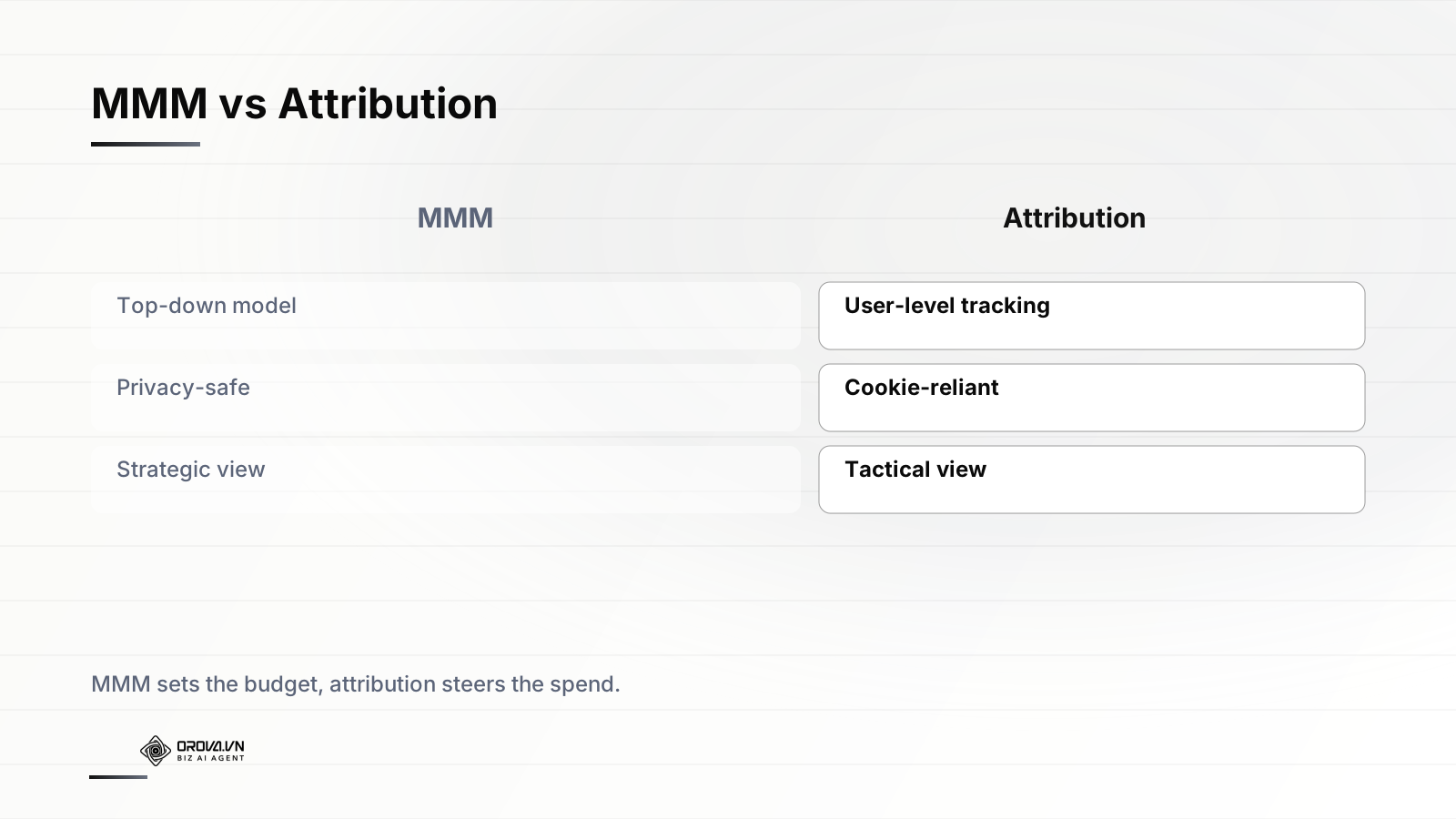
Attribution, and specifically multi-touch attribution (MTA), is a bottom-up method. It starts with an individual person, stitches together the touchpoints that person encountered on the way to a conversion, and then divides credit for that conversion across those touchpoints according to a rule. The rule can be crude (last click gets everything) or sophisticated (a data-driven model that uses Shapley values or a Markov chain to estimate each touchpoint's marginal contribution). But the foundation is always the same: a tracked user journey, assembled from cookies, device IDs, login states, and click identifiers.
The appeal of attribution is granularity and speed. Because it works at the level of the individual click, it can tell you that the "summer-sale-broad-prospecting" ad set on Meta drove 47 conversions yesterday at a cost per acquisition of $22, while a near-identical ad set targeting a lookalike audience drove 31 at $34. That resolution is exactly what you need to make tactical calls: which keyword to bid up, which creative to pause, which audience to scale. Attribution operates on a daily, even hourly, clock. You can act on it before the campaign has finished running.
What marketing mix modeling actually does
Marketing mix modeling (MMM) is a top-down method, and it could not be more different in spirit. Rather than tracking individuals, MMM takes aggregate data, total weekly sales, total spend per channel, plus external factors like seasonality, pricing, promotions, weather, and competitor activity, and fits a statistical model (historically multiple regression, increasingly Bayesian time-series models) that estimates how much each input contributed to the output. It never sees a single user. It sees columns of weekly or daily totals and asks: when we moved this lever, what happened to sales?
Because MMM works on aggregates, it is immune to almost everything that is breaking attribution right now. It does not need cookies. It does not care whether iOS users opted out of tracking. It is happy to measure television, radio, billboards, podcasts, sponsorships, and any other channel where individual tracking is impossible. It also captures effects attribution structurally cannot, such as ad stock and carryover (the fact that a TV campaign keeps lifting sales for weeks after it airs) and saturation (the fact that the tenth million dollars in a channel buys far less than the first million). The price you pay is resolution and latency. A good MMM tells you that paid social as a whole contributed roughly 14% of incremental sales last quarter, plus or minus a confidence interval. It will not tell you which ad set to pause, and it cannot tell you anything about this week because it needs months of history to fit.
Where each method quietly lies to you
If both methods were unbiased, the discrepancy in our opening story would be impossible. The gap exists because each approach has systematic blind spots, and those blind spots push the numbers in predictable directions. Understanding the direction of the error is what lets you read either report intelligently instead of taking it at face value.
The blind spots of attribution
Attribution's central weakness is that it can only credit what it can track, and it increasingly cannot track very much. The deprecation of third-party cookies, Apple's App Tracking Transparency, intelligent tracking prevention in browsers, and the general tightening of privacy regulation have all eroded the user-level data that MTA depends on. When a journey is partly invisible, the visible touchpoints inherit credit they did not earn. This is why platforms that own a login, like Google and Meta, tend to look fantastic in attribution reports: they can see their own users, so their own touchpoints get stitched into journeys while upper-funnel and offline channels go dark.
There is a deeper, structural problem too: correlation is not causation, and attribution cannot tell the difference. A retargeting ad served to someone who already typed your brand name into search and added a product to cart will reliably show a gorgeous conversion rate. Attribution dutifully hands that ad most of the credit. But would the person have bought anyway? Very often, yes. Attribution counts the touchpoint that happened to be standing closest to the conversion, regardless of whether it caused anything. This is the single biggest reason performance channels are overcredited: the bottom of the funnel is where people who were already going to convert collide with the ads chasing them. Brand search, retargeting, and email frequently look like the best-performing channels in any attribution model precisely because they harvest demand that other, less measurable channels created.
Garbage in, garbage out applies with full force here. Attribution is only as trustworthy as the event data feeding it, and most accounts have duplicate conversions, broken tags, and consent gaps quietly corrupting the numbers. Before you trust any attribution model, the tracking underneath it has to be sound, which is why getting clean conversion data as a prerequisite for measurement is non-negotiable. No model, however clever, can rescue a dataset that is double-counting purchases or losing a third of its events to consent mode.
The blind spots of marketing mix modeling
MMM dodges the tracking problem but introduces problems of its own, and they are subtler because they hide inside the statistics. The first is collinearity. Marketers tend to spend across channels in synchronized waves, the budget goes up everywhere for the holiday push and down everywhere in the lull. When two channels move together, a regression cannot cleanly separate their effects, and the model has to guess how to split the credit. Small changes in the data or the model specification can swing those estimates substantially, which is why two competent analysts can build two MMMs on the same data and disagree.
The second is the modeler's hand. MMM is full of choices: how to model carryover decay, where saturation curves bend, which control variables to include, what priors to set in a Bayesian model. Each choice is defensible, and each one moves the answer. A model is not an objective readout of reality; it is a hypothesis about reality with parameters tuned to fit history. That tuning means MMM can be confidently wrong, and its aggregate, slow-moving nature makes the error hard to catch.
The third blind spot is granularity, which is not a bug so much as a category limit. Even a flawless MMM operates at the level of the channel, or at best the campaign type. It will never tell you which keyword, which creative, or which audience is working. Trying to run daily optimization off an MMM is like trying to parallel-park using satellite imagery: the resolution is wrong for the task. Finally, MMM is hungry. It typically needs two to three years of history with enough variation in spend to estimate response curves, and it is slow to refresh, monthly or quarterly in most shops. By the time it tells you a channel is saturated, you may have been overspending for a quarter.
Incrementality: the referee both methods need
So we have a fast, granular method that systematically overcredits the bottom of the funnel, and a slow, strategic method that is privacy-safe but blurry and assumption-laden. When they disagree, who wins? Neither, on its own authority. You need a third method that measures the one thing both of the others only infer: causation. That method is incrementality testing, and it is the tie-breaker that turns two arguing models into a coherent measurement system.
Incrementality answers the only question that ultimately matters: if we had not run this, what would have happened anyway? The cleanest way to find out is experimentation. A geo holdout splits markets into a test group that sees the campaign and a control group that does not, then compares the difference in outcomes. A conversion lift study, offered natively by the major ad platforms, randomly withholds ads from a control set of users and measures the incremental conversions among those who would have been exposed. Public service announcement (PSA) tests show a neutral ad to the control group so both groups have the same ad-load experience. In every case the logic is the same: create a counterfactual, measure against it, and read off the genuinely incremental effect.
Attribution tells you where conversions appeared. MMM tells you how the channels combined to drive sales. Only incrementality tells you what would have happened if you had done nothing, and that is the number a budget decision actually rests on.
The power of incrementality is that it grounds the other two. When attribution claims retargeting drives a 6x return but a holdout test shows the incremental return is closer to 1.4x, you have just discovered exactly how much demand-harvesting inflation is baked into your attribution. When MMM says social contributed 14% but you want to act with more confidence, a lift study on a representative campaign calibrates the model against reality. Incrementality is the expensive, slow, but trustworthy measurement that you sprinkle across the system to keep the cheap, fast measurements honest. You do not run it on everything; you run it on the decisions large enough to justify the cost and the channels most prone to over- or under-crediting.
Three layers of truth, three different jobs
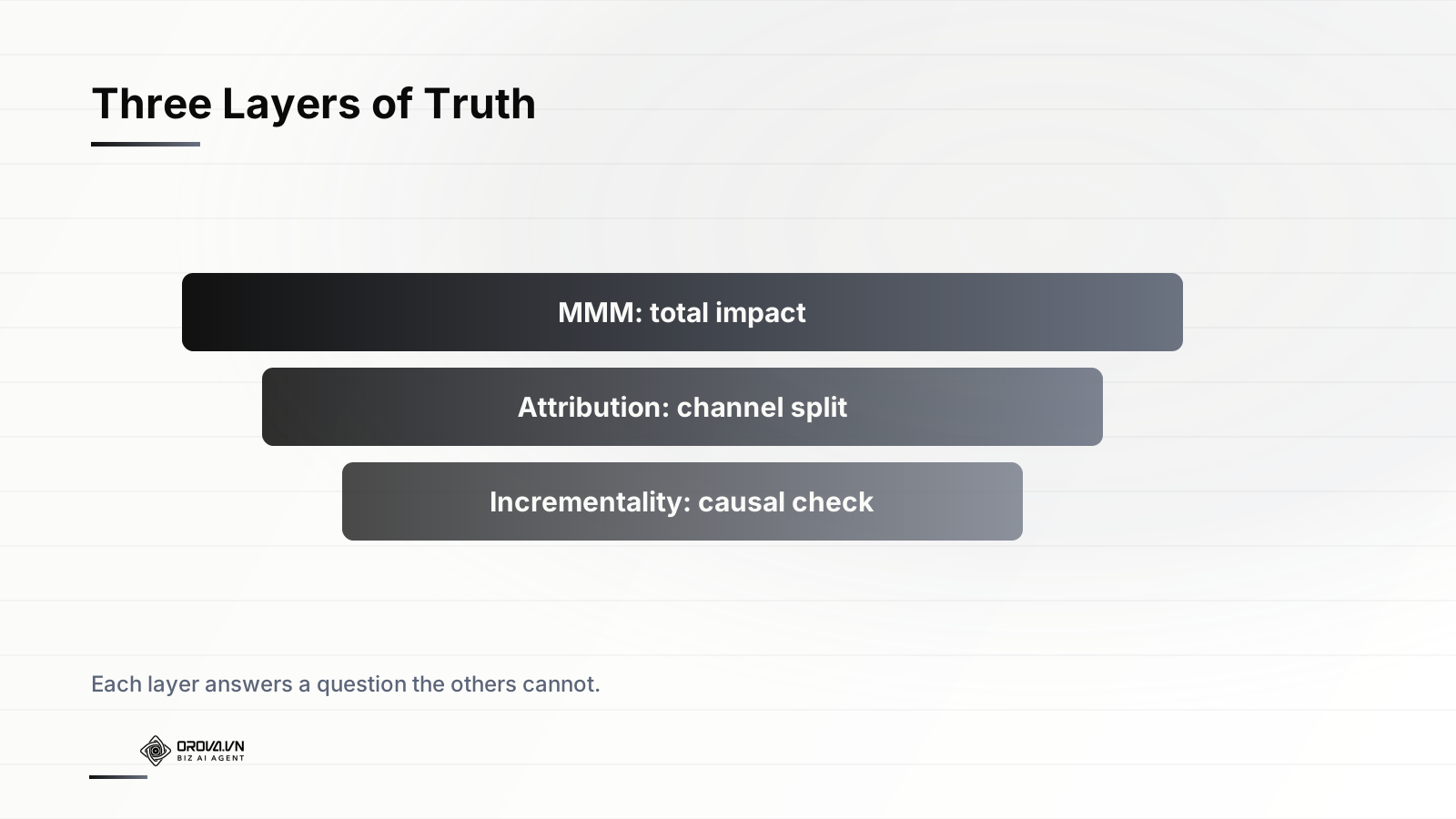
The most useful mental model is not "which to trust" but "which to trust for what." Mature measurement teams run all three methods and assign each one the decision it is qualified to make. Think of it as a hierarchy of zoom levels.
MMM sets the envelope
MMM operates at the altitude of the annual and quarterly budget. Its job is to answer the big allocation questions: how much should go to brand versus performance, to upper funnel versus lower funnel, to digital versus offline? Because it sees saturation curves, it is the only method that can tell you a channel is hitting diminishing returns and the next dollar is better spent elsewhere. Treat MMM as the instrument that draws the boundaries of each channel's budget. It says "paid social should sit somewhere between 12% and 16% of spend this year," and that is a strategic guardrail, not a daily instruction.
Attribution steers inside the envelope
Once MMM has set how much paid social gets, attribution governs how that budget is deployed day to day. Within the boundary MMM drew, attribution's granularity is exactly what you want: which campaigns, ad sets, keywords, and creatives are pulling their weight, and which are dragging. The trick is to use attribution for relative comparison within a channel, where its biases are roughly constant and therefore cancel out, rather than for absolute cross-channel claims, where its biases differ wildly by channel and lead you astray. Attribution is excellent at telling you that creative A beats creative B in the same ad set. It is dangerous when it tells you brand search beats connected TV, because those two channels are tracked with completely different fidelity.
Incrementality calibrates both
Incrementality runs on a slower cadence, perhaps a few well-chosen tests per quarter, and its job is calibration. It produces correction factors that you fold back into the other two layers: a multiplier that deflates retargeting's attributed return to its true incremental value, a validation that the MMM's estimate for a channel is in the right ballpark. Over time these tests accumulate into a body of knowledge about how much each channel's reported numbers should be trusted, and that knowledge is what keeps the whole system from drifting into self-deception.
Here is how the three fit together in practice, as a working loop:
- Quarterly: refresh the MMM, read off the recommended budget split and saturation warnings, and set channel-level budget envelopes.
- Per quarter, selectively: run incrementality tests on the highest-spend or most-suspect channels to derive correction factors.
- Daily: apply those correction factors to attribution data, then optimize within each channel's envelope, scaling what works and cutting what does not.
- Continuously: feed actual results back so the next MMM refresh and the next round of tests are fitted on better data.
Why the daily layer is where agents live
Notice that two of those three layers, MMM and incrementality, are deliberate, infrequent, expensive, and analyst-led. They are strategic exercises you run a handful of times a year. But the third layer, the daily optimization inside the budget envelope, is relentless, high-frequency, and combinatorially huge. A mid-sized account might have hundreds of ad sets, thousands of keywords, and dozens of audiences, each generating fresh data every day. No human reviews all of it. In practice, most accounts get a weekly glance at the top spenders and a great deal of inertia everywhere else, which is exactly where money quietly leaks: the bid that should have come down three days ago, the creative whose fatigue started last Tuesday, the audience that quietly stopped converting.
This is the natural home for an AI agent, and it is important to be precise about why. An agent does not replace MMM, it cannot draw saturation curves from aggregate sales, and it does not replace incrementality, it cannot run a geo holdout on its own authority. What it does is operate the granular attribution layer at a scale and frequency no human team can sustain. It reads the daily data across every campaign, applies the optimization logic, the budget shifts, bid adjustments, on/off decisions, and audience changes, that a good analyst would apply if they had time to look at everything, and it does so within the strategic guardrails the human-led layers have set. The MMM tells the agent how big each channel's budget should be. The incrementality correction factors tell the agent how much to discount each channel's attributed numbers. Inside those constraints, the agent works the granular layer continuously.
The crucial design point is that the agent stays inside the envelope. Autonomy at the tactical layer is safe precisely because the strategic layer is not autonomous. A human still decides that paid social gets 14% of budget; the agent just spends that 14% as intelligently as possible, hour by hour, across hundreds of decisions. This division of labor is the whole game: humans own the slow, judgment-heavy, causally grounded decisions, and the agent owns the fast, repetitive, data-dense ones. That is also why human-in-the-loop approval and a full audit trail matter, the agent acts at a speed and volume that demands traceability, so that every change it makes can be reviewed, understood, and reversed.
Common mistakes and how to avoid them
Teams tend to fail at this in a small number of recognizable ways. Knowing the failure modes is half the cure.
- Treating one model as ground truth. The single most expensive mistake is picking the model that flatters the channel you already wanted to fund and calling it the answer. Every model is a lens with distortions. Trust the system, not any one number.
- Using attribution for cross-channel allocation. Attribution's biases differ by channel, so comparing channels with it is comparing measurements taken with different rulers. Use it within channels; use MMM across them.
- Believing MMM down to the decimal. An MMM estimate comes with a confidence interval that most decks quietly drop. A point estimate of 14% might really mean "somewhere between 9% and 19%." Treat ranges as ranges.
- Skipping incrementality because it is hard. Geo tests and lift studies take effort and sacrifice a little short-term spend efficiency, so they get postponed forever. Without them you have two models arguing and no referee. Budget for at least a few tests a year on your biggest line items.
- Optimizing on dirty data. All three methods inherit the quality of the underlying event data. A measurement program built on broken tags and duplicated conversions produces confident nonsense at three levels of abstraction instead of one.
- Letting the daily layer run on autopilot without guardrails. Granular optimization is powerful and, unchecked, will happily over-rotate toward whatever attribution overcredits. The strategic layers exist to constrain it; remove the constraints and the agent will chase the same demand-harvesting mirage a junior media buyer would.
A practical starting point
You do not need a data science team and a seven-figure budget to start running all three layers; you need a sequence. Begin with the data foundation, because everything downstream depends on it: audit your conversion tracking, fix duplication and consent gaps, and confirm the numbers reconcile across platforms. Next, accept that your existing attribution, whatever model you run, is your tactical layer, but discipline yourself to use it for within-channel comparison only. Then add incrementality where it is cheap and high-leverage: most platforms offer conversion lift studies you can run with a few clicks, and a single geo holdout on your largest channel will teach you more about your true return than a quarter of dashboard-watching. MMM comes last for most teams, because it is the heaviest lift, but even a lightweight, open-source Bayesian MMM run twice a year will surface saturation and carryover effects your attribution is blind to.
Once those layers are in place, the daily grind of acting on the granular data is the part you should automate. The strategic thinking, what budget envelope, which tests, how to read the results, is irreducibly human. The execution, hundreds of small daily adjustments inside those envelopes, is exactly the kind of work that benefits from an always-on agent that never gets tired, never skips the low-spend campaigns, and logs every move it makes. Documentation and tooling for that execution layer, including how an agent reconciles attributed numbers with incrementality corrections, live alongside the rest of the resources for AI-driven ads management.
The marketing mix modeling vs attribution question, then, has a clean answer once you stop framing it as a contest. MMM is your strategist, attribution is your tactician, and incrementality is your auditor. None of them is trustworthy alone; together they form a measurement system that is far more reliable than the sum of its parts. Get the data clean, let each method do the job it is built for, and reserve your skepticism for any slide that asks you to bet the budget on a single number.
If you want the daily, granular layer handled without leaking money on the campaigns no human has time to review, that is exactly what Orova Ads is built for. It is an AI agent that reads your ad data across Google, Meta, and TikTok every day, recommends and executes the optimizations, budgets, bids, on/off, and audiences, that work inside the strategic guardrails you set, all with human-in-the-loop approval and a full audit log of every change. Let the agent steer the spend so your team can focus on the strategy.
Run your business with AI Agents
Orova is the always-on Biz AI Agent — it plans, runs, and optimizes the work for you. Save time, unlock productivity.
Try it free