
ROAS Formula & Conversion Lag: Why Today's ROAS Is Wrong
On a Monday morning, a media buyer opens her dashboard and sees that yesterday's campaign returned a 1.4x ROAS. The target is 3.0x. Her instinct is to pause the campaign, shift budget elsewhere, and write a Slack message about underperformance. By Friday, that same Sunday will read 3.6x — because the conversions that hadn't landed yet finally arrived. The campaign was never broken. The data was simply too young to trust.
This is conversion lag, and it is one of the most expensive misunderstandings in paid media. Every report you read about recent performance is wrong in a specific, predictable direction: it understates results. The more recent the day, the more it understates. Buyers who do not internalize this end up cutting their best campaigns at exactly the moment those campaigns were about to prove themselves. The fix is not a better dashboard. It is a mental model — and a set of habits — for reading numbers that are still in motion.
What conversion lag actually is
Conversion lag is the gap in time between when an ad interaction happens (a click or a view) and when the conversion it caused is recorded. The click is instantaneous. The conversion is not. A person sees your ad on Tuesday, clicks, browses, leaves, thinks about it, comes back through a branded search on Thursday, and finally buys on Saturday. Depending on your attribution settings, that purchase may get credited back to Tuesday's click — but it only shows up in your reporting after it happens on Saturday.
Crucially, when the conversion is backdated to the click, it does not just appear in Saturday's row. In platforms that use click-time attribution — which includes Google Ads and Meta by default — the conversion is stitched back onto the day of the click. This means a day you looked at on Wednesday can keep gaining conversions for a week or more, retroactively. The Tuesday in your report is not a finished number. It is a number that is still filling up.
That single fact breaks the intuition most people carry from other parts of business. Yesterday's revenue in your accounting system is final. Yesterday's conversions in your ad platform are not. They are an estimate that improves over time as reality catches up.
Why the delay exists in the first place
There are several independent forces stacking on top of each other, and understanding them tells you how big your own lag will be:
- Human deliberation. Higher consideration purchases take longer. A $12 phone case converts in minutes. A $4,000 enterprise software contract converts in weeks. The bigger the decision, the longer the curve.
- Multi-session journeys. Few people buy on the first visit. They click an ad, leave, and return later through a different channel. The conversion is recorded only at the end of that journey, but credited to the earlier ad touch.
- Offline and delayed events. If you import conversions from a CRM, count phone calls, or wait for a refund window to close before counting a sale, those events arrive in your reporting hours or days after they occurred.
- Attribution windows. A 7-day click window literally tells the platform to keep watching for a conversion for seven days after the click. By definition, a click from today can still produce a recorded conversion six days from now.
- Modeled conversions and processing. Privacy changes mean platforms increasingly model conversions they cannot directly observe. These models run on a delay and revise their estimates as more signal arrives.
Add these together and you get a curve, not a point. The curve is the heart of this entire topic.
The conversion delay curve
Imagine you fixed a single day — say, all the clicks that happened on June 1 — and then checked back every day afterward to count how many conversions had been attributed to that day. You would not see a flat line. You would see a curve that rises steeply at first and then flattens as it approaches its true final value.
A typical pattern for a mid-consideration ecommerce product looks something like this: by the end of day zero, you have captured roughly a third of the conversions that day will eventually show. Three days later you might be at two-thirds. By day seven you are near 85%. It can take a full two weeks before the day reaches its mature, final number. Lead-generation and B2B funnels are slower still; some have curves that are not even half complete after a week.
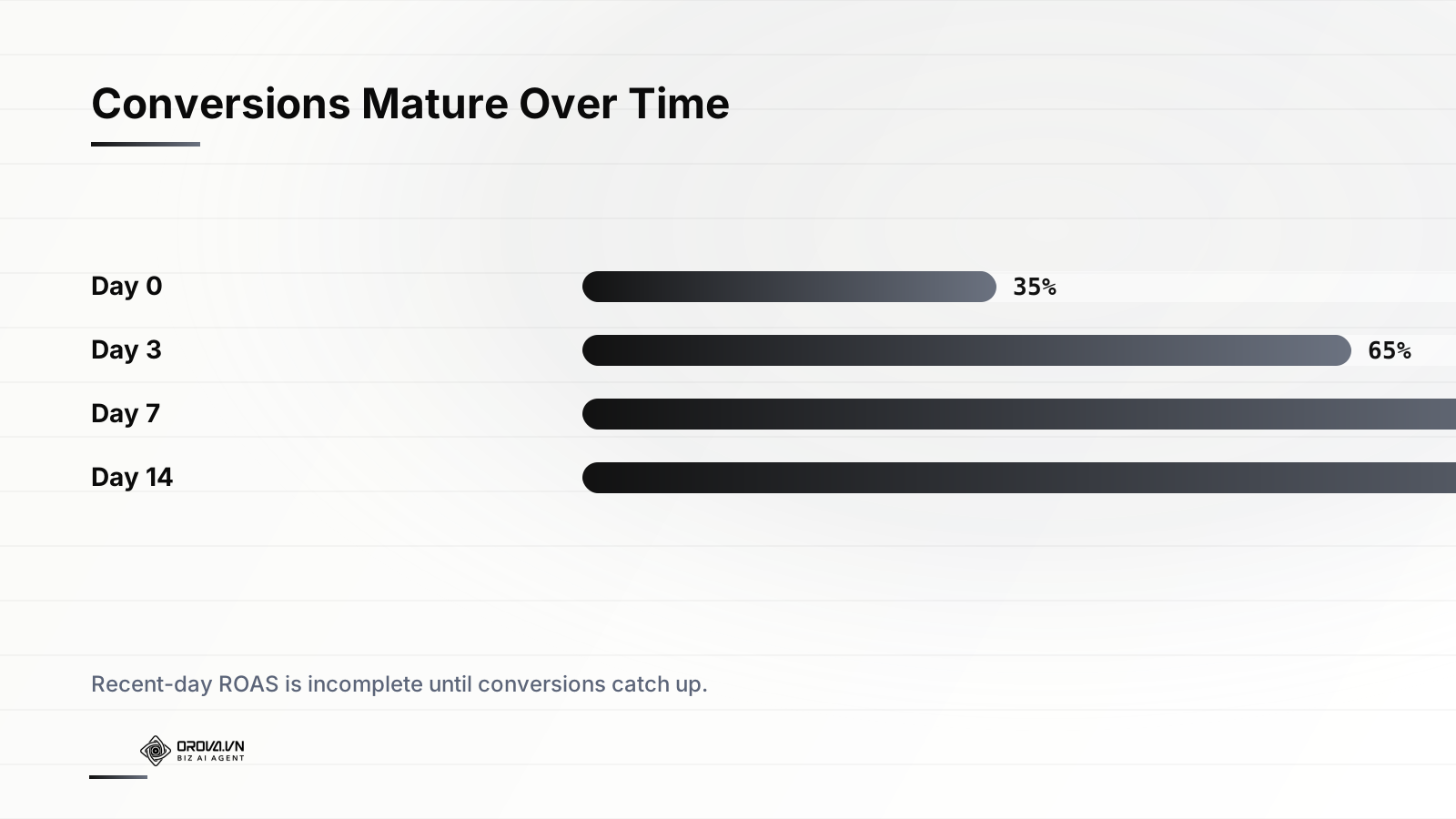
The shape of this curve is the single most useful thing you can know about your own account, and almost nobody measures it. Once you have it, every recent number in your dashboard becomes interpretable. A day that is two days old and shows a 1.5x ROAS is not a 1.5x day — it is a day that has revealed about half of its conversions, so its real ROAS is closer to 3.0x. You stop reacting to the surface number and start reading through it to the destination.
Why recent days always look weak
Put the curve and the calendar together and an inevitable optical illusion appears. The right edge of every trend chart — the most recent days — will always slope downward, even when nothing has changed. Today has only captured its day-zero share of conversions. Yesterday has captured a bit more. The day before, more still. Older days are fully matured. So the line droops at the end purely because the recent days have not had time to fill.
This produces a recurring, demoralizing experience. You glance at the chart, the recent trend looks like a decline, and your brain — wired to spot threats — sounds the alarm. You are reacting to the geometry of incomplete data, not to a real change in performance. The cruelest part is that the illusion is strongest precisely for the campaigns with the longest, most valuable conversion journeys, because their curves take longest to mature.
The right edge of every performance chart slopes down for the same reason a glass you just started filling looks emptier than one filled an hour ago. The water is still running.
This is also why comparing "this week so far" against "last week complete" is one of the most common analytical mistakes in the industry. You are comparing a half-filled glass to a full one and concluding the tap is broken.
How to measure your own lag curve
You cannot manage what you have not measured, and lag is no exception. The good news is that you do not need exotic tools — you need a little discipline and a snapshot habit.
The snapshot method
The most reliable way to learn your curve is to take dated snapshots of the same window over time. Pick a stable, completed day — say, last Tuesday. Today, record how many conversions are attributed to it. Tomorrow, record again. Keep going for two or three weeks. You will watch that single day's number climb and then plateau. Divide each day's count by the final plateau value and you have your maturation curve expressed as percentages: the share of total conversions visible at age zero, age one, age three, and so on.
If you can automate a daily export of conversions-by-day-of-click into a spreadsheet, the curve builds itself. Each row is a click-date; each column is a snapshot-date; the diagonal shows how each cohort fills in. This is the same cohort-triangle technique insurers use to estimate claims that have not been reported yet, and it works just as well for conversions.
Reading the platform's own tools
The major platforms expose some of this directly, and you should use it:
- Google Ads offers conversion-lag and days-to-conversion reporting that tells you the distribution of how long after a click conversions occur. It will also adjust historical numbers upward as conversions land, which is why last week's numbers in Google quietly keep rising for days.
- Meta attributes conversions back to the click or view date within your chosen attribution window, so recent days are similarly incomplete; the longer your window, the longer your tail.
- Any CRM or offline import introduces its own delay on top of the platform's, which you must add to the curve. If sales close in your CRM and upload nightly, every conversion is at minimum a day late before the platform even starts its own lag.
Segment the curve where it matters
A single account-wide curve is a useful start, but lag is not uniform. Segment it where the economics differ. New-customer acquisition usually lags longer than returning-customer purchases. High-ticket products lag longer than impulse buys. Lead funnels with a sales call in the middle lag dramatically longer than direct ecommerce. Search often matures faster than display or video, because search captures people closer to the moment of intent. If you blend a fast funnel and a slow funnel into one average curve, you will under-discount the fast one and over-discount the slow one. Build separate curves for materially different conversion types.
Turning the curve into better decisions
A measured curve is only valuable if it changes what you do. Here is how practitioners who respect lag actually operate differently from those who do not.
Discount fresh data instead of trusting it
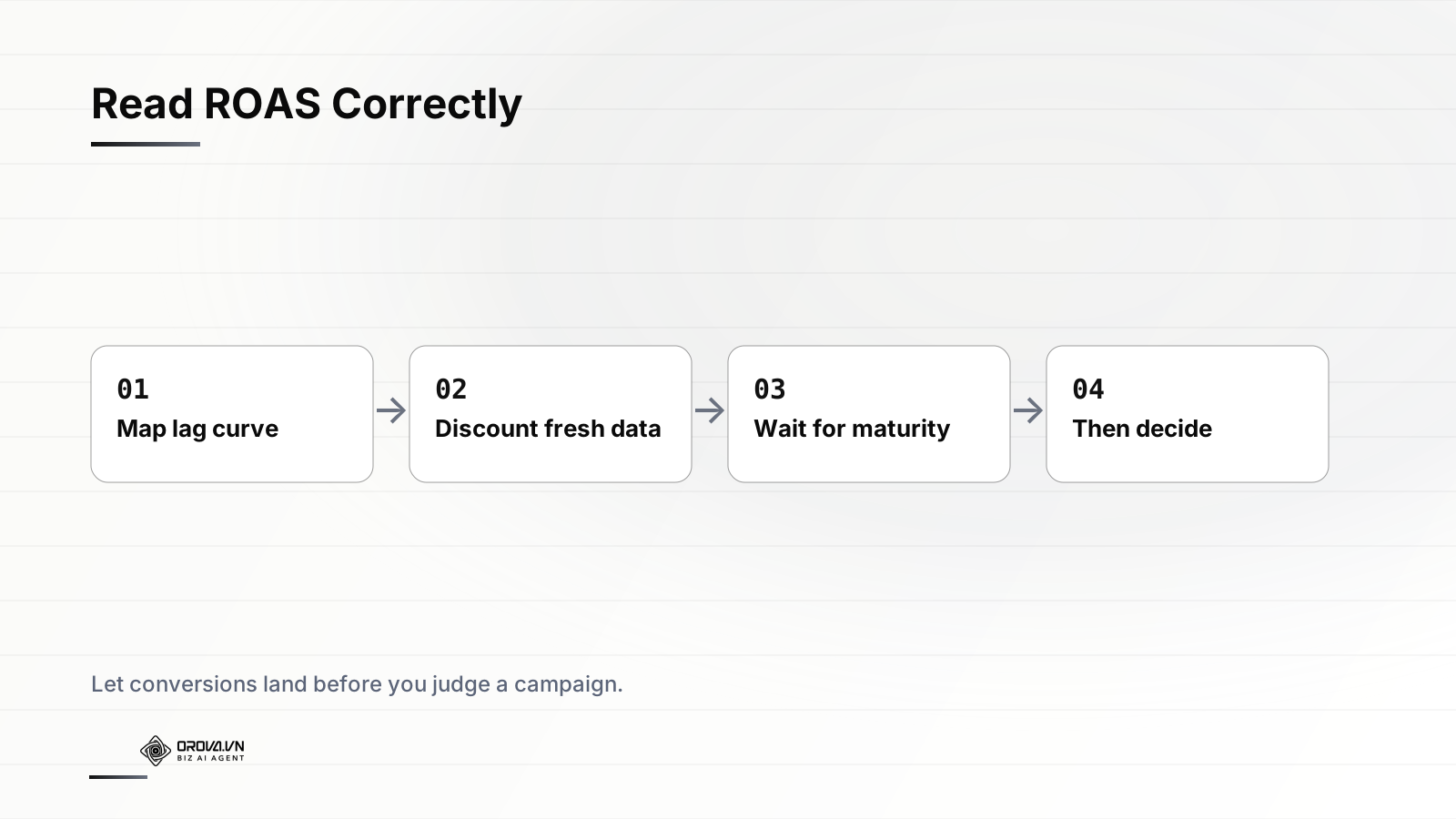
The core move is to gross-up incomplete days using your curve. If your curve says a two-day-old day has revealed 55% of its eventual conversions, then divide that day's observed conversions by 0.55 to estimate where it is headed. A campaign showing a 1.6x ROAS at age two is really tracking toward roughly 2.9x. Now you are comparing a projected-mature number against your target, not a guaranteed-understated one. This single adjustment eliminates the majority of false alarms.
Be honest about uncertainty, though. The grossed-up estimate for a one-day-old day, where you are dividing by something like 0.35, carries enormous error bars — a small swing in raw conversions becomes a huge swing in the projection. The fresher the day, the wider the confidence interval, and the less weight any decision should place on it.
Define a maturity threshold before you judge
Decide in advance how mature a window must be before it is allowed to drive a decision. A practical rule for many ecommerce accounts is to treat data as decision-ready only once it is at least 80% matured according to the curve. For a curve that hits 85% at day seven, that means you do not pass final judgment on a day or a test until it is about a week old. For slower B2B funnels, that waiting period might be three or four weeks.
This is not the same as doing nothing. You still monitor leading indicators — click-through rate, cost per click, landing-page behavior, add-to-cart rate — which are available immediately and not subject to conversion lag. You simply stop making irreversible budget and pausing decisions on the basis of conversion ROAS until the conversions have had time to arrive.
The discipline is simple to state and hard to practice: leading metrics for fast feedback, conversion metrics for slow decisions. Never let an immature conversion number trigger an irreversible move.
Choose evaluation windows that respect the lag
If your conversions take fourteen days to mature, a three-day campaign test is not a test — it is noise. The minimum honest evaluation window should comfortably exceed your maturation period plus enough additional days to accumulate a statistically meaningful sample. A useful habit is to evaluate trailing windows that end a few days before today, deliberately excluding the freshest, least-mature days. Looking at "days 3 through 17 ago" gives you a window that is both mature and recent enough to be relevant, instead of "the last 7 days" which is contaminated at the right edge.
Be consistent about attribution windows
Your lag is partly a choice. A 1-day click window will show you mostly mature data quickly but will miss the long tail of slow converters and undercount your true results. A 7-day or longer window captures more truth but introduces more lag. Neither is wrong, but you must pick deliberately and compare like with like. Switching attribution windows mid-analysis, or comparing a campaign on a 1-day window against one on a 7-day window, produces conclusions that are pure artifact. Pacing and budget decisions in particular need a stable attribution basis so that you are not chasing ghosts created by your own settings. The same principle applies to how you spread spend across the day; if you are interested in keeping delivery smooth without overreacting to incomplete signals, our guide to budget pacing on autopilot covers the mechanics of pacing without panicking.
Common mistakes lag causes — and how to avoid them
Almost every recurring error in account management traces back to treating immature data as final. Here are the most damaging, with the antidote for each.
Cutting a campaign on its worst-looking day
The classic failure: a new campaign launches, the first two days show a weak ROAS because the conversions are still in flight, and the campaign is paused before its data ever matured. Worse, pausing it freezes the conversion learning the platform's algorithm needed, so even when the conversions land, the campaign never gets the chance to compound. The antidote is the maturity threshold above — a launched campaign gets a protected window equal to at least one full maturation cycle before any pause decision is allowed.
Declaring a test winner too early
In an A/B test, if one variant happens to attract a faster-converting audience and the other attracts slower converters, the fast variant will look like the winner during the immature window even if the slow variant ends up superior. People crown winners on day three, roll out the wrong creative, and never know. Always let both arms of a test reach the same maturity before comparison, and compare them at the same age, not at the same calendar date.
Month-end and weekly-report panic
Reports run on the morning after a period closes capture that period at its least mature. The last few days of any month are barely filled when the month-end report runs. A campaign that looks like it faded in the final week often did no such thing — the week simply had not matured by report time. Re-pull period-end reports a week or two later and watch them improve, and set stakeholder expectations that the freshest numbers in any report are provisional.
Misreading a real decline as lag — the other failure mode
Respecting lag does not mean ignoring every dip. Sometimes a campaign really is breaking. The way to tell the difference is to watch leading indicators that are not subject to lag. If click-through rate has collapsed, cost per click has spiked, or add-to-cart rate has cratered, those are real-time signals of a genuine problem, and you should act regardless of where conversions stand. Lag awareness means you discount immature conversion data — not that you go blind to immediate evidence. The skill is holding both ideas at once: be patient with conversion ROAS, be alert to leading metrics.
Building lag into how you think
The deepest fix is cultural, not technical. Teams that handle lag well share a few habits worth adopting deliberately.
- They annotate the right edge. Every chart they share has the immature days visually marked — shaded, dashed, or labeled "still maturing" — so nobody reacts to the droop. The chart itself reminds the viewer not to trust its own ending.
- They speak in maturity, not just dates. Instead of "Tuesday did 1.5x," they say "Tuesday is at 1.5x but only 50% mature, tracking toward roughly 3x." The sentence carries its own caveat.
- They protect new launches. A launch gets a written, agreed-upon evaluation date based on the curve, so the decision to keep or kill is made on schedule and on mature data, not on a nervous Tuesday.
- They re-forecast instead of reacting. When a fresh number looks alarming, the response is to gross it up against the curve and see whether the projection is still alarming. Usually it is not.
- They keep the curve fresh. Lag is not static. A new product mix, a seasonal shift, a change in attribution settings, or a platform update can reshape the curve. They re-measure it quarterly so their discounting stays accurate.
None of this slows a team down. If anything, it speeds them up, because they stop wasting energy on phantom emergencies and stop undoing yesterday's panic with today's correction. The hours saved from not chasing the right edge of the chart are real.
The compounding cost of getting it wrong
It is worth being concrete about the stakes. Suppose an account runs ten campaigns and, on average, two of them get prematurely paused each month because of immature data — campaigns that would have hit target had they been left to mature. If each paused campaign would have driven, say, $8,000 in monthly revenue at a healthy ROAS, that is $16,000 a month of self-inflicted loss, plus the algorithmic learning destroyed each time delivery is interrupted, plus the buyer's time spent relaunching and re-optimizing from scratch. Over a year, the cost of misreading lag dwarfs the cost of almost any tool you might buy to manage it. The expensive part is never the data. It is the decisions made on data read too soon.
From discipline to automation
Everything above can be done by a careful human with a spreadsheet and a calendar. The honest difficulty is that lag discipline demands patience exactly when human psychology demands action, and it requires recomputing curves and grossing-up numbers consistently across dozens of campaigns, every day, without fatigue. That is precisely the kind of work where consistency beats heroics, and where a tireless system outperforms a stressed buyer staring at a drooping chart at 9 a.m.
The right approach is to encode the curve once and let it inform every recent-data decision automatically: flag immature days, project them toward maturity, withhold judgment until a maturity threshold is crossed, and only then surface a campaign as genuinely underperforming. When the discipline lives in the system rather than in your willpower, the false alarms simply stop reaching you.
That is the philosophy behind Orova Ads, an AI agent that manages paid campaigns across Google, Meta, and TikTok. It reads your data daily, deliberately discounts immature conversions so it never panics over the right edge of the chart, and recommends budget, bid, audience, and on-off changes — then executes them with your approval and a full audit log. You keep the human-in-the-loop control; the agent keeps the patience. If you have ever cut a campaign that would have come good, that is the mistake worth automating away — see how it works at orova.vn.
Orova Ads optimises campaigns for you
Connect Google, Meta and TikTok in one place. AI reads the numbers, proposes changes and executes under the rules you set.
Explore Orova Ads