
Programmatic Ad Platforms: How They Work and What to Watch
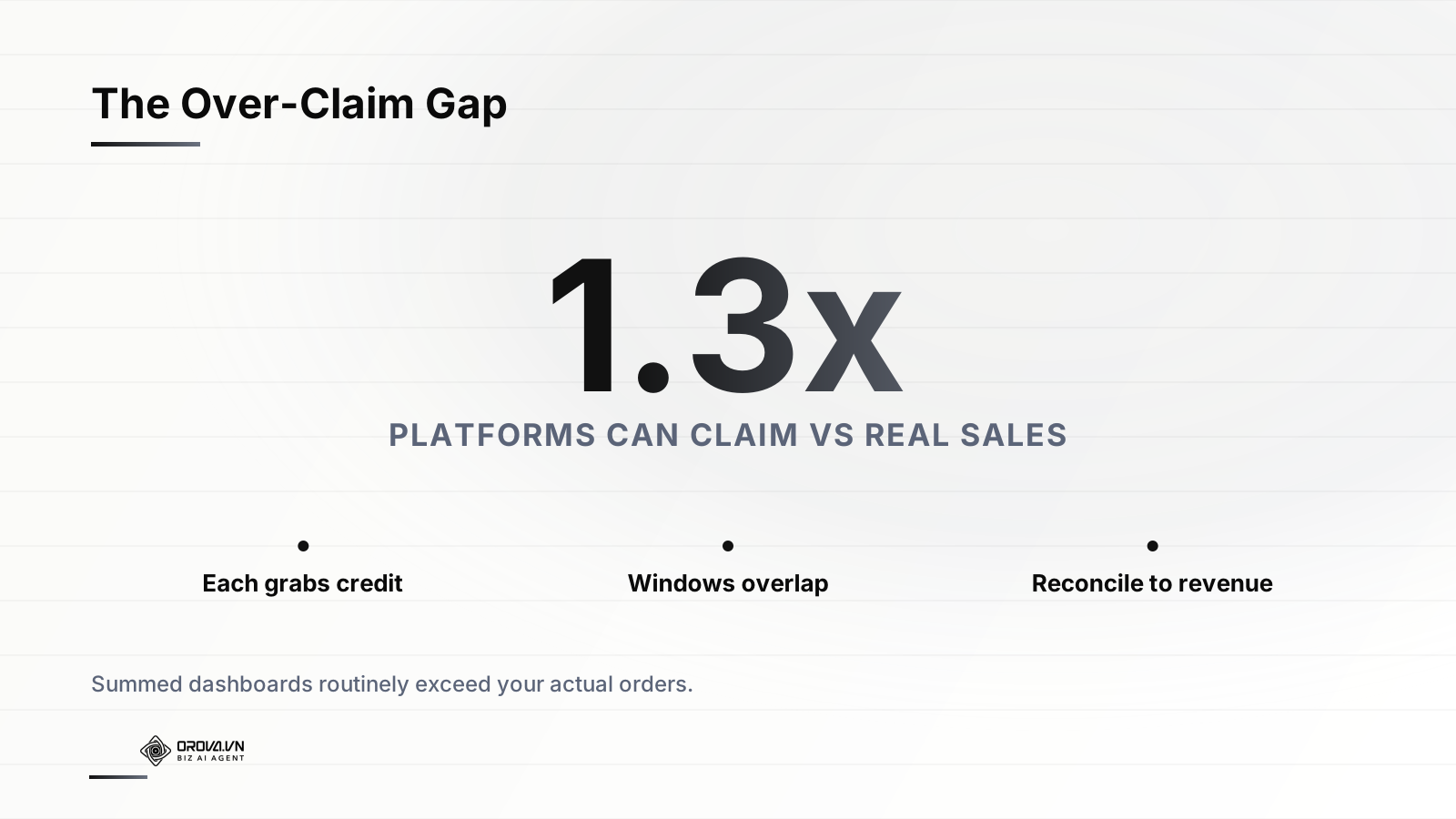
You already know the feeling: three ad dashboards, three different "truths," and none of them match what actually landed in your bank account. Add up the purchases claimed by Google Ads, Meta Ads Manager, and TikTok Ads Manager, and the total is almost always bigger than the real order count sitting in Shopify or your CRM. That gap isn't a glitch you can ignore — it's money. Every budget decision you make based on those inflated numbers is a decision made on the wrong information.
The reason this keeps happening is that programmatic ad platforms are each built to take credit for a sale whenever they had any hand in it, even if another platform also touched that same customer along the way. So each dashboard is technically not lying — it's just telling its own story without checking with the others. The old habit of glancing at each platform separately and trusting the "purchases" number at face value is exactly what lets the double counting slide through unnoticed, month after month.
This article walks you through why this mismatch happens, what it actually costs you when you act on the wrong totals, and — most importantly — how to reconcile every platform back to one real number you can check against your own sales records. By the end, you'll have a repeatable way to know which channels are truly earning your budget, instead of guessing based on numbers that were never meant to be added together.
What Programmatic Ad Platforms Are and Which Exist
Programmatic advertising means buying ad space automatically through an auction, rather than negotiating with a publisher. The whole transaction happens while a web page loads.
The main platforms: Google Display & Video 360, The Trade Desk, Amazon DSP, Adobe Advertising, and Meta and TikTok's own systems which are programmatic in everything but name. For most small advertisers, Google Ads and Meta already are programmatic buying.
How a single impression is sold: a visitor opens a page; the publisher's system announces the available space; several advertisers' systems bid based on what they know about that visitor; the highest effective bid wins and the ad renders. Total elapsed time is under a tenth of a second.
What to watch: where your ads actually appear, how much of your spend reaches the publisher rather than intermediaries, and whether the impressions were seen by humans.
Which leads to the problem every programmatic buyer meets eventually: three systems reporting three different numbers for the same campaign. The rest of this article explains why, and which number to trust.
Why three dashboards claim the same sale
The root cause is structural, not a bug. Every ad platform is built to prove its own worth. Each one watches for conversions it can plausibly take credit for, and each one credits itself generously. None of them can see what the others did, and none of them is incentivized to give credit away. So when a single customer is touched by more than one platform on the way to buying — which is normal, not unusual — multiple platforms record the same purchase.
The customer journey is not single-channel
Consider a realistic path to purchase. A shopper sees your TikTok video on Tuesday and remembers your brand. On Thursday they search your product name on Google and click a Search ad to compare prices. On Saturday Meta retargets them with a carousel of the exact items they viewed, and they buy. One sale. Three platforms involved. When that order fires, here is what happens behind the scenes:
- TikTok's pixel saw the early view and, within its attribution window, claims the conversion as view-through or click-through influence.
- Google's tag saw the Search click and claims it — search clicks are high-intent, so Google is confident this was its win.
- Meta's pixel saw the retargeting click immediately before checkout and claims it as a last-click conversion, the strongest claim of all.
Each platform is correct that it played a role. But you only shipped one order and collected one payment. If you add up the dashboards, you have counted that customer three times. Multiply this across thousands of buyers who interacted with more than one channel, and the gap between summed dashboards and reality becomes the rule rather than the exception.
Attribution windows overlap and overlap again
The second source of inflation is the attribution window — the period after an ad interaction during which a platform will still claim a resulting sale. Defaults vary and they are wide. A 7-day click plus 1-day view setting on Meta means any purchase within seven days of a click, or one day of merely seeing an ad, gets credited. Google's data-driven attribution looks back across a long path. TikTok offers click windows up to 28 days. These windows were chosen by each platform to capture as much credit as possible, and because they all overlap the same calendar days, the same purchase can fall inside all three windows simultaneously.
The dashboards are not competing to report your sales accurately. They are competing to claim your sales persuasively. Stacking them is like asking three salespeople who each shook the customer's hand to total up their individual commissions and treating that sum as the deal size.
View-through conversions make it worse
View-through conversions deserve their own warning. A view-through means the platform counts a sale even though the person never clicked the ad — they merely had it served to them, sometimes below the fold, sometimes in a feed they scrolled past. Display and video campaigns can rack up large view-through numbers because impressions are cheap and plentiful. These are the softest claims of all, yet they appear in the same conversion column as a hard last-click purchase. When you sum dashboards, you are blending a confident "they clicked my ad and bought" with a flimsy "I showed them something once and they later bought from someone." Treating those as equal is how channels that contribute little get scaled aggressively.
The cost of trusting inflated totals
If the only consequence were a vanity number, this would be a footnote. But over-claiming distorts every downstream decision, and the distortions compound.
You overstate ROAS and underprice risk
Return on ad spend is conversions value divided by spend. If conversions value is inflated 30 percent because of double counting, your reported ROAS is inflated by roughly the same amount. A campaign that looks like 4.0 ROAS might be a real 3.0. The difference decides whether you are comfortably profitable or quietly losing margin once you subtract product cost, shipping, payment fees, and overhead. Many advertisers believe they are at break-even when they are actually below it, because the dashboard's generous accounting papers over the gap. The first time the truth shows up is in the monthly P&L, by which point a lot of money has already been spent on the wrong belief.
You scale the wrong campaigns
Budget decisions are comparative. You move money toward whatever channel shows the best efficiency. When all three platforms over-claim, they do not over-claim equally — the one with the most aggressive attribution window and the heaviest view-through reporting looks best, regardless of its true incremental contribution. So you systematically reward the platform that is best at claiming credit, not the platform that actually drives the most new sales. Over months this hollows out your media mix: the genuinely incremental channels get starved while the credit-grabbing ones get fed.
You kill assist channels that were doing real work
The flip side is just as damaging. Upper-funnel channels — the TikTok video that planted the idea, the broad Meta prospecting that introduced your brand — rarely win the last click. In a single-source last-click view they look weak. Cut them, and a month later your "winning" Search and retargeting campaigns mysteriously soften, because the demand they were harvesting is no longer being created. You only discover the assist channel mattered after you have removed it. Reconciliation, done properly, surfaces these relationships before you make an irreversible cut.
Reconciling to a single source of truth
The fix is conceptually simple and operationally disciplined: stop treating platform dashboards as the scorekeeper, and appoint one trusted system as the denominator for everything. That system is whatever actually records money changing hands — your e-commerce backend, your order database, your CRM with closed-won deals, your payment processor. This is the number you can defend to a CFO because it ties to deposits in your bank account. Everything the platforms report is a claim about influence; only your backend records the fact of a sale.
Step one: pull the platform claims
Export each platform's conversions for the exact same date range, and be precise about settings. Note the attribution model and window each one is using, because two platforms on different windows are not comparable. Record click-through and view-through separately — never let them merge into one figure. The goal of this step is an honest inventory of what each channel is claiming and under what rules, not a total. Resist the urge to add them up; the sum is the very mirage you are trying to escape.
Step two: pull the real revenue
From your backend, pull actual orders and revenue for the identical period. Apply the same filters you care about — exclude cancellations and refunds, separate new customers from repeat if that matters to your strategy, and match the currency and time zone exactly. This is your ground truth, the single number every platform claim will be measured against. If your backend and your platform date ranges are even a day off, or one uses UTC and another uses local time, you will manufacture a discrepancy that looks like double counting but is really a clock problem. Getting this clean is foundational — it is the same discipline described in our guide to why clean conversion data is a prerequisite for every optimization, because reconciliation is impossible if the underlying tracking is broken.
Step three: find the overlap
Now quantify the gap. Subtract real revenue from the summed platform claims; the difference is your over-claim, and dividing summed claims by real revenue gives you an over-claim ratio. A ratio of 1.3 means your dashboards collectively inflate by 30 percent. Then go deeper than the headline number. Where order-level data allows, match individual platform-claimed conversions to real orders by order ID, email hash, or transaction value and timestamp. This reveals which specific sales are being claimed by more than one platform, and it tells you which platform tends to win the overlap. Patterns emerge quickly: retargeting almost always overlaps with prospecting; brand Search overlaps with everything because people search for brands they already know.
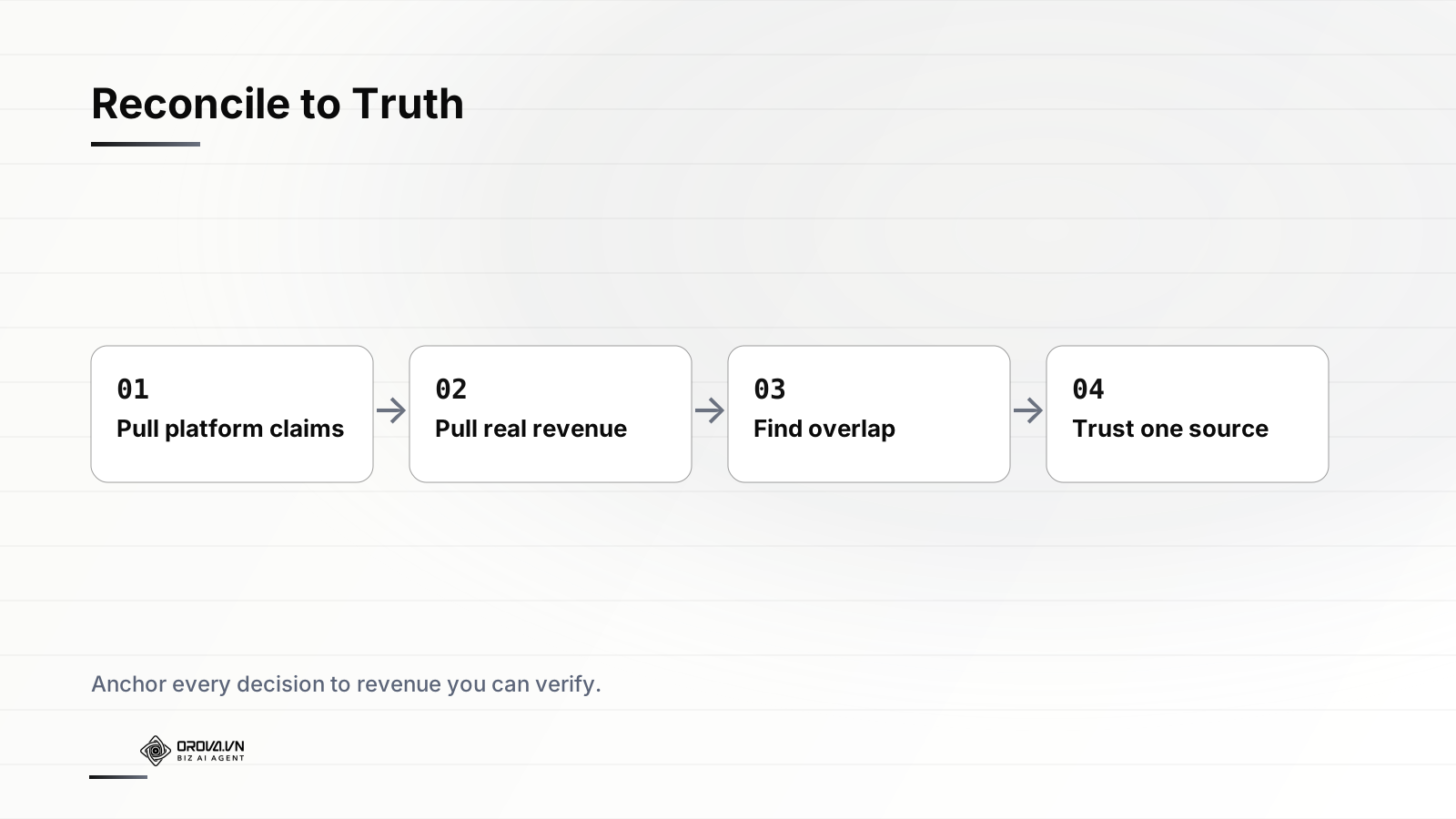
Step four: trust one source and allocate from it
The decisive move is to make your backend revenue the denominator for every efficiency metric you act on. Instead of letting each platform divide by its own self-reported conversions, you allocate the verified total across channels using a model you control and understand. There are several legitimate ways to do this:
- Pick a single source of truth attribution. Choose one platform's tracking or, better, a neutral analytics tool, and use only its view for cross-channel comparison. You lose some nuance but you eliminate double counting because one system is doing all the crediting.
- De-duplicate at the order level. Match claims to real orders and assign each order to exactly one channel by a consistent rule, so the channel totals sum to real revenue and no further.
- Run incrementality tests. The gold standard. Turn a channel off for a holdout, or use geo experiments, and measure how much real revenue actually drops. This answers the only question that matters — what would have happened anyway — which no attribution model can fully infer.
Whichever method you choose, the rule is the same: one denominator, applied consistently, anchored to money you can verify. The platforms can keep their dashboards; you just stop using their arithmetic to decide your budget.
Building reconciliation into your routine
Reconciliation fails when it is a one-time spreadsheet heroics project. It works when it becomes a habit with a cadence and an owner.
Make it weekly, not quarterly
The over-claim ratio is not constant. It drifts as your mix changes, as platforms update their attribution defaults, and as seasonal demand shifts how many people are touched by multiple channels. A reconciliation done once and forgotten goes stale within weeks. Pull platform claims and backend revenue on the same day each week, recompute the over-claim ratio, and watch the trend. A ratio that suddenly jumps from 1.25 to 1.6 is a signal — maybe you launched a heavy view-through campaign, maybe tracking broke on one channel, maybe a platform changed its window. Either way you want to know in days, not at the end of the quarter when the budget is already spent.
Decide before you have a fight
Write down your reconciliation rules while you are calm, not in the middle of a debate about which channel deserves credit for a good month. Document which system is the source of truth, which attribution model you compare on, how view-through is handled, and how overlaps are assigned. When everyone has agreed to the rules in advance, the monthly review becomes a discussion about what to do, not an argument about whose number is real. This is also what makes the practice survive staff turnover — the logic lives in a document, not in one analyst's head.
Keep the platform dashboards for what they are good at
Reconciliation does not mean ignoring the platforms. Their dashboards remain excellent for in-platform optimization: relative performance of ad creatives, audiences, placements, and bids within that channel. A platform comparing its own ad set A to its own ad set B is reliable, because the double-counting problem only appears when you compare across platforms or sum them. Use each dashboard to tune the inside of its own channel, and use your reconciled, revenue-anchored view to decide how much money each channel deserves in the first place. Keep those two jobs separate and you get the best of both.
A worked example
Imagine a mid-size store running all three platforms. Last month the dashboards reported: Google 520 purchases, Meta 610 purchases, TikTok 290 purchases. Summed, that is 1,420. The backend recorded 1,050 real orders. The over-claim ratio is about 1.35 — the dashboards inflate by 35 percent.
Order-level matching reveals the structure. Of Meta's 610, about 230 also appear in Google's count and 90 also appear in TikTok's — Meta's retargeting is harvesting demand created elsewhere. TikTok's 290 include a large share of view-through claims that match orders Google and Meta also claim. After de-duplication using a last-meaningful-click rule, the verified 1,050 orders allocate roughly: Google 470, Meta 410, TikTok 170. Notice TikTok dropped from a claimed 290 to an allocated 170 — but that does not mean TikTok is worthless. A holdout test the following month, pausing TikTok in two matched regions, showed Search and retargeting conversions in those regions fell 12 percent. TikTok was creating demand the other channels were closing. Without reconciliation and a test, the team would have cut TikTok on its weak last-click number and watched their "winners" decline for reasons they could not explain.
This is the payoff. Reconciliation does not just deflate a vanity number — it changes which decisions you make. The store kept TikTok funded as a demand creator, trimmed Meta's redundant retargeting that was claiming sales Google would have closed anyway, and reallocated the savings into prospecting. Real revenue rose while total spend stayed flat, because the budget finally followed truth instead of claims.
Common reconciliation mistakes that recreate the problem
Once teams accept that summing dashboards is wrong, they often introduce a new set of errors that quietly reintroduce the same distortion. Knowing these traps in advance saves months of confusion.
Comparing platforms on different attribution windows
The single most common mistake is pulling each platform on its own default settings and then comparing them side by side. Meta on 7-day-click-1-day-view and TikTok on 28-day-click are measuring fundamentally different things. TikTok will look stronger simply because it has four extra weeks to claim a sale, not because it drove more business. Before any cross-channel comparison, force every platform to the shortest common window you can — many practitioners standardize on 1-day or 7-day click only, dropping view-through entirely for allocation purposes. You can always look at the longer windows separately for context, but the number you compare and the number you allocate on must use identical rules across all three channels. Anything else bakes a structural bias into your budget.
Letting refunds and cancellations hide in the backend total
Your source of truth is only true if it reflects net revenue. A backend that counts gross orders at the moment of checkout will overstate just as the platforms do, because a meaningful slice of those orders get refunded, cancelled, returned, or charged back. For physical goods, return rates of 10 to 30 percent are normal in some categories; for subscriptions, early cancellations and failed renewals quietly erase revenue you already counted as won. Always reconcile against net, settled revenue — money you actually kept after returns and chargebacks clear. Otherwise you have simply moved the inflation from the ad dashboards into your own ledger and congratulated yourself for fixing it.
Ignoring sales that no platform claims
Reconciliation is usually framed as deflating an over-claim, but there is a second gap that matters just as much: orders your backend records that no platform claims at all. These are your organic, direct, email, referral, and word-of-mouth sales — demand that exists independently of paid media. If you forget this bucket, you will try to force the platform claims to sum to total revenue and end up over-crediting paid ads for sales that would have happened with no advertising whatsoever. A healthy reconciliation explicitly carves out the non-paid baseline first, then allocates only the genuinely paid-influenced remainder across channels. The size of that baseline is itself a strategic number: a business where 60 percent of orders are organic has very different scaling math than one where paid drives nearly everything.
Treating de-duplication as a one-time recipe
The rule you use to assign overlapping orders to a single channel — last meaningful click, first touch, a position-based split — is a choice, and reasonable people choose differently. The mistake is pretending your chosen rule is objective truth and never stress-testing it. Periodically re-run your allocation under a different rule and see how much the channel splits move. If switching from last-click to a position-based model dramatically reshuffles which channels look best, that fragility is itself information: it means your conclusions are riding on an assumption rather than on robust signal, and you should lean harder on incrementality testing to settle the question with real-world evidence.
How reconciliation changes the conversations you have
The deepest benefit of reconciling to one source is not a cleaner spreadsheet — it is a healthier relationship between marketing and the rest of the business. When marketing reports numbers that the finance team cannot find in the bank, trust erodes. Every quarterly review becomes a negotiation about whose figures are real, and marketing slowly loses credibility even when it is doing good work, simply because its reported results never tie to the ledger.
Speaking the language of the P&L
When your headline marketing number is verified backend revenue, the conversation with finance changes entirely. You are now reporting the same total they see, allocated transparently across channels by rules you have documented. The debate moves from "is this number real" to "given this real number, where should we invest next" — which is the conversation a marketing leader actually wants to be having. It also makes the case for budget far stronger. A request to increase spend that is grounded in verified, incremental revenue is much harder to refuse than one resting on a ROAS figure that finance suspects is inflated.
Setting expectations with channel partners and agencies
Agencies and platform reps are paid, directly or indirectly, on the numbers their channel reports. That is not malice; it is incentive. When you reconcile to your own source of truth and share the methodology, you reset that relationship on honest terms. A good partner welcomes it, because it lets them prove genuine incremental value rather than fight over last-click credit. A partner who resists any measurement that is not their own dashboard is telling you something useful about how much of their reported performance is real. Reconciliation gives you the standing to have that conversation from a position of evidence rather than suspicion.
Doing this at scale without drowning in spreadsheets
Everything above is correct and also tedious. Pulling three exports every week, matching order IDs, recomputing ratios, running holdouts, and re-allocating budget is real work, and it is exactly the kind of work that gets skipped when the team is busy — which is most of the time. The discipline is sound; the manual labor is the failure point.
This is the practical case for letting an AI agent carry the routine. Orova Ads reads your Google, Meta, and TikTok data every day, reconciles platform claims against your verified revenue rather than summing inflated dashboards, surfaces the over-claim gaps and overlaps, and then proposes and executes the optimizations that follow — budget shifts, bid changes, turning campaigns on or off, audience adjustments — with human-in-the-loop approval and full audit logs so you can see exactly what changed and why. You keep the judgment; the agent keeps the discipline. If you want your budget anchored to revenue you can verify instead of three dashboards that each claim the same sale, that is what it is built to do — see how at orova.vn.
Stop guessing, start reconciling — without the spreadsheet headache
Doing this reconciliation by hand works, but it eats real time: pulling reports from every platform, matching order IDs, adjusting for double-counted sales, and repeating the whole thing every time you want to check your numbers. For a business running more than one or two channels, that's an hour or more every week just to know what's actually true — time most owners would rather spend running the business.
This is exactly the kind of repetitive checking that Orova Ads is built to take off your plate, pulling the numbers together and doing the matching automatically so you get one trustworthy total instead of three conflicting ones. If this sounds like something that would save you a headache every month, it's worth taking a look.
Read next: Attribution Window: 1-Day vs 7-Day vs 28-Day Explained · Incrementality vs Last-Click Attribution: Which to Trust
Orova Ads optimises campaigns for you
Connect Google, Meta and TikTok in one place. AI reads the numbers, proposes changes and executes under the rules you set.
Explore Orova Ads